One question for a keeper
Before a feeding, ask each child to think of one question: how does the keeper tell the animals apart, decide what to feed, or notice a change in behaviour? Keep it to one question each so others can take part.
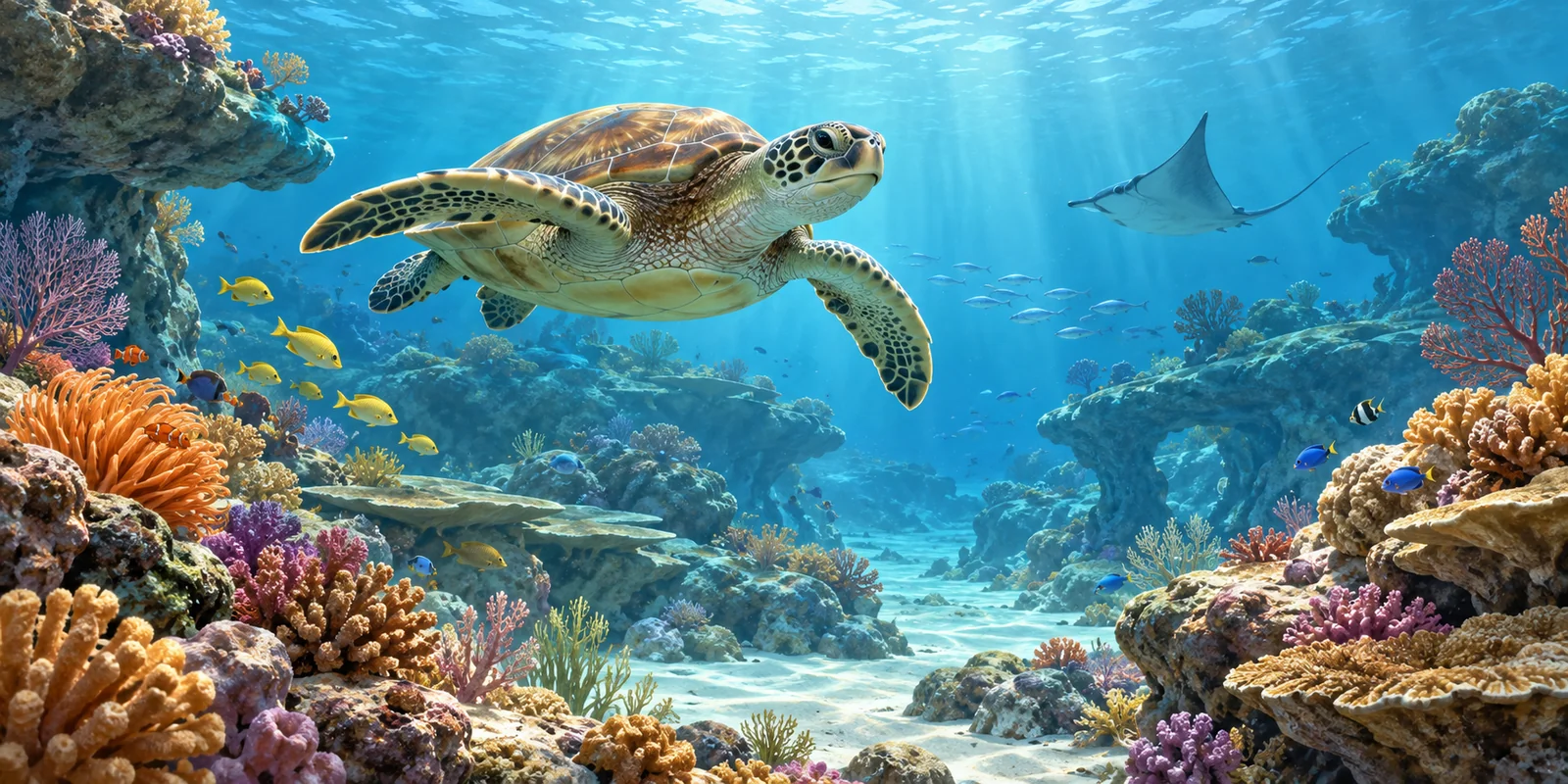 Illustration
Come to Aquarium Wilhelmshaven for a close look at life below the North Sea and a journey into prehistoric oceans.
Come to Aquarium Wilhelmshaven for a close look at life below the North Sea and a journey into prehistoric oceans. At Südstrand, the sea is just outside, while the exhibition brings its less visible inhabitants into view. Before following the aquarium circuit, check the feeding programme so you can save time for the animals your children most want to see.
The North Sea displays reward a slower look. Flatfish, catsharks, lobsters and edible crabs share the theme, giving you plenty to compare: an animal lying against the bottom, another moving through the water, and another protected by a hard shell. Let everyone choose one small tank to study properly. At the seal pool and penguin enclosure, give yourselves time to watch how these larger animals move through the water.
The tropical sections change the scene again. Look for the patterned Picasso triggerfish and zebra moray among the reef displays, then spend a quiet few minutes in the tropical hall with its sloths, small monkeys, reptiles and free-flying birds. A resting animal can be a good reason to pause rather than hurry on. Look at how it holds itself and what it uses for support.
Save some time for the museum sections. Original fossils, large reconstructed animals and the animated Paläoaquarium offer different ways into the past. With younger children, simply pick out a tooth, a shell and a recognisable body outline. Older children can ask which details are preserved in a fossil and which have been reconstructed. The big Spinosaurus and Liopleurodon exhibits are models; the animals swimming across the Paläoaquarium screen are animated. That distinction is part of the fun of looking closely. Explore the grounds like a pro—download the Snappit app to instantly identify animals and plants.
Follow the signed aquarium circuit through the museum and animal displays, choosing a few longer stops instead of treating every tank as a checklist. At the North Sea tanks, compare body shapes and hiding places. At the reef displays, choose a pattern to look for. In the tropical hall, lower your voices and scan the branches as well as the more obvious viewing areas.
Build in one keeper feeding. The programme lists seals and penguins at 11:00 and 15:30, sharks and rays at 14:30, and tropical animals at 12:30 on Mondays to Fridays except public holidays. The seal and penguin times coincide, so ask the entrance team how that day’s sessions run. Follow on-site changes rather than rushing through the museum to meet an outdated time.
For children drawn to fossils, finish a section by choosing one exhibit to sketch and one question to ask. There is no need to read every panel to have a satisfying visit. If you want a guided explanation, the bookable 30-minute themed tours cover the rainforest, North Sea, ancient life or tropical reefs; these cost extra to admission.
From 9 November 2026 to 19 March 2027, regular winter hours are Tuesday–Sunday, 10:00–17:00, with Mondays closed. School-holiday exceptions can apply. The aquarium closes on 24 and 25 December and uses special hours around New Year; check the official calendar before travelling. Bring a layer for the outdoor seal viewing area.
The exhibition areas are accessible, with lifts and accessible toilets. Wheelchairs, walking frames, pushchairs and double buggies are permitted; pull-along wagons and bicycle trailers are not. Some visitor areas are darkened, so allow time to adjust. Assistance dogs are admitted throughout opening hours with identification; advance notification is optional. Ask the team about any particular viewing or mobility needs.
Spend time with the smaller local-water tanks before watching the seals move through their pool.
Watch the Magellanic penguins swimming, then compare their movement on land.
See large reconstructed reptiles and the animated Paläoaquarium alongside fossil displays.
Look through the tropical hall for sloths, small monkeys and reptiles, with birds moving overhead.
Before a feeding, ask each child to think of one question: how does the keeper tell the animals apart, decide what to feed, or notice a change in behaviour? Keep it to one question each so others can take part.
Pick the theme your family already enjoys: Expedition Regenwald for the tropical hall, Tauchgang Nordsee for local marine life, Lebende Fossilien der Urzeit for ancient lineages, or Ab in die Südsee for reef life. Check the booking page before visiting if you want one of these guided sessions.
Try the outdoor and underwater viewing perspectives. Follow one seal long enough to notice when it turns and rises, then compare its movement with the penguins. Let it come back into view rather than following every window.
Follow a penguin beneath the waterline, then watch the birds on land. Ask children which movement surprised them more. During a feeding, leave space for other visitors at the viewing area.
Look along branches in the tropical hall for a green basilisk. When you find one, sketch its outline before adding colour. It may remain still; enjoy that chance to look closely.
Look around the reef display’s sheltered spaces as well as open water. If you spot the zebra moray, try following its contrasting pattern with your eyes without losing where its body disappears from view.
Use the aquarium label to find the Picasso triggerfish, then choose one part of its pattern to draw or describe. Comparing sketches afterwards is a good way to discover how differently people notice the same fish.
Take a slow look through the branches for the sloths. A still shape may be easier to overlook than the moving birds. Watch without calling or trying to wake an animal, and let children decide how long they want to wait.
Try a three-part treasure hunt: find an original fossil, a reconstructed giant reptile and an animated animal on the Paläoaquarium screen. Explain what each can show you about the past, using the labels to separate preserved remains from reconstructions.
The Magellanic penguin display introduces Patagonia. Use them as a starting point for a map conversation about South America and the different coasts penguins inhabit.
Use Südstrand as your destination in SWWV’s journey information, and save a return option before entering the aquarium. Line 8 has gaps between departures, so checking ahead is worthwhile. If using the line 6 approach, include the walk via Kaiser-Wilhelm-Brücke in your timing.
The house rules draw attention to darkened visitor areas and trip or bump hazards. Move at a comfortable pace and use the lifts when needed. The aquarium’s online 360-degree views of the seals and museum can help you picture parts of the setting before arrival.
Each card links to a full Explore page with photos, traits, and fun facts.
Start with the big picture, then zoom in to explore individual wildlife observations around this place.
Arrival
Head to Südstrand 123, 26382 Wilhelmshaven. Nearby parking is within walking distance; follow signs for Südstrand or Helgoland-Kai.
By bus
From Wilhelmshaven station, use line 8 towards Südstrand. Line 6 to Kaiser-Wilhelm-Brücke is another option with a walk across the bridge. Check SWWV return times and diversions before setting off.
One combined ticket
Admission includes the aquarium, Urzeitmeer-Museum and SAURIER – Giganten der Meere. The ticket is for a single entry; plan outdoor breaks before or after your circuit.
Travel light
There are no lockers or cloakroom, and wagons or bicycle trailers cannot be stored inside.
Plan the food stop
Bringing food and drinks is not permitted. The Panorama self-service restaurant serves meals and snacks, including vegetarian and vegan choices.
Photos and animals
Private photography is allowed without flash. Do not tap the glass, feed animals or put anything into open tanks.
Leave pet dogs at home
Pet dogs cannot enter the building. For an assistance dog, bring the required identification and make its status clearly visible.
Check transport notices
SWWV has Südstadt diversions through the end of 2026 and an additional line 8 diversion on 19–20 October 2026. Use its current journey information.
Recent snaps will appear here as new observations are added.

Ohio, US
You might spot Sand Tiger Shark, Nurse Shark, and Cow.
View guide →

California, US
You might spot Orca, Bottlenose Dolphin, and Beluga Whale.
View guide →

Illinois, US
You might spot Beluga Whale, Pacific White-Sided Dolphin, and Sea Otter.
View guide →

Texas, US
You might spot Brown-Throated Three-Toed Sloth, Ant, and Penguin.
View guide →
Take the discovery with you
Identify the wildlife you spot, learn as you go, and keep a collection of the adventure.