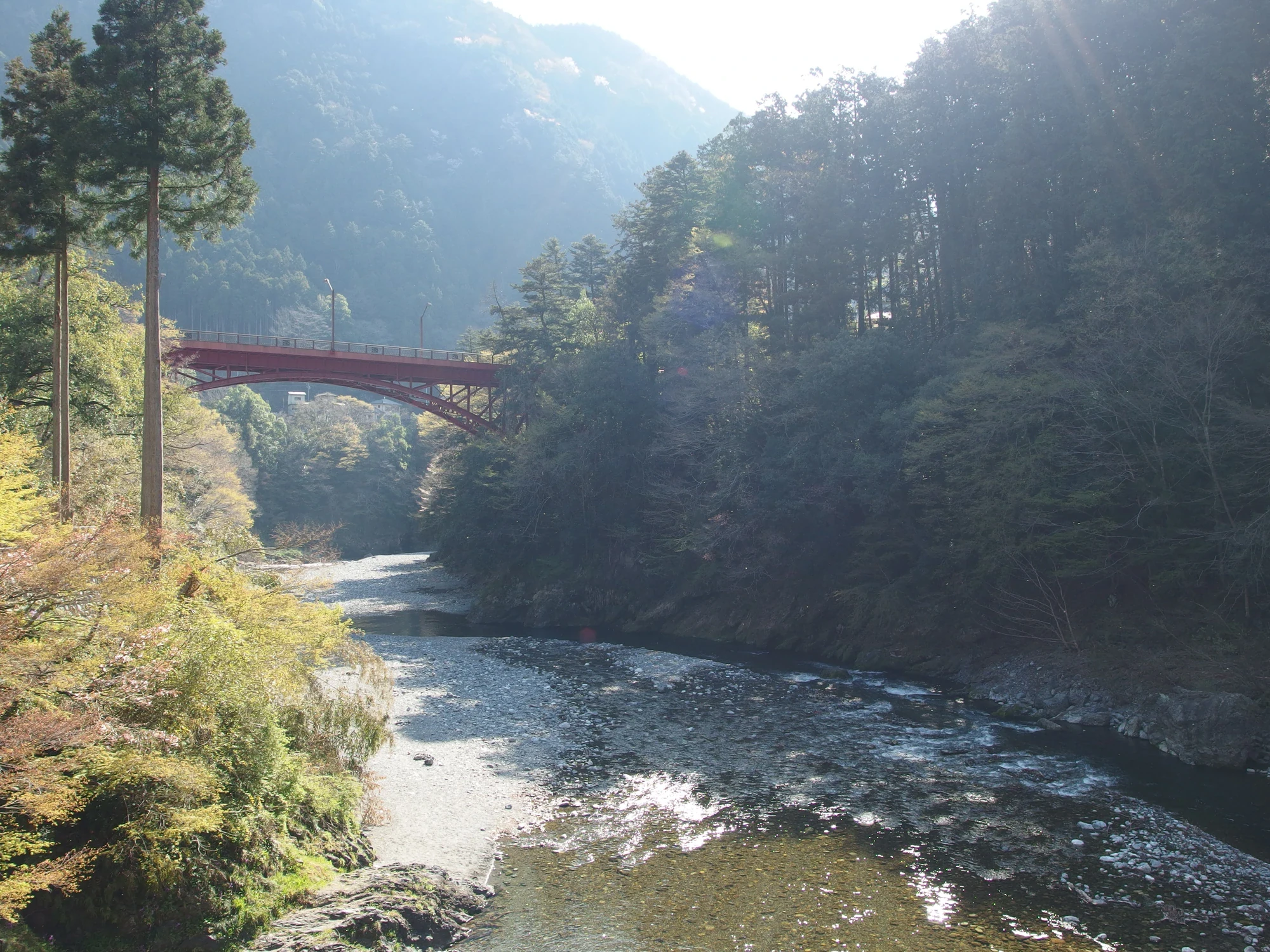
You can start exploring this mountain national park without starting up a mountain. At Okutama Station, head first to the nearby visitor center, then make the short Hikawa Gorge circuit your main outing. Two rivers meet below the town, suspension bridges carry you across the gorge, and woodland gives you plenty to examine at walking pace. It is a satisfying introduction for a family that would rather notice a bird or an unfamiliar flower than tick off a summit.
The scale changes dramatically once you look beyond that little circuit. Chichibu-Tama-Kai stretches across Tokyo, Saitama, Yamanashi and Nagano, protecting mountain country and the headwaters of several major rivers. Its mountains are not volcanic: erosion, varied rock and forest are the central story here. The Okutama visit in this guide occupies one small eastern corner. Mount Kumotori, distant gorges and the park's western granite peaks belong to other, separately planned days.
Okutama Visitor Center is in the town, about two minutes on foot from the station. Use the displays to get your bearings, then ask a staff member what is worth looking for and whether the gorge path is suitable today. Natural-history exhibits, photographs and local terrain interpretation help you make sense of the green landscape outside. Give children one question to take outside: Which plants keep their leaves? What can you hear above the river? Where might a small bird find shelter?
Hikawa Gorge is part of the national park itself, in a designated special zone. Here the Nippara River meets the Tama River among wooded slopes. Evergreen oaks grow alongside deciduous trees such as Japanese zelkova and Japanese horse chestnut, so the gorge has texture even outside the autumn-color season. The operator describes a circuit of roughly 40 minutes with two suspension bridges. Leave yourself longer to stop; steps, exposed roots and uneven ground make this a short nature walk rather than a pushchair stroll.
The small things are worth your attention. A grey wagtail's yellow underside can be easier to pick out than its name suggests. In autumn, the fine red flower spikes of mizuhiki reward a closer look from the path. The visitor center's surveys also record mammals such as sika deer, Japanese macaques and Japanese squirrels in Hikawa Gorge, but an ordinary daytime walk is better planned around plants, birds and signs of animal life than around a hoped-for large-animal encounter.
Keep the river as the setting for your visit, viewed from the path and bridges. Swimming is prohibited in Hikawa Gorge, and the entrances can close after rain or during dam releases. If the route is closed, spend your time with the center's exhibits and change the outdoor plan with staff advice. The pleasure of this visit is how much fits close to the station; there is no need to salvage the day by turning a short outing into an unplanned mountain hike. Eager to name that creature? Identify any animal you find during your visit using the Snappit app.
The national park was designated on 10 July 1950. Its identity is tied to the wooded mountain ranges and river headwaters shared by four prefectures. Hikawa’s long-running nature surveys add a smaller, local history: repeated attention to the same gorge reveals animals and plants that a passing visitor could easily miss. The station-side visitor center continues that work by turning field knowledge into exhibits, maps and guided interpretation.