Snappit logo
Snappit
Get App
Generic illustration, not a photograph of this venueIllustration
ParkKR

Geumjeongsan National Park

Geumjeongsan brings Busan’s mountain landscape close to the city without making it an effortless city stroll.

About

Geumjeongsan brings Busan’s mountain landscape close to the city without making it an effortless city stroll. The rewarding contrast is between Beomeosa’s temple precinct, the forested approach to the North Gate and the more open granite scenery above. A good first visit follows that progression and returns to the same gateway, leaving enough time to enjoy the temple rather than treating it only as a trailhead. This is South Korea’s 24th national park, formally designated in November 2025 and under national-park management from March 2026. Its protected area crosses into Yangsan and includes the Baegyangsan sector; the Beomeosa outing explores just one part. Wondering what that bird or insect is? Find out on your visit using the Snappit nature app.

The mountain’s cultural history is much older than its national-park status. Beomeosa has Silla-period origins and was rebuilt after destruction during the Imjin War. Geumjeongsanseong’s major Joseon-period construction dates to 1703, with later changes and restorations; the North Gate was restored in 1989. The modern designation followed a committee decision on 31 October 2025 and the formal gazette on 28 November. National-park management began on 3 March 2026, with a commemorative ceremony on 20 March. The designation brought national-park protection to a mountain already woven into daily life around Busan.

What to do here

Choose between a temple-and-valley visit and a mountain half-day. Around Beomeosa, look for the stone architecture, wooded setting and protected wisteria habitat from permitted paths. For a substantial hike, follow the current KNPS Beomeosa course through the North Gate of Geumjeongsanseong to Godangbong and return the same way. Keep the summit optional if weather, footing or the pace of your group changes.

Seasonal info

Hot, humid summer days call for a shorter outing and an early start within permitted entry times. Rain and thunderstorms can change the plan entirely. In winter, bring insulation for exposed stops and be ready for icy footing. Autumn colour is a bonus, but shorter daylight matters more when deciding how far to go.

Accessibility

The summit course is an intermediate mountain walk and should not be treated as step-free. A lower-level temple visit may be a better fit for visitors avoiding sustained climbing, but a complete wheelchair route has not been verified. Before travelling, ask Beomeosa about the current accessible drop-off, gradients, steps and toilet route; ask KNPS separately about any suitable park path.

Don't miss

1

Beomeosa’s living Buddhist heritage and wooded approach

2

The North Gate and mountain setting of Geumjeongsanseong

3

Godangbong’s granite landscape on a clear, suitable day

4

The protected wisteria grove near Beomeosa

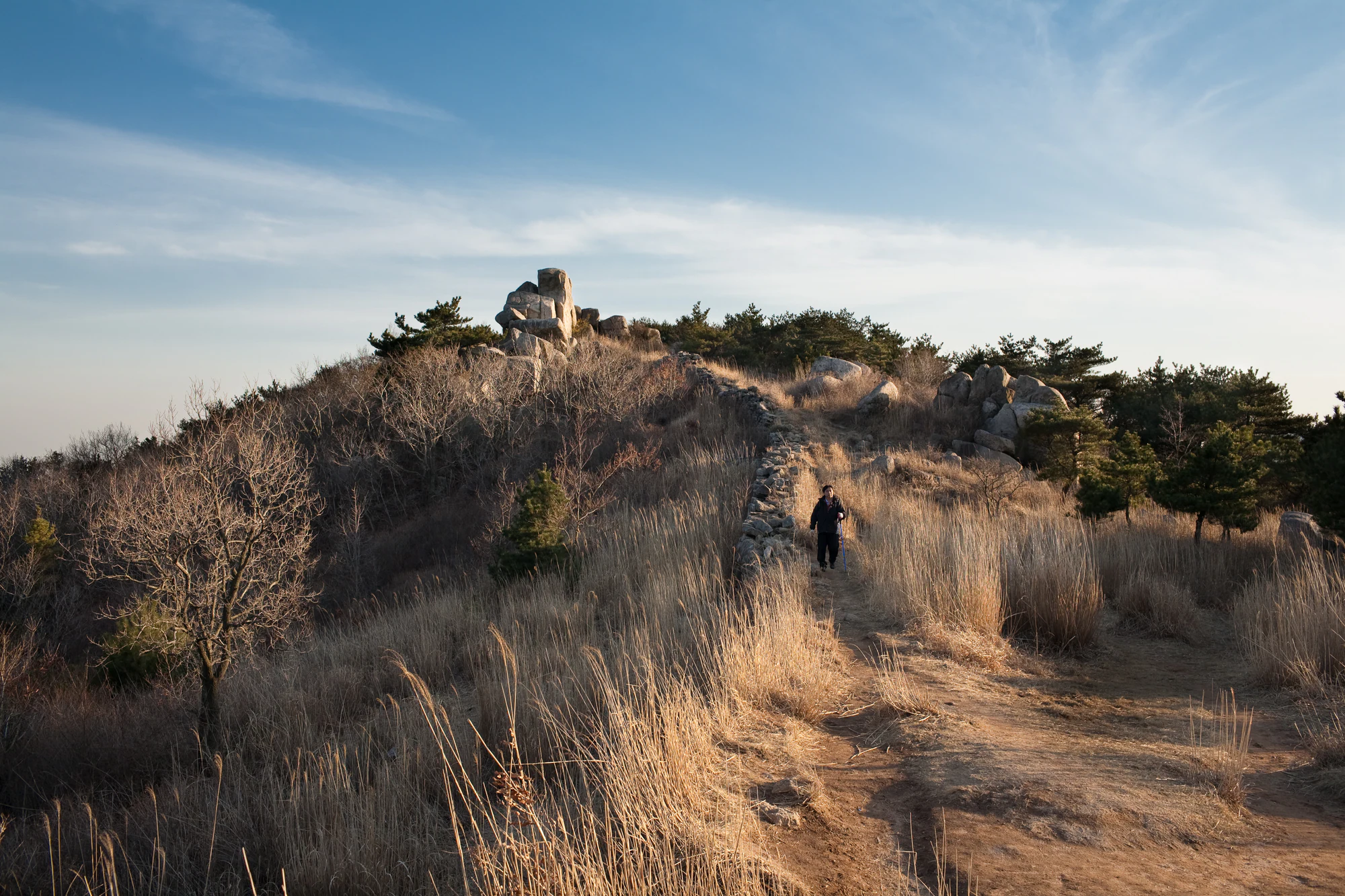
A low stone wall runs through dry grass past granite boulders and pines, with a small hiker on the adjacent path.

Geumjeong Fortress, photographed by Beyond Neon on 3 April 2010. A historical view of stonework, grass and granite in the mountain landscape, before national-park designation.

“Geumjeong Fortress” by Beyond Neon, Flickr, CC BY 2.0. Unchanged original; no crop, resizing or re-encoding. · Creative Commons 1 · Creative Commons 2

Walks and routes

Beomeosa–North Gate–Godangbong return

The official profile divides the ascent into Beomeosa to the North Gate, 1.5 km in 50 minutes, then the North Gate to Godangbong, 1 km in 40 minutes. It shows the same stages in reverse for the descent and grades all four sections intermediate. Use the North Gate as a decision point: check the remaining daylight, conditions and everyone’s energy before continuing. Return toward Beomeosa rather than following a different ridge simply because it looks attractive. The published schedule is a planning reference, not a pace you must keep. Open the KNPS course page.

This is a mountain ascent, unsuitable as a wheelchair or stroller route. A short distance on the profile should not be mistaken for an easy paved walk. If anyone struggles on the approach, shorten the day rather than relying on the summit section being easier.


Beomeosa–North Gate–Godangbong return

A balanced mountain half-day

Arrive at Beomeosa with water and your return transport checked. After confirming the trail is open, walk to the North Gate, reassess conditions and continue to Godangbong only if the plan still fits. Descend by the same route, then spend your remaining time in the permitted temple precinct. If the summit is the priority, avoid using up your daylight with a long temple stop first. The suggested 4–5 hours on site allows more breathing room than the published walking time.

Things to try

Give Beomeosa its own time

Pause in the public precinct before or after the hike. The main hall, three-storey stone pagoda and entrance architecture belong to a functioning religious place, with a history of rebuilding as well as survival. Leave temple interiors and restricted areas to the rules posted on the day. If your main interest is the temple, a relaxed visit is a better choice than squeezing it into the last few minutes before a bus.

Read the mountain in its rock

Geumjeongsan’s granite formed from magma underground and became exposed through uplift and erosion. The landscape includes tors, weathered rock basins and accumulations of large blocks. Look at how rounded natural outcrops differ from stones arranged into a fortress wall. The mountain’s famous Geumsaem basin also belongs to local origin folklore, but it is an additional destination rather than part of the measured summit return described here. Enjoy formations from the signed path without scrambling onto an unmarked outcrop.

See the fortress as a landscape

The North Gate is a useful place to understand why a mountain was chosen for defence. Geumjeongsanseong occupied an important position above the Dongnae area and Nakdong River mouth. Its long walls and later repairs tell a different story from a single intact building. You do not need to complete a wall circuit to appreciate it: look at the gateway and the way the masonry follows the terrain, keeping pedestrian passages clear.

When the mountain is the wrong choice

If only light rain is expected and local access remains safe, a shorter permitted temple visit may work, with no summit commitment. It is not an all-weather refuge: heavy rain, lightning, flooding warnings or a closure are reasons to stay off the mountain altogether and choose an indoor day in Busan.

Wildlife and habitats

Wisteria at the lower gateway

The Beomeosa grove is a protected natural habitat, not simply an ornamental arbour. The heritage authority highlights flowering around May, while a site-specific ecological study identifies the vine as Wisteria floribunda. Enjoy the canopy from the visitor path and resist pulling stems closer for a picture. The tangled vegetation matters outside the flowering season too. Follow protective fences and signs even when the best flowers seem to be just beyond them.

Eurasian Otter

Eurasian otters are documented among Geumjeongsan’s wild fauna, though a summit walk is unlikely to be a useful way to look for them. They depend on waterside habitat and can be elusive. Treat their presence as a reason to protect streams: keep out of bankside vegetation, leave potential resting places undisturbed and never use food to attract wildlife. If an animal appears, watch quietly from the path and let it move away.

Stories and discoveries

A new status for an old landscape

Geumjeongsan’s place in the national-park system is recent, but local residents have long valued the mountain. Busan’s account traces the public campaign for national-park designation back to 2005. The new status adds a national conservation framework to a landscape already shaped by religious life, defensive history and everyday recreation.

When to visit

Spring

A temple-and-grove day is particularly appealing around the usual May wisteria season. Leave enough time to enjoy it without adding pressure to the ascent. Check fire-prevention restrictions and current entry rules before committing to a ridge walk.

Summer

Use a settled forecast to choose the day, then keep the route proportionate to heat and humidity. Cancel the summit plan for thunderstorms or heavy rain. A wet-weather control can remain in force after rain stops while staff assess conditions.

Autumn and winter

In autumn, plan the return around earlier darkness. In winter, do not assume a mild city forecast describes exposed summit conditions. Pack an extra layer, assess ice before continuing and choose the temple-focused outing when mountain footing is unsuitable.

Getting there and practical advice

Plan around the gateway

Beomeosa’s own directions identify the temple as a road-accessible destination. Confirm current parking charges, vehicle access and toilet availability before travel. Carry the drinking water and food you need rather than making the summit plan depend on an unverified shop or spring. The park office can answer route questions on 051-865-8015; the temple office is 051-508-3122.

Metro and bus to Beomeosa

Beomeosa’s current directions use Busan Metro Line 1 to Beomeosa Station, then the bus 90 boarding point reached from exits 5 or 7. Get off at the Beomeosa ticket-office stop. The temple also lists bus 90 from outside exit 2 at Nopo Station. Check the current timetable and locate your return stop before starting the walk. The station called Beomeosa is not the mountain trailhead, so allow for the uphill connection.

Driving and restricted mountain roads

For this outing, use Beomeosa as the destination, at 250 Beomeosa-ro, Geumjeong-gu, Busan. Follow the current parking and road signs rather than a navigation shortcut into the mountain. Since 6 September 2026, specified forest roads in the fortress, Yangsan and Baegyangsan sectors have been limited to approved vehicles until further notice. Check the KNPS vehicle-control notice before planning to use a mountain access road. A car-accessible gateway does not make the summit reachable by car.

Questions to ask before an easier visit

For a visitor using a mobility aid, ask about the route from the actual bus stop or drop-off to the intended temple area, not just whether the site has a ramp somewhere. Confirm steps, uneven paving, accessible toilets and any assistance needed. For families, keep the lower visit flexible and do not use a stroller as the basis for a mountain-walk plan. A short visit can be rewarding without covering every part of the precinct.

Sources and useful links

Wildlife you might spot

1

Each card links to a full Explore page with photos, traits, and fun facts.

Snap map for this place

Start with the big picture, then zoom in to explore individual wildlife observations around this place.

Loading map…

Good to know before you go

Check the exact KNPS control notice and the forecast before leaving, then follow signs and ranger instructions on arrival.

Wear footwear with a reliable grip, and carry water, food, a rain layer and a charged phone.

Set a turnaround time before starting; include the descent, temple visit and bus journey in the day’s plan.

Stay on designated paths. Do not climb the fortress masonry or step into protected vegetation for a photograph.

Keep voices low at Beomeosa, avoid blocking worshippers and follow the temple’s photography instructions.

Leave plants, rocks and wildlife undisturbed, and carry all litter back down.

Frequently asked questions

No. The KNPS course panel gives 2.5 km and 1 hour 30 minutes for Beomeosa–North Gate–Godangbong. Its profile explicitly shows the return journey as 5 km and 3 hours. Add time for rests, photography, congestion and temple sightseeing.
Yes. Make Beomeosa and its valley setting the focus, using only currently permitted visitor paths. This avoids committing to the summit ascent, although it does not mean every temple approach is level or accessible. Check the conditions that matter to your group before travelling.
It has several sectors and gateways. Do not apply a temple’s visiting arrangements to every mountain trail. Check the KNPS entry-time and control pages, and ask the Geumjeongsan office on 051-865-8015 about the precise route and date if the rules are unclear.
Plan them separately unless you have checked the extra route, current access and return logistics. The 5 km itinerary covers Beomeosa, the North Gate and Godangbong only. A landmark appearing in a park photograph or on a map does not make it an included stop.

Recent snaps at this place

Recent snaps will appear here as new observations are added.

View all ›

Take the discovery with you

Exploring Geumjeongsan National Park?

Identify the wildlife you spot, learn as you go, and keep a collection of the adventure.

  1. 1Spot it
  2. 2Snap it
  3. 3Keep the discovery