
Snappit logo
Snappit
Get App
Generic illustration, not a photograph of this venueIllustration
ParkKyushu, Japan

Heiwadai Park

Heiwadai is a good park for a visit that can grow or shrink with your family’s energy.

About

Heiwadai is a good park for a visit that can grow or shrink with your family’s energy. Start around the tower lawn, then slip into the Haniwa Garden, where roughly 400 replicas of excavated clay figures and pottery stand among the trees. Looking for differences in their faces and shapes gives children something to do without turning the walk into a race. These are reproductions brought together for display, rather than objects excavated in place.

Beyond the garden, paths follow wooded slopes and the edges of the two ponds. The change from open lawn to tree cover and water is the main pleasure: stop, listen, and give a patch of the park a few unhurried minutes. Play areas offer another way to spend the afternoon, although the uphill paths and steps mean a full circuit is a different outing from a short garden visit.

Plan around the current hazard map. It identifies damaged waterside railings and decking, and the third observation tower has been removed. Ask the management office which paths are suitable before extending your walk. A short visit with time to look closely is more rewarding than completing a route despite tired legs or a barrier.

The tall stone monument needs context, too. Its present name, Peace Tower, sits alongside a wartime origin tied to Japanese imperial ideology. Make room for that history as well as the view; the woods, replicas and monument tell different stories. Turn your visit into a safari! Use the Snappit app to scan and log wildlife sightings here.

The tower was completed in 1940 for celebrations of the supposed 2,600th anniversary of the mythical Emperor Jimmu’s accession. Its inscription, Hakkō ichiu, was used to justify Japan’s imperial expansion and wartime aggression. Its present peaceful setting can obscure that wartime purpose. It was renamed Peace Tower in 1957; the Hakkō ichiu inscription, removed after the war, was restored in 1965. Miyazaki Prefecture’s 2025 response on the monument describes it both as a historical work of art and as a reminder of the tragic wartime era. The surrounding park now supports everyday recreation, but that later use does not erase the tower’s original political meaning.

What to do here

Explore the Haniwa Garden, pause on the tower lawn, and choose either a woodland stroll or a short pondside birdwatching stop after checking path advice. Let children sketch a clay figure or compare the sounds of the open lawn and the trees. Add playground time only if the equipment and the weather suit your group.

Seasonal info

Spring brings cherry blossom; flowering dates move with the weather. Autumn can bring leaf colour, cosmos in planted beds and the scent of sweet osmanthus. For the colder months, bring binoculars for waterbirds. Summer needs water, shade breaks and a check of hot play surfaces.

Accessibility

The park has hills and steps. The official map marks wheelchair-accessible toilets at several locations, and tourism information lists an accessible parking space in Car Park 1. Ask the management office for a suitable route from your arrival point, especially while repair notices remain posted. The map’s “Flatness” route name does not establish a step-free circuit; the haniwa workshop is on the rest house’s second floor, so check lift access before booking your day around it.

Don't miss

1

The Haniwa Garden’s woodland display of about 400 clay-figure and pottery replicas

2

A flexible choice of lawn, forest paths and pondside pauses

3

Winter waterbird watching, with mallards and tufted ducks recorded by the local bird group

4

The tower and city outlook, best visited with an understanding of the monument’s wartime history

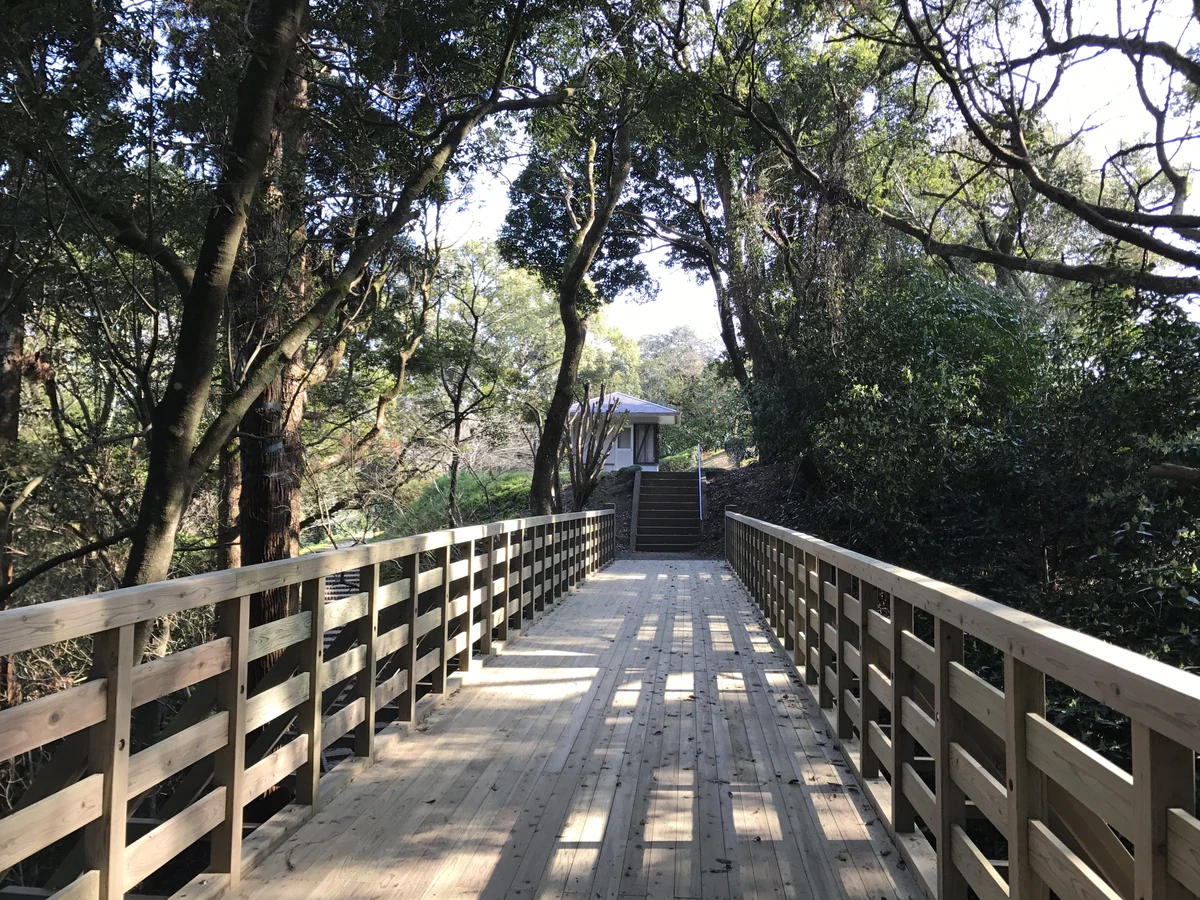
A broad wooden footbridge with railings crosses a shaded wooded hollow, with a short stairway at its far end.

A wooden footbridge beneath the trees in Heiwadai Park, photographed in March 2017. Steps rise beyond the bridge.

© そらみみ / Wikimedia Commons / CC BY-SA 4.0. View_in_Heiwadai_Park.jpg. Source: https://commons.wikimedia.org/wiki/File:View_in_Heiwadai_Park.jpg. License: https://creativecommons.org/licenses/by-sa/4.0/. Proportional downsampling to fit 1200 × 1200 pixels without enlargement; WebP quality 92, method 6. No crop, retouch, recoloring or added text. EXIF omitted. Source metadata records iPhone 7 and iPhoto 9.6.1; source tonal processing retained. · Creative Commons

Walks and routes

Tower lawn and Haniwa Garden

Start by Car Park 1 and the rest house, visit the tower lawn, then follow open signs into the Haniwa Garden. Let each person choose a favourite figure to sketch. Return when you have had enough; there is no need to add a pond circuit.

Allow for slopes and steps, and ask staff for the easiest approach if using a stroller or wheelchair.


Tower lawn and Haniwa Garden

A longer woodland option

If everyone is still keen, use the map to choose an open woodland section beyond the garden. Pause where you can stand safely off the main flow of walkers and listen before looking for birds. Turn back before small children become tired, since the return can include climbing.

Woodland paths include slopes and stairs. Shoes with grip are useful, especially after rain.

A longer woodland option

A short pondside pause

Ask staff which pondside section is currently suitable, then make a short out-and-back walk. Stop well back from the edge and watch the water through binoculars. This works as a small addition to the garden visit rather than a commitment to a complete loop.

Keep children close. A waterside path is not automatically a stroller- or wheelchair-friendly route.

A short pondside pause

An easy two-hour family visit

Spend the first part around the tower and Haniwa Garden. Pause for a drink, then let the group choose one extra: a short woodland walk, safe pondside watching, or play. Leave time to get back to the right bus stop or car park. Save the longer paths for a day when everyone wants them.

Things to try

Make a haniwa figure

The October 2026 notice offers a roughly one-hour workshop in the rest house’s second-floor temporary haniwa gallery. Reception is 09:00–15:00; it closes Mondays and Tuesdays except public holidays. The price is ¥1,800 including tax per figure. Ask about completion and collection before starting: delivery outside the prefecture is possible, with shipping extra. Recheck the next month’s notice if you are travelling later.

Keep a rainy visit small

Wet steps and wooden surfaces make a long circuit less appealing. If the temporary haniwa gallery is open, ask about a look around or a workshop, and check second-floor access. In strong wind or heavy rain, postpone the woodland walk rather than sheltering beneath suspect branches.

Wildlife and habitats

Mallard

In the colder months, scan the pond from a safe path. A male mallard’s green head and yellow bill can be useful clues; females are mottled brown. Look through binoculars rather than moving closer to the water.

Tufted duck

A duck that keeps diving may be worth a second look. Tufted ducks have golden eyes, and males show strong dark-and-white contrast. The local bird group records them here, but what you see will depend on season and conditions.

Wild boar: give it space

Do not seek out boar. The prefecture has reported them within the park; if one appears, stay quiet and leave calmly. Keep your group together and give the animal room.

Stories and discoveries

Two different ways to read a duck pond

Try watching what a duck does instead of only its colour. Tufted ducks disappear underwater to feed. Wait quietly for a diver to come back up rather than trying to draw it closer, then compare its behaviour with ducks that stay on the surface.

When to visit

Let the season choose the extra stop

In spring, look for blossom; in autumn, check flower updates before making a special trip for cosmos or fragrant osmanthus. In winter, spend your extra time scanning the pond. On a hot day, shorten the visit and use an open indoor rest space when available.

Getting there and practical advice

Help, toilets and an AED

The management office is on the rest house’s first floor beside Car Park 1; telephone 0985-35-3181. The map marks toilets, including accessible toilets, and an AED at the office. Ask staff about the nearest usable facilities before a longer walk.

Opening and cost

The park is free to enter and has no regular closing day. Choose daylight for an ordinary family walk; car parks and indoor activities keep separate hours.

By bus

Use Miyazaki Kotsu’s current route 1-06 timetable and look for the full destination “Heiwadai Park Rest House” (平和台公園レストハウス前). Some journeys reach only the separate Heiwadai stop. The 1 October 2026 timetable distinguishes weekdays, Saturdays and Sundays/holidays; check both directions and your boarding stop before travelling.

By bus

By car

Miyazaki tourism gives about 20 minutes from JR Miyazaki Station by car. Car Park 1 serves the tower/rest-house area; use the operator map to choose an entrance for the part of the park you want. Gate hours are 05:00–22:00 for Car Park 1, 08:30–17:00 for Car Park 2, and 05:00–20:00 for Car Park 3. Car Park 4 is listed as open year-round. Check signs for any temporary change.

By car

Plan the exact path

Call the office with your starting car park and mobility needs. Ask about gradients, steps, the route to a suitable toilet, and access to the second-floor gallery. Keep the visit close to the areas staff recommend; neither the wooden bridge photograph nor a “flat” route label proves a continuous step-free route.

Sources and useful links

Wildlife you might spot

3

Each card links to a full Explore page with photos, traits, and fun facts.

Snap map for this place

Start with the big picture, then zoom in to explore individual wildlife observations around this place.

Loading map…

Good to know before you go

Read the latest hazard map before choosing a loop. Keep away from damaged waterside rails and decking, and follow barriers and staff directions.

Paving work was scheduled for 1 September–9 October 2026. The notice was still posted on 16 October; ask whether the affected path has reopened.

Keep children beside you near the ponds. Watch birds from a safe path without feeding them or playing bird calls.

Wild boar have been reported in the park. If one appears, stay quiet and move away calmly; do not approach it for a photograph.

Wear shoes with grip. In summer, check slides and handrails by touch before children play, and take frequent drink breaks.

Look up before stopping beneath trees. If a branch looks ready to fall, stay away and tell the management office.

Check the return bus before you start walking: not every Heiwadai service reaches the park rest house, and weekday and weekend timetables differ.

Use the toilet before the longer paths, carry water, and note your car park’s closing time.

Frequently asked questions

General park admission is free, with no regular closing day. Parking gates and individual facilities have their own hours. Paid activities, food and transport cost extra.
No. They are replicas of clay figures and pottery excavated in different parts of Japan. Treat the display gently and enjoy it from the paths.
Check with staff first. The posted hazard map flags damaged waterside fencing and a rotted deck. For a family visit, choose a short, safe out-and-back section instead of assuming the whole loop is suitable.
Do not rely on interior access during an ordinary visit. The prefecture runs special interior-viewing occasions; check for a specific announcement if that is important to you.

Recent snaps at this place

Recent snaps will appear here as new observations are added.

View all ›

Take the discovery with you

Exploring Heiwadai Park?

Identify the wildlife you spot, learn as you go, and keep a collection of the adventure.

  1. 1Spot it
  2. 2Snap it
  3. 3Keep the discovery







