Snappit logo
Snappit
Get App
Generic illustration, not a photograph of this venueIllustration
ParkHokkaido, Japan

Hidakasanmyaku-Erimo-Tokachi National Park

At Cape Erimo, the first thing to notice is the shape of the land.

About

At Cape Erimo, the first thing to notice is the shape of the land. The headland narrows toward a line of rocks stretching into the Pacific, giving you a visible ending to Hokkaido’s long Hidaka mountain range. Start with Cape Erimo “Kaze no Yakata,” the House of Wind, then decide how much outdoor walking the conditions allow. A few unhurried viewpoints and time looking through a telescope make a better visit than rushing to the furthest point.

This is a small coastal introduction to a much bigger national park. Hidakasanmyaku-Erimo-Tokachi was designated on June 25, 2024, and covers a mountain-to-coast landscape extending roughly 140 kilometres north to south. Its remote high mountains demand a completely different trip. You do not need to climb them to understand part of the park’s story: here the continuation of the landscape into cliffs, reefs and the sea is right in front of you.

Kaze no Yakata is tucked into the ground beside the lighthouse, a design intended to fit the landscape and avoid obstructing the lighthouse beam. Inside, the view becomes something you can take your time over. Sit by the observation-room windows, look along the reefs and use the viewing equipment to search for movement. The indoor setting is particularly helpful for children or anyone who finds it hard to stand outside comfortably in the wind.

The animals that make this view special are wild harbor seals, called zenigata azarashi in Japanese. The offshore reefs are a resting and breeding habitat, rather than an enclosure. Try watching one area patiently instead of sweeping the whole coastline at speed. A seal may be hauled out on a rock, but fog, sea conditions and the animals’ movements can leave you with no clear sighting. The center’s displays and recorded footage keep the visit worthwhile when the real animals are difficult to see.

Make time for the exhibits as well as the windows. They connect local winds, seals and the work of a fishing town; the film includes underwater seal footage and kelp and salmon fishing. The artificial strong-wind experience gives the cape’s weather a memorable physical dimension, but it is optional. For a quieter family activity, ask whether the craft session using supplied natural materials is available that day, or try the seal quiz together.

Outside, keep the outing flexible. In suitable conditions, follow the signed visitor paths to the cape viewpoints and look at the white lighthouse from the public area. The sea can look very different on either side of the headland, and the offshore rock chain is the detail worth lingering over. Return indoors or end the visit if the wind makes walking uncomfortable. There is no need to approach the shoreline or climb onto rocks to get a satisfying sense of this coast. Eager to name that creature? Identify any animal you find during your visit using the Snappit app.

The national park designation dates to June 25, 2024; the cape’s cultural importance is much older. Cape Erimo became part of the nationally designated scenic site Pirika-noka in 2010 in recognition of its importance to Ainu spiritual culture. Treat it as a meaningful place as well as a viewpoint. The surrounding Erimo coast also tells a story of repair. Logging and grazing left land badly degraded, and a community-supported restoration project began in 1953. Kaze no Yakata’s exhibits introduce this greening work. The recovered coastal forest is part of the wider area, rather than a forest walk included in this short cape itinerary.


What to do here

Begin at Kaze no Yakata, ask about the day’s conditions, and spend time at the observation windows before exploring the wind and wildlife displays. Try the wind experience only if it suits everyone in your group. If conditions are comfortable, add a short walk on the signed cape paths and view the lighthouse exterior; otherwise make the center the whole visit.

Seasonal info

Spring brings the seal pupping period, while the observation room offers a way to watch without approaching the animals. Summer does not guarantee a clear horizon; fog is part of the coastal climate. September–November uses shorter center hours than May–August. The center normally closes throughout December–February, with a separately listed New Year’s Day opening. Strong weather can also cause temporary closure during the ordinary season.

Accessibility

Kaze no Yakata has a lift and designated accessible parking, with two wheelchairs listed for loan. There are also steps on the approach and within the site, plus steps and slopes on the toilet route. Do not assume a continuous step-free visit. Call 01466-3-1133 to discuss the entrance, lift route, toilets and viewing position you need. Outdoor cape paths are a separate, exposed option; check suitability before taking a wheelchair or stroller onto them.

Don't miss

1

The Hidaka landscape continuing into an offshore chain of reefs

2

Watching for wild harbor seals from the center’s indoor observation area

3

Wind exhibits and an optional artificial 25 m/s wind experience

4

A short, weather-dependent cape outing with views of the lighthouse exterior

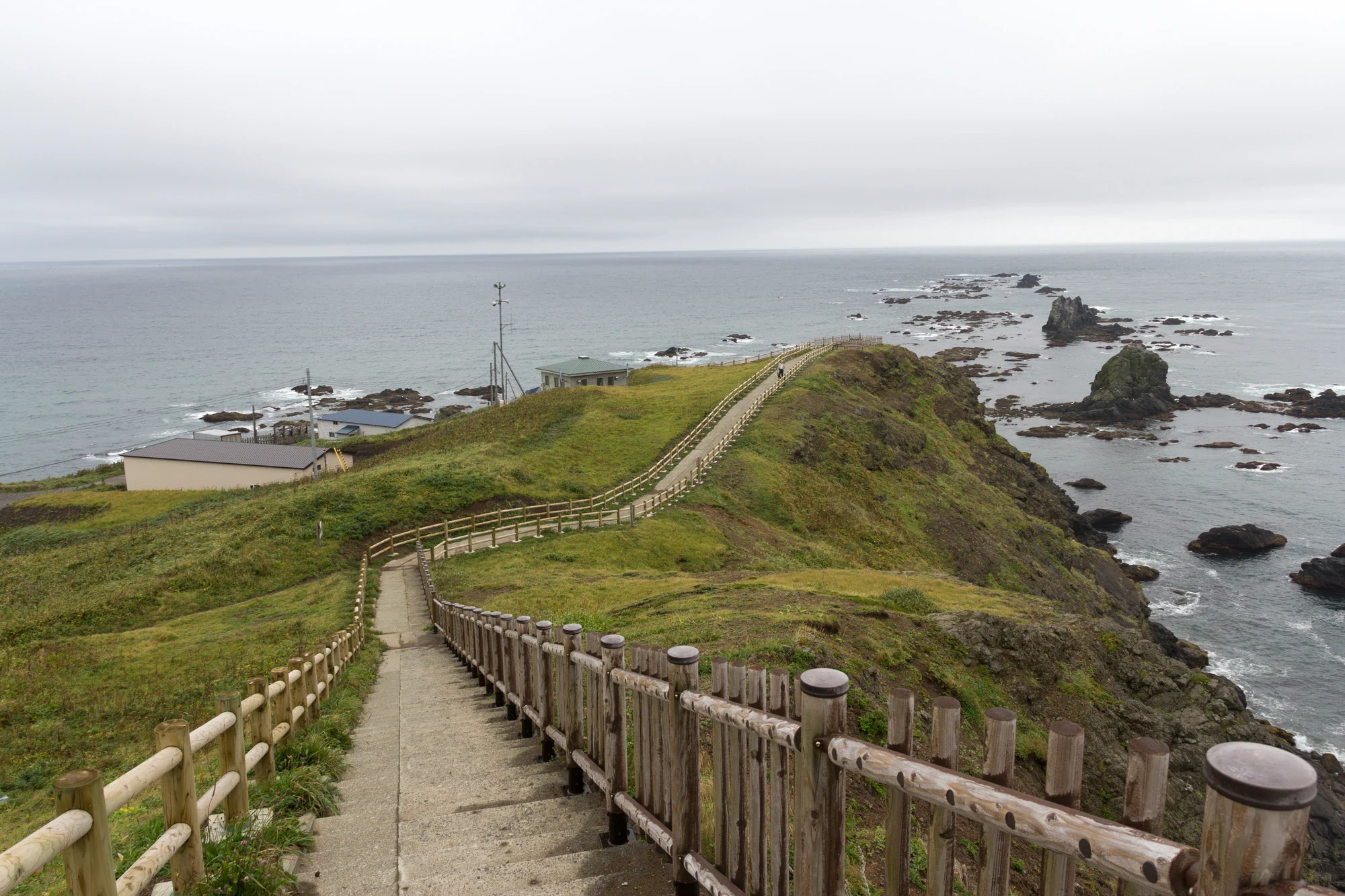
Fenced concrete steps descend across a grassy headland towards the sea, with a long chain of dark offshore rocks beyond the cape under an overcast sky.

The path and steps towards Cape Erimo’s tip overlook a chain of offshore rocks, showing the land’s continuation into the Pacific. Photographed on 8 September 2013.

2013-09-08 Cape Erimo.jpg — A_CUVE, CC BY-SA 2.0 (https://creativecommons.org/licenses/by-sa/2.0/). Source: https://commons.wikimedia.org/wiki/File:2013-09-08_Cape_Erimo.jpg. Resized and recompressed as WebP; no crop or retouching. · Creative Commons 1 · Creative Commons 2

Walks and routes

Center first, with an optional cape walk

Enter Kaze no Yakata from the parking-side entrance. Use the observation area and exhibits, then decide with staff whether outdoor conditions suit your group. Follow the signed cape visitor paths only as far as is comfortable and return to the visitor area.

Indoor lift access does not establish a continuous step-free route. Outdoor exposure, steps and slopes require individual assessment.

An indoor-focused visit

Use the observation room, wind displays, quiz and theater without adding the cape walk. This works when outdoor conditions are uncomfortable, provided the building and the journey to it remain safe and open. Ask staff which activities are available.

Arrive and ask

Check the return journey, use the facilities you need and ask about wind, visibility and today’s activities.

Look before you walk

Spend most of the visit with the observation room, wildlife footage and wind exhibits. Let the group choose one hands-on activity if available.

Make the outdoor decision

If conditions suit everyone, add the signed cape viewpoints and lighthouse exterior. If they do not, finish indoors rather than feeling obliged to reach the cape tip.

Things to try

Draw where the land becomes the sea

From a sheltered viewing spot, ask children to sketch three shapes: the headland, a near reef and the horizon. Compare the drawing with the view rather than trying to identify every distant object. When fog covers the water, draw what is actually visible.

Turn seal watching into a quiet observation game

Take turns at the viewing equipment. Look for a changing shape or movement and ask staff what you are seeing. A still rock is a useful reminder to be patient; there is no score for finding more animals.

Choose a wind experiment or a quieter exhibit

The advertised artificial wind reaches 25 m/s. Ask staff about suitability before joining, and make it an opt-in activity. Anyone who would rather avoid the sensation can explore the exhibits or sit by the windows.

Ask about a craft session

The tourism office lists crafts using natural materials. Check the day’s availability, fee and age suitability before promising the activity to children. Use materials supplied for the session; leave the coast’s plants, shells and driftwood in place.

Keep the visit inside Kaze no Yakata

The film, exhibits and seal quiz give you something worthwhile to do when the view is hidden. Check that the center is open and the approach is safe; an indoor attraction is not a reason to travel through severe weather.

Wildlife and habitats

Harbor seal: let the telescope bring the animal closer

From the center, choose one patch of visible reef and watch patiently. Ask staff to help distinguish an animal from a wet rock. Remain in the visitor areas and let the viewing equipment bring the detail closer.

Stories and discoveries

The building’s low profile helps it sit within the landscape beside a working lighthouse.

The seal habitat is also part of a productive fishing coast. The exhibits offer a way to connect wildlife watching with local livelihoods.

When to visit

spring

Pups may be visible into about mid-June. Use distant observation, and keep expectations flexible.

summer

The center’s May–August day is longer, but fog can obscure the reefs. Keep indoor activities in the plan.

autumn

September–November has a 17:00 closing time and 16:30 last entry. Build the return journey around the shorter day.

winter

Ordinary center opening stops for December–February. Treat the separately listed New Year’s Day sunrise session as something to confirm, not a normal winter service.

Getting there and practical advice

Cape Erimo “Kaze no Yakata”

May–August 09:00–18:00; March–April and September–November 09:00–17:00. Last entry 30 minutes before closing. Closed December–February apart from the listed January 1 05:00–08:00 sunrise opening. Temporary severe-weather closure is possible.

Set the destination to Cape Erimo Kaze no Yakata rather than the national park’s general map pin. Parking is listed at the cape. Allow a substantial travel margin, check the approach roads and weather, and arrange food and onward travel around the cape visit.

Use the current municipal and JR Hokkaido Bus information to plan a connection to えりも岬 (Erimo-misaki). The intercity Erimo bus serves the town, and reservations are required for that service. Read the correct weekday or holiday timetable and confirm the return directly with the operator before travelling.

Ask about the complete route you need

An elevator and loan wheelchairs are useful, but the published access information also records steps. Ask how to get from parking to the observation area and toilets, whether the lift serves every needed level, and what assistance is available. Request current information about the particular outdoor viewpoint you hope to use.

Sources and useful links

Wildlife you might spot

1

Each card links to a full Explore page with photos, traits, and fun facts.

Snap map for this place

Start with the big picture, then zoom in to explore individual wildlife observations around this place.

Loading map…

Good to know before you go

Check wind, visibility and road conditions before leaving, then ask the center staff about outdoor conditions. Wear a warm windproof layer and secure hats, glasses and loose items; hold children close on exposed paths.

Keep to signed paths and viewing areas. Fast currents, submerged rocks and waves make the offshore reefs unsuitable for independent exploration; watch seals through optics instead of trying to reach them.

The posted center hours are 09

00–18:00 in May–August and 09:00–17:00 in March–April and September–November, with last entry 30 minutes before closing. Recheck for weather closures before travelling.

Plan your return transport first. For buses, check the current JR Hokkaido Bus timetable for the actual えりも岬 (Erimo-misaki) stop and the correct weekday or holiday service. Erimo town center is a different destination.

Ask staff which viewing equipment is available and give everyone a turn. Take your time at the windows and keep a little of the visit for the exhibits and film.

The wind experience is optional. Ask about participation requirements and let anyone who dislikes strong wind or loud noise choose the observation room or exhibits instead.

Check nearby places to eat before setting off, and bring food and drinks for the journey. Do not depend on finding a café inside the center.

On this coast, notice evacuation signs and check the town’s tsunami guidance. If an earthquake or tsunami alert calls for evacuation, follow official directions promptly; never go toward the shore to watch.

Frequently asked questions

No. It concentrates on Cape Erimo and Kaze no Yakata at the coastal end of a very large park. The Hidaka mountain interior is a separate undertaking that needs its own access, weather and safety planning.
They are wild harbor seals, Phoca vitulina, also called common seals and locally zenigata azarashi. Use the observation equipment to look toward their offshore reef habitat.
Use the wind exhibits, seal quiz and film, and ask staff what is working that day. The center describes recorded seal footage as an alternative when the view is obscured or animals are not hauled out. Severe weather may close the building too, so check before making the journey.
The operator’s posted individual admission is ¥300 for adults and university students, ¥200 for elementary, junior-high and high-school students, and free for preschool children. This is center admission. Confirm the current price and any separate activity charge before your visit.
Contact the center first with your exact needs. A lift and loan wheelchairs are listed, but steps and slopes are also documented. Neither the entire building visit nor the outdoor cape route should be treated as automatically step-free.
Stay at the visitor viewing areas and use optics. The rocks are separated by dangerous water with strong currents and submerged hazards. This itinerary includes no shore scrambling, wading or independent boat approach.
Plan on an exterior view from the public visitor area. Check current official announcements if you hope to go inside, including any date-specific special opening.
Yes, local bus information includes the Erimo-misaki stop, but the connections need careful planning. Check the latest operator timetable and return journey before setting out. The intercity bus to Erimo town does not itself deliver you to the cape.
Its ordinary winter closure covers December, January and February. A 05:00–08:00 opening on January 1 is listed separately for sunrise viewing, but confirm that specific event and the weather before planning around it.

Recent snaps at this place

Recent snaps will appear here as new observations are added.

View all ›

Take the discovery with you

Exploring Hidakasanmyaku-Erimo-Tokachi National Park?

Identify the wildlife you spot, learn as you go, and keep a collection of the adventure.

  1. 1Spot it
  2. 2Snap it
  3. 3Keep the discovery