Snappit logo
Snappit
Get App
Generic illustration, not a photograph of this venueIllustration
ParkShikoku, Japan

Ishizuchi Quasi-National Park: a gentle day at Omogo Gorge

Ishizuchi Quasi-National Park reaches across Ehime and Kōchi, taking in high ridges, forests and deeply cut valleys.

About

Ishizuchi Quasi-National Park reaches across Ehime and Kōchi, taking in high ridges, forests and deeply cut valleys. For a first visit without a mountain ascent, head to Omogo Gorge on the Ehime side. Here the interest is close at hand: water slipping around pale rock, trees hanging over the gorge and the broad rock face of Kamebara above Goshikigawara.

Start at Omogo Mountain Museum, beside the gorge entrance. Its displays connect the rocks and living things outside with the history of mountain worship and climbing. Then, if the access road is open, make a separate stop at Goshikigawara and Goshiki Bridge. A little time watching the changing colour of the water is more rewarding than trying to tick off every waterfall.

Keep the day flexible. The well-publicised Kanmon riverside path has a rockfall restriction around Kūsen-kyō Bridge (空船橋); do not count on walking through from the museum. A separate upstream repair near Shimokumabuchi was completed in spring 2026. These are different sections. Ask locally which short walks are open, and let the weather and your footing decide how far you go. Planning to visit? Download the Snappit app to identify the wildlife you spot in real-time.

Omogo’s gorge scenery received national scenic designation in 1933. Ishizuchi Quasi-National Park followed on 1 November 1955, protecting a wider mountain landscape across Ehime and Kōchi. The museum opened in 1991 to help visitors understand this landscape and its natural and cultural history.

What to do here

Pair the museum with a short Goshikigawara scenery stop. Look at the water and Kamebara rock from open visitor areas, then consider a short out-and-back towards Momijigawara only if staff and signs confirm the path is open. Keep the river-viewing day separate from Ishizuchi summit routes, ropeways and canyoning.

Seasonal info

Spring brings fresh greens and rhododendron flowers. Summer needs insect protection and careful attention to rain upstream. Autumn is a good time to linger over foliage. Winter can bring icy footing and reduced services; the museum closes on winter weekends and public holidays, and the separate Ishizuchi Skyline closes seasonally.

Accessibility

The museum lists an accessible toilet but has no lift or stairlift; its upstairs special-exhibition area requires stairs. Call 0892-58-2130 before visiting to discuss access. Outdoor gorge paths and river rocks are not a dependable wheelchair or pushchair route. Ask about a suitable viewing stop and keep a museum-only option.

Don't miss

1

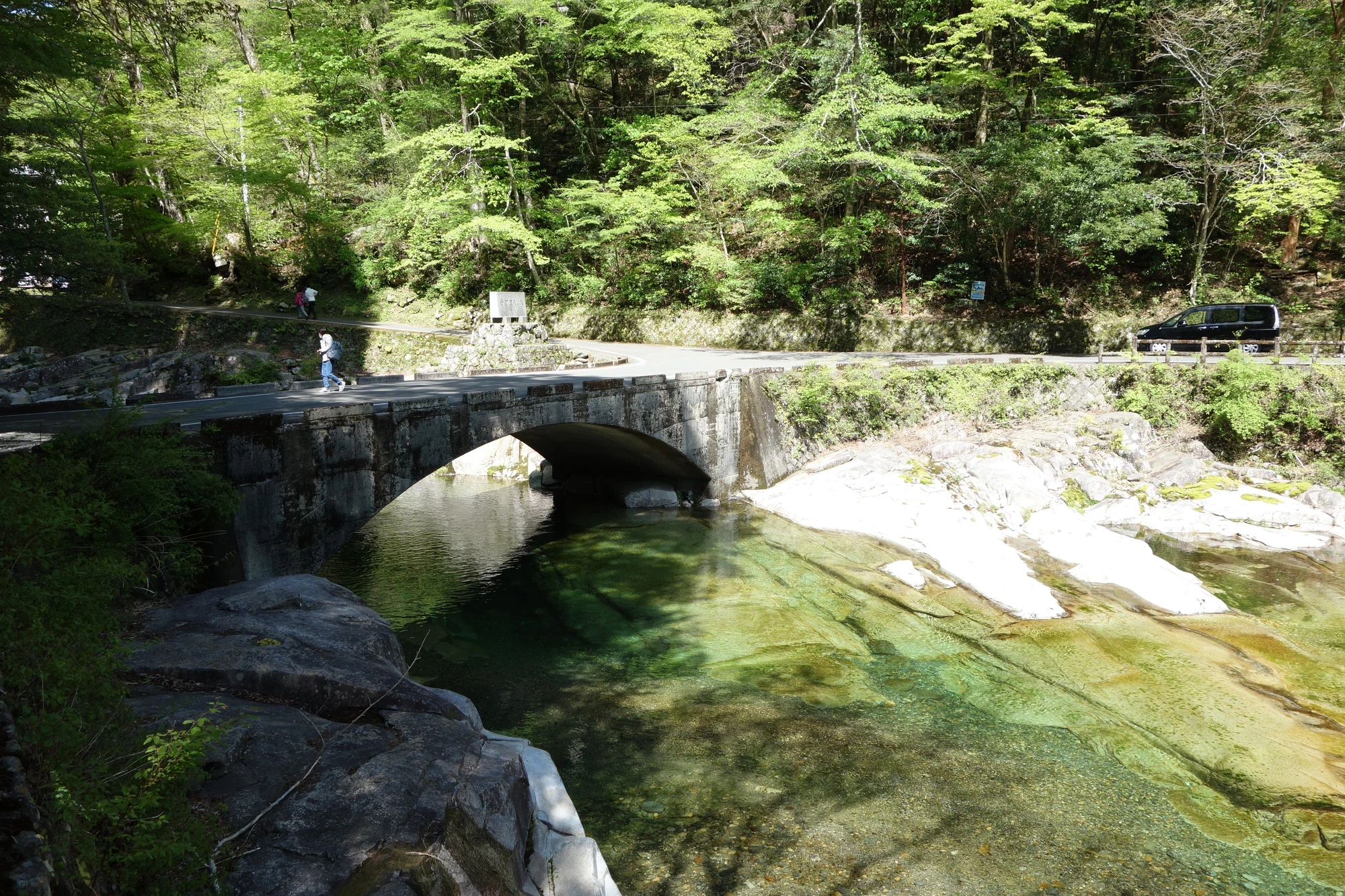
The pale rock and green water around Goshikigawara and Goshiki Bridge

2

Kamebara’s broad rock face above the central gorge scenery

3

Omogo Mountain Museum’s rocks, insects and mountain stories

4

Spring foliage and autumn colour in a mixed gorge forest

A low arched bridge crosses green-tinted water between pale rock slabs and leafy woodland.

Goshiki Bridge spans clear water at Goshikigawara in Omogo Gorge, photographed in May 2021.

五色河原と五色橋.jpg — Koda6029, CC BY-SA 4.0 (https://creativecommons.org/licenses/by-sa/4.0/). Source: https://commons.wikimedia.org/wiki/File:%E4%BA%94%E8%89%B2%E6%B2%B3%E5%8E%9F%E3%81%A8%E4%BA%94%E8%89%B2%E6%A9%8B.jpg. Proportionally resized to a maximum 2000-pixel long edge without upscaling; recompressed as WebP quality 92, method 6. No crop, added text, colour adjustment or retouching. Original retained as working evidence only; EXIF omitted from derivative. · Creative Commons

Walks and routes

A short look upstream from Goshikigawara

Begin with the scenery around Goshiki Bridge. If the upstream path is open and dry enough for your group, follow the signed main-stream path towards Momijigawara, then return the same way. The tourism association places it about eight minutes upstream; allow 20–40 minutes with stops. Turn back sooner if footing or signs call for it, and leave the longer gorge and mountain trails for another visit.

Expect a gorge path rather than a paved park circuit. Wear grippy shoes; wet rock and uneven footing can make a short distance demanding. For a wheelchair or pushchair, ask locally about viewing options rather than attempting this extension.


A short look upstream from Goshikigawara

Start with 45–60 minutes in Omogo Mountain Museum. Check the day’s path and road notices before leaving.

Move to Goshikigawara by your arranged vehicle when the road is open; do not assume the closed Kanmon trail provides a walking link.

Spend 20–40 minutes with the bridge, rock face and water views. Add the short Momijigawara return only if conditions and your group suit it.

Leave time to eat your packed food in a permitted rest area, use available toilets and meet your return ride without rushing.

Things to try

Make a small rock-and-colour study

From an open viewing area, choose one patch of river and notice how white stone, shadow and reflected leaves alter its colour. Try a wide photograph and a close detail without moving onto wet rocks.

Let the museum set the scene

Look for the links between rock, forest and the people who travelled into these mountains. Give children one question to take outside, such as which colours they can find in the gorge.

Choose a guided river day separately

Canyoning is an organised activity with specialist equipment and participation limits. Check the operator’s current season, age or height rules, meeting place and weather decision before booking; it is not part of the walking plan.

Stay with the museum

On a damp day, spend longer with the museum displays and leave the riverside extension out. In heavy rain, strong wind or road restrictions, postpone the trip rather than treating an indoor attraction as a reason to drive into unsafe conditions.

Wildlife and habitats

Japanese maple

Iroha-momiji is one of the maples linked to Omogo’s autumn colour. Enjoy the changing canopy, then compare a photographed leaf with the museum’s identification material; several kinds of maple grow in these forests.

Wild rhododendrons and azaleas

Local spring notes name akebono-tsutsuji and hikage-tsutsuji in the gorge. Their flowers add another layer to a spring visit, but cliffs and closed paths are places to admire from a distance. In spring, take a few minutes to scan the woodland edge for flowers before moving on.

Beech woodland

Beech is part of the gorge’s mixed broadleaved forest. Look at the canopy as a whole and compare its leaves and trunks with neighbouring trees. Let the wider forest be part of the visit, even when you only have time for a short stop.

The forest is worth looking at slowly. The plants below are documented in the gorge, but flowers and colours depend on season. Stay on open paths, use a camera rather than collecting, and let the museum help with uncertain identifications.

Stories and discoveries

Upstream of Niyodo Blue

The Omogo River feeds the river system known downstream in Kōchi as the Niyodo. This gorge is one place to see the rocky, forested headwaters behind that celebrated blue-green scenery.

A forest with more than one shade of green

The gorge woodland mixes broadleaved trees, including beech and maples, with fir and hemlock. Looking at the different crowns is worthwhile even when no flowers or autumn leaves are on show.

When to visit

Spring

Fresh leaves make a good reason to come even before the forest fills out. Local walking material records gorge-side rhododendron flowers around mid-to-late April; look from open paths and never enter a closed section to reach them.

Summer

Bring insect repellent and enjoy the forest shade. Watch the weather over the catchment as well as overhead; a clear-looking pool is not a signal to enter the water.

Autumn

Late October to early November is the usual foliage window in the gorge. Allow time for photographs and a slow drive, and check the local colour reports rather than assuming the mountain summit and valley peak together.

Winter

Build a winter visit around confirmed opening days, road conditions and a warm indoor stop. The museum is closed on winter weekends and public holidays. Snow or ice can make short outdoor stops awkward; do not plan a casual gorge walk in icy conditions.

Getting there and practical advice

Omogo Mountain Museum

Open 09:30–17:00, last admission 16:30. Normally closed Mondays and after public holidays, with holiday exceptions; December–March also brings weekend and public-holiday closures. Year-end and exhibition-change closures apply. Standard admission is ¥300 for adults and ¥150 for elementary and junior-high pupils; special exhibitions may cost more. Address: 650-1 Wakayama, Kumakōgen. Phone: 0892-58-2130. The museum lists ten parking spaces and an accessible toilet.

Autumn 2026 admission

The 35th-anniversary special exhibition runs from 18 July to 23 November 2026. During this exhibition admission is ¥500 for adults and ¥250 for elementary and junior-high pupils. Check its calendar for holiday openings and closures.

Food and comfort stops

Use the museum’s facilities while it is open, and ask where the next available toilet is before heading farther into the gorge. Carry your own water and a snack or lunch; do not base the day on a historic café listing.

Driving to the right entrance

The museum’s directions use Route 33 from Matsuyama towards Kōchi, then the turn at Mimido towards Omogo. They allow roughly 80 minutes from Matsuyama Interchange. Continue towards the gorge rather than turning onto the Ishizuchi Skyline. Check local road notices before continuing beyond the museum to Goshikigawara.

Bus, then a reserved ride

JR Shikoku Bus links JR Matsuyama Station with Kuma; the museum allows about 80 minutes for that leg and about an hour more by taxi or Kumakuru to the museum. The old Kuma–Omogo / Ishizuchi Tsuchigoya scheduled bus ended on 31 March 2026. Check the JR timetable and arrange the onward and return journeys together.

Booking Kumakuru

The Omogo / Shinagawa shared service accepts visitors and runs Monday–Saturday, excluding public holidays. The listed nonresident fare is ¥1,500 one way. Call 0892-56-0321 by noon the previous day; book earlier for travel after a weekend or holiday, because the booking office works weekdays. For Monday travel, reserve by Friday. Agree the exact pickup, drop-off and return: published time slots are approximate, seats are subject to availability, and it does not run without a booking.

Keep the Skyline as a separate plan

You do not need the Ishizuchi Skyline to visit the museum from Kuma. If you add a drive to Tsuchigoya, check its gates and road status: the published winter closure is 1 December–31 March, and it closes at night during the open season. The Skyline timetable does not describe opening hours for the whole gorge.

Inside the museum

An accessible toilet is listed, but there is no lift or stairlift to the upstairs special-exhibition area. If you need assistance, telephone by the previous day to discuss what is practical for you. Do not assume staff assistance makes every display accessible.

Beside the gorge

Choose the shortest visit that works for your group. A road-accessible scenic stop does not make the riverside rocks or walking trails step-free. Ask staff about the route from parking to a suitable viewpoint, and keep children close near traffic and steep edges.

Visitor information

Two trail notices, two different places

Checked 16 October 2026: do not use the Kanmon through-path around Kūsen-kyō Bridge. The town’s spring 2026 reopening notice concerns Shimokumabuchi farther upstream, not that bridge. Ask the museum about any open short sections before you walk.

Plan lunch before you arrive

Pack food and drinking water. Older guides still advertise Keisentei / Omogo Chaya beside Goshikigawara, but the town planned to end its management contract in March 2026. Check directly before relying on any café or shop in the gorge.

Sources and useful links

Wildlife you might spot

3

Each card links to a full Explore page with photos, traits, and fun facts.

Snap map for this place

Start with the big picture, then zoom in to explore individual wildlife observations around this place.

Loading map…

Good to know before you go

Check the town’s notices and ask at the museum before using a gorge path; barriers are turn-around points.

Treat Kūsen-kyō Bridge and the Kanmon through-path as closed unless the town explicitly announces otherwise.

Enjoy the water from the path. Clear pools can be deep; keep children beside you and away from wet rock edges.

Skip riverside walking in heavy rain, after severe weather or when water is rising or cloudy, even if the sky overhead is bright.

Wear grippy shoes, bring a rain layer and water, and carry food rather than depending on old tea-house listings.

Reserve both legs of a car-free visit. The former scheduled Omogo bus ended in March 2026.

Check the museum calendar carefully

winter weekends are closed, and special exhibitions can change the admission price.

Photograph plants where they grow, leave rocks and living things in place, and take litter home.

Frequently asked questions

No. This visit stays around the gorge entrance and Goshikigawara. The Omogo summit route is a substantial mountain undertaking; ropeway and Tsuchigoya approaches also need their own plans.
Do not plan on it. The route around Kūsen-kyō Bridge is affected by rockfall restrictions. Ask museum staff whether any short return section is available, and never enter from the far side to get around a barrier.
This itinerary is for looking at the river from land. Deep pools, slippery rocks and sudden changes in flow make casual water entry a poor add-on. If you want canyoning, book a specialist guided activity separately and check its conditions and eligibility.
Yes, with advance planning: take the JR Shikoku bus from Matsuyama to Kuma, then a reserved Kumakuru ride or taxi. Confirm the exact drop-off, any transfer to Goshikigawara and the return before setting out; there is no longer a regular Omogo bus.
Make the museum the visit, provided it is open and the approach roads are safe. Do not substitute a walk through road tunnels or a scramble along the river to reach a closed path.

Recent snaps at this place

Recent snaps will appear here as new observations are added.

View all ›

Take the discovery with you

Exploring Ishizuchi Quasi-National Park: a gentle day at Omogo Gorge?

Identify the wildlife you spot, learn as you go, and keep a collection of the adventure.

  1. 1Spot it
  2. 2Snap it
  3. 3Keep the discovery