Snappit logo
Snappit
Get App
Generic illustration, not a photograph of this venueIllustration
ParkShikoku, Japan

Matsuyama Shiroyama Park

Shiroyama Park gives you a lovely choice before you take a single uphill step.

About

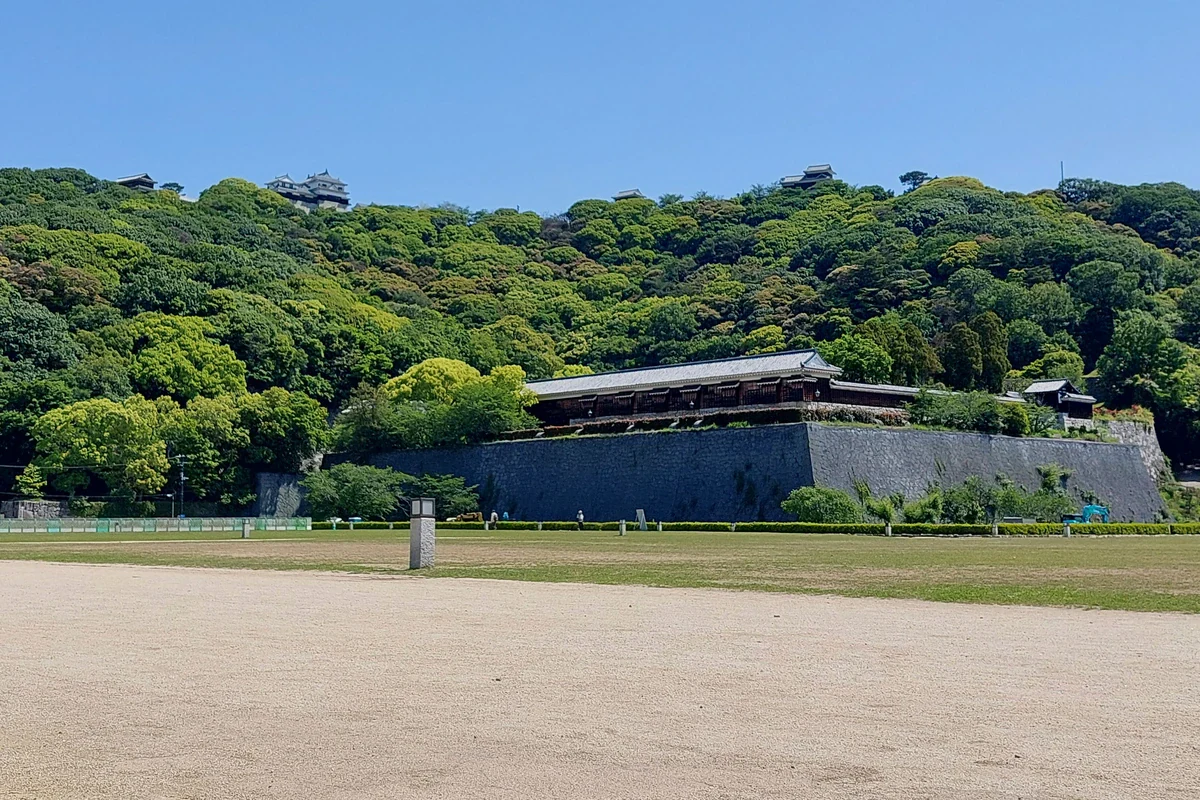
Shiroyama Park gives you a lovely choice before you take a single uphill step. At the foot of Matsuyama Castle, the Horinouchi grounds have room for a slow walk, a picnic and a long look at the wooded skyline. Above them, stone walls and castle roofs appear through the trees. A visit can stay entirely down here, especially with a stroller, small children or someone who would rather save their energy.

Start with Yasuragi Square and let the hill be the view. Walk a little, pause beside the moat, then choose whether to continue. Sakura Square brings cherry blossom into the lower park in spring, while Fureai Square gives families space for gentle games in the permitted area. The simplest outing is a short circuit with plenty of stops, rather than an attempt to cover every corner.

The trees on the hill are part of what makes this place special. Matsuyama Castle Hill Woodland is a prefectural natural monument, with warm-temperate evergreen trees and a leafy understorey. The city's botanical account describes camphor trees, evergreen oaks and tsuburajii, a tree whose pale yellow flowers can brighten the canopy in early May. Look at the layers: rounded crowns high above, shrubs beneath, then ferns close to the ground. You can enjoy the woodland as a landscape from below or meet it more closely on an open ascent path.

For a different kind of plant discovery, add Ninomaru Historic Site Garden. Citrus trees and flowers mark out former palace rooms; elsewhere, water, gravel and grass suggest another part of the old layout. It is an engaging place to ask children where they think a doorway or room once stood. This is a separately ticketed garden on the hillside, so treat it as an optional visit with its own approach and access needs.

The castle summit is another choice again. Walk up the Shinonome approach if everyone enjoys slopes and steps, or take the ropeway to reduce the climb. Either way, there is still uphill walking to reach the main castle area. Honmaru Square gives broad city views without entering the keep; the keep adds a separate ticket and steep indoor stairs. Choose the version that leaves everyone enough energy to enjoy the way back. Be ready to snap and learn! Get the Snappit app to identify any nature species you find here.

Castle construction began in 1602 under Katō Yoshiaki. The hilltop first opened as a public park in 1874, and the hill woodland gained prefectural natural-monument status in 1949. Ninomaru Historic Site Garden opened in 1992. Much of today’s open Horinouchi landscape took shape in the 2010 first-stage park redevelopment, which made the castle setting and buried historic layout easier to appreciate.


What to do here

Walk the lower Horinouchi grounds, watch the moat from the path and compare the open lawn with the wooded hill. Add the citrus-planted Ninomaru garden or the castle summit as a separate part of the day.

Seasonal info

Blossom and foliage change with the weather. Summer lawns can feel exposed, and wet hill steps need care. The ropeway and ticketed sites close earlier in December and January; the chairlift does not run in rain.

Accessibility

Horinouchi is the gentlest starting point, with accessible-toilet symbols on the city map. The hill has steep slopes, steps and high thresholds, including after the ropeway. The operator advises two or three helpers for wheelchair access to Honmaru; wheelchairs cannot enter the keep. Contact Ninomaru before an assisted visit, especially during the current rear-approach vehicle restriction.

Don't miss

1

Yasuragi Square

open ground with a wooded-hill and castle backdrop.

2

Castle Hill Woodland

evergreen layers protected as a prefectural natural monument.

3

Ninomaru garden

citrus, flowers and water trace the rooms of a vanished palace.

4

Honmaru Square

an optional climb or ropeway-assisted visit for views over Matsuyama.

An open gravel-and-grass foreground leads toward stone walls and a densely wooded hill, with castle roofs visible above the trees.

The wooded hill and castle walls rise beyond the open grounds of Shiroyama Park in Matsuyama, photographed in May 2024.

CT-May / Wikimedia Commons / CC0 1.0. Shiroyama_Park_(Matsuyama)_20240510_(1).jpg. Source: https://commons.wikimedia.org/wiki/File:Shiroyama_Park_(Matsuyama)_20240510_(1).jpg. License: https://creativecommons.org/publicdomain/zero/1.0/. Proportional downsampling to fit 1200 × 1200 pixels without enlargement; WebP quality 92, method 6. No crop, retouch, recoloring or added text. EXIF omitted. No software field displayed on the individual file page. Source rendering retained; no assertion of unprocessed capture. · Creative Commons

Walks and routes

The short lower-park walk

The official Horinouchi short course is about 1.2 km, with a walking time of 20–30 minutes. Allow 45–60 minutes if you stop to look at the hill, watch the moat and take a snack break. Use the operator’s course map to follow the lower-ground route, and shorten the outing whenever you like.

The gentlest choice here. Stay on the lower park paths; a lawn shortcut may be harder to roll across. Check the map for the nearest toilet and choose your entrance around your own access needs.

The short lower-park walk

A longer wander below the hill

The official Horinouchi full circuit is about 1.9 km, with an approximate walking time of 25–35 minutes. Allow about an hour with pauses. This stays within the lower-park outing; the separate 4 km route around Shiroyama follows city streets and is a different walk.

Choose this after the shorter walk feels comfortable. Use the official map rather than assuming the moat edge forms one continuous step-free circuit.

A longer wander below the hill

Citrus and palace rooms at Ninomaru

Give the garden about 40 minutes, plus time to reach its entrance. Follow the room-shaped planting, then look at the water garden and the exposed well remains. It is a good alternative to climbing all the way to the summit.

The garden has steps and gradients. Wheelchair visitors need assistance and should arrange the approach with the management office on 089-921-2000.

Citrus and palace rooms at Ninomaru

An optional woodland climb from Shinonome

Start beside the lower ropeway station and follow the signed Shinonome ascent via the shrine approach, passing Chōjaganaru toward Honmaru. The operator lists about 30 minutes uphill; allow 90–120 minutes for an unhurried up-and-back outing with summit pauses, excluding the keep. Return by the same signed approach unless you have checked another route.

This is a hill walk with steps and drainage channels crossing the path. It is unsuitable as a stroller or independent wheelchair route.

An optional woodland climb from Shinonome

Ropeway-assisted summit visit

Ride from Shinonome-guchi to Chōjaganaru, then follow the signed uphill approach to Honmaru. Allow about 10 minutes for the walk from the upper station to the keep. The operator suggests about 90 minutes for a return ropeway trip with keep entry; leave extra time for queues.

The ropeway reduces the ascent but leaves slopes, steps and thresholds. Discuss wheelchair assistance with staff in advance. The keep itself cannot accommodate wheelchairs.

Ropeway-assisted summit visit

An easy hour with children

Begin in the lower grounds, choose a short stretch toward Yasuragi Square and stop to look up at the hill. Spend a few minutes beside the moat, then settle for a snack or a little drawing. Finish while everyone is still enjoying themselves; the summit can be another outing.

A plant-focused half day

Start with a lower-park wander, add Ninomaru if its approach suits your group, then decide over a break whether you want the summit. If you do, move to Shinonome and choose walking or the ropeway. Leave enough time for the descent rather than making the keep a compulsory final stop.

Things to try

A three-layer woodland picture

From a safe stopping place, draw a line for the high canopy, another for the shrubs and a third for the plants near the ground. See how different the hill looks from the open lawn and from an ascent path.

Two minutes beside the moat

Pause on the path and watch the water. Can you find a reflection, a ripple and something moving? Let children describe what they see while an adult stays close to the edge.

Find a room made of plants

At Ninomaru, choose one planted rectangle and imagine the room it represents. Compare it with a space outlined by water, gravel or grass before reading the garden explanation.

If it is only lightly raining

Keep the outing short on the lower grounds and make the hill optional. The open-chair lift stops in rain; the ropeway has its own operating decision, so check the notice rather than assuming it will run.

If rain becomes heavy or wind strengthens

Postpone the woodland ascent. Matsuyama has closed ascent paths during heavy-rain warnings, and wet stone steps are slippery. Choose an indoor city outing and return when the weather and access notices are suitable.

Wildlife and habitats

Japanese aucuba · woodland shrub

Look beneath the taller trees for an evergreen shrub with leaves growing in opposite pairs. Aucuba is part of the documented castle-hill understorey. Red fruit may help with identification when present, but leave all berries untouched.

Mute swan · managed moat birds

If a swan is in view, look for the adult’s white plumage, orange-red bill and black knob at its base. These birds are cared for by the city. Watch quietly from the path, give them room and leave feeding to staff.

Lemon tree · cultivated garden planting

In Ninomaru’s citrus beds, use the plant labels to look for lemon among the other citrus. Compare leaf shapes and the room-like outlines of the beds. Fruit varies with the season; do not pick it.

Notice the difference between woodland plants growing on the hill, citrus deliberately planted in the garden and swans cared for in the moat. What is visible changes with the season, so enjoy what you find without searching off the paths.

Stories and discoveries

The wooded hill has its own protected status

The castle hill’s woodland was designated an Ehime prefectural natural monument in 1949. Its plants are part of the place’s heritage alongside the castle structures.

A palace remembered through planting

Ninomaru uses citrus and flowers to suggest the former reception-palace layout, while water, gravel and lawn express the inner-palace rooms. The garden lets you read a building plan with your feet.

When to visit

Spring

Sakura Square is a good lower-ground choice for cherry blossom. Later in spring, look at the wooded hill as a whole: tsuburajii can bring pale yellow flowering to the canopy in early May. Check current bloom reports before a flower-focused trip.

Summer

Start early, carry water and keep the exposed lower-park section short. Woodland shade does not remove the effort of the hill climb. Take breaks and choose the ropeway or a lower-only visit when the group is feeling the heat.

Autumn and winter

A mild autumn day suits the longer lower walk. In winter, enjoy the evergreen woodland silhouette and plan around shorter ticketed-site and ropeway hours. Leave time to descend in daylight.

Getting there and practical advice

Free areas and opening times

Horinouchi is open 24 hours with no regular closing day. Honmaru Square is also free, but has gates: normally 05:00–21:00 in April–October and 05:30–21:00 in November–March. For a family nature walk, visit in daylight and check event or weather changes.

Standard admission, checked 16 October 2026

Keep: ¥520 adult, ¥160 primary-school child. Ninomaru: ¥200 adult, ¥100 primary-school child aged 6–12. Ropeway/chairlift: return ¥520 adult/¥260 primary-school child; one-way ¥270/¥140. Accompanied preschool children have limited free-entry allowances; confirm your group’s eligibility at the ticket desk.

Garden and keep hours

Both normally open at 09:00 and close at 17:00, extending to 17:30 in August and closing at 16:30 in December–January. Both close on the third Wednesday in December. Keep entry ends 30 minutes before closing and may stop earlier when busy. Arrive well before the last admission time.

Ropeway and chairlift hours

The ropeway normally runs 08:30–17:30, until 18:00 in August and until 17:00 in December–January. The chairlift runs 08:30–17:00 and stops in rain. Recheck the day’s service notice before using either.

Combined ticket if you plan to enter the keep

The return-ride-plus-keep ticket costs ¥1,040 adult or ¥420 child and is sold at the Shinonome station machines from 08:00 to 14:00. It saves a second ticket purchase at the keep, but its keep-admission portion is nonrefundable.

Toilets, water and a place to pause

The city’s lower-park map shows accessible toilets near the east side and by the management square near the west entrance, plus rest shelters and drinking-water points. On the hill, toilets are outside the keep, including beside the Honmaru shop and west of the upper ropeway station. Carry water even when you plan to use a fountain.

Ask before an assisted visit

For castle and ropeway access, contact 089-921-4873. For Ninomaru and Horinouchi, contact 089-921-2000. Explain your mobility needs and ask about current approaches and assistance.

Getting to the lower park

The city gives walking times of about 10 minutes from Matsuyama-shi Station and 15 minutes from JR Matsuyama Station to the park. Minami-horibata and Nishi-horibata tram stops are useful for the lower grounds. These are park-arrival times, with the garden and summit still ahead.

Starting with the summit

Head for the ropeway’s Shinonome-guchi station on the eastern side if the summit is your first priority. The walking ascent begins nearby. Do not assume arriving in Horinouchi means you are already at the ropeway station.

Arriving by car

Horinouchi has no dedicated visitor car park. Use public transport or a nearby paid car park, and choose your arrival point around the part of the park you want to visit first. General visitor vehicles cannot use the castle ascent paths.

Lower grounds

Start with Horinouchi and use the city facility map to find a suitable entrance, toilet and short return route. Ask the management office about surfaces or temporary diversions that matter to you; the map’s accessible-toilet symbols do not mean every path is step-free.

Hill and keep

The upper approach retains steep slopes, steps and gate thresholds. The operator advises two or three companions to assist a wheelchair user to Honmaru. Plan this with staff rather than attempting it independently. The keep has steep internal stairs, no lift and no wheelchair entry.

Ninomaru during the vehicle restriction

Ninomaru admits wheelchair visitors with assistance, but its usual special vehicle approach is via the Prefectural Office rear road. That road is closed to vehicles through 27 November 2026. Call 089-921-2000 for current arrangements before travelling; the garden also has gradients and steps inside.

Current approach restriction: checked 16 October 2026

The Prefectural Office rear approach is closed to vehicles from 12 September to 27 November 2026 for works preparation. Pedestrians are allowed through, but the route is narrower. This particularly matters if you need the usual assisted vehicle access to Ninomaru. Check the latest notice and call the garden before relying on that arrangement.

Sources and useful links

Wildlife you might spot

3

Each card links to a full Explore page with photos, traits, and fun facts.

Snap map for this place

Start with the big picture, then zoom in to explore individual wildlife observations around this place.

Loading map…

Good to know before you go

Choose lower park, garden or summit first. Trying all three with tired children can make the return feel long.

Check the operator’s latest notices before climbing. Use signed paths and respect barriers, including around the castle platform.

Wear shoes with grip for the hill, carry water and turn back if rain or heat makes the walk uncomfortable.

Keep children beside you at the moat and away from stone-wall edges. Leave plants and fruit in place, and let staff feed the swans.

Preschool children must use the ropeway rather than the single-seat chairlift.

Use the toilets before entering the keep; there are none inside, and its stairs are steep.

For a picnic, bring ready-to-eat food and take your litter away. Barbecues and personal fireworks are prohibited.

For Ninomaru wheelchair access, call 089-921-2000 before travelling; do not rely on the usual vehicle approach while its restriction is in force.

Frequently asked questions

No. The lower Horinouchi grounds are a complete outing, with lawns, moat views and the wooded hill above you. Keep Ninomaru and the summit as optional additions.
It reaches Chōjaganaru, below the main castle area. The official guide gives about 10 minutes of further walking to the keep, with slopes and steps along the approach.
The lower park and Honmaru Square are free. Ninomaru, the keep and the ropeway or chairlift have separate charges; the practical details list the standard prices checked on 16 October 2026.
The moat’s mute swans are birds cared for by the city. Watch from the path and leave their feeding to the people who look after them.
For the lower grounds, follow the designated Fureai-area rules: use a short lead, keep dogs off the lawns and take waste away. Garden and castle facilities have separate restrictions; check them before bringing a pet.

Recent snaps at this place

Recent snaps will appear here as new observations are added.

View all ›

Take the discovery with you

Exploring Matsuyama Shiroyama Park?

Identify the wildlife you spot, learn as you go, and keep a collection of the adventure.

  1. 1Spot it
  2. 2Snap it
  3. 3Keep the discovery