
Snappit logo
Snappit
Get App
Generic illustration, not a photograph of this venueIllustration
ParkHokkaido, Japan

Nopporo Forest Park

Nopporo is a place to slow your eyes as well as your feet.

About

Nopporo is a place to slow your eyes as well as your feet. A tapping sound, a fallen seed or the pattern of branches can become the highlight of a visit. Its 2,053 hectares stretch across three cities, yet the forest feels quite different from a city garden: choose one gateway and explore a manageable piece rather than trying to tick off the whole park. The Ohsawa entrance and Nature Fureai Exchange Hall make a particularly helpful first stop. Elsewhere, pond-side paths, older trees and the cultural facilities on the northwestern edge offer several different kinds of day out. [Park overview](https://www.pref.hokkaido.lg.jp/ks/skn/environ/parks/nopporo-prefecturali-nationalpark.html) Eager to name that creature? Identify any animal you find during your visit using the Snappit app.

The prefectural park was designated in 1968. Much of it is national forest, but the park boundary also includes other land and the northwestern memorial-facilities area. The woodland combines naturally regenerated and planted stands; it has experienced logging, farming and storm damage. Calling the whole place untouched primeval forest would hide that history.

What to do here

Start with the nature centre’s displays and current advice, take a short woodland walk, and leave time to compare what you noticed with a field guide. Longer visits can focus on the Ohsawa paths or combine a forest-edge outing with one separately ticketed museum.

Seasonal info

Before leaving, check the [current trail notices](https://nopporo-vc.com/news/20261012-1440/) and local bear information. Several paths near Mizuho Pond and the cultural facilities were closed in the latest October 12, 2026 notice; Centennial Plaza construction also interrupts connections.

Accessibility

A gentle-looking landscape does not establish a step-free forest route. Check the exact surface, slope, toilet access and seasonal condition with the nature centre before choosing a wheelchair or stroller outing.

Don't miss

1

Woodland observation from the Ohsawa gateway

2

Free nature-centre displays and family crafts

3

Resident woodpeckers and the Hokkaido form of Long-tailed Tit

4

Mizuho Pond from its currently designated approach

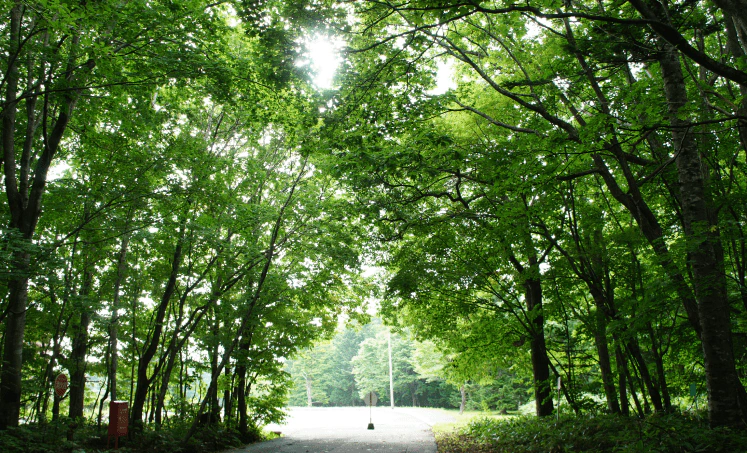
Sunlight filters through a dense green canopy above a broad approach leading toward a brighter clearing, with a small sign and barrier visible ahead.

Green woodland in Nopporo Forest Park, in a photograph published by Hokkaido Government. The capture date and precise location are not supplied; this image does not establish current access or seasonal conditions.

Source: Hokkaido Government, 道立自然公園野幌森林公園 (https://www.pref.hokkaido.lg.jp/ks/skn/environ/parks/nopporo-prefecturali-nationalpark.html). CC BY 4.0 (https://creativecommons.org/licenses/by/4.0/). No changes. Individual photographer and capture date not supplied. · Creative Commons 1 · Creative Commons 2

Walks and routes

A flexible first walk from Ohsawa

Ask for the day’s advice at the nature centre, then use the Ohsawa Path for an out-and-back that you can shorten whenever the group needs. The official course description gives 1.9 km from Ohsawa-guchi to Ohsawa Rest Site: walking the full line both ways is approximately 3.8 km, before any extra exploring. For a small-child visit, choose a turnaround point rather than promising the far end. Watch the trees as well as the ground.

Suggested allowance: 1–2 hours for the centre and a shorter walk; allow longer for the full return walk and frequent stops.


Mizuho Pond, approached from Mizuho-guchi

The October 12 notice directs pond visitors to enter from Mizuho-guchi along Mizuho Path. The map labels 0.8 km to the pond rest site, approximately 1.6 km for the same-way return. Check that approach again before setting out, and return the way you came. Do not continue toward the Historical Village or the Mizuho-renraku junction through the closed sections. A pond visit is a shoreline observation stop, not permission to enter the water.

Suggested allowance: 1–1.5 hours with a quiet stop, subject to conditions.

Choose a second forest gateway

Tomanbetsu-guchi on the eastern side accesses the area around the named Momiji, Karamatsu and Ezomatsu paths. Todoyama-guchi serves the southern network. For a return visit, pick one small section with the official trail map and current local advice, then return to the same entrance. A cross-park traverse needs deliberate transport and daylight planning.

Suggested allowance: half a day for an unhurried outing including travel and preparation; actual walking distance depends on the route chosen.

Things to try

Make a tiny forest notebook

Give each person three things to notice: one leaf shape, one sound and one texture seen from the path. Sketch them, then compare notes over a break. The activity needs no collecting and works even on a day when animals stay hidden.

Use the nature centre as part of the outing

The centre explains forest, forest-floor, water and grassland relationships. Its books, drawing and mini-game areas are useful companions to a walk. Free crafts and observation sessions add another option; check the programme and register where required. Staff-guided walks must be requested in advance and depend on availability.

Pair nature with a cultural visit

Hokkaido Museum introduces the island’s natural and human history, including Ainu culture. The Historical Village presents relocated and reconstructed buildings from across Hokkaido. Choose one if you want time to absorb it. During the current Kaitaku-no-sawa closure, the official advice for walking between the two is to use the pavement beside the road.

Wildlife and habitats

Woodpeckers throughout the year

The park’s digital guide records both Great Spotted and Black Woodpeckers year-round. Great Spotted Woodpeckers have contrasting black-and-white plumage with red beneath the tail. The larger Black Woodpecker can be a memorable sight, but neither species is guaranteed. Observe feeding signs without inspecting nest cavities closely.

Shima-enaga and squirrels

Hokkaido’s shima-enaga belongs to the Long-tailed Tit species and is recorded throughout the year. The local Ezo squirrel is a subspecies of Red Squirrel. It does not hibernate, so winter traces can be as interesting as a summer sighting. Stand back and let animals continue feeding or travelling.

Summer visitors have their own calendar

The centre lists Blue-and-white Flycatcher for April–August and Narcissus Flycatcher for April–September. These are recorded seasonal windows, not fixed arrival dates. Treat a sighting as a bonus, and listen without following a bird into the undergrowth.

Stories and discoveries

The forest sits between temperate broadleaf woodland and northern coniferous woodland. Different stands give a single walk several different moods.

The national-forest area became a recreation forest in 1969 and received its Showa-no-mori designation in 1977. Those dates describe a component of the park, whose prefectural designation came in 1968.

Woodpecker work can outlast its maker. Old holes can later become shelter for other animals, so a battered trunk can be valuable habitat rather than an untidy tree.

When to visit

Spring: look near your feet

The prefecture’s broad flower calendar places fukujuso in March–April and mizubasho in April–May. Snowmelt and annual weather shift the display. Choose an open path and look from its edge; soft wet ground is a reason to keep your feet on the trail.

Summer: a listening walk

With the canopy in leaf, spotting a bird may take patience. Let calls, insect movement and changing light carry the walk. Bring water and insect protection. Giant lily season is broadly July–August in the prefectural flower guide; do not expect every path to have flowering plants.

Autumn: notice fruit and colour

Make a colour count, compare seed shapes without taking them away, and enjoy the extra visibility as leaves fall. The October 6, 2026 forest bulletin actually summarises September 2–29 observations. It is a useful seasonal record, not a list of birds guaranteed to be present today.

Winter: tracks tell stories

Watch for tracks beside an established winter route and resident birds overhead. Keep the outing short enough to stay warm, with suitable footwear and daylight in reserve. Check snow, ice, toilet and parking conditions locally; a summer map alone cannot establish a safe winter walk.

Getting there and practical advice

For the Ohsawa nature-centre gateway

The centre gives approximately 30 minutes on foot from JR Oasa Station. From Shin-Sapporo, its guidance lists buses to Bunkyodai-minamimachi with about 10 minutes’ walking, or Ohsawa-koen-iriguchi with about 7 minutes’ walking. Check the current operator timetable and your return service; the walk is additional to the bus ride.

For the museum and Historical Village side

Hokkaido Museum directs visitors to JR Hokkaido Bus Shin 22 from Shin-Sapporo’s north-lane stop 10, bound for the Historical Village. Alight at Hokkaido Museum for the museum. The bus also calls at Shinrinkoen Station; use a local train because rapid services do not stop there. These are access instructions, not a live departure board.

By car

Set navigation to the intended entrance or facility. The nature centre lists approximately 40 free spaces. Other gateways have separate car parks; follow their posted seasonal and closing arrangements. A year-round forest does not mean every gate, toilet and car park is continuously available.

The prefecture lists wheelchair-accessible toilets, but its older facilities inventory does not establish their exact current layout or a continuous accessible trail. No measured gradient, width or surface audit was verified for these walks. Contact the nature centre on 011-386-5832 with your mobility needs and intended date, including whether you need accessible parking, a toilet or a firm-surfaced short outing. The Historical Village separately advertises wheelchair and stroller loans and a nursing room; confirm availability and which buildings can be entered. Those facilities do not certify access to the forest network.

Nature centre

Free admission. May–September: 09:00–17:00; October–April: 09:30–16:30. Closed Mondays except public/substitute holidays, and December 29–January 3. Take rubbish home. For a long walk, use facilities before starting and check which mapped toilets operate in the season.

Paid cultural attractions

Checked October 19, 2026: ordinary adult admission is ¥800 for Hokkaido Museum’s main exhibition and ¥1,000 for the Historical Village; an adult joint ticket is ¥1,400. Special exhibitions may cost extra. Discounts and free-entry categories apply, so check each operator’s museum or Village page before purchasing. Opening calendars are separate from forest access.

Read the closure notice before choosing a route

The October 12 bulletin closes the Mizuho-renraku junction–pond section because of hornets, the Historical Village–pond Mizuho section because of landslide repairs and dangerous hanging trees, and all Kaitaku-no-sawa because of an unsafe bridge. The Mizuho works were expected to reopen in December 2026 or later; that is a plan, not confirmation. Centennial Plaza restrictions are planned through mid-March 2027. Never bypass a barrier.

Check bear information across all three cities

Check the Sapporo, Ebetsu and Kitahiroshima notices and ask locally. Historic records and an empty list cannot prove a route is bear-free. Follow posted restrictions, avoid solitary or dim-light forest visits, make your presence known, and take food waste home. Turn back if you find bear signs.

Protect the forest and other visitors

Stay on paths, give wildlife space and never feed it. Breeding-season restraint may affect some paths from early spring to around mid-June. Avoid stopping in a crowd at nests or monopolising a narrow path with camera equipment. Watch for hornets and other local hazards; leave dead wildlife untouched.

Sources and useful links

Wildlife you might spot

4

Each card links to a full Explore page with photos, traits, and fun facts.

Snap map for this place

Start with the big picture, then zoom in to explore individual wildlife observations around this place.

Loading map…

Good to know before you go

Save the official map and your return bus details before walking. Choose your exit as carefully as your entrance.

Wear footwear suited to mud, and carry water, a snack, an extra layer and a bag for every piece of rubbish.

Use binoculars or a zoom lens from the path. Keep nest sites quiet and leave plants, animals and their food in place.

In snow, allow extra time and turn back well before daylight or energy runs short.

Frequently asked questions

Yes. General park access is free, and the nature centre is free too. Hokkaido Museum and the Historical Village charge separately; their tickets are not needed for an ordinary forest walk.
No. The official map also shows Kinento-guchi, Mizuho-guchi, Tomanbetsu-guchi and Todoyama-guchi. They serve different parts of a large forest, so avoid treating them as interchangeable meeting points.
Both are recorded here, but they are wild birds. A good visit can be a few calls, movement high in a tree or an interesting feeding mark. Never chase a bird, play calls to attract it, or crowd a nest.
No. The tower has been demolished. Kinento-guchi survives as an entrance name, and construction restrictions affect the surrounding plaza.
No blanket permission applies. The memorial-facilities district restricts dogs to specified areas such as some pavements and car parks. Check the exact intended route with the manager before bringing a dog.
Yes. Build the outing around a short walk, a drawing challenge and the nature centre. Check the current programme for crafts and family observation events; age limits and booking requirements depend on the activity.

Recent snaps at this place

Recent snaps will appear here as new observations are added.

View all ›

Take the discovery with you

Exploring Nopporo Forest Park?

Identify the wildlife you spot, learn as you go, and keep a collection of the adventure.

  1. 1Spot it
  2. 2Snap it
  3. 3Keep the discovery






