
Snappit logo
Snappit
Get App
Generic illustration, not a photograph of this venueIllustration
ParkKR

Seoul Forest

Think of Seoul Forest as four related landscapes.

About

Think of Seoul Forest as four related landscapes. The Culture and Arts Park holds the main lawn, Mirror Pond, playgrounds and sports areas. Across the road, the Experiential Learning Garden contains the greenhouse and Butterfly Garden. The Ecological Forest has controlled access and an enclosed deer habitat, while the Wetland Ecology Garden occupies a separate pocket beyond the school at the northern end. A visit feels better when you choose two areas rather than hurry through every gate. The surrounding Seongsu streets can supply a meal afterward, but they are outside this park guide. Take the ultimate field guide with you: use the Snappit app to identify birds, plants, and animals on your trip.

Seoul Forest opened on 18 June 2005 after a decision to create a large public park on land with a long sequence of other uses, including a royal hunting ground, water-supply works, a racecourse and golf course. More than 5,000 citizens contributed funds or volunteer work to its creation. The galloping-horse sculpture near the main entrance recalls the racing years. In the learning-garden area, the retained waterworks structures make the site’s industrial history much more tangible than a date on a sign.

What to do here

Begin with the Mirror Pond and a walk around the lawn, then pick the extension that suits your day: garden planting and indoor exhibits, an ecological-forest overlook, or the wetland paths. Keep a little time for sitting. The contrast between small garden details and the tall city skyline is part of the pleasure here.

Seasonal info

Cherry blossom, tulips and autumn foliage depend on the year’s weather. Butterfly Garden access is seasonal, and the greenhouse has shorter winter hours. A winter visit still works well as a tree-and-waterworks walk; do not build it around summer fountains or outdoor butterfly displays.

Accessibility

The main entrance and approach are described by Seoul Tourism Organization as step-free, with wide internal paths. Accessible toilets, a nursing room, wheelchair charging and equipment loans are documented. That does not establish a continuous accessible route through every wetland deck, bridge or side path; ask staff about your intended circuit.

Don't miss

1

Mirror Pond and its tree reflections

2

The open family lawn against the city skyline

3

Reused waterworks in the garden and greenhouse area

4

Wetland planting and the controlled ecological-forest overlook

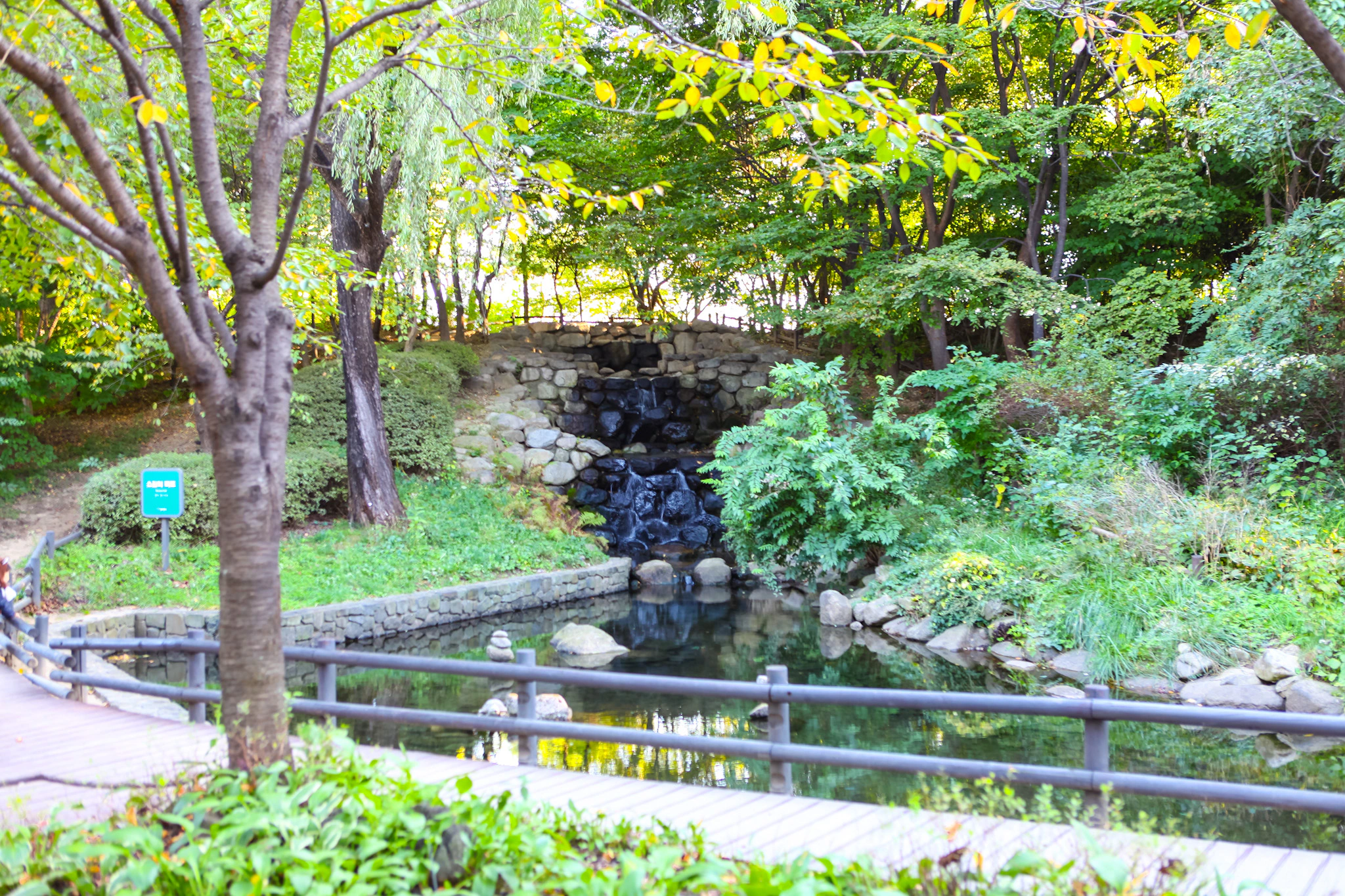
Trees surround a small stone cascade and pool, with a wooden railing across the foreground and a green sign to the left.

Trees surround a stone-lined water feature in Seoul Forest, photographed on 17 October 2021. This historical view does not show current access or water operation.

Photo: [A Fun Couple / afuncouple.com](https://www.afuncouple.com), [Flickr original file page](https://www.flickr.com/photos/192730404@N08/51627612971/), [CC BY 2.0](https://creativecommons.org/licenses/by/2.0/deed.en). Image unchanged. No endorsement implied. · Creative Commons 1 · Creative Commons 2

Walks and routes

First visit: Mirror Pond, lawn and lakeside

From the Seoul Forest Station side, enter the Culture and Arts Park and orient yourself at the main plaza. Find the horse sculpture and Mirror Pond, then follow the public paths around the family lawn toward the lakeside. Return through the garden paths, adding the playground only if your group wants it. This stays within the main park and is the easiest plan to shorten: you can leave the longer lakeside stretch for another visit. Keep the narrow pond edge clear when taking photographs.

Keep to the main paths rather than crossing the lawn or garden beds. Choose a turning point that leaves enough time and energy for the return to your starting gate.


First visit: Mirror Pond, lawn and lakeside

Gardens first, then an ecological-forest overlook

From the visitor-centre side, use the mapped Rainbow Tunnel connection toward the Experiential Learning Garden. Visit the Gallery Garden and greenhouse area while they are open, then decide whether to add the ecological-forest approach and pedestrian bridge using the signed public connections. The bridge gives a view over habitat that visitors should not enter. Return by an open, signed route to the main park; do not treat the deer enclosure or the fenced water-supply compound as a shortcut.

This extension includes the tunnel connection and an elevated bridge rather than just the central paths. Decide whether the full extension suits your group before leaving the greenhouse area.

Gardens first, then an ecological-forest overlook

A separate wetland stop

For a different view of the park, head toward the sports-area side and follow the mapped northern connection beyond Seongsu Middle and High School to the Wetland Ecology Garden. It is a distinct pocket rather than a small pond beside the main lawn. Use the public paths to look across the water and planting, then return the way you came. The 2026 Urban Garden adds a designed planting stop here; leave enough time to enjoy this area without rushing back through the main park.

Stay on the public paths and decks around the water, leaving room for people to pass. The approach is part of the outing, so allow for the return as well as time beside the wetland.

A separate wetland stop

A relaxed two-to-three-hour afternoon

Start with the main-park route and a pause by the lawn. If gardens appeal most, continue to the Gallery Garden and greenhouse before their last-entry time. If you would rather stay outside, choose the wetland stop instead. Save the ecological-forest bridge for a visit when its access and your return route are clear; you do not need to fit all four zones into one afternoon.

Things to try

Make the picnic the main event

Choose an available part of the family lawn and treat the walk as a short outing before or after lunch. A reusable lunch box and a mat suit the park better than bulky equipment. Leave circulation paths open and take your belongings and waste away when you leave.

Read the old waterworks through the gardens

The Gallery Garden retains former settling-basin structures, while the greenhouse occupies a former rapid-filtration building. Compare the straight concrete edges with the planting around them. This is a particularly good choice when someone in your group enjoys architecture more than a long walk.

Try a scheduled nature activity

The 2026 programme includes forest interpretation, gardening and biodiversity activities, with different meeting points and booking arrangements. Pick one first and build the walk around it; a programme at the wetland learning space is not interchangeable with one at the greenhouse. Use the live official listing for dates, language and available places.

Change the balance, or change the day

In light rain, a short garden walk and an open greenhouse visit may be enough. On a Monday or outside indoor opening hours, there is no dependable all-day indoor substitute within this guide. With heavy rain, thunderstorms or flooded-path warnings, postpone the wetland and river extensions rather than trying to complete a circuit.

Wildlife and habitats

Sika deer: an enclosure visit

Look from the designated public viewing areas or the ecological-forest bridge, when open. The animals may be distant or resting out of sight. The official 2026 programme lists a keeper-led deer activity; that is a separate managed experience, not permission to feed animals during an ordinary walk.

Dawn redwood: reflection and structure

The Mirror Pond is the operator’s recommended place to see reflected Metasequoia. Try a composition that includes both tree and reflection, then move aside for other visitors. The planted trees are a park feature; their presence says nothing about wild forest habitat here.

Ginkgo: a planted grove

The official park map identifies a ginkgo grove on the main-park side. It is a useful autumn destination, but colour and leaf fall vary, so avoid choosing a single date as a guaranteed peak. Keep to the path when the ground is covered with leaves.

Stories and discoveries

A wetland with an urban past

The wetland area was created from a former basin that collected local wastewater. Its water planting, paddy habitat and bird-observation facilities give that infrastructure a new educational role. The latest garden-show layout adds designed gardens alongside this ecological setting.

When to visit

Spring: flowers with a flexible plan

Cherry blossom and tulips are established spring attractions. Arrive early if photography matters, and leave yourself room to change direction when a path is crowded. The flower display is a reason to visit, not a promise of bloom on a particular weekend.

Summer: short walks and shade

Choose a shaded walk with generous pauses and carry drinking water. Check the forecast before approaching the river links: the operator’s 2026 monsoon notice allowed closures to start early or continue longer during bad weather. Never enter a closed underpass.

Autumn: trees and 2026 gardens

The ginkgo grove makes a worthwhile autumn detour. As checked on 18 October 2026, the Seoul International Garden Show is scheduled through 27 October. Its gardens and events extend beyond this park, so use the current show map for installations without mistaking the entire event area for Seoul Forest.

Winter: a smaller outdoor plan

Choose a short main-park walk and check the greenhouse’s reduced schedule before relying on it. Wet decking and shaded paths can be slippery in freezing conditions. Leave the Butterfly Garden and water-play plans for their operating season.

Getting there and practical advice

Hours that matter

The city park page lists the visitor centre at 09:00–18:00 daily; the park information number is 02-460-2905. The greenhouse normally opens 10:00–17:00, with last entry at 16:30 and Monday closure. In November–February it closes at 16:00, with last entry at 15:30; confirm the winter morning opening time before arriving early. The Butterfly Garden is listed for May–October, 10:00–17:00, last entry 16:30, closed Mondays.

Toilets, equipment and family needs

Use the visitor centre to locate an accessible toilet and nursing facilities before taking a longer extension. Wheelchair and pushchair loans are listed as free for up to two hours, with the borrower’s identification required. Equipment is not guaranteed to be available; ask about stock, collection and return time on arrival.

Fountains and indoor stops

Check that day’s fountain operation before planning water play: seasonal schedules, weather and maintenance can all affect it. The greenhouse offers an indoor visit when open, but the park as a whole is an outdoor destination.

Arrive by rail

Use Exit 4 at Seoul Forest Station on the Suin–Bundang Line, roughly a two-minute walk from the park. From Ttukseom Station on Line 2, take Exit 8, around ten minutes on foot. These are the park operator’s ordinary walking estimates. If you need a lift, follow the station’s lift signs rather than assuming the numbered exit is step-free.

Driving and buses

Use 273 Ttukseom-ro, Seongdong-gu as the park address, then navigate to the actual parking entrance rather than a pedestrian gate. The 2026 city event page lists 211 spaces, 24-hour parking and a small-car rate of KRW 200 per five minutes. Space is limited; check live availability. The same page lists bus 121 at Entrance 1, Seongdong 13 at Entrance 2, and 121, 2014, 2224 and 2413 at Entrance 3. Recheck the route and stop before travelling.

Choose a circuit, not just an accessible destination

Seoul Tourism Organization documents a level main approach, wide entrances and paths, tactile paving, accessible toilets and powered-wheelchair charging. For the wetland decks, tunnel and elevated bridge, ask the visitor centre to confirm a continuous step-free route, gradients, lift operation and the toilet you plan to use. Temporary event barriers can change the easiest route.

Keep a manageable return

If a loaned wheelchair or pushchair is essential, plan around the two-hour loan limit and the centre’s closing time. Treat the elevated forest route and wetland paths as separate access questions. Do not substitute an unsigned shortcut or a steep ramp simply because it looks shorter on a map.

Sources and useful links

Wildlife you might spot

3

Each card links to a full Explore page with photos, traits, and fun facts.

Snap map for this place

Start with the big picture, then zoom in to explore individual wildlife observations around this place.

Loading map…

Good to know before you go

Bring a picnic mat for the lawn, but leave tents and shade canopies at home; the park map prohibits them.

Use the current on-site map at the entrance. Older maps remain useful for the four-zone layout but miss newer gardens and temporary event arrangements.

Walk bicycles through the designated pedestrian-only core park paths. Follow signs for any permitted connecting cycle corridor.

Keep out of planted beds and fenced habitat, and leave flowers, fruit and leaves where they grow.

View the deer quietly from public viewing areas. Do not feed them or reach through the enclosure.

Carry water and check the weather before adding wetland or river-side paths; change plans if gates close or storms approach.

Frequently asked questions

Ordinary park entry is free. Guided activities, organised experiences and sports facilities can have separate booking requirements or charges. Check the listing for the specific activity rather than assuming every programme is included in park admission.
No. The main park is generally open around the clock, but the Ecological Forest, deer enclosure and pedestrian bridge have published hours of 05:30–21:30. The greenhouse and Butterfly Garden have daytime schedules. For the wetland area, check the entrance notice; its learning space opens for programmes, and the park’s general 24-hour statement is not a guarantee that every gate or facility is available.
The sika deer are kept in a managed enclosure. Treat a visit as animal viewing, not a wild-deer sighting or a promise of close contact. Stay on the visitor side of barriers, and join any keeper-led activity only under its current booking and welfare rules.
Dogs are allowed in the general park under the published leash and clean-up rules; use a leash no longer than 2 metres and carry waste bags. Check local restrictions before entering animal, ecological or indoor spaces. General park permission does not establish access to every enclosure or building.
Ask the visitor centre which mapped river connection is open before committing to a one-way walk. The elevated pedestrian bridge and underpass are separate options, and weather or works can affect access. If the onward connection is unavailable, return through the park by an open, signed route.

Recent snaps at this place

Recent snaps will appear here as new observations are added.

View all ›

Take the discovery with you

Exploring Seoul Forest?

Identify the wildlife you spot, learn as you go, and keep a collection of the adventure.

  1. 1Spot it
  2. 2Snap it
  3. 3Keep the discovery




