Snappit logo
Snappit
Get App
Generic illustration, not a photograph of this venueIllustration
ParkComunitat Valenciana, Spain

Serra d’Espadà Natural Park

The pleasure of Espadà is often at tree-trunk height.

About

The pleasure of Espadà is often at tree-trunk height. Thick cork bark, a patch of red rock and the sudden shade of a ravine can tell you more about these mountains than a hurried summit photograph. This is a lived-in forest landscape, shaped by cork harvesting, cultivated terraces and villages whose paths connect work, water and woodland.

For a first visit, make Eslida your information stop. The visitor centre occupies the old school building and introduces the natural landscape alongside traditional trades. Aín is a separate walking gateway: its signed Barranc de la Caritat circuit offers a compact way to connect cork woodland with old irrigation works. Travel between the two villages before starting the walk; they are not neighbouring stops on a flat park promenade.

Give the water features a closer look. An irrigation channel or mill is evidence of how people made a living here, while a damp ravine creates a different plant world from a sunny slope. Look from the public path, leave water clean and resist shortcuts into orchards or around closed buildings.

The summer 2026 fire and subsequent repair work make advance checking especially important. Road and forestry works were still being reported on 5 October. Ask the Eslida centre which approach and signed route are suitable for your date, and keep a village-and-exhibition visit as a worthwhile shorter plan. Old trail descriptions and photographs can explain the place without showing today’s conditions. Eager to name that creature? Identify any animal you find during your visit using the Snappit app.

Espadà became a natural park in 1998, protecting a landscape in which livelihoods and woodland are closely connected. Cork remains part of that relationship. Medieval settlement and castles reveal the mountains’ Islamic and Morisco past; irrigation and mills show how village life depended on water. The sierra also preserves remains of the Republican XYZ defensive line from the Spanish Civil War. Enjoy these layers from authorised routes, without entering unstable ruins or assuming every heritage structure is open.

What to do here

Begin with the Eslida exhibition and ask about the day’s restrictions. If staff confirm that the Aín route and access road are usable, follow the signed Barranc de la Caritat circuit, pausing for bark, woodland sounds and water-management remains. Finish in the village rather than adding an unplanned summit.

Seasonal info

Spring brings more woodland activity; summer makes heat, water and fire restrictions the priorities. Autumn can bring heavy rain as well as pleasant walking days. After rain, avoid swollen ravines, slippery rock and damaged slopes. Winter shade stays chilly. Forestry work and organised hunts can alter an otherwise sensible plan at any time.

Accessibility

Do not treat the Aín circuit’s short distance or low official difficulty as a wheelchair-accessibility rating. It gains height on mountain paths, and the castle approach adds awkward footing. For wheelchair users or anyone needing a step-free visit, ask the centre about its entrance, toilet, parking and a currently suitable path before travelling. An older map marks an adapted itinerary near Artana, but its present condition and facilities need specific confirmation.

Don't miss

1

Cork bark and the story of a working forest

2

Red sandstone, locally known as rodeno

3

Aín’s Barranc de la Caritat and its water-management heritage

4

Eslida’s old-school visitor centre and traditional-trades exhibition

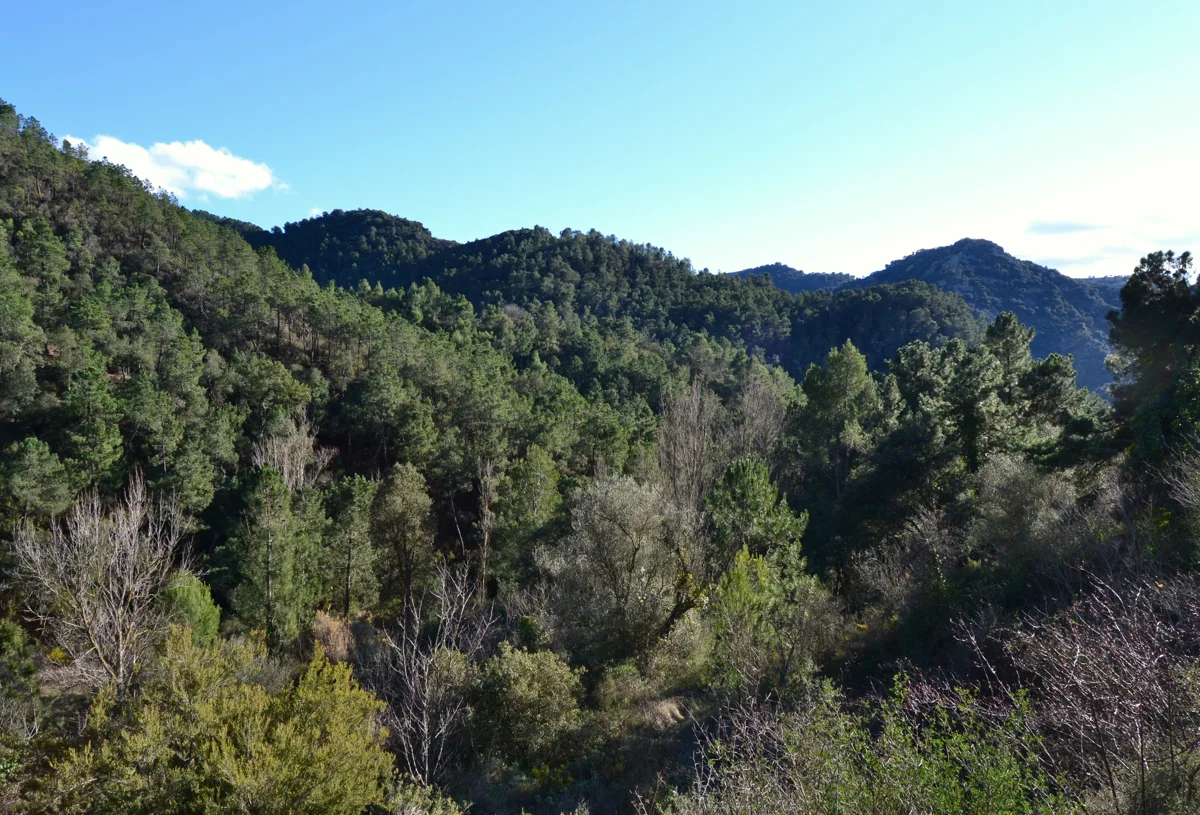
Dense woodland fills a valley and rounded mountain slopes, with bare branches in the foreground and a clear blue sky above.

Woodland in Serra d’Espadà in January 2013, before the 2026 fires. This historical view does not show present vegetation or access conditions.

Bosc de la serra d'Espadà.JPG — Joanbanjo / Wikimedia Commons / CC BY-SA 3.0 Unported · Creative Commons 1 · Creative Commons 2

Walks and routes

Barranc de la Caritat, Aín

The best fit for this first-visit plan is the signed red circuit from Aín’s Calvario area. Look for the relationship between woodland and water: the village’s mill and irrigation heritage makes the ravine more than a pretty backdrop. Stay on the signed circuit; a castle visit is optional and should not pull you onto unsuitable terrain. The official leaflet describes a circular route; return to Aín and leave longer GR or summit trails for another day.

Uneven mountain paths and ascent require secure footing. Do not plan it with a wheelchair or ordinary pushchair. Children need supervision near water infrastructure and ruins; omit the castle approach if necessary.


Barranc de la Caritat, Aín

El Castillo de Almonecir, Vall de Almonacid

A different gateway for a separate visit, centred on the castle landscape. The park’s blue circular itinerary is longer than the Aín option but has the same published total ascent. Follow the official circuit from Vall de Almonacid after checking its condition, and treat the castle as a landscape and heritage stop rather than a promise of entry into every structure.

The published distance and ascent describe a hill walk, not a step-free route. Ask about surface condition and the castle approach; do not climb walls or enter unstable sections.

El Castillo de Almonecir, Vall de Almonacid

Before travelling: confirm the centre, road and chosen walk; check fire and weather notices.

Start in Eslida: allow 30–45 minutes for the exhibition and a route conversation.

Travel to Aín only if the plan is suitable that day; use permitted village parking.

Walk Barranc de la Caritat at an observation pace, allowing 90 minutes to two hours.

Finish with food or a rest in the village, keeping enough time for your return transport.

Confirm opening and any access needs with the Eslida centre.

Make the exhibition the main visit and ask staff to explain the cork landscape.

Add only a village wander that suits your mobility and the weather; you can stop whenever you want.

Save the forest route for a day when conditions and energy are right.

Things to try

Read a tree without taking anything

Compare rough cork bark with the smoother-looking sections left by harvesting. Ask at the exhibition how cork is removed and renewed, then look for the signs from a public path. Leave the bark alone and give workers plenty of room.

Be water detectives in Aín

Trace the idea of water moving from hillside to channel, storage pool and mill. Ask children which parts look natural and which were made by people. Look from the path: working channels and pools are not places to paddle or scramble.

Try a woodland listening stop

Choose a safe stopping place on the path where others can pass, stand quietly and count different sounds for a minute. A harsh jay call may be easier to notice than the bird itself. Binoculars help, but you can enjoy the exercise without identifying everything.

Save the longer circuits for another day

The official network also includes Barranco de Ajuez from Chóvar, 10.4 km with 480 m ascent, and L’Arquet from Alfondeguilla, 5.7 km with 180 m ascent. The yellow Villamalur–Pavías–Matet itinerary is a 23.8 km mountain-bike circuit with 740 m ascent. Choose these only after checking current access and your group’s experience; they are not additions to a short Eslida morning.

Make the exhibition the main event

If rain makes the trails unattractive, confirm that the Eslida centre is open and spend more time with the cork and traditional-trades story. In a serious weather alert, avoid driving into the mountains just to salvage the outing; postpone it.

Wildlife and habitats

Cork oak

The tree to make time for is cork oak, Quercus suber. Its thick bark is the starting point for the park’s forestry story. Look at the trunk from the path and compare what you see with the centre’s explanation; never prise bark from a tree.

Two woodland pines

Maritime pine, Pinus pinaster, and Aleppo pine, Pinus halepensis, are documented in the park’s forests. Photograph needles, cones and the overall tree from the path for a later identification check. A forest record alone does not tell you whether a particular tree was planted or naturally regenerated.

Eurasian jay

Listen for a rough, conspicuous call, then look for a pinkish-brown bird with a flash of blue in the wing. Jays carry and bury acorns, a lovely connection to make while looking at the oaks.

Eurasian nuthatch

Watch tree trunks for a compact bird working along the bark, sometimes headfirst downwards. Blue-grey upperparts and a dark eye stripe help distinguish it. Wait quietly rather than following it into the undergrowth.

Let the wildlife set the pace

These are documented parts of Espadà’s woodland community, not guaranteed sightings. Fire and woodland work can change habitats locally. Enjoy what is present on your open route, keep your distance and avoid feeding, playback or searching for nests.

Stories and discoveries

Why the red rock matters

The sandstone known locally as rodeno helps explain why these woods differ from nearby limestone country. Look for changes in rock colour and vegetation as a prompt to ask questions, without leaving the path to collect samples.

A protected place can still be a workplace

Cork management, farming and conservation share this landscape. A natural-park boundary does not turn a private grove into a public garden. The most useful visitor habit is simple: stay with the signed public route and leave forestry operations undisturbed.

When to visit

Spring

Choose a calm morning for listening and close-up observation. Keep to paths around new growth and give nesting birds space; shorten the visit if heat arrives early.

Summer

Keep walks short, carry ample water and favour an early start when access is allowed. Check the fire-risk notice and any additional restrictions for that exact day. If walking is restricted, choose a permitted indoor or village visit rather than searching for another forest entrance.

Autumn and winter

Mild days can be excellent for a slower woodland visit. Wet leaves and rock change the footing, while heavy rain can make ravines and damaged slopes unsafe. Check hunts and forestry work before choosing the route, and return before daylight fades.

Getting there and practical advice

Eslida visitor centre

Francisco Mondragón, 2, 12528 Eslida, in the former school building on the Aín road. There is a permanent exhibition and audiovisual space, with free entry listed in the park brochure. The administrative directory gives 09:00–14:00 Tuesday–Sunday; phone +34 964 715 750 because other listings differ and staff may be working outside. Email: [email protected].

Toilets, food and water

Use village toilets before you set out, and ask which ones are open and whether an accessible toilet is available. Plan to complete either walking circuit without a toilet stop. Carry enough drinking water instead of relying on springs, and check village opening times if you are counting on a meal.

Parking and picnic stops

Use signed permitted spaces and leave access clear. The park map shows recreation and picnic areas, but a symbol does not establish a working toilet, drinking-water tap or permission to barbecue. A cold picnic is the simplest choice; take your waste away.

Arriving by road

For the Eslida–Aín visit, the CV-223 is a key approach through the eastern side of the park. Confirm the usable route before leaving, especially while repairs affect CV-223 and CV-219. Drive patiently on mountain roads, allow for works, and follow signed diversions rather than a navigation app’s forestry-track shortcut.

HICID route 365

Route 365 connects Castelló, Betxí and Eslida, with selected journeys to or from Aín. Its current linked sheet separates school weekdays, non-school weekdays and working Saturdays. Aín’s marked on-demand journeys require a request at least 24 hours ahead, by calling +34 964 200 122 or emailing [email protected] during 08:00–14:00. Confirm acceptance and return options directly. The sheet has no Sunday/holiday timetable; Saturday service from Castelló reaches Eslida close to the centre’s listed closing time.

Make a car-free day realistic

Check the journey for your actual date before choosing a walk. Eslida and Aín are separate villages, and the published bus does not provide a frequent sightseeing shuttle between them. If the timetable leaves too little time, arrange an overnight stay or pre-booked transfer, or make the centre and Eslida your whole visit.

For a step-free visit

Call before travelling and ask specific questions: is there step-free access from the drop-off or parking place into the exhibition, is there an accessible toilet, and is seating available? Explain your equipment and how far you are comfortable walking so staff can suggest a realistic visit.

On woodland paths

Neither recommended hill circuit is presented here as wheelchair-accessible. Total ascent, uneven ground and conditions after rain matter more than the label “easy”. The old park map’s adapted-route symbol near Artana needs a fresh check of surface, barriers, parking and current post-fire access before making it the basis of a trip.

Visitor information

Check your route after the summer fire

Reports dated 5 October 2026 described ongoing post-fire road and forestry works, including CV-219 and CV-223. Before travelling, ask the park centre about your exact approach and walking circuit. If that route cannot be confirmed, choose the exhibition and village visit or postpone the woodland walk. Follow local barriers and emergency advice.

Sources and useful links

Wildlife you might spot

4

Each card links to a full Explore page with photos, traits, and fun facts.

Snap map for this place

Start with the big picture, then zoom in to explore individual wildlife observations around this place.

Loading map…

Good to know before you go

Call the Eslida centre on +34 964 715 750 before setting out. Ask about the exact road and trail, including post-fire work and hunting notices.

Check the dated Generalitat fire-risk bulletin and any access orders for your day. Follow closures on the ground; do not go around tape, forestry machinery or a hunting warning.

Carry your own drinking water and a cold picnic. A marked spring is not a promise of safe water or year-round flow, and a picnic area does not mean you may light a fire.

Use shoes with grip and keep children close beside channels, pools, steep edges and ruins. Skip any optional castle climb if the footing, heat or group’s energy is wrong.

Follow the official route signs and carry the route information offline. Other marked trails leave the same villages and may be much longer than your chosen circuit.

Park only where permitted, leaving village streets, farm entrances and emergency access clear. Keep to public paths and respect gates and private forestry land.

Keep dogs on a lead. Watch birds quietly, leave bark, cones, flowers and fungi in place, and take all litter home.

Plan the return journey before boarding a bus. School-day, non-school-day and Saturday services differ, and Aín’s on-demand journeys need advance arrangement.

Frequently asked questions

At the visitor centre in Eslida, at Francisco Mondragón, 2, on the Aín road. It is the place to check a manageable walk and current access. Aín is a separate starting point for the Barranc de la Caritat circuit.
The Generalitat directory checked on 17 October 2026 lists 09:00–14:00, Tuesday–Sunday. Another official tourism page lists daily opening and warns that staff may be out on activities. Call +34 964 715 750 to confirm, particularly for Monday or a special journey.
The park brochure lists free entry to the centre. Ask in advance if you are organising a group, want an activity or need particular access arrangements. Check with the centre whether your chosen walk needs any advance arrangements; temporary restrictions can still prevent a visit.
Its official 3.7 km circuit is a manageable choice for children used to uneven paths and some climbing, once staff confirm access. Build in breaks and treat any castle detour as a separate decision. It is not a pushchair circuit.
HICID route 365 links Castelló with Eslida, with limited Aín services. Check the correct school/non-school timetable and both directions. The published Saturday arrivals leave little time for the centre before 14:00; do not assume a useful Sunday connection.
Keep this visit to looking and listening. Irrigation pools are working infrastructure, springs are not guaranteed drinking-water supplies, and bark belongs on the tree or to the forestry operation. Bring water and leave natural materials in place.
Check the precise route before travelling. Reporting on 5 October 2026 described continuing road repairs and forestry work, including the CV-219 and CV-223. A village reopening or an old trail listing does not tell you whether a particular footpath is ready for visitors.

Recent snaps at this place

Recent snaps will appear here as new observations are added.

View all ›

Take the discovery with you

Exploring Serra d’Espadà Natural Park?

Identify the wildlife you spot, learn as you go, and keep a collection of the adventure.

  1. 1Spot it
  2. 2Snap it
  3. 3Keep the discovery