Snappit logo
Snappit
Get App
Generic illustration, not a photograph of this venueIllustration
ParkTohoku, Japan

Towada-Hachimantai National Park

Start beside the water at Yasumiya, where Lake Towada gives you a gentle introduction to a very large national park.

About

Start beside the water at Yasumiya, where Lake Towada gives you a gentle introduction to a very large national park. The national park stretches across Aomori, Akita and Iwate, with Towada–Hakkoda in the north and Hachimantai farther south. For this visit, stay around Towada Visitor Center and the southern lakeshore. You can enjoy the lake, a short walk and some nature learning without fitting mountain roads and distant trailheads into the same day.

Inside the visitor center, use the caldera model to get your bearings before looking out over the real lake. The exhibitions connect Lake Towada with Oirase Stream and the Hakkoda Mountains; bird models and seasonal films give younger visitors something specific to look for outside. The observation lounge is also a useful pause when the weather turns. The lake occupies a volcanic depression shaped by repeated eruptions and collapse, and reaches about 327 metres at its deepest point. From the shore, that hidden depth is hard to picture.

Follow the signed lakeside walk toward Gozengahama and the Otome no Zō, the Maiden Statue. Aomori's visitor information puts the statue about 15 minutes on foot from the Towadako (Yasumiya) bus stop, but allow longer to stop and look. Close to shore, Ebisu-Daikoku Island is a small outcrop of volcanic rock with trees above the water. Near the statue, fractured rock shows how cooling lava can split into columns. These are good details to notice before turning back, especially if a long woodland walk would be too much.

The paired bronze figures at the end of the shore walk were created by sculptor and poet Kōtarō Takamura in 1953. If the paths are open and everyone has energy left, the wooded connection toward Towada Shrine adds a change of mood: large deciduous trees replace the broad lake view. Keep the steep lookout steps as a separate decision rather than an automatic continuation. The old ladder route down to the fortune-telling place is closed to entry.

Look between the lake and the trees as you walk. Eurasian nuthatches and great spotted woodpeckers belong to the lakeshore woodland, while winter brings diving ducks such as tufted ducks and common pochards onto the water near Gozengahama. Binoculars are more useful than trying to get close, and sightings are never certain. Leave food packed away and give all wildlife room.

If you'd like more lake scenery without another walk, consider a seasonal sightseeing cruise from Yasumiya. The round-trip peninsula cruise brings you back to the same departure area; the Nenokuchi service is a one-way journey and needs a return plan. Oirase Gorge starts at Nenokuchi, elsewhere on the lakeshore. Treat it as a separate outing, with its own transport and walking time, rather than a short extension of the Yasumiya stroll. Take the ultimate field guide with you: use the Snappit app to identify birds, plants, and animals on your trip.

The Towada area became Towada National Park on February 1, 1936. Hachimantai was added on July 10, 1956, giving the park its present name. The Maiden Statue was erected in 1953 as part of a commemorative project honouring people who helped bring wider recognition and national-park protection to Lake Towada. Towada Shrine represents an older layer of the landscape’s history: the local park association describes its role as a place of mountain ascetic practice before the Kamakura period and a spiritual site under the Nanbu domain in the Edo period.


What to do here

Begin at Towada Visitor Center, then choose a short out-and-back walk along Gozengahama toward the Maiden Statue. Compare the lake model with the landscape, pause for volcanic rocks and woodland birds, and return for a meal in Yasumiya. Add the forest approach to Towada Shrine only after checking the paths, or choose a seasonal round-trip cruise if you want a longer lake view. Plat, the separate tourism exchange center, has local-history displays and a living himemasu fish exhibit.

Seasonal info

Winter changes the visit substantially: snow and ice affect walking, some mountain roads close, and regular sightseeing boats are seasonal. Bus schedules also change, so do not assume a summer connection runs in winter. Autumn foliage and the first snow vary by year. For winter birdwatching, use only a safely accessible, open lakeshore viewpoint and dress for cold wind off the water.

Accessibility

For a visit with a wheelchair or stroller, start by asking the visitor center which lakeshore sections suit you that day. Plat explicitly lists ramps, an elevator and wheelchair/ostomate-compatible toilets. The shore, forest link and shrine approaches are different surfaces and routes; do not assume they form a continuous step-free circuit. Skip the steep lookout steps if they do not suit your group, and check boat boarding arrangements directly before buying tickets.

Don't miss

1

Get the shape of the volcanic lake straight with the visitor center’s caldera model, then compare it with the view outside.

2

Stroll beside Gozengahama to the Maiden Statue, noticing the little lava island and fractured shore rocks along the way.

3

Watch for woodland birds in the trees and, in winter, diving ducks on the lake.

4

Choose a seasonal Yasumiya round-trip cruise for a different view of the wooded peninsulas.

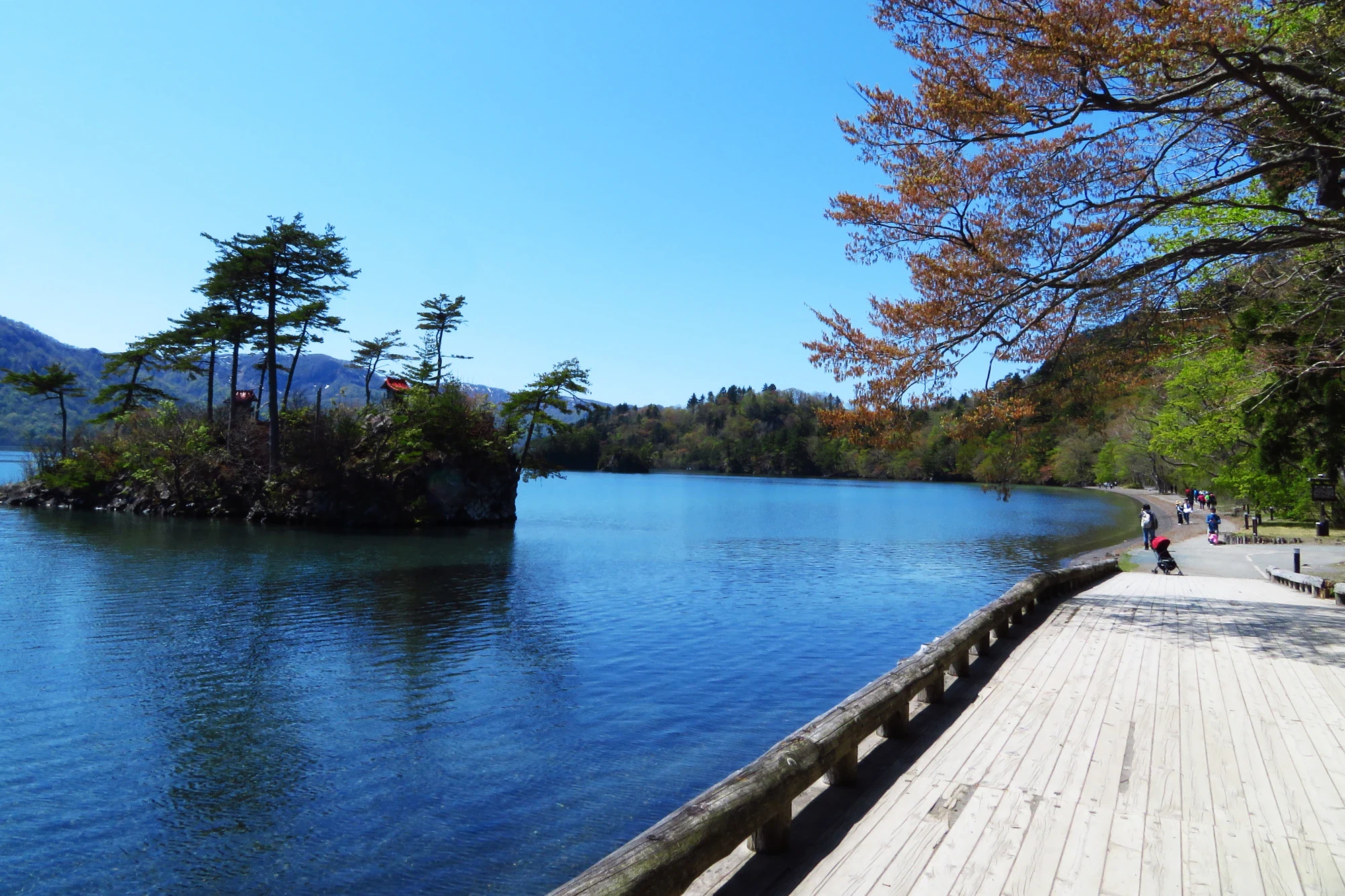
A wooden lakeside walkway curves beside blue water, with a small tree-covered rocky island on the left and distant walkers along the wooded shore on the right.

The Yasumiya lakeshore curves past Ebisu-Daikoku Island on Lake Towada. Photographed on 12 May 2019.

Towadako Yasumiya 01.jpg — Marho, CC BY-SA 4.0 (https://creativecommons.org/licenses/by-sa/4.0/). Source: https://commons.wikimedia.org/wiki/File:Towadako_Yasumiya_01.jpg. Resized and recompressed as WebP; no crop or retouching. · Creative Commons

Walks and routes

Visitor center and Gozengahama out-and-back

After asking about current paths, follow the shore toward Gozengahama and the Maiden Statue. Pause for the lake and return the same way whenever your group is ready. The forest connection toward Towada Shrine is an optional addition; leave the lookout climb out of the basic walk.

Ask staff about the surface, slopes and any obstacles on the exact section you plan to use. A short out-and-back lets you turn around without committing to the shrine approaches.

Visitor center and Gozengahama out-and-back

Optional separate outing: Nenokuchi to Choshi Otaki

Travel to Nenokuchi separately, then follow the open signed river path toward Choshi Otaki. For an unhurried return on foot, set aside 1–1.5 hours on the trail, plus transport and waiting time. If using different bus stops at each end, check the onward service first.

Treat this as a woodland riverside walk. Ask locally about bridges, uneven ground and any detours before choosing it for a wheelchair or stroller.

Optional separate outing: Nenokuchi to Choshi Otaki

Get oriented

Spend roughly 30–45 minutes in the visitor center and ask about today’s paths.

Walk the shore

Allow roughly 45–75 minutes for Gozengahama, the statue and your return, with as many pauses as you like.

Take a break

Use the remaining time for lunch in Yasumiya or a stop at Plat. Keep a comfortable margin before your bus.

Keep the day flexible

If wind or rain makes the shore uncomfortable, spend longer indoors and shorten the walk. A boat trip depends on the operator’s weather decision. Oirase is worth saving for another day when transfers or path conditions would make this one rushed.

Things to try

Turn the model into a landscape puzzle

In the visitor center, find the lake’s outline and peninsulas on the model. Outside, ask everyone to choose one feature they can recognise in the view. It gives the shore walk a simple purpose without needing a long hike.

A slow shore walk

Choose a few stops rather than a distance target: the small lava island, a patch of fractured rock and the paired bronze figures. Look from the permitted path; there is no need to climb onto shoreline rocks.

Take the peninsula round-trip cruise

Choose the Yasumiya-to-Yasumiya service for the simplest return. The 2026 operator timetable gives about 50 minutes on board. Check the sailing period and weather status; allow extra time for ticketing and boarding.

Meet the lake’s human history at Plat

Stop at the separate tourism exchange center for displays about people connected with Lake Towada and the living himemasu exhibit. It makes a useful indoor complement to the national park visitor center.

Visitor center plus Plat

Use the lake-view lounge, exhibits and films, then add local history and the fish display at Plat. Confirm that both facilities are open before making this your whole plan.

Wildlife and habitats

Eurasian nuthatch

Lakeshore woodland at Yasumiya / Gozengahama

Great spotted woodpecker

Lakeshore woodland at Yasumiya / Gozengahama

Tufted duck

Open water near Gozengahama

Common pochard

Open water near Gozengahama

Asian black bear

Lake Towada surroundings; Yasumiya specifically named by the city safety notice

Stories and discoveries

A deep lake beneath a quiet surface

Lake Towada reaches about 327 metres at its deepest point. The visitor center’s model and a boat trip offer two ways to make sense of its volcanic form.

Rock records cooling lava

The column-like fractures beside the shore are joints formed as lava cooled and solidified.

Two anniversaries in one park

The Towada section was designated in 1936; Hachimantai joined in 1956. That history helps explain why the park has two distinct travel sectors.

When to visit

spring

Choose fresh foliage and a flexible short walk. Check which roads and seasonal boat services have reopened; the lake can still feel chilly.

summer

Pair indoor nature learning with a shore walk and shade in the trees. Carry a layer for the water and leave room for a longer lunch stop.

autumn

Enjoy colour around the lake, with your return transport arranged in advance. Check current bear warnings, weather and any visitor-traffic measures for your date.

winter

Plan around snow, ice, shorter outdoor stops and confirmed transport. Winter waterbirds can be interesting from an open shore viewpoint, but a summer walking plan is not a winter route.

Getting there and practical advice

Towada Visitor Center

Nature exhibits, seasonal films, a lake-view lounge and a children’s corner. Published opening is 09:00–16:30; entry is free. A changing table is listed, but no nursing room or stroller rental.

Towadako Tourism Exchange Center Plat

Tourist information, local-history displays, a living himemasu exhibit and a free rest area. The listing gives 09:00–17:00; check seasonal arrangements.

Yasumiya village services

Restaurants, accommodation and souvenir shops are concentrated around this southern lakeshore base. Check opening days before relying on a particular meal stop, especially outside the main visitor season.

JR Bus Tohoku to Towadako (Yasumiya)

Use the operator’s date-specific Mizuumi-go / Oirase-go timetable. Hachinohe departures require an online reservation from the west-exit starting stop; the 2026 notice says return journeys are unreserved. Save the last usable return before you choose a walk or cruise.

Drive to Yasumiya with a seasonal road check

Use current Aomori road information and your accommodation’s directions in snowy months. Seasonal closures affect particular mountain and old-road sections; an open route into Yasumiya does not mean every scenic road around the lake is open.

Yasumiya North parking trial

The announced trial runs September 5, 2026–February 28, 2027. Ordinary cars cost JPY500 per 24 hours. The notice provides 24-hour gate operation in September–November, but limits winter entry in December–February to 08:00–16:30. Check posted terms for changes.

Separate transfer for Oirase

Nenokuchi is a different lakeshore stop. Reach it by a suitable bus or seasonal one-way boat, then allow separate time for the river walk and return. A one-way cruise is not the same ticket or itinerary as the Yasumiya round trip.

Ramps, an elevator and wheelchair/ostomate-compatible multipurpose toilets are explicitly listed. Contact the facility for equipment dimensions or assistance needs.

Ask about the entrance, toilet facilities and today’s most suitable shore section before setting out. Plan an out-and-back with a turnaround that fits your group.

The lookout approach has steep steps. Ask the boat operator about boarding assistance and the particular vessel before purchasing a ticket.

Sources and useful links

Wildlife you might spot

5

Each card links to a full Explore page with photos, traits, and fun facts.

Snap map for this place

Start with the big picture, then zoom in to explore individual wildlife observations around this place.

Loading map…

Good to know before you go

Check bear notices before walking. Towada City reports a bear-injury incident at Yasumiya in August 2026, and Aomori’s alert runs through November 30, 2026. Ask staff which paths are open and avoid areas with recent sightings.

In woodland, walk together and make your presence known. Never approach a bear or cub; if you encounter one, keep calm, back away slowly and do not run. Carry out all food and rubbish.

Book the Oirase-go in advance if boarding at Hachinohe Station’s west exit. The 2026 operator notice requires an online reservation there, including for rail-pass users; return journeys from Lake Towada are unreserved.

Bring shoes with grip and a windproof or waterproof layer. Wet leaves, rain and later-season ice can make a short walk more demanding.

Leave time for the visitor center

its published hours are 09:00–16:30, with Wednesday closures outside the late-April–late-May and late-July–late-October daily-opening periods, plus December 29–31. Confirm holiday and winter arrangements before travelling.

Keep bicycles out of the Gozengahama walking area and stay outside all closed paths, including the ladder route below Towada Shrine.

For a boat trip, check whether your ticket returns to Yasumiya or ends at Nenokuchi. Fog or strong wind can change or cancel sailings.

Use designated parking and read the gate conditions. Yasumiya North’s 2026–27 trial charges ordinary cars JPY500 per 24 hours; winter entry hours are shorter than the autumn arrangement.

Frequently asked questions

Yasumiya on the southern shore of Lake Towada, centred on Towada Visitor Center and the Gozengahama walk. Hachimantai, Mount Iwate and the higher Hakkoda trails need separate travel and route planning.
Yes. Spend time in the visitor center, then walk as far along the shore as suits your group and return the same way. A seasonal round-trip sightseeing boat is another way to extend the visit without adding a forest hike.
Yes, the published admission is free. Parking, meals and boat trips are separate costs.
Seasonal JR Bus Tohoku services reach Towadako (Yasumiya), close to the visitor center. The Oirase-go from Hachinohe requires an advance reservation when boarding at Hachinohe’s west exit. Check the date-specific timetable and your return service before setting out.
No. Travel separately to Nenokuchi or another Oirase stop. For a shorter option, the official Nenokuchi–Choshi Otaki segment is about 1.5 kilometres and 30 minutes one way; allow longer for stops and arrange your return. The full gorge is about 14 kilometres.
Use the visitor center’s exhibitions and lake-view lounge, then visit Plat for local history and its fish display if it is open. Keep any shore walk short, and choose the boat only if the operator confirms suitable conditions.
Ask about the exact shore section you want to use. Plat lists accessible facilities, but the woodland and shrine routes include different terrain and steep steps toward the lookout. Check the visitor center, toilets and boat boarding arrangements for your individual needs.
It is better to choose one sector. A relaxed Lake Towada visit fills a useful half-day, and Oirase can take the rest of the day once transfers are included. Hachimantai is a separate travel area farther south.

Recent snaps at this place

Recent snaps will appear here as new observations are added.

View all ›

Take the discovery with you

Exploring Towada-Hachimantai National Park?

Identify the wildlife you spot, learn as you go, and keep a collection of the adventure.

  1. 1Spot it
  2. 2Snap it
  3. 3Keep the discovery