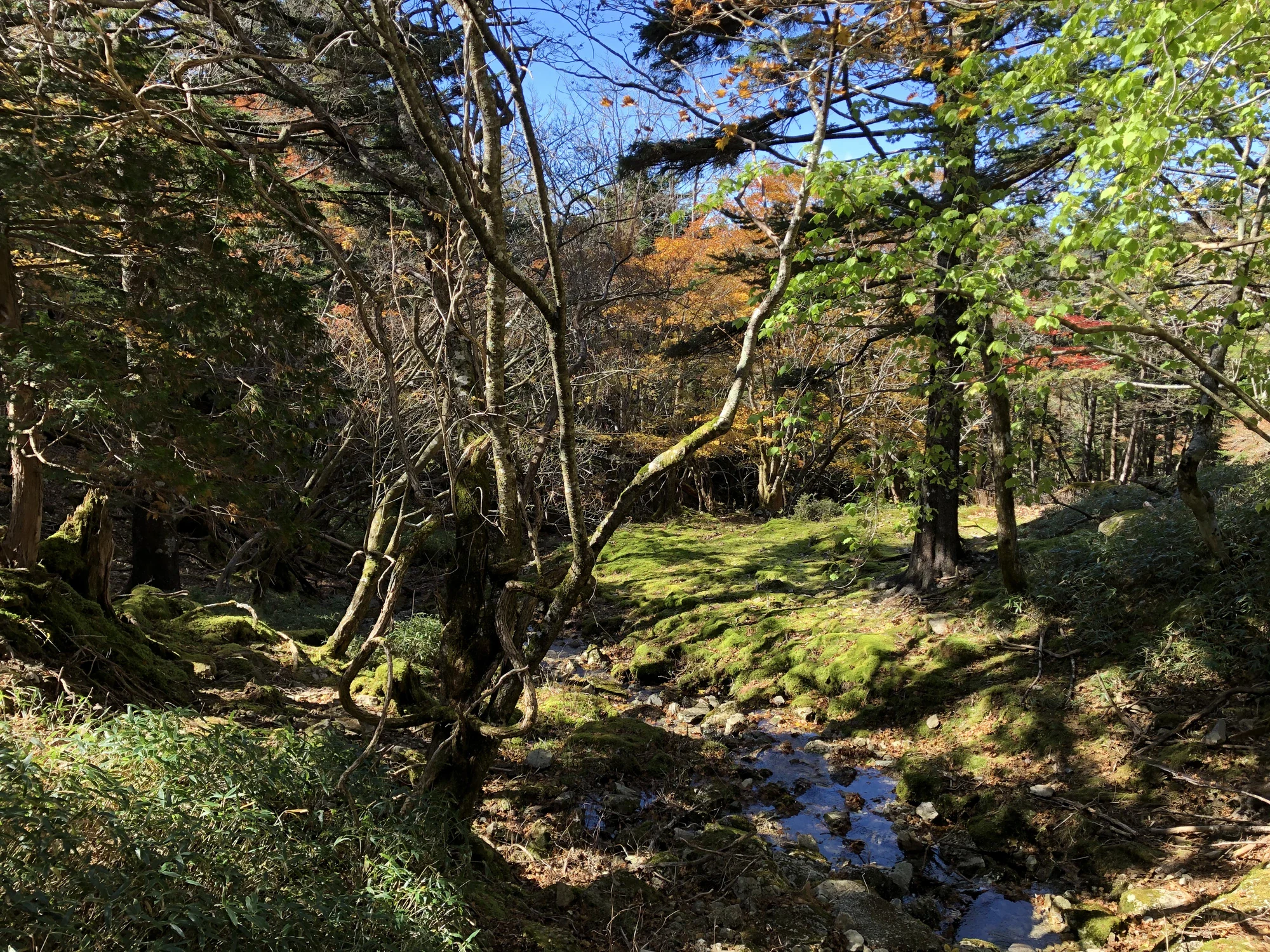
Yoshino-Kumano National Park reaches across mountains, rivers and coastline in Mie, Nara and Wakayama. For one nature outing, choose the Odaigahara plateau near the Nara–Mie border. Its visitor center and eastern trails give you a focused introduction to the mountain forest. The Kumano shrines, pilgrimage paths and coast are other journeys; they are not stops on this walk.
Start inside Odaigahara Visitor Center. The leaf-identification displays, moss exhibits and animal-footprint stamps turn an unfamiliar forest into something you can begin to read. Spend a little time on the conservation displays, too. They explain why some open, grassy views here are evidence of a changing woodland. Before leaving, ask staff about the weather, trail surfaces and latest bear notice, and choose a return time that comfortably fits your transport.
For a first visit in suitable conditions, follow the signed eastern trail toward Mount Hidegatake, the plateau’s 1,695 m high point, then return the same way. This keeps the outing simpler than a full circuit and lets you turn back whenever your group needs to. The wooded approach is worth enjoying slowly: look at bark, leaves and damp fallen wood from the trail, and listen for birds between the sounds of other walkers. The final approach involves steps. On a clear day the outlook reaches across surrounding ranges toward the Kumano Sea; cloud can remove that view completely.
With more time and confident walkers, Masaki Pass offers another part of the story. Wooden paths lead through an open landscape of bamboo grass and weathered tree remains. Boardwalk renewal is underway in 2026: the section toward Masaki uses a signed temporary path with earth, exposed roots and steps, so follow the current diversion rather than expecting continuous boardwalk. Severe typhoons opened the forest canopy; grass spread, while deer browsing and bark damage made recovery harder. The protection fences are helping young trees survive. Rather than looking only for a dramatic photograph, compare the vegetation you can see inside and outside a fence, without entering it or leaving the boardwalk.
The famous Daijagura rock lookout belongs to a more demanding choice. Its exposed rock stands above a very deep drop, and the longer eastern circuit continues down toward Shiokara Valley before a strenuous climb back to the parking area. A chain barrier does not make a cliff suitable for every child or anyone uncomfortable with heights. Skip this spur in wet, windy or poor-visibility conditions, and do not add the valley loop just because it appears to return to your starting point.
There is plenty to notice without reaching every landmark. A Eurasian nuthatch may work its way down a trunk headfirst; a jay’s rough call can reveal a bird you never see. Stairstep moss makes miniature tiers as new growth rises from older stems. Sika deer belong to this landscape, but the more dependable discovery is their effect on the forest. Enjoy animals from a distance, leave moss and fallen leaves in place, and let an ordinary stretch of woodland be part of the day. Explore the grounds like a pro—download the Snappit app to instantly identify animals and plants.
Yoshino-Kumano National Park was designated on 1 February 1936. Its wider landscape includes mountain sacred sites and sections of pilgrimage routes, alongside river and coastal environments. Odaigahara tells a natural-history story of its own: high ground preserved cold-climate conifer forest as the climate warmed after the last glacial period. Large typhoons in 1959 and 1961 damaged the canopy, and interacting changes in vegetation and deer pressure contributed to later forest decline. Today, protective fencing and other restoration work help the next generation of trees establish.