Snappit logo
Snappit
Get App
Generic illustration, not a photograph of this venueIllustration
ParkBretagne, FR

Cap d’Erquy–Cap Fréhel Grand Site

The pleasure here is the contrast between a broad, low heath and the sudden drop to the sea.

About

The pleasure here is the contrast between a broad, low heath and the sudden drop to the sea. At Cap Fréhel, look across to the offshore rocks from the designated belvédère rather than trying to peer over an edge. In the breeding season, binoculars turn distant marks on the cliffs into a busy colony. Outside it, the shape of the headland, the light on the rock and the two lighthouse towers still give the visit a clear focus.

Cap d’Erquy offers another way into the same landscape: the Sentier des Carriers explains how the stone beneath your feet became paving for distant streets. The Lacs Bleus occupy former quarries above the harbour. Choose this side when industrial history appeals more than bird identification, or save it for a second half-day. Neither headland needs to be the starting point for an all-day coastal march. Explore the grounds like a pro—download the Snappit app to instantly identify animals and plants.

Both caps tell a working-coast story. At Erquy, quarry workers cut sandstone above the port and sent the finished stone out by sea. At Fréhel, successive lights helped ships navigate this exposed coast: the surviving Tour Vauban dates from 1702, while the current lighthouse entered service in 1950 after the preceding tower was destroyed during the Second World War. Conservation adds a newer chapter, with visitor routes and landscape restoration designed to keep the headlands open without wearing away their habitats.

What to do here

Make La Fauconnière your main stop at Cap Fréhel: walk from the designated parking area using the signed paths, spend time watching the cliff faces from the belvédère, and return before anyone gets cold or tired. Add a lighthouse visit only if it is open and your group wants the climb. A separate outing on the Sentier des Carriers at Erquy brings quarry history and views over the port.

Seasonal info

Summer brings heavier parking pressure. In autumn and winter, fit the outing comfortably within daylight and expect fewer breeding birds at the cliff colony. Wind and the day’s access notices matter more than the season alone.

Accessibility

The published accessible approach reaches the lighthouse area from the parking, but it does not make the cliff paths wheelchair-accessible. For a pushchair, wheelchair or reduced stamina, plan the lighthouse approach as a separate outing and check its current condition with Plévenon mairie.

Don't miss

1

The La Fauconnière belvédère facing Cap Fréhel’s seabird rocks

2

The old and modern lighthouse towers on the same headland

3

Pink sandstone and the Lacs Bleus quarry landscape at Cap d’Erquy

4

Heathland that changes with soil moisture, flowering and grazing

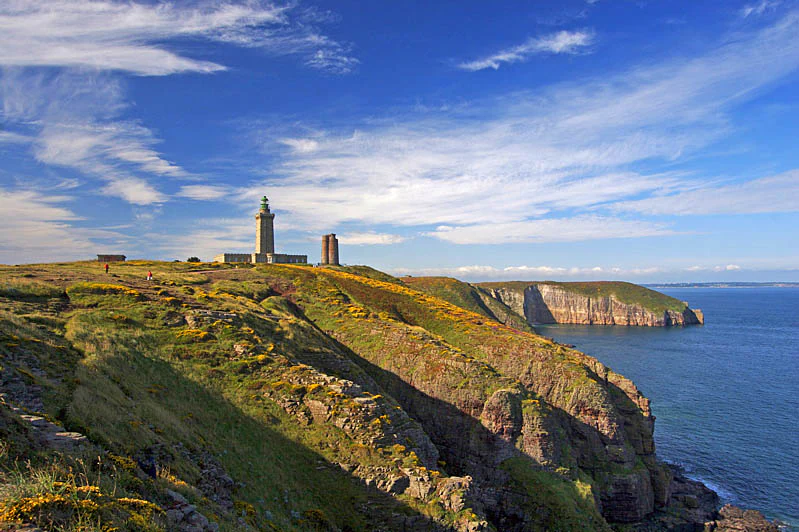
Yellow-flowered heath covers cliffs above blue sea, with two lighthouse towers beneath streaked clouds.

Historic view of Cap Fréhel’s cliffs and lighthouse, uploaded in February 2008; the capture date is unknown. It predates the July 2026 fire and does not show current vegetation or access conditions.

“Morning Light on Cap Fréhel (France)” — Jean-Marie Hullot, CC BY-SA 2.0. Source: https://www.flickr.com/photos/32856635%40N00/2271122071/. License: https://creativecommons.org/licenses/by-sa/2.0/. Original photograph unchanged. · Creative Commons

Walks and routes

Cap Fréhel: La Fauconnière belvédère

Use the designated Cap Fréhel parking area and the current signed pedestrian paths to make a short outing to the La Fauconnière belvédère, the manager’s recommended place to look towards the seabird islets. Pause there, then return by the permitted approach. Keep the visit on the headland: there is no need to continue towards Fort La Latte. The official visitor leaflet also shows short headland loops, but choose the open signed option on the day rather than following an old map across a diversion.

Exposed, uneven cliff-top walking. The lighthouse’s accessible approach is not proof that the belvédère or the paths beyond it suit a wheelchair or pushchair. Shorten the outing before the surface or wind becomes uncomfortable.


Cap Fréhel: La Fauconnière belvédère

A manageable first visit

Check wind and access notices before leaving. Arrive with drinks and a snack, read the signs at Cap Fréhel, then make La Fauconnière the main destination. Give birdwatching its own unhurried stop. Decide afterwards whether to add the lighthouse, rather than promising the climb in advance. Finish in Plévenon for a break. If everyone still wants more coast, plan Cap d’Erquy for another half-day instead of extending along the restricted coastal section.

Things to try

Watch a colony without disturbing it

Choose a comfortable position at the belvédère, find the rocks with the naked eye, then raise the binoculars. Let children describe a bird’s shape or position before naming it. Keep voices low and avoid any attempt to draw birds closer. During nesting season, watch from land; the manager specifically asks boats to avoid the gap between the Fauconnière islets from February to 15 July.

Follow the quarry story at Cap d’Erquy

The Sentier des Carriers runs by the Lacs Bleus above Erquy’s port. Its interpretation gives the stone, quarry remains and sea views a shared story. The port approach described by the tourism office starts with a wooden stairway and a climb, so choose it for walkers comfortable with steps. Keep this as its own outing rather than adding an unplanned headland circuit at the end.

Go with a Grand Site guide

The Grand Site offers nature and heritage outings, including family activities and visits focused on the two caps. A guide can make distant birds or apparently similar heath plants easier to understand. Look at the current programme for the exact location, age range and booking arrangements: activities across this large destination do not all meet at the lighthouse.

When the headland weather is wrong

Strong wind is a good reason to postpone the cliff-top walk. The lighthouse is not a dependable bad-weather refuge because visits depend on conditions. Use the break to choose another slot and check the Grand Site’s programme; a scheduled heritage or exhibition visit may fit, but confirm its location and opening before travelling.

Wildlife and habitats

Common guillemot

Look for tightly grouped birds on narrow horizontal ledges. The common guillemot is one of the colony’s characteristic breeding birds. Watch from the belvédère with binoculars; the most useful observation is often the birds’ comings and goings rather than a close view.

Razorbill

Compare its stockier outline and deep bill with the guillemots nearby. A white line crosses the bill, but it may be too distant to resolve. A scope or a guided birdwatching session can help without bringing you closer to the nesting rocks.

Black-legged kittiwake

This breeding gull uses steep cliff faces. Its black legs are an identification clue when the view is good. Spend a moment looking at where different birds settle: the rock face offers many small nesting sites that are invisible in a quick panorama.

European shag

The shag is another recorded breeder at Cap Fréhel. Include it in your search across the rocks, but do not label every distant dark seabird a shag. A field guide is useful for checking an uncertain identification back from the cliff edge.

Common heather

At Cap d’Erquy, look from the path for the tiny, closely overlapping leaves and small pink flowers of calluna. It is one of several heath plants described here. Their different moisture preferences help explain why the vegetation is a patchwork rather than one uniform carpet.

Stories and discoveries

The pink rock is sandstone

Erquy’s pink stone began as layers of sediment, and iron oxides give it its colour. At the old quarries, the connection between geology and everyday life is especially clear: blocks were cut and shaped for building and paving. The blue pools now preserve an unexpected trace of that industrial past.

Two towers, several generations of light

The squat Tour Vauban survives beside the much later lighthouse. Between them came a nineteenth-century tower that was destroyed in 1944. The old tower temporarily carried the light again while its replacement was built. Looking at the two surviving buildings makes the continuity of navigation here easier to picture.

Open heath needs care

At Cap d’Erquy, sheep grazing has been used to help keep heath and wet low ground open. The landscape therefore combines wild habitats with deliberate management. If you meet grazing animals, leave them undisturbed, keep a dog close on its lead and shut any gate you are permitted to use.

When to visit

Spring and early summer

Make the breeding cliffs the priority. Choose binoculars over a longer route, and keep to the visitor viewpoint. The annual breeding cycle varies, so a date in the right season improves the opportunity without guaranteeing particular birds.

Summer

Plan around visitor pressure and sun exposure on the open headland. A quieter early or later visit can be more comfortable, provided there is enough daylight for the return. Treat dry heath with particular care: no flames, and follow any fire-related restriction.

Autumn and winter

A calm day can still suit a short landscape visit, but do not expect the spring colony scene. Keep plans flexible if the wind strengthens. For a different wildlife theme, the Grand Site’s seasonal programme includes wintering-bird outings around the wider coast.

Getting there and practical advice

Parking, food and the lighthouse

Cap Fréhel’s designated car park is chargeable throughout the year, not just in summer. Check the tariff board and permitted stay when you arrive. The headland has no restaurant or food shop, so buy supplies in Plévenon. Lighthouse admission is separate from parking and depends on its opening schedule and conditions; confirm those directly before making the climb central to your day.

Arriving without a car

Coastal buses can be seasonal: check a timetable valid for your exact travel date and confirm that the stop is Cap Fréhel itself. A service to a nearby village may still leave a substantial walk. Verify the last return before setting off, including any disruption or event diversion. BreizhGo’s summer route 214 has served Cap Fréhel from the Saint-Malo side; do not assume that summer extension operates all year.

Driving or cycling to the cap

Aim for the signed Cap Fréhel parking rather than a roadside space. On busy summer days, allow extra time and be ready to change your plan if it is full. A bicycle avoids a car-parking search, but it still needs to stay in the designated cycle parking for the headland walk. On major event days, check Plévenon’s special traffic plan before approaching.

Separate the lighthouse approach from the cliff paths

The official leaflet describes a short link from the parking to the old road towards the lighthouse. Beyond the lighthouse, it describes stony paths and an 8% slope and says these routes are unsuitable for wheelchairs. For anyone who needs a firm surface, use the lighthouse approach as the planned limit unless current local advice supports more. Ask about parking, toilets and the precise route before travelling.

Visitor information

Before setting out in autumn 2026

After the July 2026 fire, the original GR34 section between Cap Fréhel and Fort La Latte must not be assumed open. Follow the municipality’s current diversion and closure notices. Do not enter Anse de Sévigné unless the mairie confirms that its closure has been lifted. Stay out of burned ground and cleanup areas. On 1 November 2026, special Route du Rhum traffic arrangements apply at Plévenon and the lighthouse is scheduled to close.

Sources and useful links

Wildlife you might spot

5

Each card links to a full Explore page with photos, traits, and fun facts.

Snap map for this place

Start with the big picture, then zoom in to explore individual wildlife observations around this place.

Loading map…

Good to know before you go

Bring binoculars and take turns from a stable spot well back from the edge.

Keep children beside an adult on exposed sections; low wires protect plants and are not safety barriers.

Wear shoes with grip, carry a windproof layer, and bring water before leaving the village.

Use marked paths, including any signed diversion, and leave flowers, stones and wildlife in place.

Keep dogs on a lead and give feeding or nesting birds plenty of space.

Park only in designated areas; do not turn a full car park into roadside parking.

Choose one headland first, then decide whether your group still wants another outing.

Frequently asked questions

Treat that as a separate long-distance walking plan. For this visit, choose one headland and return to the same starting point. Combining the two by the coastal path is not a short family loop, and transport, daylight and current diversions need their own planning.
No. Grand Site de France is a landscape-management label, first awarded here in 2019. Statutory landscape protection and Natura 2000 also apply in the area. La Fauconnière is described by the manager as an associative bird reserve; that does not turn the entire two-cap destination into a national nature reserve.
No sighting is guaranteed. The breeding colony is the main spring and early-summer attraction, while weather, date and distance affect what you can make out. Bring binoculars and enjoy the landscape as part of the visit, even if the birds remain hard to identify.
Leave bicycles in the designated parking area and continue on foot. The coastal footpath and the tip of Cap Fréhel are not cycle routes. Use an official cycle itinerary for the approach rather than treating the GR34 as an extension of the bike ride.
A self-guided headland walk is separate from ticketed lighthouse visits and organised outings. Check the current listing before joining a guided activity, including booking, age guidance and the meeting place. Allow for parking charges when arriving by car.

Recent snaps at this place

Recent snaps will appear here as new observations are added.

View all ›

Take the discovery with you

Exploring Cap d’Erquy–Cap Fréhel Grand Site?

Identify the wildlife you spot, learn as you go, and keep a collection of the adventure.

  1. 1Spot it
  2. 2Snap it
  3. 3Keep the discovery