Snappit logo
Snappit
Get App
Generic illustration, not a photograph of this venueIllustration
ParkRías Baixas, Galicia, Spain

Galician Atlantic Islands National Park

Arriving at Cíes makes the park’s name feel very literal: land and sea belong to the same place.

About

Arriving at Cíes makes the park’s name feel very literal: land and sea belong to the same place. Rodas curves around pale sand, low dune plants hold their ground against salt and wind, and seabirds move between the shore and the water. It is a rewarding destination even if your plan stops well short of a lighthouse summit.

For a first visit, start at the information point near the passenger landing on Monteagudo. Use the signed paths around Rodas and, when open and suitable, the O Lago crossing towards Faro island. Spend time watching the water and reading the landscape instead of treating every viewpoint as a target. A beach pause, a short walk and a quiet wildlife stop make a satisfying day.

Cíes is only one part of the national park. Ons, Sálvora and Cortegada have their own character, landing arrangements and visiting rules, and the protected waters around each island sector are central to the story. Pick one archipelago for the day and enjoy it properly. Eager to name that creature? Identify any animal you find during your visit using the Snappit app.

The islands have a human history as well as a natural one. Archaeological remains at As Hortas on Cíes show settlement in the Bronze Age and later Roman occupation. Medieval religious communities, coastal defence and the fish-salting trade all left traces. In the nineteenth century, a former monastery site on Faro island became an artillery store; it now houses the island visitor centre. The Cíes lighthouse dates from 1852. Cíes became a natural park in 1980. On 1 July 2002, Cíes, Ons, Sálvora and Cortegada were brought together as the marine-terrestrial national park. Their shared protection recognises that beaches, cliffs, seabirds and underwater habitats depend on one another.

What to do here

Make Rodas and the nearby signed paths your starting plan. Ask at the information point which sections are open, watch O Lago from the permitted crossing if conditions allow, and choose either a relaxed beach-and-nature visit or one longer walk. The lighthouse climbs are optional.

Seasonal info

High season is Easter and 15 May–15 September. Outside it, public-boat visits to Cíes are organised guided outings rather than independent day trips. Island services are seasonal. Wind, swell and rain can change the plan, so check the operator’s sailing update and the park’s advice before leaving.

Accessibility

Plan the whole journey with both the boat company and the park: mainland boarding, the island landing, path surfaces, toilets and any support equipment. Rodas sand, slopes and the longer cliff routes call for different arrangements. Ask which beach access suits your needs today and whether assistance must be booked.

Don't miss

1

See how Rodas, its dunes and O Lago fit together without leaving the public paths.

2

Pause for seabirds and the changing colours of the water.

3

Discover the islands’ fishing, monastic and maritime history.

4

Choose a longer signed viewpoint walk only if the weather, access and return boat allow.

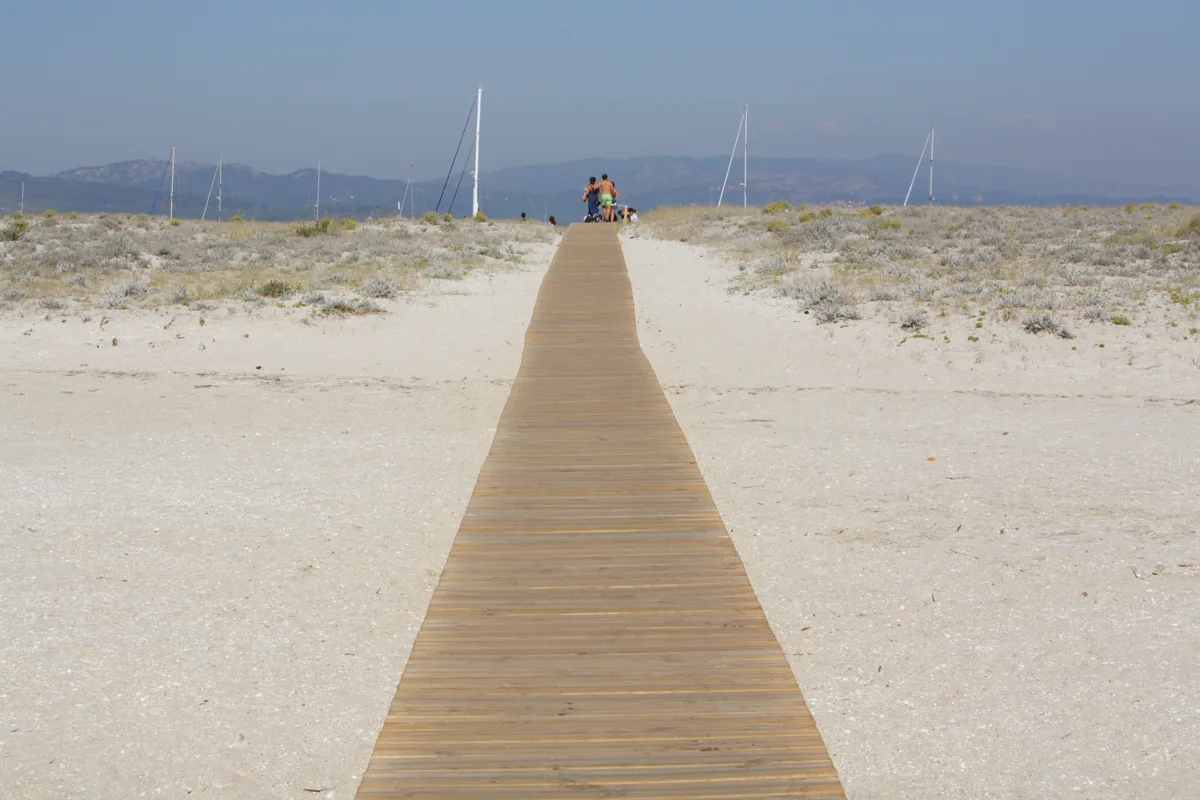
A timber boardwalk crosses pale dunes with low vegetation toward distant beachgoers and boat masts.

A boardwalk across the dunes at Rodas on the Cíes islands, photographed in September 2007.

Playa de rodas en las islas Cíes.jpg — Javier Albertos / Wikimedia Commons / CC BY-SA 4.0 · Creative Commons

Walks and routes

Rodas and O Lago: a short introduction

Start with the map at the information point near the landing. Follow the signed public access around Rodas and, if open, towards the O Lago crossing. Watch from the path and turn back whenever you have had enough. Allow roughly 60–90 minutes for walking and nature stops; this is a flexible outing rather than a complete named trail.

Ask staff to match the route to your group. Surface changes, slopes, sand and the crossing need checking individually; a short distance does not make every section suitable for a wheelchair or pushchair.


Rodas and O Lago: a short introduction

Alto do Príncipe: an optional climb

The official route is 1.7 km each way from the information point, with 95 m of height difference and an estimated 45 minutes outward. It climbs from the Rodas area to the cliff-top landscape. Plan for the return as well as a rest; choose it instead of adding several viewpoints to a short visit.

This is an uphill walk ending near abrupt cliffs, not a level beach stroll. It is a poor choice if balance, exposure or uneven ground is a concern; keep children close.

Alto do Príncipe: an optional climb

Faro de Cíes: a longer, conditional option

The lighthouse route is 3.5 km each way, with 175 m of height difference and an official outward time of 1 hour 30 minutes. It gives a broader contrast between the ría and the open Atlantic. Reserve at least a substantial half-day ashore for the return walk and stops, and only set off if your boat schedule leaves ample room.

The climb and exposed upper landscape make this a separate walking commitment. Do not assume that a surfaced section lower down continues as an easy accessible route to the top.

Faro de Cíes: a longer, conditional option

A relaxed first visit

Around 3–4 hours ashore, plus travel and the boat crossings.

Arrive with your return sailing already booked. Check the information point and agree how far everyone wants to walk.

Spend 60–90 minutes exploring the permitted Rodas and lagoon-side paths, shortening the outing whenever needed.

Leave a generous interval for a picnic, a beach pause or an available interpretation activity.

Make your way back to the landing in good time for your operator’s boarding instructions.

A day with one longer walk

A full-day trip; choose your boat times around the walking time and plenty of rests.

Ask which routes are open and compare the one-way distances before choosing.

Pick Alto do Príncipe or, if access and time allow, Faro de Cíes. Keep the shorter Rodas plan as your fallback.

Return on the authorised route, with food and water stops along the way.

Enjoy the arrival area only if time remains; do not rely on catching a later boat than the one you booked.

Things to try

Read the beach from the path

Compare the open beach, low dune vegetation and sheltered lagoon. Ask children to draw the three habitats and explain why trampling plants could change a beach. Use the marked accesses and make your discoveries without collecting anything.

Watch the lagoon quietly

If the permitted crossing is open, pause where you do not obstruct others. Look for movement beneath the surface and compare calm water with the sea beyond. The lagoon shelters young marine animals; watching from dry land is enough.

Join an interpretation walk

In the summer programme, park staff offer free guided walks with limited places. Ask at the information point about the day’s topics and sign-up, or check the park’s reservation announcements beforehand. These activities are separate from booking your boat.

Make room for a beach pause

Bring a picnic and leave time to simply sit by Rodas. If you enter the sea, choose a permitted bathing area, check conditions and supervise children closely. A sunny beach does not make the water warm or remove the need for caution.

Stay on the mainland at Cambón

The national park’s Cambón visitor centre in Vigo’s old town introduces all four archipelagos through models, audiovisual material and exhibits. The visitor entrance is at Rúa da Palma, 4. Confirm opening on +34 886 218 082 before going, especially around holidays or group visits.

Wildlife and habitats

Yellow-legged gull

Watch the shore and open water from public paths. Yellow-legged gulls are part of Cíes’ breeding birdlife; watching behaviour at a distance is more useful than trying to approach a nest.

European shag

Look from a safe public viewpoint for a dark seabird resting on rocks or diving for fish. A long neck and hooked bill help shags catch underwater prey; binoculars let you watch without approaching the colony.

Sea holly

The park’s flora catalogue includes sea holly among its coastal plants. Compare dune plants from the path, using signs or a guide to help with identification. Its flowering season is listed as June–September; leave flowers and roots untouched.

Common octopus

The common octopus belongs to the park’s underwater story. Learn about its habitat through interpretation or an authorised marine activity suited to conditions. It is not a target for the short land walk, and rocks or animals should never be disturbed to find one.

The birds, plants and marine animals below are documented wild members of the park, rather than exhibits or guaranteed encounters. Their habitats extend beyond this short walk. Keep your distance, use binoculars and never enter dunes, breeding areas or the water just to find a species.

Stories and discoveries

Most of the park is underwater

Of the park’s 8,480 hectares, 7,285.2 are marine and 1,194.8 are land. A view of the islands shows only a small part of what is protected.

A beach joins two islands

The Rodas sand barrier links Monteagudo and Faro. Together with O Lago it forms a connected beach, dune and lagoon system, which helps explain the careful control of visitor access.

There are forests beneath the waves

Large brown seaweeds form underwater habitats that shelter many animals. The park also protects sand, shell-gravel and maërl seabeds; the water is habitat, not merely the journey between islands.

One building tells several stories

The Cíes visitor centre occupies a nineteenth-century artillery store built over the former Santo Estevo monastery. Its surviving remains connect a present-day nature visit with much older island lives.

When to visit

Easter and summer

Expect the main transport and service season, a visitor quota and advance planning. Bring sun protection and a warm layer together. Keep wildlife watching quiet during the breeding period and respect every marked exclusion.

Autumn and winter

Use an organised guided sailing and pack for a more self-sufficient visit. Confirm toilets, refreshments and assistance with the organiser. Be ready to keep the outing on the mainland if the operator or park advises against travelling.

Getting there and practical advice

Information near the landing

The park’s Cíes information point is about 100 m from the passenger pier on Monteagudo. It operates during the high-season transport period and can advise on paths, activities and accessibility support.

Cíes visitor centre

The centre on Faro island is about 1.2 km from the Rodas pier and generally opens at Easter and in summer. Check the day’s opening before adding it to your walk.

Drinking water and food

Bring your own drinking water: the public springs have no sanitary guarantee. Restaurants generally operate with the regular-boat season, and water can be bought when they are open. Carry a picnic or snacks rather than depending on an unconfirmed opening.

Toilets and resting places

The park lists accessible public toilets on the path above the campsite, on the lighthouse route, and resting areas including one by O Lago. Ask about the current toilet opening and the approach from your chosen path.

Health and beach assistance

Island health assistance is seasonal, with the park listing a high-season point near the campsite reception. Beach surveillance is also seasonal. Bring essential medication and plan for travel time to mainland care; call 112 in an emergency.

Overnight stays

Camping is allowed only in the designated campsite. Reserve it separately, check its opening dates and follow its park-permit instructions before completing the boat booking. The park lists a maximum stay of 15 consecutive days.

Choose your departure port

Regular-season Cíes services commonly use Vigo, Cangas and Baiona. Routes, sailings and prices vary by operator and date; use the authorised-company list on the park’s Cíes page and compare the whole return journey.

High-season day visits: authorization, then ticket

For Easter and 15 May–15 September, request your Xunta authorization first. The provisional code gives you two hours to buy a ticket with an authorised operator. After purchase, download or check your final authorization and carry it on your phone or on paper for boarding. Follow the operator’s ticket-collection instructions too.

Daily capacity is limited

The park currently publishes a Cíes high-season daily visitor range of 1,600–1,800, and 250–450 in low season. The quota and available places for your actual date matter more than the upper number. Reserve early rather than travelling to the port hoping to find a space.

Outside high season

Book through an authorised operator organising a guided group. The park requires an accredited guide and groups of no more than 25 people; the organiser handles the visit authorization. A quiet winter day does not mean independent walk-on access.

Private boats and other archipelagos

Private boating requires the park’s navigation and anchoring permissions. Ons has its own transport arrangements; Sálvora and Cortegada boat-group authorizations are handled by their operators. A permit or booking for one sector is not a universal island pass.

Confirm the boat and landing together

Tell the operator about your chair, walking aid or pushchair and ask about the actual vessel, ramps, boarding assistance and island disembarkation. Check these before paying, including the return sailing.

Choose the precise path, not an island-wide label

The park leaflet identifies a cement-surfaced section between the Figueiras beach junction and Carracido port, but warns that some stretches exceed 10% gradient. Sand and the uphill viewpoint routes add different barriers. Ask staff which shorter section suits your needs.

Arrange support in advance

The park describes equipment and information resources including wheelchairs, amphibious chairs, Joëlette chairs and Braille material. Ask which are available on Cíes for your date, whether assistance is needed and how to reserve them.

Leave equipment for fires and fishing at home

Fires are prohibited. Recreational and underwater fishing are also prohibited, and visitors may not carry fishing nets, including children’s nets, or similar collecting equipment.

Check special permissions

Drones, kites and other flying devices need express park authorization. Commercial filming or photography also requires prior authorization; ask the park before arranging a shoot.

Sources and useful links

Wildlife you might spot

4

Each card links to a full Explore page with photos, traits, and fun facts.

Snap map for this place

Start with the big picture, then zoom in to explore individual wildlife observations around this place.

Loading map…

Good to know before you go

Book both directions of the boat journey, keep your final park authorization handy and follow the operator’s check-in instructions.

Carry enough drinking water for the day. Public springs on Cíes have no guarantee of safe drinking water.

Pack a windproof layer, sun protection, comfortable walking shoes, food and a bag to bring every scrap of rubbish back.

Stay on marked public paths and authorised beach accesses. Dunes, nesting areas and closed sections are not shortcuts.

Watch animals quietly without feeding them; leave shells, sand, plants and shore creatures where they are.

Pets cannot land. If you travel with a recognised assistance dog, check the park’s documentation and access rules before booking.

Keep children close near water and cliff edges. Follow beach flags and local advice; the Atlantic water can be very cold.

Keep a generous return-boat buffer. Shorten a walk rather than rushing back over unfamiliar ground.

Frequently asked questions

Cíes is one of four archipelagos in the park, alongside Ons, Sálvora and Cortegada. This guide’s main outing is on Cíes; a boat ticket there does not give you a tour of all four.
For an independent high-season day visit to Cíes or Ons, obtain Xunta pre-authorization first, then buy the ticket within the time allowed. Low-season guided visits and campsite stays follow different arrangements; see the access and overnight-stay sections.
No. San Martiño is a separate Cíes island, with no public-use trail facilities. The signed walking routes described here are on Monteagudo and Faro; do not improvise a crossing.
Only where bathing is permitted and conditions suit your ability. Follow local safety advice and leave all marine life untouched. Diving with a weight belt requires advance authorization; the protected lagoon is not a casual swimming alternative.
Use the authorised campsite and book ahead. Camping elsewhere is prohibited. The campsite handles the park authorization process for its booked dates; follow its instructions to complete your transport arrangements.
Contact your operator about the booking and its current cancellation arrangements. Keep a mainland alternative, such as the park’s Cambón visitor centre in Vigo, subject to its opening hours.

Recent snaps at this place

Recent snaps will appear here as new observations are added.

View all ›

Take the discovery with you

Exploring Galician Atlantic Islands National Park?

Identify the wildlife you spot, learn as you go, and keep a collection of the adventure.

  1. 1Spot it
  2. 2Snap it
  3. 3Keep the discovery