Snappit logo
Snappit
Get App
Generic illustration, not a photograph of this venueIllustration
ParkÎle-de-France, FR

Jardin des Plantes, Paris

The most revealing change of scene here is from a flower display to a teaching collection.

About

The most revealing change of scene here is from a flower display to a teaching collection. In the École de botanique, the planting invites you to ask which plants are related, not simply which colours look good together. You can enjoy it without knowing a single Latin name: pick two neighbouring labels, compare the plants, then let the next question lead you on.

For a first visit, keep the ambition modest. Combine the main garden paths with the teaching beds and one or two labelled trees. The buildings and their collections can fill separate days; the pleasure of this outing is having time to look at a leaf, a branching pattern or a plant label. The Jardin alpin adds a different kind of gardening, but its shorter opening window makes it a bonus to plan deliberately. Planning to visit? Download the Snappit app to identify the wildlife you spot in real-time.

The garden grew from a royal project for the teaching of medicine and botany. The Muséum’s history dates its foundation to 1626, its establishment on this site to 1635 and its public opening to 1640. Public lessons were taught in French, widening access beyond those who could follow Latin instruction. In 1793, the garden and natural-history collections became the Muséum national d’Histoire naturelle. Today’s labels, teaching beds and living collections continue that educational purpose.

What to do here

Start with the long central perspective, spend your best attention in the École de botanique, and finish with a tree stop chosen from the official remarkable-tree guide. For children, let each person nominate one plant to investigate rather than trying to identify everything.

Seasonal info

Each visit can have a different subject: spring flowers, the contrast between summer foliage, autumn colour or winter branching. Planting displays and weather vary, so choose the day’s most interesting bed rather than expecting every named plant to be at its peak.

Accessibility

The Muséum describes most of the garden as accessible to visitors with mobility impairments. Its main paths have a relatively firm sandy surface, which can become sticky after heavy rain. The shorter visit below avoids a planned climb of the Labyrinthe; specialist garden access should be checked separately.

Don't miss

1

The École de botanique

a living collection arranged to explain plant relationships

2

The Cèdre de Jussieu, a cultivated Lebanon cedar brought to Paris in 1734

3

A morning in the Jardin alpin, when its separate opening conditions allow

4

A family outing built around real plants, labels and questions

Walks and routes

Perspective and École de botanique

From the Place Valhubert side, use the central perspective to orient yourself, with the Grande Galerie de l’Évolution as a visual landmark. Follow the on-site signs to the École de botanique and choose a handful of beds rather than a complete circuit. Begin at the evolutionary-tree display, then compare two plants whose labels place them in the same family. Return by the main garden paths whenever attention or energy runs low. This is a suggested sequence of existing garden areas, not a waymarked trail.

Stay with the main garden paths and public approaches to the beds. There is no planned ascent of the Labyrinthe or entry into the sunken alpine garden. Exact surface conditions at individual beds can vary.
Perspective and École de botanique

Add the Jardin alpin

On an open morning, find the Jardin alpin entrance through the École de botanique and give this small garden its own unhurried visit. Notice how rock, shelter and changes in exposure allow quite different plants to grow close together. Use the signs to distinguish geographic groupings; do not treat the photograph below as a map or a promise of today’s planting. If this area is closed, spend the extra time with the teaching beds instead.

The garden occupies a depression below the surrounding paths. For wheelchair or pushchair access, ask reception about the entrance and paths before making this area essential to your visit.

Add the Jardin alpin

Choose one historic-tree detour

Use the official remarkable-tree page to choose a stop that fits your exit: the Cèdre de Jussieu at the foot of the Labyrinthe, or the Judas-tree and Robinier de Robin near 18 rue Buffon. Treat these as alternatives to an exhaustive tree hunt. Stand back far enough to see the outline, then look at the label and one visible detail. You can enjoy the cedar without adding a climb to the hilltop.

Keep to signed public paths and respect any protective barriers around the trees. Ask staff for the easiest approach to your chosen specimen if slopes or steps would be difficult.

Choose one historic-tree detour

A first family visit

For a comfortable 90-minute outing, give the perspective about 15 minutes, the teaching beds around 35, a rest about 10, and one tree stop roughly 20, leaving a little flexibility for the exit. Treat these as choices, not a schedule to complete. If the alpine garden is your priority, replace part of this plan with the morning add-on instead of simply stretching a tired child’s visit.

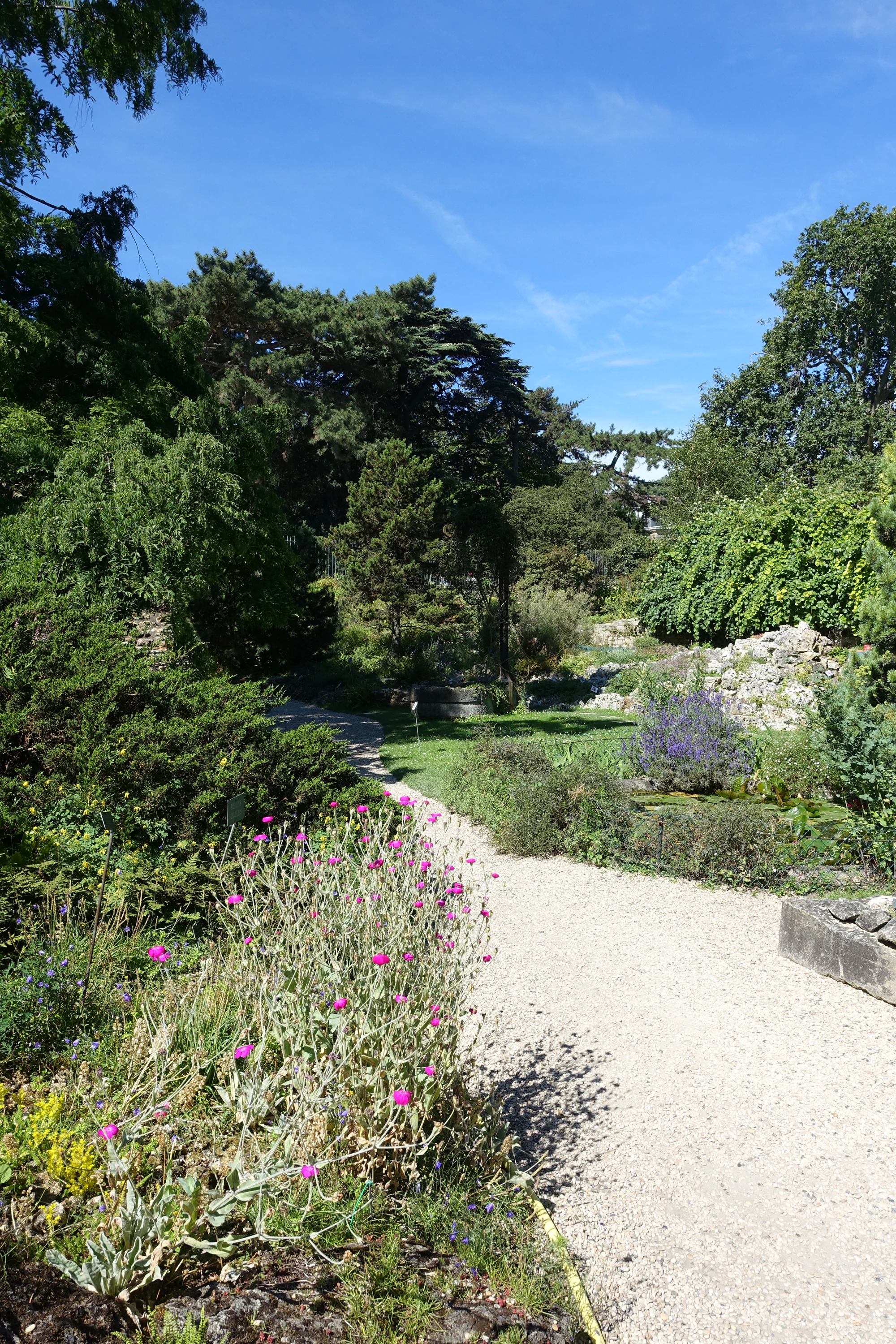
A pale gravel path curves between pink flowers, planted rock beds and a small pond beneath leafy trees and a blue sky.

The Jardin alpin at the Jardin des Plantes in Paris, photographed on 10 July 2016. This historical view does not establish today’s opening or path conditions.

“Jardin Alpin @ Jardin des Plantes @ Paris” — Guilhem Vellut, CC BY 2.0. Source: https://www.flickr.com/photos/o_0/28213931925/. License: https://creativecommons.org/licenses/by/2.0/. Original unchanged. · Creative Commons

Things to try

A plant-family detective game

In the École de botanique, pick two labels sharing a family name. Before reading anything else, decide whether their plants look alike. Compare leaf outline, how leaves sit on a stem and any visible flower structure. The aim is to discover that scientific relationships are more interesting than a simple colour match. With a younger child, reduce the task to finding two very different leaf shapes.

Three drawings, one plant

Make a tiny portrait of a whole plant, a closer sketch of one leaf and a final drawing of its label. Add the date and garden name. This gives children a record they can revisit without picking anything, and it helps adults notice the difference between a garden variety and a broader plant name.

Ask what makes this a collection

A botanical garden keeps records as well as attractive plants. The Muséum describes seed conservation, exchanges between gardens and laboratory propagation among its work. Use one labelled specimen as a starting point: what might someone need to record to care for it over many years? There is no need to solve the whole question on the spot.

If the weather turns

A gallery or the Grandes Serres can be a separate indoor visit, but confirm admission, opening and accessibility first. As checked on 18 October 2026, the Grandes Serres page reports temporary wheelchair inaccessibility because its exterior lift is broken. The Galerie de Paléontologie et d’Anatomie comparée is closed for works into 2027. Neither should be treated as a guaranteed fallback. In severe weather, parts or all of the garden can close too.

Wildlife and habitats

Lebanon cedar

The Cèdre de Jussieu at the foot of the Labyrinthe is the garden’s historic Lebanon cedar. Brought from England in 1734, it connects today’s walk with the exchange of living plants between botanical collections. The tale of Jussieu carrying it in his hat is a legend, not a documented part of the journey.

Judas-tree

Near the 18 rue Buffon entrance, look for the labelled Judas-tree. Its pink spring flowers can grow directly from the trunk and older wood. Later, broad rounded leaves and flat pods provide other details to study. It is a cultivated collection tree; do not sample its leaves or seeds.

Black locust

The Robinier de Robin, near 18 rue Buffon opposite the rose garden, is interesting for what survives below ground. The Muséum explains that the original aerial growth disappeared but shoots from the same root system formed the present group. Look at the whole clump rather than expecting one intact ancient trunk.

Ginkgo

The official remarkable-tree guide places ginkgos near the amphithéâtre Verniquet and the Labyrinthe, among other locations. Their fan-shaped leaves are a good starting point for identification, with yellow colour in autumn. Choose a tree reached from an open public path rather than relying on access to a gallery courtyard.

Dawn redwood

The Jardin alpin holds a dawn redwood cultivated here since 1948. It is a conifer that sheds its foliage, an excellent challenge to the idea that every conifer stays green all winter. Its copper autumn colouring can be a bonus, but entering its garden remains subject to the separate morning and seasonal opening rules.

These are cultivated collection plants, not a list of species growing wild in Paris. Use the botanical labels to confirm the specimen in front of you. Birds and insects may add interest to the walk, but this visit makes no promise of a particular wildlife sighting.

Stories and discoveries

A family tree built into the planting

The École de botanique has been rearranged repeatedly as classification has developed. Its present approach reflects evolutionary relationships, supported by a central explanatory display. Four teaching beds explore adaptation, diversification, convergence and the direction of evolution. This makes the layout part of the lesson, rather than merely a backdrop.

Mountain plants need careful gardening

The Jardin alpin is a deliberately managed collection. Its sheltered, sunken position helps create small-scale differences in growing conditions. Some plants receive protective covers from autumn because a wet Paris winter is quite unlike the conditions beneath mountain snow. Covers, work areas and seasonal closures are part of looking after the collection.

When to visit

Spring: flowers close to the wood

April–May is the Muséum’s stated flowering period for the Judas-tree. If it is in flower, look for blossoms growing directly from older branches or the trunk. Let this single tree become the main event rather than racing between every flowering bed.

Summer: compare shade and exposure

Make an early start, take water and decide where to rest before a child is tired. Move between the open perspective and shadier paths as conditions require. A sunny view can make a good photograph, but it does not make the middle of a hot day the best time for a long visit.

Autumn: follow the leaves

The ginkgo offers bright yellow autumn foliage, while the dawn redwood changes to copper tones before shedding its leaves. The latter is in the alpine garden, so its access window may matter more than the colour calendar. Timing shifts with the weather; no particular date guarantees a display.

Winter: a different outdoor lesson

Use a shorter visit to notice bare branching, bark and evergreen forms. The published alpine closure removes that add-on from a normal winter plan. Leave enough daylight and time to reach an exit well before the garden’s seasonal closing time.

Getting there and practical advice

Reception and a practical pause

The Muséum lists a reception pavilion on the Place Valhubert side and another information point in the Grande Galerie de l’Évolution hall. Ask for the day’s garden plan and the nearest open toilets before starting with small children. The official plan marks toilets, drinking-water points, play equipment and picnic areas; availability can change. Changing tables listed in the FAQ are inside ticketed attractions, so do not assume that an outdoor-only visit includes them.

Choose an entrance that suits the visit

Public transport is the simplest starting point. The Muséum lists Gare d’Austerlitz for Métro 5 and 10 and RER C, Jussieu for Métro 10, and Censier-Daubenton for Métro 7. Place Valhubert is a useful starting side for the perspective; 57 rue Cuvier is the main published garden address. There is no visitor car park. Check the transport operator’s live service and step-free journey information separately.

Plan the easy version first

Benches are distributed through the garden, making a series of short stops possible. In dry weather the firm sandy paths suit many wheelchair users; wind can raise dust and heavy rain changes the surface. For detailed access needs, contact [email protected] or +33 1 40 79 56 01. The Muséum also advertises wheelchair loans; arrange availability rather than relying on one being waiting.

Opening times and the day’s plan

As checked on 18 October 2026, the outdoor garden is scheduled 08:00–18:30 through 24 October, then 08:00–17:30 from 25 October 2026 to 28 February 2027. Last entry and clearance begin 15 minutes before closing. Use the current garden page for later dates and any exceptional closure, and check specialist gardens separately.

Sources and useful links

Wildlife you might spot

5

Each card links to a full Explore page with photos, traits, and fun facts.

Snap map for this place

Start with the big picture, then zoom in to explore individual wildlife observations around this place.

Loading map…

Good to know before you go

Take a photograph of a plant and its label together; it makes a much better record than a name guessed later.

Bring a small sketchbook and choose a bench before settling down to draw.

Use only designated picnic areas. A lawn or flower-bed edge is not automatically a lunch spot.

Leave plants, seeds and fallen material where they are; botanical collections are for looking, not tasting or collecting.

Check the garden’s current notices on the day, particularly during severe weather.

Frequently asked questions

An individual, self-guided visit to the outdoor Jardin des Plantes is free and does not require a reservation. Organised group visits have separate arrangements. The galleries and Grandes Serres have their own admissions and opening conditions.
No. This protected area is entered on a reserved guided visit. It is not part of the independent family route; check the Muséum’s current programme if its regional habitats are your main interest.
Build the visit around the main paths and keep it short after rain. A general statement that most of the garden is accessible does not certify every narrow path, specialist garden entrance or hill. Ask staff about the day’s easiest route if access is essential.
The garden’s visitor rules prohibit pets, even on a lead, and state an exception for guide dogs in an appropriate harness. Contact the Muséum in advance for any specific assistance-dog access question.

Recent snaps at this place

Recent snaps will appear here as new observations are added.

View all ›

Take the discovery with you

Exploring Jardin des Plantes, Paris?

Identify the wildlife you spot, learn as you go, and keep a collection of the adventure.

  1. 1Spot it
  2. 2Snap it
  3. 3Keep the discovery