
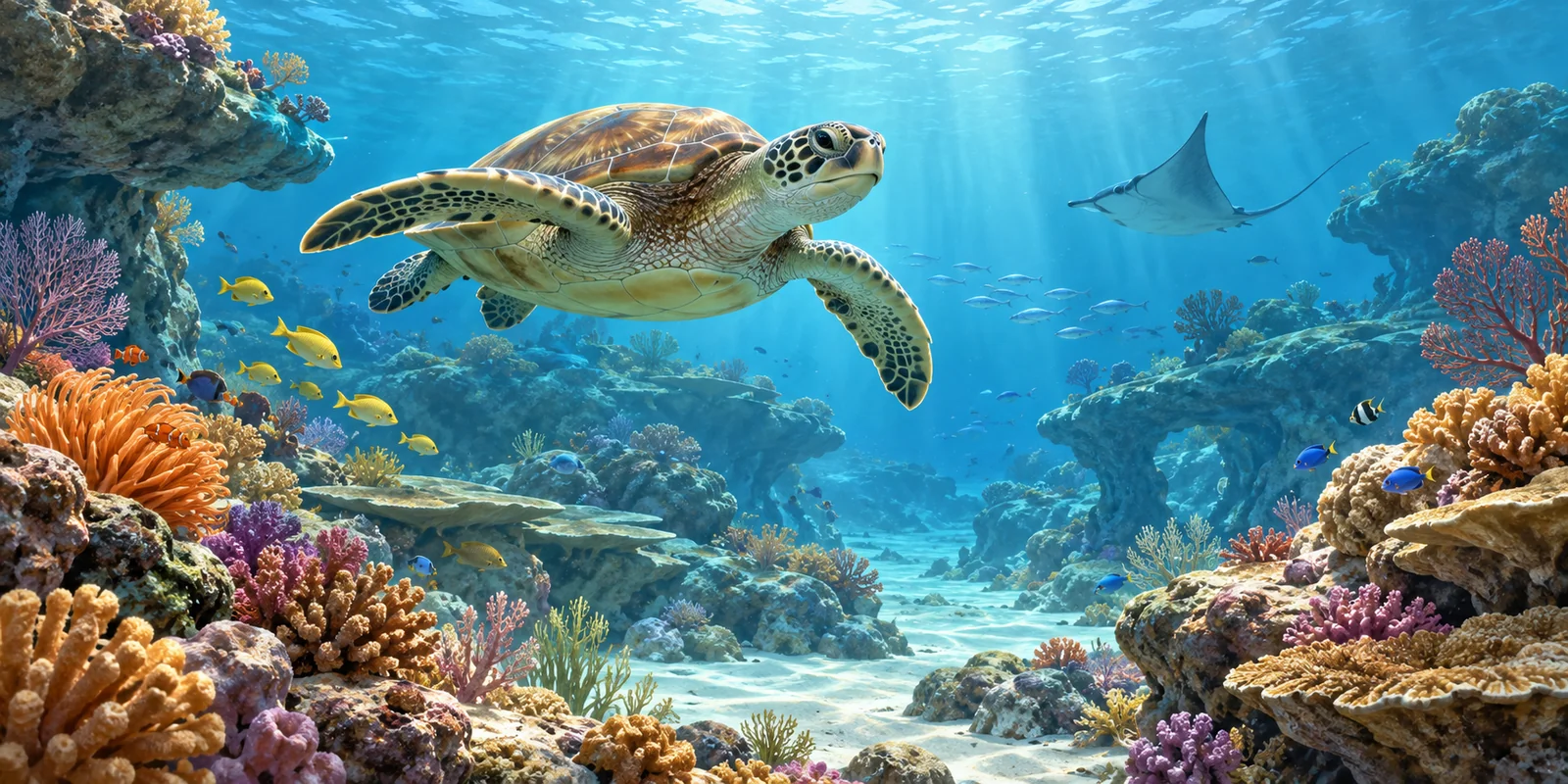
These are green sea turtles, labelled Grüne Meeresschildkröte or Suppenschildkröte. At the Maldives tank, follow one animal through a turn and watch how its front flippers move. If Frieda or Käthe is resting, read her story beside the tank and give her time. The leatherback Marlene in the museum galleries is a model of a different species.
 Illustration
AquariumMecklenburg-Vorpommern, Germany
MEERESMUSEUM Stralsund
Come to the MEERESMUSEUM for a journey from ancient sea life to living coral reefs, all within a former monastery in Stralsund’s old town.
About
Come to the MEERESMUSEUM for a journey from ancient sea life to living coral reefs, all within a former monastery in Stralsund’s old town. Start by looking up: a digitally animated sardine shoal and life-size predator models fill the former church hall. The building’s height becomes part of the exhibition, with animals suspended between the floors and the brick vaults still visible overhead.
Give the museum galleries real time before heading for the aquariums. They connect evolution, ocean habitats, human uses of the sea and fishing. A fin-whale skeleton occupies the old church choir, while shark models and preserved animals help explain creatures that could never share an ordinary aquarium. The leatherback turtle Marlene is represented by a model; the green sea turtles awaiting you later are living animals. Making that distinction is a good game for children: which things are fossils, skeletons, models or alive?
Across a glass bridge, the aquarium circuit begins with the Caribbean Reef. Its roughly 800,000 litres of water can be viewed from three levels, so the same underwater scene changes as you descend. The route continues through the historic vaulted basement, passing Pacific habitats and ending with the Indian Ocean and the sea turtles. There are 31 tanks in the renewed circuit. Choose a few to watch closely rather than treating each window as another box to tick. Don't forget to bring the Snappit nature identification app along to scan local species.
Otto Dibbelt’s natural-history museum opened in the former Katharinenkloster in 1951. The church hall gained its distinctive three-level exhibition structure during the 1972–1974 refurbishment. A much larger modernisation began in 2020: the exhibitions reopened on 17 July 2024, followed by the aquarium circuit on 5 May 2025. The fin whale has a much longer story. It stranded near Lieschow on Rügen on 8 April 1825. Its skeleton spent years in Greifswald before being transferred to Stralsund in 1968 and mounted in the museum’s choir in 1974. Looking at those bones brings a local encounter with a very large sea mammal into the middle of the visit.
What to do here
In the Evolution gallery, try the station that reveals an ichthyosaur’s anatomy, then compare the whale skeleton with the shapes of the other marine mammals nearby. The giant megalodon jaw makes an enjoyable family photograph and a starting point for talking about extinct animals. Follow the “Schlau mit Marli” signs with younger children and ask about the free discovery quizzes; the turtle mascot gives them things to search for between the larger exhibits.
Rest beneath the digital globe. Its projections explore geology, climate and people’s relationship with the oceans, with sound available in English as well as German. Pick one subject to follow together: an underwater volcano, a current or the routes people use across the sea. In the fishing display, compare the net models and think about what a fishing method might catch besides its intended fish.
At the Caribbean Reef, use more than one viewing level and notice how the fish occupy different parts of the water. The coral forms in this tank are artificial reproductions. Later, look for the living corals, including colonies grown by the museum, and the display of coral fluorescence under ultraviolet light. It is a particularly good place to challenge the idea that a coral must be a plant.
The Pacific section includes a cooler-water stop off California, with horn sharks, kelp bass and anemones. Compare that scene with the dark volcanic setting of Hawaii and the pale sand of the Fiji tank. At Fiji, scan low down for blue-spotted rays before following the fish above them. Save an unhurried final stop for the green sea turtles Frieda and Käthe in the Maldives tank. Watch how they steer and turn, then find their individual stories beside the aquarium.
Seasonal info
The museum opens daily, normally 09:30–17:00 from September to June and 09:30–19:00 in July and August. It is closed on 24 December and closes at 15:00 on 31 December. Check the official visitor page and ticket availability before travelling.
Accessibility
Use the step-free entrance at Bielkenhagen 10. All exhibition and aquarium areas can be reached by lifts, with seats along the circuit and accessible toilets. Most exhibits and information can be viewed while seated. A tactile museum guide and Braille material support visitors with sight loss; there is no induction hearing loop. Expect changes in light between the galleries and aquariums. Parts of Stralsund’s old town have access barriers, so plan the approach as carefully as the indoor visit. For specific requirements, contact the museum on +49 3831 2650-610.
Don't miss
1
The Caribbean Reef seen from three different levels
2
Green sea turtles at the Maldives tank
3
The original fin-whale skeleton in the former church choir
4
A projected globe and Marli’s family discovery stations
Wildlife and habitats
Sources and useful links
- MEERESMUSEUM: Ihr Besuch
- MEERESMUSEUM: Gästetipps
- MEERESMUSEUM: Ausstellungen
- MEERESMUSEUM: Aquarien
- Barrierefreiheit im MEERESMUSEUM
- Modernisierung des MEERESMUSEUMs
- Wie gelangt ein Finnwal ins Museum?
- Digitaler Globus im MEERESMUSEUM
- Basis-Pressetexte: Standort MEERESMUSEUM
- MeerBlick 2026, Ausgabe 21
- Osterferienprogramm im Deutschen Meeresmuseum
- Herbstferienprogramm 2026
- Lederschildkröte Marlene
- BERNSTEINTICKET: Meeresmuseum Stralsund
- MEERESMUSEUM Stralsund
Wildlife you might spot
1Each card links to a full Explore page with photos, traits, and fun facts.






Snap map for this place
Start with the big picture, then zoom in to explore individual wildlife observations around this place.
Loading map…
Good to know before you go
Tickets
Choose an entry time through the official online shop. Children under four enter free; check the current family discount before paying.
Prams
Bring a compact buggy or a baby carrier. Bicycle trailers, pull-along wagons and bulky prams cannot go through the galleries and aquariums; parking spaces are provided in the foyer/entrance area.
Baby breaks
Nursing and changing rooms are available. Ask at the information point if you have run out of essentials such as wipes.
Food
The snack point before the turtle aquarium has vending machines. Eating is restricted to this area, so plan a proper meal before or after the museum.
Bags
Deposit lockers are limited, and the museum cannot store suitcases or large luggage. Leave travel bags elsewhere before arriving.
Looking closely
Use the illustrated tank labels to match fish shapes and patterns. Turn off your flash to reduce reflections, and never tap the glass or try to attract an animal’s attention.
Touching
Some exhibits are designed for hands-on exploration. Follow the signs that specifically allow touching and leave the other objects alone.
Frequently asked questions
- The main visitor entrance is opposite Mönchstraße 45 in Stralsund’s old town; the step-free entrance is at Bielkenhagen 10. Arrive by train at Stralsund Hauptbahnhof, then use the VVR journey planner for buses towards Kütertor or Knieperwall; the transport operator lists lines 1 and 4. Drivers can use the public “Am MEERESMUSEUM” car park. Check your final walking approach, especially with a wheelchair.
- They are separate sites of the same museum foundation. MEERESMUSEUM occupies the old monastery and focuses its aquariums on tropical seas, with a brief California detour. OZEANEUM is on the harbour island and explores northern seas. If you want both, compare the combination ticket, which also includes NATUREUM; its three-month validity lets you spread the visits over different days.
- Pets cannot enter. Guide dogs and assistance dogs are permitted; animals used in animal-assisted therapy are not included in that exception.
- The huge animals suspended in the church hall are models, and the fin whale is a skeleton. Live animals are in the aquarium circuit. Keep the distinction clear with younger children so they know what to expect when the galleries lead into the tanks.
Recent snaps at this place
Recent snaps will appear here as new observations are added.
More aquarium guides
View all ›
Photo coming soon
Aquarium30 sightings15 species
Ohio, US
Greater Cleveland Aquarium
You might spot Sand Tiger Shark, Nurse Shark, and Cow.
View guide →

Photo coming soon
Aquarium30 sightings15 species
California, US
SeaWorld San Diego
You might spot Orca, Bottlenose Dolphin, and Beluga Whale.
View guide →

Photo coming soon
Aquarium30 sightings15 species
Illinois, US
Shedd Aquarium
You might spot Beluga Whale, Pacific White-Sided Dolphin, and Sea Otter.
View guide →

Photo coming soon
Aquarium23 sightings15 species
Texas, US
Dallas World Aquarium
You might spot Brown-Throated Three-Toed Sloth, Ant, and Penguin.
View guide →
Take the discovery with you
Exploring MEERESMUSEUM Stralsund?
Identify the wildlife you spot, learn as you go, and keep a collection of the adventure.
- 1Spot it
- 2Snap it
- 3Keep the discovery