Snappit logo
Snappit
Get App
Generic illustration, not a photograph of this venueIllustration
ParkBretagne, FR

Saint-Brieuc Bay National Nature Reserve

The water is only half the story here.

About

The water is only half the story here. When it retreats, the inner bay reveals channels, wet sand and mudflats that supply food for migrating and wintering waterbirds. Around their edges sit saltmarsh, low cliffs and the small dune system of Bon-Abri. You can understand this whole sequence from public shore paths without walking into the birds’ feeding grounds.

Start on the Hillion side if you want a compact introduction: the Maison de la Baie explains the landscape, while the Hôtellerie/Fronteven area provides a bird hide and a separate viewpoint over the saltmarsh and tidal flats. On the opposite shore, Langueux offers a different reading of the same bay, with interpretation near Boutdeville. The two sides work well as separate visits; the empty-looking space between them is tidal habitat, not a pedestrian shortcut. Enhance your adventure: download the Snappit app to identify the local species you encounter.

The reserve was created in 1998 after a long local conservation effort. Saint-Brieuc Armor Agglomération and VivArmor Nature now manage it together. Its 1,140 hectares protect part of the inner bay, rather than the entire coastal landscape visible from a viewpoint.

What to do here

Choose one shore base, scan the channels with binoculars, and add a short signed path or the Maison de la Baie museum.

Seasonal info

Winter birds, spring dune flowers and summer gulls give the bay a different emphasis each season. Use the seasonal suggestions below to choose your focus.

Accessibility

For step-free planning, begin with the Maison de la Baie. Check the final outdoor approach separately: parts of the coastal GR34 are uneven and sloping.

Don't miss

1

Fronteven’s bird hide and nearby saltmarsh viewpoint

2

The shifting channels of the anse d’Yffiniac

3

Bon-Abri’s dune habitats, viewed from permitted paths

4

The Maison de la Baie’s journey from cliffs to underwater life

Walks and routes

Fronteven: a short shore-based birdwatch

Make the Hôtellerie/Fronteven area in Hillion your destination. Use the signed public access to the ornithological hide and the nearby viewpoint over the saltmarsh and intertidal flats, then return by the same permitted approach. If arriving via the Maison de la Baie, ask for the current local approach before setting out.

If using a wheelchair or pushchair, ask about the gradients, surface and doorway on the final approach before setting out.
Fronteven: a short shore-based birdwatch

Bourienne to the Grève des Courses

The reserve’s first leaflet walk follows the Langueux side from Bourienne through Boutdeville towards La Cage and the Grève des Courses. Choose a short out-and-back section if you want an easy family outing; the full description is a point-to-point walk. The Ville aux Oies interpretation near Boutdeville is a useful stop for understanding saltmarsh and tides.

The leaflet calls the route very easy, but that is not an accessibility certification. Separate tourism guidance for the Grèves de Langueux notes short cross-slopes and narrow passages between bollards, which can affect wheelchairs.

Bourienne to the Grève des Courses

Maison de la Baie to the Pointe des Guettes

For a longer walk, the reserve’s third leaflet route leaves the Maison de la Baie, passes Saint-Guimond and the Pointe du Grouin, and continues to the Pointe des Guettes. It adds a broad view across the bay and the offshore mussel-growing structures. Choose this option when you want a walking-focused visit and have time for the return.

The official description calls the path uneven with some short steep climbs. For a step-free or easy-pushchair outing, choose a different, checked access point.

Maison de la Baie to the Pointe des Guettes

A relaxed first half-day

Check the weather, tide and opening arrangements first. Begin at the Maison de la Baie for context, then make a short observation visit around Hôtellerie/Fronteven if access is open. Returning to the same viewpoint later may reveal new channels and birds. With young children, this makes a satisfying half-day on its own.

Things to try

A family bill-shape challenge

From one observation spot, compare a broad duck bill, a stout oystercatcher bill and a slim wader bill. Sketch their outlines rather than chasing each bird for a closer look. Ten attentive minutes can be more rewarding for children than a long species list.

Photograph the changing shoreline

Choose a fixed shore viewpoint and make two landscape photographs during your visit. Compare the exposed channels and waterline afterwards. Let the birds remain small within the landscape if that is the undisturbed view available. Drone flight below 300 metres is prohibited over the reserve.

Let a guide open up the mudflat story

The Maison de la Baie organises themed outings, including birds, shore life and mussel farming. Choose an outing that fits your group, confirm its meeting point and book ahead. It is a good way to ask about the bay’s less visible life without improvising an excursion onto the flats.

Keep the museum as a real fallback

On an open day, explore the Maison de la Baie’s films, models and displays about the tides and coastal habitats. In strong wind or heavy rain, make that the visit and save exposed headlands for better conditions. Confirm opening first, especially outside summer.

Wildlife and habitats

Common shelduck

A strongly patterned duck with a dark green head, red bill and chestnut breast band. Watch how it feeds on the exposed flats. The reserve describes nesting in local clay banks and crevices; observe from a distance without looking for nests.

Eurasian oystercatcher

Black-and-white plumage and a vivid orange-red bill make this a satisfying first bird to identify. The bay’s numbers build towards winter. Scan exposed feeding areas from shore and compare its solid outline with the smaller waders nearby.

Brent goose

Look for a small, dark goose with a black head and pale rear. Winter flocks feed on coastal vegetation, including algae and saltmarsh grasses. The official walk leaflet highlights winter geese around Pointe de Billemont; their exact location still changes with conditions.

Dunlin

A small wader with a slender, slightly curved dark bill. In winter, look for grey-brown upperparts and a pale belly rather than the black belly patch seen in breeding plumage. Compact groups alternate feeding on the exposed flats with resting at high water.

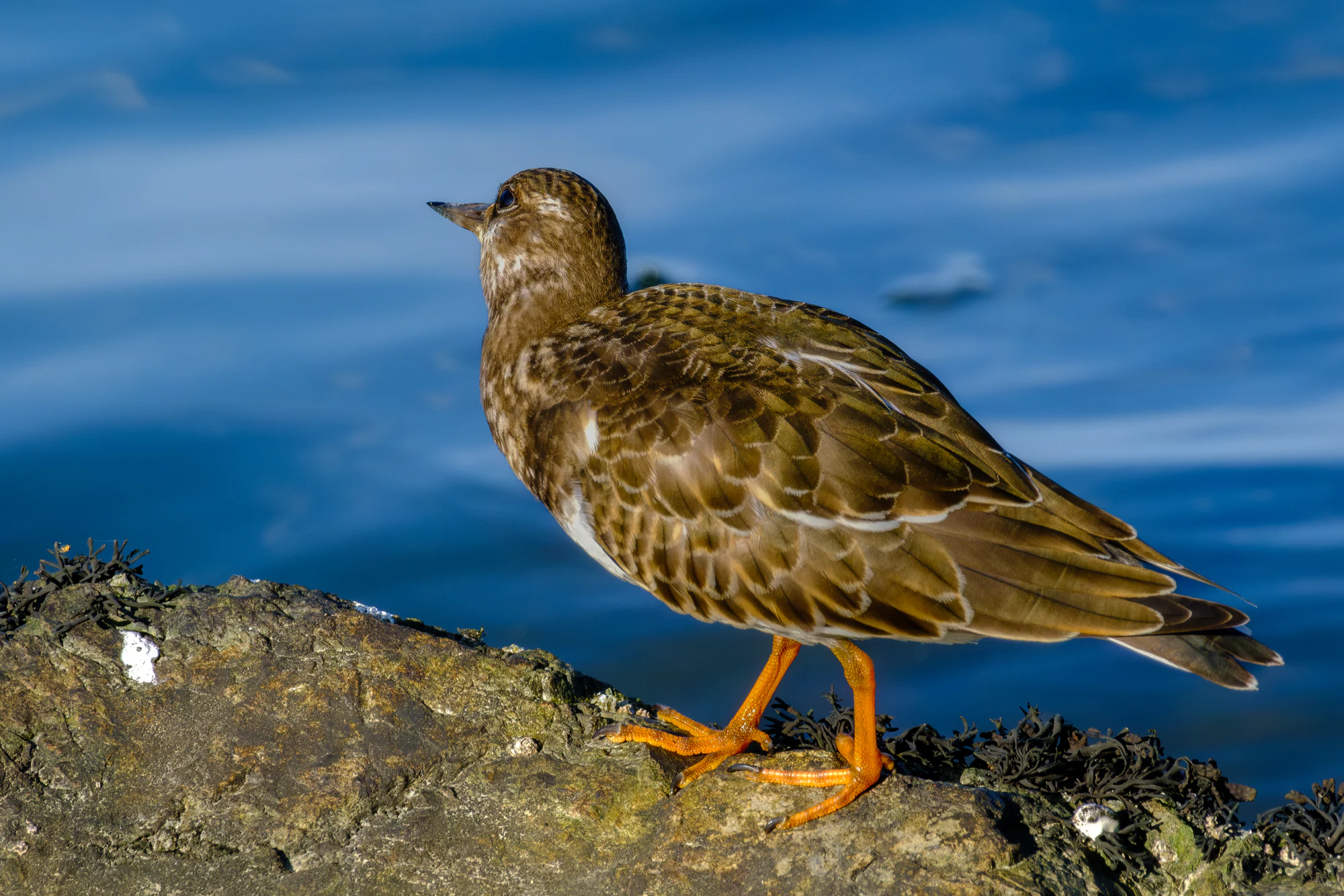
Ruddy turnstone

A stocky wader with orange legs and a short, pointed bill. The reserve records it as a winter visitor. Look for its habit of turning small stones or shifting seaweed to uncover food, while keeping your own feet on the permitted route.

A brown-patterned ruddy turnstone with orange legs stands on a seaweed-fringed rock against blue water.

Ruddy turnstone photographed on 26 September 2023, from the Saint-Brieuc Bay Nature Reserve’s collection. The source does not identify the exact capture location.

[“Tournepierre à collier”](https://www.flickr.com/photos/188559988%40N06/53221575015) by Réserve Naturelle Baie de Saint-Brieuc, [CC BY 2.0](https://creativecommons.org/licenses/by/2.0/). Original photograph, unchanged. · Creative Commons

Stories and discoveries

Most of the reserve is sea territory

Almost all of the protected area lies in the maritime public domain. The approximately seven-hectare Bon-Abri dunes form its small terrestrial component. That helps explain why a shore viewpoint can reveal so much of this reserve.

An oystercatcher’s name can mislead

On this coast, oystercatchers mainly take bivalves such as cockles and mussels. Individuals can hammer shells or prise the valves apart. Watch the bill at work as well as using it to recognise the bird.

Rest is part of migration

The bay’s high-water roosts are places where birds conserve energy between feeding periods. A flock standing still is using the reserve just as actively as one probing the mud, which is why close approaches matter even when nothing seems to be happening.

When to visit

Winter: concentrate on feeding and resting birds

Bring warm layers and spend longer at one observation point. Ducks and geese are a particular focus from November to February; the main winter-wader period runs from October to March.

Spring: change your expectations

Winter numbers fall as migrants leave. Look instead for stopover birds and spring colour from the permitted Bon-Abri paths. The dune vegetation is sensitive; keep photographs and footsteps on the authorised route.

Summer: use the coast and the interpretation

Gulls and terns remain part of the bay’s story. Pair a shorter outdoor visit with the museum or a booked activity, and check algae-related notices before deciding which shore access to use.

Autumn: watch the bay fill again

Returning migrants make late summer and autumn rewarding. Compare feeding groups across quiet visits as the season moves towards winter.

Getting there and practical advice

Maison de la Baie: plan around its opening

The visitor centre is at Site de l’Étoile, Hillion. Its museum has seven spaces exploring the bay. The operator lists adult admission at €5, €3.10 for ages 6–18, and free entry under six; activities are priced separately. Hours vary by season, with a Christmas-holiday closure and most public holidays closed. Check the current timetable before making the museum the centrepiece of your visit.

Bring the small essentials

Carry water, a snack and sun or rain protection. Ask the visitor centre about toilets when it is open, and bring what you need for time away from services.

The main starting point is in Hillion

For the main visitor focus, use Maison de la Baie, Site de l’Étoile, 22120 Hillion as your destination. It is a shore-side starting point outside the city centre. If arriving by car, use designated parking and finish on foot; do not drive onto the foreshore.

By bus from Saint-Brieuc

TUB line 20 serves Hillion Centre from the Saint-Brieuc Centre Clemenceau side via Langueux and Yffiniac. Tourism guidance allows about 15 minutes on foot from Hillion-centre to the Maison de la Baie. Check the operator’s date-specific timetable and diversions, and arrange your return before walking; school-day and holiday services differ.

Museum and panorama

Local accessibility guidance lists adapted parking near the Maison de la Baie, lifts, large-print and Braille material, magnetic-transmission listening equipment and a telescope at an adapted height. Confirm which facilities are operating and whether they meet your needs. An adapted guided visit requires advance arrangement.

Choose the outdoor section separately

Do not apply the museum’s access provision to the whole reserve. For Langueux, ask specifically about cross-slopes and bollard gaps; for Fronteven, ask about the final hide approach. A short viewpoint visit can be the right choice even when the longer coast path is unsuitable.

Two quiet zones stay closed

The reinforced-protection areas at the head of the anse d’Yffiniac and in the Gouessant estuary are closed to visitors throughout the year. Read the boundary signs and the reserve’s regulation map; an open-looking channel or beach is not permission to enter.

Keep this visit on the shore

Take the tides seriously even on a short outing. Stay on the established public path and avoid soft mud, tidal channels and informal foreshore shortcuts. If you want to explore beyond the shore, ask the visitor centre about a suitable guided outing instead.

Algae and temporary restrictions

Thick accumulations of decomposing green algae can release dangerous gas. Do not walk onto or disturb deposits; follow closures and use another permitted viewpoint if necessary. The Maison de la Baie may move outdoor activities when algae or gas conditions require it.

Sources and useful links

Wildlife you might spot

5

Each card links to a full Explore page with photos, traits, and fun facts.

Snap map for this place

Start with the big picture, then zoom in to explore individual wildlife observations around this place.

Loading map…

Good to know before you go

Read the entrance notices before setting off; temporary closures override older leaflets.

Bring binoculars, a windproof layer and shoes with grip. A telescope helps with distant birds.

Check a local tide table for your actual date. Do not use a previous month’s download.

Stay back from resting birds. If your approach makes a flock lift its head, bunch up or move away, increase the distance.

Keep away from accumulated or decomposing green algae and obey barriers. Ask the Maison de la Baie whether a booked outing has moved.

Leave plants and animals in place. Do not touch a sick, injured or dead bird; report it to the municipality or the Office français de la biodiversité.

Frequently asked questions

Do not plan an independent crossing from this guide. Channels, soft ground and the returning tide make the apparent shortcut a poor choice. Use shore paths; if you want an intertidal outing, book an appropriate guided activity and follow its instructions.
Dogs must be kept on a lead where permitted in the reserve. They are prohibited in the Bon-Abri dunes and the reinforced-protection zones. Beach-specific municipal restrictions can add further limits, so check the signs at your chosen access.
The reserve’s permitted public areas are freely accessible. The Maison de la Baie museum and organised activities have their own opening arrangements and charges; you do not need a museum ticket simply to enjoy the public shore viewpoints.
Winter improves the chances, but tide, weather and disturbance affect where birds settle. Choose the habitat and the season, then enjoy what is present. A published count is not a promise for the day of your visit.

Recent snaps at this place

Recent snaps will appear here as new observations are added.

View all ›

Take the discovery with you

Exploring Saint-Brieuc Bay National Nature Reserve?

Identify the wildlife you spot, learn as you go, and keep a collection of the adventure.

  1. 1Spot it
  2. 2Snap it
  3. 3Keep the discovery