Snappit logo
Snappit
Get App
Generic illustration, not a photograph of this venueIllustration
ParkProvence-Alpes-Côte d’Azur, FR

Verdon Regional Nature Park

The Verdon park stretches across Alpes-de-Haute-Provence and Var, in Provence-Alpes-Côte d’Azur.

About

The Verdon park stretches across Alpes-de-Haute-Provence and Var, in Provence-Alpes-Côte d’Azur. Its 54 communes cover about 216,700 hectares, from cultivated plateaux to wooded slopes, limestone gorges and reservoirs. This is an inhabited region with villages, farms and roads. There is no single entrance gate or park-wide admission charge. Individual estates, attractions, paths and protected sites have their own access rules.

The river gives the territory its name, but people have shaped much of what you see. Water supplies crops and towns, generates electricity and fills large artificial lakes. Grazing and cultivation help maintain open ground alongside woodland. A visit makes more sense when you look at these relationships as well as the dramatic cliffs.

Valx is a particularly useful starting point for families who want a manageable walk. The estate sits between Moustiers-Sainte-Marie and Lac de Sainte-Croix. Its farmhouse, terraces, channels and trees make changes in land use easy to understand at ground level. The Maison du Parc is also here, so a weekday visit lets you ask about your next outing before committing to a longer journey.

The short walk below explores Valx’s agricultural landscape. It does not descend into the canyon. Give the gorges their own day if you want to explore them further: distances, exposed terrain, river hazards and seasonal restrictions require separate planning. Don't forget to bring the Snappit nature identification app along to scan local species.

Valx developed as a country estate in the sixteenth century, when prosperous owners invested in agricultural land and rural houses. Its survival as open countryside was not inevitable: the Conservatoire du littoral began acquiring the land in 1993, following action by Moustiers-Sainte-Marie, and entrusted its management to the park. Restored buildings and agricultural activity now sit alongside conservation and public interpretation. The wider regional park’s current charter runs from 2025 to 2040; its renewed boundary was approved by decree on 28 April 2025.

What to do here

Follow the Histoires paysannes discovery route from the Valx car park. Look for the way a channel carries water across a slope, then compare it with the terraces that hold soil in place. Add a booked farm activity or continue the local-history theme in Moustiers’s pottery museum.

Seasonal info

Valx is described as a year-round destination, but the discovery-route sheet limits public access to 09:00–17:00. The Maison du Parc welcomes visitors Monday–Friday, 09:00–12:00 and 14:00–17:00. Confirm weekend, public-holiday and exceptional access before travelling; year-round access does not mean buildings or activities are always open.

Accessibility

The Valx route has stairs and a sloping stone-paved section. Its “very easy” walking grade does not mean step-free access. Wheelchair and pushchair users should discuss suitable areas with the Maison du Parc before setting out.

Don't miss

1

A short agricultural-history loop with irrigation channels and dry-stone terraces

2

A living farm landscape rather than a reconstruction of a vanished rural world

3

Fruit-tree conservation beside the discovery trail

4

A practical first base for understanding the wider Verdon park

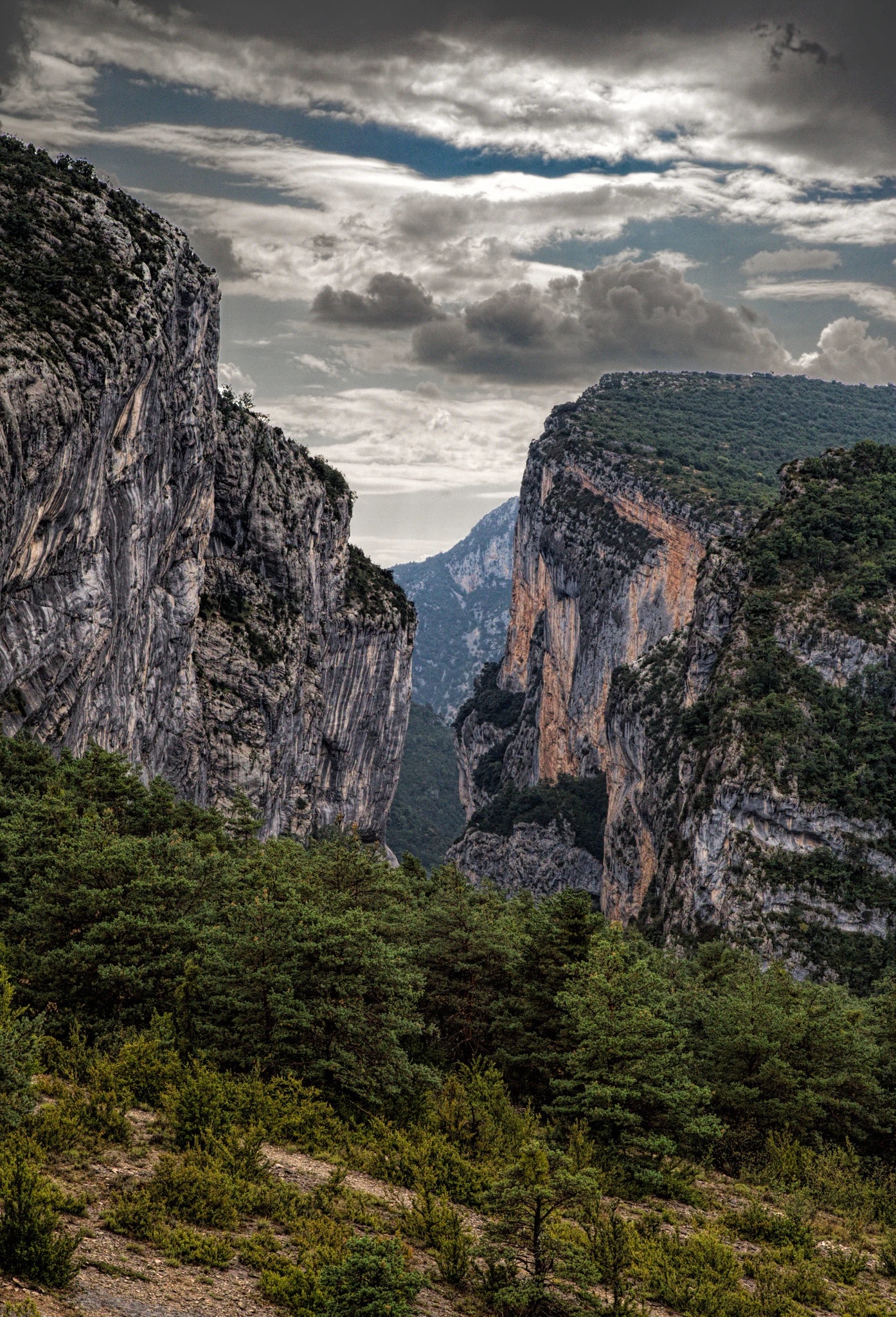
Tall pale limestone walls frame a deep wooded gorge beneath dark and white clouds, with shrubs in the foreground.

Limestone walls of the Verdon gorge, photographed on 10 September 2016. This wider-park view is not identified as a viewpoint on the Valx discovery route.

“Gorges Du Verdon.jpg” by Sheila Sund, CC BY 2.0. Original photograph, unchanged. · Creative Commons

Walks and routes

Valx: the Histoires paysannes discovery loop

The detailed Chemins des Parcs circuit is listed at 1.4 km, with 41 m of ascent and a duration of 2 hours. The park’s overview describes a 2 km walk with less ascent; use the detailed plan linked below and ask staff if gradients matter for your group. The circuit starts and finishes at the Valx car park, taking in an irrigation channel, old stone paving and a viewpoint.

Expect steps at the start and later on the circuit. Take care on the old paving when wet, and follow the visitor route rather than agricultural tracks.


Valx: the Histoires paysannes discovery loop

An unhurried weekday morning

Arrive when reception opens in the morning and ask about conditions. Collect your booklet, then allow the full 2 hours for the discovery loop. Finish before the midday reception break if you need staff help afterwards. Leave the afternoon for a farm booking or Moustiers, according to your plans.

With children who like a story

The optional trail game booklet is sold at the Maison du Parc and Moustiers tourist office; the park lists it at €2. Pick it up before walking. Let the child choose a favourite stop, then use the rest of the route to see how farming has changed the scene. The booklet complements adult supervision around water and steps.

Things to try

Read the landscape through its crafts

The trail’s interpretation uses local ironwork, basketry, dry stone and stone engraving. Choose a couple of stops and ask what each material was doing for the farm. Children can make sketches of the structures or compare a wall’s stonework with a channel’s construction.

Book a farm experience

The educational goat farm is part of a working business. A raised walkway and openings into production areas were designed to help visitors understand the work. Access is through organised sessions: check the current agenda for the theme, age range, language, price and booking instructions. A farm activity can be the main event of the day.

Notice the conservation orchard

The park is conserving older local apple and pear varieties through propagation and planting. A conservation orchard began taking shape at Valx in 2025, and the nursery and orchard are accessible or visible from the educational path. This adds another dimension to the visit: biodiversity also includes cultivated varieties maintained through people’s skills. Look from the permitted route and ask before entering planted areas or touching fruit.

Follow the pottery story in Moustiers

The Musée de la Faïence links the area’s craft history with old ceramics and a video explaining production. Allow the operator’s suggested 30 minutes to 1 hour for a self-guided visit. Tuesday is normally closed and winter opening is limited: check the calendar. In severe weather, follow official travel advice.

Wildlife and habitats

Olive trees at Valx

Olive — Olea europaea. The estate includes cultivated olive groves. Treat these as crops within a working landscape: observe from the public route and leave fruit and branches alone. Their presence helps explain why this small area is useful for talking about Mediterranean agriculture.

Pear trees in the collection

Pear — Pyrus. Pear varieties form part of Valx’s nursery and conservation-orchard work. Read the labels to learn about individual cultivated varieties. Their names and histories are a good reminder that an orchard can hold a collection worth conserving.

Griffon vultures in the wider gorges

Griffon vulture — Gyps fulvus. A wild population lives in the gorges following reintroduction begun in 1999. This is a wider-park wildlife story; sightings on the Valx loop are not promised. At an authorised viewpoint, watch with binoculars from a secure position, well back from cliff edges.

Small life in the channels

The estate manager records white-clawed crayfish in Valx’s irrigation channels. These are living habitats as well as historic structures. Enjoy the water from the path without lifting stones, entering the channel or trying to catch an animal.

Stories and discoveries

Terraces are working structures

The dry-stone walls known as restanques helped organise cultivation on slopes. Look at their relationship to the ground above and below: the visible wall belongs to a whole terrace system. The route’s historical interpretation connects these structures with changes in farming, including the abandonment of some small plots as practices became more mechanised.

A coastline conservancy beside a reservoir

Valx belongs to the Conservatoire du littoral, although your walk is inland. In this lake-and-gorge setting, the estate combines habitat care, restored buildings and continuing agriculture. Even its historic irrigation system works by gravity, linking water management with the shape of the land.

When to visit

Spring and autumn

A mild day suits the interpretation walk, and quieter periods make it easier to combine it with a conversation at reception. Check for heavy-rain, thunderstorm or strong-wind warnings before leaving. After rain, decide according to the condition of the stone steps and paving, not simply the route’s easy grade.

Summer

Heat and wildfire risk can change an outdoor plan. Consult the official fire-access map for the exact area: the park crosses two departments with different restrictions. Start within permitted access hours, carry sufficient water and change plans if conditions are unsuitable.

Winter

Confirm estate access and leave enough daylight for the walk. Wet or icy steps may make another activity a better choice. The Blanc-Martel operator specifically warns about winter rockfall, so canyon walking needs its own careful assessment.

Getting there and practical advice

Maison du Parc and arrival

The address is Domaine de Valx, 135 route des Salles–Aups, 04360 Moustiers-Sainte-Marie. The route starts at the estate car park. The Maison du Parc has reception, information and a shop; telephone +33 (0)4 92 74 68 00. Plan around its weekday morning and afternoon opening periods if you need advice or a booklet.

Food, water and essential needs

Bring water and any food you need, and use toilets before arriving. Ask ahead if an accessible toilet, baby-changing space or refill tap is essential. Farm sessions and cheese sales have their own arrangements; do not rely on finding catering at the estate.

Arriving by car

Navigate to Domaine de Valx rather than simply to the centre of Moustiers. Once you reach the estate, use the identified car park and leave farm access clear. On any later sightseeing drive, stop only in a proper parking or viewing area; pulling onto a narrow roadside to take a photograph can create a hazard.

Coming without a car

Moustiers tourist office lists regional bus line 450 between Riez and Castellane via Moustiers, with seasonal variations. Check the date-specific outward and return services before making plans. A bus to the village is not a verified door-to-door connection to Valx: arrange the final transfer and ask about a suitable walking connection rather than assuming the roadside is a family path.

Ask about the complete journey

Ask about the whole approach from parking to reception and any outdoor area staff suggest. For an indoor alternative, the Musée de la Faïence states that its galleries are accessible to people with reduced mobility; contact it about the village approach and your particular needs.

Check the canyon’s own notices

As checked on 18 October 2026, the Blanc-Martel operator still reports a rockfall closure between the Couloir Samson vehicle turning area and Point Sublime. It describes an alternative via RD23A and GR49. This is a warning for anyone planning that separate hike, not an extension to the Valx loop. Read the current notice and follow local signs; never cross a closure because an older route or photograph shows a path.

Water and cliff country

On a later gorge visit, stay behind viewpoint barriers and keep well back from unprotected edges. River releases and storm runoff can change conditions quickly; do not wade across the Verdon or use low water as evidence that it is safe. Climbing routes can also have nesting restrictions and rockfall hazards. Choose properly planned activities with the necessary equipment and professional advice.

Sources and useful links

Wildlife you might spot

3

Each card links to a full Explore page with photos, traits, and fun facts.

Snap map for this place

Start with the big picture, then zoom in to explore individual wildlife observations around this place.

Loading map…

Good to know before you go

Save the detailed Valx route page before you arrive; it labels the route non-waymarked, even though interpretation stops help explain the site.

Bring water, sun protection and shoes with grip. Do not drink from the irrigation channels or assume there is a public refill point.

Keep children beside you at channels, stairs and terrace edges; stone walls are part of the landscape, not climbing equipment.

Leave dogs at home for Valx

the estate prohibits them because livestock and protection dogs are present.

Keep gates and farm entrances clear, stay on the visitor route and give working animals space.

No fires, camping stoves, barbecues or overnight stays are permitted on the estate. Take your rubbish away.

Frequently asked questions

There is no admission ticket for the regional park as a whole. The Valx discovery path is free. Guided visits, workshops, museums and other attractions may charge separately; check the specific activity before booking.
The farm opens to visitors during scheduled visits and activities. Book through the current park programme; simply walking the estate does not include access to working farm buildings or permission to feed the goats.
No. It is a separate, demanding canyon hike with technical sections, stairs and tunnels. The park discourages it for young children and people affected by vertigo. Choose it only after checking its current access, transport and equipment requirements.
Do not plan an informal swim or river crossing. Dam releases can raise the water suddenly, and currents and siphons are dangerous. Swimming in the Verdon river is prohibited in Aiguines, Castellane, Rougon and La Palud-sur-Verdon. A properly planned lake visit has separate local rules; this Valx outing includes no swimming.

Recent snaps at this place

Recent snaps will appear here as new observations are added.

View all ›

Take the discovery with you

Exploring Verdon Regional Nature Park?

Identify the wildlife you spot, learn as you go, and keep a collection of the adventure.

  1. 1Spot it
  2. 2Snap it
  3. 3Keep the discovery