
Snappit logo
Snappit
Get App
Generic illustration, not a photograph of this venueIllustration
ParkExtremadura, Spain

Cornalvo Natural Park

Cornalvo rewards a slower kind of outing.

About

Cornalvo rewards a slower kind of outing. Water, scattered oaks and denser Mediterranean woodland share a landscape that has long supported both wildlife and rural livelihoods. The dehesa is the open oak-pasture country you see between the wooded slopes: its trees, grazing land and traditional uses are part of the park’s character.

The reservoir gives a first visit a clear focus. At the dam, look at the meeting of masonry, earth and water, then turn your attention to the surrounding habitats. The structure belongs to Mérida’s long story of water supply, but it also has later alterations. A walk here works well alongside the city’s Roman monuments without needing to turn into a long expedition.

Start with advice at the interpretation centre near Trujillanos. The centre and the dam are separate stops, so plan the onward journey before you arrive. For a short visit, combine the displays with a little time beside the dam. For a fuller morning, choose the signed reservoir circuit. Leave the farther corners of this 11,601-hectare park for another day rather than trying to include every route. Wondering what that bird or insect is? Find out on your visit using the Snappit nature app.

Cornalvo’s dam is part of the water-supply history of Roman Mérida, then known as Emerita Augusta. Municipal heritage information links it with the Aqua Augusta system and explains that later work, including alterations in the early twentieth century, changed what visitors see today. It is better understood as a long-used piece of water infrastructure than as an untouched Roman ruin. The dam was declared a National Monument in 1912. Around it, traditional grazing and cork production helped shape a landscape where livelihoods and nature remain closely connected. Cornalvo received an earlier natural-park designation in 1993; the present park was declared through Law 7/2004. Its protected landscape extends well beyond the reservoir.

What to do here

Ask at the interpretation centre which routes are open and how to reach their starting points. At the dam, spend a few minutes understanding the waterworks before looking across the reservoir with binoculars. If the weather and your group suit a longer walk, follow the reservoir circuit through the changing oak habitats. Keep children close to you beside water and on the dam.

Seasonal info

Water levels and the birds using the reservoir change through the year. Dry-season views may include a broad exposed margin; stay on the signed route rather than following the retreating water. After heavy rain, ask about flooded sections and stream crossings. Summer fire restrictions or weather warnings may change access.

Accessibility

For reduced mobility, ask about the interpretation centre and the separate route from El Mendrillo to the reservoir’s northern end. The official brochure describes this 2 km section as designed for people with reduced mobility. Confirm its present surface, barriers, gradients and return arrangements for your chair or pushchair. That description does not cover the full reservoir circuit.

Don't miss

1

The dam and the story of Roman water supply to Mérida

2

A reservoir circuit where open dehesa gives way to denser oak woodland

3

Waterbirds on the reservoir and smaller birds among the trees

4

The interpretation centre’s explanation of water, wildlife and working landscapes

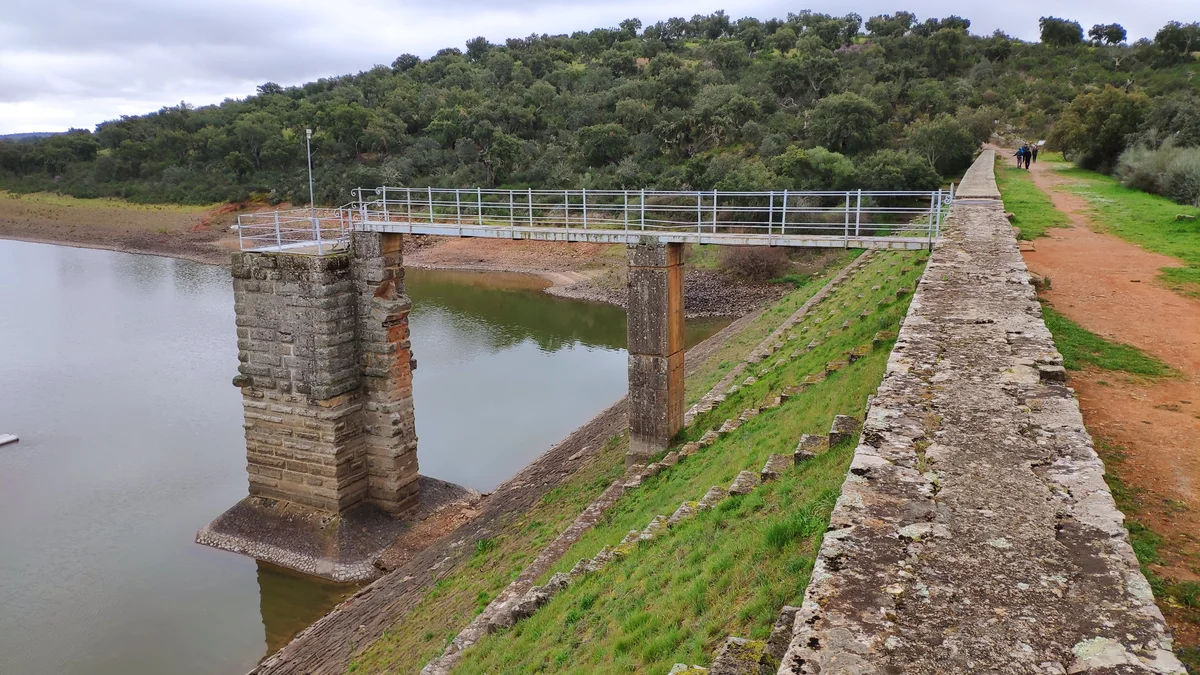
A stone water-intake tower linked by a metal walkway to the dam beside Cornalvo reservoir, with wooded slopes behind.

The dam tower and reservoir in Parque Natural de Cornalvo, photographed in March 2019.

Torre de la presa romana de Cornalvo, Extremadura.jpg — Alonso de Mendoza / Wikimedia Commons / CC BY-SA 4.0 · Creative Commons

Walks and routes

Embalse de Cornalvo: the reservoir circuit

Choose this for a proper half-day with the centre. The park brochure gives a 7 km circuit; the birding guide gives 6.8 km. Start at the dam-side route access and follow the signed circuit, which includes the dam crossing, woodland paths and more open oak pasture. Allow 2½–3 hours with stops. Use the official map and current signs at junctions rather than tracing the water’s edge.

The route mixes paths and tracks and is separate from the adapted El Mendrillo section. Do not assume that the circuit or dam crossing is wheelchair-accessible. Ask about gates and uneven sections if using a pushchair.


Embalse de Cornalvo: the reservoir circuit

El Mendrillo to the reservoir’s northern end

The park brochure describes a 2 km section from El Mendrillo parking to the reservoir’s northern end, designed for people with reduced mobility. It offers a way into the oak-pasture landscape without committing to the reservoir circuit. Plan the return as well: retracing the whole section gives about 4 km in total, or turn back earlier to suit your group.

Confirm current surface firmness, slopes, gate widths, resting places and parking access directly with staff. Ask whether assistance is useful for your chair or pushchair. The brochure’s accessibility label belongs to this particular section.

El Mendrillo to the reservoir’s northern end

A gentle introduction: about 1½–2 hours

Visit the centre for an overview, allowing roughly 30–45 minutes. Continue by your planned transport to the dam area and spend 30–45 minutes looking at the waterworks and birds from open public access points. Leave a margin for the transfer and staff advice. If access is restricted or the heat is uncomfortable, shorten the outdoor stop.

A walking morning: roughly half a day

Start with the centre, then transfer to the reservoir route. Allow 2½–3 hours for the circuit, with water and a snack already packed. Enjoy a few longer stops rather than trying to reach El Rugidero or Las Muelas as well. Plan your return transport before leaving the start.

A visit planned around access

Contact the centre first about your equipment and needs. Combine its indoor visit with a confirmed suitable length of the El Mendrillo section. Decide in advance where to turn back, whether you need assistance and where the nearest usable toilet will be. You do not need to complete a set distance for a worthwhile visit.

Things to try

Make one quiet birdwatching stop

Choose an open, permitted place on the route and spend ten minutes looking across the water. First separate swimming birds from those standing at the margin; then try a few identifications. Birds move with the seasons and water levels, so use the species suggestions as possibilities rather than a checklist you must complete.

Compare open pasture and woodland

Notice where oaks stand well apart and where their crowns become a denser wood. Look at leaf shapes, bark and the ground beneath the trees without picking or peeling anything. The contrast helps explain how grazing and traditional land use have shaped the dehesa.

Follow the idea of a water supply

At the centre, ask how water was gathered and carried towards Mérida. At the reservoir, look for the different jobs done by the dam and intake structures. Children can sketch a simple reservoir-to-town story without climbing on stonework.

Keep the centre, postpone the circuit

If the centre is open, use its displays to explore the park’s water and wildlife story. Postpone the reservoir walk when flooding, high winds or storms make it unsuitable. Do not enter a stream channel or the granite gaps at El Rugidero to watch fast-flowing water.

Wildlife and habitats

Great crested grebe

On open water, look for a slim-necked bird that repeatedly dives. Its head ornament is clearest in breeding plumage. Watch a single bird from the path and see where it resurfaces, rather than moving down to the shore.

Mallard

Compare the shapes and behaviour of the ducks on the reservoir before worrying about every colour. Mallard is one of the waterbirds named in the Cornalvo guide. Use binoculars and let the birds choose their own distance.

Grey heron

Scan the margin for a tall bird standing almost motionless, then watch its slow, deliberate movements. Keep watching from the path rather than stepping closer for a photograph.

Eurasian nuthatch

In the oak woodland, look along trunks as well as out into the canopy. A small bird moving headfirst down a trunk is worth a closer look. Listening quietly for a minute can be more productive than continuing to walk.

Hoopoe

In open dehesa, watch for a bird with strongly patterned black-and-white wings and a long curved bill. It often looks most distinctive when it takes flight. Stay on the route and avoid following it into grazing fields.

Black stork

This is one of Cornalvo’s emblematic wild birds. Learn its dark upperparts and contrasting white belly at the centre, then enjoy any distant view without trying to get closer. Never search for a nest or leave the public route to follow a bird.

Stories and discoveries

A dam with several chapters

The Roman origin is only part of what you see. Mérida’s heritage account also describes early-twentieth-century work, which is a useful reminder that infrastructure changes while its purpose continues.

A living rural landscape

Grazing and cork are part of Cornalvo’s story. Fences and livestock are therefore clues to how the landscape works as well as things visitors need to respect. The protected park contains working land, so public paths do not give permission to enter every field.

Granite shaped by water

El Berrocal del Rugidero is another park landscape, with granite forms shaped by running water along the Las Muelas stream. If you want to add it, ask staff about its separate route and conditions. It is not a quick detour to improvise during the reservoir circuit, especially after rain.

When to visit

Spring: listen as well as look

Choose a mild morning for the oak woodland and dehesa. Stop occasionally to listen before using binoculars. Keep particularly well away from nesting birds and leave all flowers in place.

Summer: make the plan smaller

Prefer a short early visit, carry ample water and check heat and fire advice. Shade beneath scattered trees is not continuous shelter. If the morning is already uncomfortable, choose another day for the full circuit.

Autumn and winter: watch the water and the forecast

The reservoir can reward winter birdwatching, while autumn offers walking opportunities in cooler weather. Wear layers for a stationary birdwatching stop. After heavy rain, ask about flooded paths before choosing a loop that commits you to a crossing.

Getting there and practical advice

Interpretation centre near Trujillanos

Find the centre on the Trujillanos–Cornalvo reservoir road near the Ermita de San Isidro. Its displays explain water, habitats, the dehesa and the park’s history. It is the useful first stop for current walking advice. Contact +34 924 327 400, +34 630 125 172 or [email protected].

Opening times and admission

The park brochure lists daily winter hours of 09:00–14:00 and 16:00–18:00, and summer hours of 08:00–15:00. Other official guides show different afternoon hours, so confirm your date, including any holiday arrangement, before travelling. The regional birding-services catalogue lists free centre entry; ask separately about organised activities.

Parking and toilets

Official visitor information identifies parking at the centre and at park route starts, while an accessibility guide records an adapted centre entrance, parking space and toilet. Confirm that the facilities you need are available that day. Do not assume there are toilets at the reservoir or that all parking-to-path connections suit a wheelchair.

Bring your own essentials

Bring drinking water and any food you need before entering the park. Ask staff where you may stop for a picnic, take all rubbish away and leave livestock access clear. Do not plan around an unconfirmed café, shop or drinking-water point.

Arrive via Trujillanos

From the A-5 corridor near Mérida, follow signs towards Trujillanos and the Cornalvo interpretation centre. Use the centre’s name as your initial destination; the dam and El Mendrillo are separate onward destinations. Follow current park signs and stay on roads or tracks open to visitors.

If you are not driving

Arrange the whole outward and return journey before you go. Ask the centre about current transport options to the chosen route start, or agree a taxi collection in advance. A journey to Trujillanos alone does not deliver you to the reservoir, and walking the access road adds distance to the outing.

Start with the centre

Published accessibility information describes an adapted entrance, ground-floor display spaces, parking and toilet. Ask staff about the present layout and any assistance or sensory support you need, especially if access details are important to your visit. Confirm the toilet arrangement rather than relying on an older description.

Choose the specific adapted section

Ask for the El Mendrillo–reservoir-tail section by name and explain what chair, walker or pushchair you use. Discuss distance in both directions, path firmness after rain and any barriers. The full reservoir circuit and the granite area at El Rugidero need separate advice.

Sources and useful links

Wildlife you might spot

6

Each card links to a full Explore page with photos, traits, and fun facts.

Snap map for this place

Start with the big picture, then zoom in to explore individual wildlife observations around this place.

Loading map…

Good to know before you go

Check the centre’s opening hours and the day’s route advice before travelling: +34 924 327 400 or +34 630 125 172. Ask specifically about dam access, El Mendrillo and any work or weather-related diversions.

Bring all the drinking water you need, sun protection and shoes with a good grip. Do not depend on a reservoir-side café or water refill.

Choose one main walk. The 7 km circuit is a proper outing; adding El Rugidero or Las Muelas extends the day beyond a simple lap of the reservoir.

Follow marked public routes, respect private-property signs and close any livestock gate you need to open. Keep well clear of grazing animals.

Swimming is prohibited in the park’s reservoir and watercourses, and recreational navigation is prohibited on Cornalvo reservoir. Plan to enjoy the water from the path.

Keep dogs on a lead and under control in public-use areas. Do not let them enter the water or approach livestock.

Watch birds quietly from the path with binoculars. Give feeding and resting birds space, never approach nests and leave flowers, bark and other natural material in place.

Do not light a fire, leave litter or camp overnight in the park. Save the route information before setting off and follow any temporary restrictions at the entrance.

Frequently asked questions

Begin at the interpretation centre on the Trujillanos–Cornalvo reservoir road, near the Ermita de San Isidro. Trujillanos is the gateway for this visit, while the natural park itself extends across Aljucén, Guareña, Mérida, Mirandilla and San Pedro de Mérida. Ask staff for the best current approach to your chosen route.
The park brochure lists daily winter hours of 09:00–14:00 and 16:00–18:00, and summer hours of 08:00–15:00. Other official guides give different afternoon hours, and the seasonal changeover dates are not specified. Confirm your date on +34 924 327 400 or +34 630 125 172 before relying on a visit.
Municipal tourism describes the dam as an open-air visit outside an enclosed monument, and the park rules allow ordinary visits on established public routes. Arrange educational visits and guided activities with the centre. Organised groups of more than 20 people require authorisation under the park’s management plan.
The regional birding-services catalogue lists free admission to the interpretation centre. Check the current arrangements and any separately booked activity charges with staff. The municipal dam listing describes a free-standing outdoor visit rather than a timed ticketed monument.
The official reservoir route is a circuit of about 7 km. Check that the complete route, including the dam crossing, is open before starting. Give yourself time for uneven paths, gates and birdwatching stops; do not improvise a shortcut across an exposed or flooded reservoir margin.
Ask first about the centre and the El Mendrillo route designed for reduced mobility. The published 2 km is the section between El Mendrillo and the reservoir’s northern end; returning along it adds the same distance. Confirm surfaces, access from parking, turning space and toilet availability. The main reservoir circuit is a different route.
Swimming is prohibited in the park’s waters, and recreational boating or paddling is prohibited on Cornalvo reservoir. Dogs must be kept secured and controlled in public-use areas; bring a lead and check any additional restrictions for the visitor centre.
No. Cornalvo and Proserpina are separate reservoirs associated with Mérida’s historic water systems. Check that your directions say Cornalvo and use the Trujillanos visitor centre as the starting reference for this outing.

Recent snaps at this place

Recent snaps will appear here as new observations are added.

View all ›

Take the discovery with you

Exploring Cornalvo Natural Park?

Identify the wildlife you spot, learn as you go, and keep a collection of the adventure.

  1. 1Spot it
  2. 2Snap it
  3. 3Keep the discovery







