Snappit logo
Snappit
Get App
Generic illustration, not a photograph of this venueIllustration
ParkAndalucía, Spain

Generalife Gardens

The Generalife rewards a slower look.

About

The Generalife rewards a slower look. Alongside the familiar fountains, notice how a hedge makes an outdoor room, how a channel orders a courtyard and how shade changes the feel of a path. The Patio de la Acequia is the natural centrepiece, but the gardens leading to it are worth your attention too.

This was an almunia: an estate combining agricultural production with a place of retreat for Granada’s rulers. Terraced huertas were part of its purpose, rather than a decorative backdrop. You can read that relationship in the slopes, retaining walls and water system without leaving the public route or entering cultivated plots.

The landscape has kept changing. The upper gardens reflect nineteenth-century tastes; much of the lower garden approach took shape in the twentieth century. Even the famous crossing jets in the Patio de la Acequia are a later addition. Enjoy the layers instead of imagining that every bed and fountain survives unchanged from the medieval period.

Make the gardens and Generalife palace courtyards a complete outing in their own right. They belong to the larger Alhambra–Generalife monument, but the Generalife palace is a different place from the separately timed Palacios Nazaríes. Choosing the right ticket is the most important part of planning. Don't forget to bring the Snappit nature identification app along to scan local species.

The Generalife developed as a medieval royal estate beside the Alhambra, combining residence, recreation and productive terraces. After the conquest of Granada in 1492, its care passed through appointed custodians and later the Granada-Venegas family. It became state property in 1921. Later gardening has made a visible mark. The Patio del Ciprés de la Sultana has a gallery dated 1584 and further changes to its pools. The Jardines Altos belong to the nineteenth-century transformation of the estate. Jardines Bajos were developed in stages in 1931 and 1951; an outdoor theatre followed in 1952 for Granada’s music and dance festival. Water, plants and architecture have remained connected through these changes.

What to do here

Start at the Pabellón de Acceso and follow the signed Generalife route through Jardines Bajos towards the palace courtyards. Give the Patio de la Acequia time, then choose whether the stair-heavy upper gardens suit you. Finish with a few plant observations rather than rushing to collect every viewpoint.

Seasonal info

Flower displays depend on weather and garden care; there is no single guaranteed peak. Evergreen hedges and water features give structure outside flowering season. Summer heat, wet paving and winter cold can all change how much you want to walk. Check the latest notice before travelling.

Accessibility

The lower Generalife gardens have a mapped practicable wheelchair route, with slopes and varied surfaces. The upper gardens and Escalera del Agua involve stairs and are not a step-free option. Use the official accessibility plan and ask staff about the palace-courtyard route, current barriers and an appropriate return before passing the controls.

Don't miss

1

The water axis and garden beds of the Patio de la Acequia

2

Clipped cypress rooms and changing perspectives in Jardines Bajos

3

The later garden and pools of the Patio del Ciprés de la Sultana

4

Laurel shade and water channels on the stepped Escalera del Agua

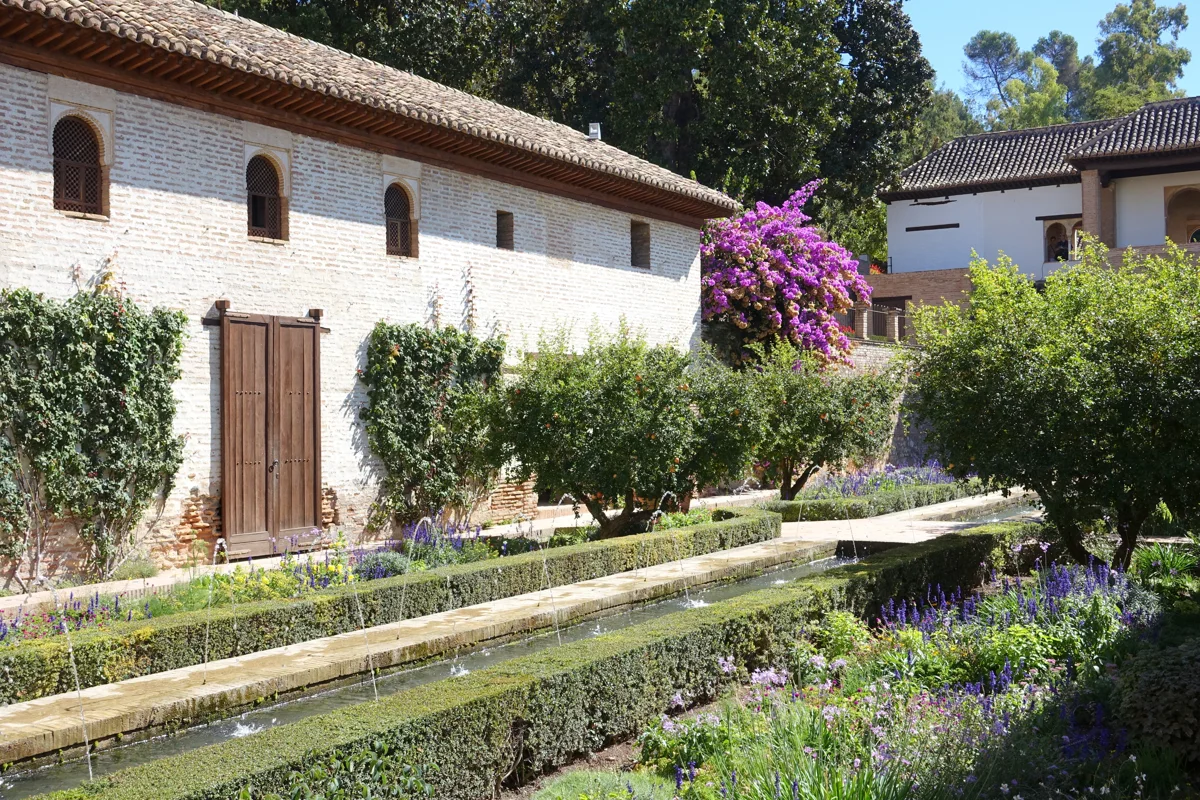
A narrow water channel with small jets runs between clipped hedges and purple flowers beside whitewashed garden buildings.

Water jets, planting beds and clipped hedges at Patio de la Acequia in the Generalife, photographed in October 2014.

Patio de la Acequia (Generalife) - DSC07802.JPG — Daderot / Wikimedia Commons / CC0 1.0 Universal Public Domain Dedication · Creative Commons 1 · Creative Commons 2

Walks and routes

Jardines Bajos and the palace courtyards

From the main access pavilion, follow the signed Generalife approach through the lower gardens. Compare the clipped green enclosures before giving most of your time to the Patio de la Acequia. Continue to the Patio del Ciprés de la Sultana where the current circulation allows, then follow the signed exit. This is a suggested selection of visitor spaces, not a separate waymarked hiking trail.

Use the mapped practicable lower-garden path if you need it. Changes of level and palace thresholds require individual planning; ask staff which courtyard approach and exit suit your wheelchair.


Jardines Bajos and the palace courtyards

Add the Jardines Altos and Escalera del Agua

If stairs are comfortable and the section is open, extend the visit into the upper terraces. Notice the smaller fountains, framed beds and changing tree canopy. The Escalera del Agua brings running channels beside the steps into the experience. Use the signed onward route; Paseo de las Adelfas connects with Paseo de los Cipreses towards the exit.

Steep steps lead into the upper gardens, and the Water Staircase is a staircase. There is no step-free version of this extension. Be particularly careful on wet surfaces.

Add the Jardines Altos and Escalera del Agua

A focused morning

Use the lower gardens and palace courtyards as the main visit, allowing 90 minutes to two hours. Take a toilet break before the controlled palace section and decide whether to add any stairs while you still have energy. Leave the other ticketed areas optional.

A garden-lover’s longer visit

Allow about two to three hours if you want the core visit, upper terraces and pauses for plants. Choose a few examples of clipping, canopy and water use rather than trying to identify every species. Keep the upper section optional if heat or stairs become tiring.

Combining the wider monument

With Alhambra General, fix the Nasrid Palace time first, then place the Generalife before or after it with enough transfer time. Give the whole outing half a day. A garden-only product cannot be upgraded simply by walking to the palace queue, and current works may alter other areas.

Things to try

Read the garden through its water

At the Patio de la Acequia, look along the channel before photographing it. Notice how water divides the space and how paths and planting respond to that line. Try comparing a still reflection with the movement and sound of a jet, without leaning over the water or obstructing other visitors.

Find an outdoor room

In Jardines Bajos, notice how hedges and arches make boundaries without a building. Choose one view through a green opening, then move along the permitted path and see how it changes. Children can look for three different ways a plant creates shade or an edge.

Listen to a plant story

The Patronato has a Spanish-language web collection of short Generalife plant recordings. Try one before your visit, then match its plant to what you can see from the public path. These online recordings are separate from the on-site general audioguide service.

In light rain, simplify the visit

If the site remains open, concentrate on the lower garden and courtyard sections that staff recommend. Wear grippy shoes and skip the upper stairs if wet conditions make them uncomfortable. Covered passages do not turn the whole Generalife into an indoor visit.

Choose an indoor visit separately

Palacio de Carlos V and the Museo de la Alhambra provide a possible alternative nearby, with their own opening and entry arrangements. Check these before changing your plan. A Generalife ticket does not give access to Palacios Nazaríes as a rain shelter.

If access is restricted

Follow staff and posted notices during wind, storms or safety work. Do not cross a barrier to recover a missed viewpoint. If an important area is affected, ask the Patronato about the applicable ticket conditions rather than assuming automatic compensation.

Wildlife and habitats

Italian cypress

Look at the contrast between tall cypresses and clipped green walls or arches. Their shapes show how the same tree can frame a path or define a garden room. The named Ciprés de la Sultana is a dead historical tree, not an example of current living growth.

Bay laurel

The Water Staircase’s canopy is formed from cultivated laurel. If you take that stepped extension, compare the leafy overhead cover with the channels beside you. Appreciate the leaves without picking or rubbing them.

Oleander

On Paseo de las Adelfas, trained oleanders create an overhead gallery. Look for their narrow leaves and, in season, flowers. The plant is toxic: keep hands and snacks separate, and never taste any part.

Strawberry tree

The Patronato documents cultivated strawberry trees in the Generalife, including the Tabla de los Bojes. Look for evergreen leaves and rough-surfaced fruit in season without leaving the visitor path. Its name is a recognition clue, not an invitation to pick.

Southern magnolia

Magnolias are documented in Jardines Altos. On that optional stepped route, look for large glossy leaves with a brownish underside; white flowers are seasonal. Their broad leaf texture contrasts with the smaller foliage of the clipped hedges.

These plants are documented as cultivated parts of the Generalife. Look from the permitted paths and use labels or the official plant guide where available. Seasonal displays and individual specimens can change; leave all leaves, flowers and fruit in place.

Stories and discoveries

The crossing jets came later

The Patio de la Acequia’s celebrated crossing sprays were installed in the nineteenth century. The underlying irrigation channel has a much older role. That contrast is a useful reminder that conserving a historic garden involves a landscape shaped by several periods.

A romantic name is not a historical record

The Patio del Ciprés de la Sultana is associated with literary love stories popularised by Ginés Pérez de Hita. The Patronato presents them as imagined legends. Enjoy the name, then look at the documented later gallery and pool arrangement around you.

A productive estate behind the garden

The palace belonged to an estate with terraced huertas held by substantial walls. Agriculture and recreation were intertwined here. Views towards those cultivated spaces help explain the Generalife, but a view across a wall does not make a working plot part of the public itinerary.

Look for gardening across the centuries

The nineteenth-century upper terraces and twentieth-century lower gardens sit alongside the medieval palace landscape. Their differences are part of the interest: compare enclosed courtyard planting, clipped green architecture and a more open view towards the Alhambra.

When to visit

Spring: take time over the changing beds

Mild conditions can make a longer garden visit appealing. Look for seasonal flowers, fresh leaves and the contrast between bright planting and clipped evergreens. Let the day’s display guide you; a plant’s usual flowering period is not an appointment.

Summer: keep the plan flexible

Start early, bring sun protection and use permitted water and rest stops. Shade is valuable, but it does not make every courtyard or terrace cool. Shorten the upper-garden extension if the heat is taking the pleasure out of looking around.

Autumn: gardens by day, selected nights

Look at fruit and changing foliage while leaving both on the plants. From 15 October the daytime closing time moves to 18:00. The published garden-night season continues only on Friday and Saturday evenings until 14 November.

Winter: structure and an earlier finish

Evergreen outlines, bare branches and the water’s relationship with architecture remain rewarding. Dress for an outdoor hillside visit and take extra care on damp or icy steps. The regular Generalife night programme is not listed for mid-November through March.

Getting there and practical advice

Tickets, information and help

The Pabellón de Acceso is the useful starting point for a Generalife-focused visit. Ask for the current plan and any access changes. Visitor enquiries: +34 958 027 971 or [email protected]. Ticket-purchase enquiries: +34 858 889 002.

Plan toilet stops

Toilets are shown at the access pavilion and by the lower Generalife gardens. Adapted toilets are explicitly listed at the Pabellón de Acceso and the services building beside Puerta del Vino. Ask which open facility meets your needs before choosing a longer circuit.

Lockers and belongings

Free storage is offered with a same-day official ticket at the access pavilion and beside Puerta del Vino, subject to available lockers. Oversized luggage may not fit. Keep a small bag and your ticket with you; carry a permitted small backpack in front in fragile interiors.

Rest, drinks and shopping

The official plan marks rest areas and food/drink services at the main access area. Use designated areas for eating and drinking and ask staff where to refill or take a water break. The decorative channels are not drinking-water points. Shops are at the entrance pavilion and Palacio de Carlos V.

Check audio and signed support before relying on it

The FAQ currently marks the general audioguide unavailable, although other official access information still refers to audio description and signed guides. Contact visitor services before travel if either is important. The separate online plant recordings can be used to prepare.

If someone becomes unwell

Tell the nearest member of staff promptly. The official plan identifies first aid by Puerta del Vino; do not send an unwell person searching across the grounds alone. In an emergency, use 112 and follow the staff’s directions.

Use a city bus for the uphill approach

C30 links the city centre at Plaza Isabel la Católica with the Alhambra; C32 links the Alhambra and Albaicín. Check the current stop, route changes and return service before setting out, especially for a night visit. Ask for the stop serving the Pabellón de Acceso for this garden-focused plan.

Walking up from Granada

Official pedestrian approaches include Cuesta de Gomérez from Plaza Nueva, Cuesta del Realejo and Cuesta del Rey Chico from Paseo de los Tristes. These hillside approaches add effort before the garden visit. Follow current signs towards the main access pavilion; do not treat Puerta de la Justicia as the Generalife entrance or a step-free shortcut.

Driving and parking

Approach the Alhambra car park via Ronda Sur rather than driving up through the restricted city-centre route. The public parking area is beside the main access approach, with reserved adapted-vehicle spaces in P1. Check tariffs and the final walking route before travelling.

Wheelchair travel needs a whole-journey plan

The city describes C30 and C32 minibuses as ramp-equipped. Check the particular service, available wheelchair space and the path from the stop to the entrance. A ramp on the bus does not remove slopes and uneven paving within the monument.

Choose the lower-garden route deliberately

The official accessibility plan marks practicable sections through Jardines Bajos and distinguishes smoother paving, uneven surfaces and cobbles. It also shows gradients in different bands. Follow that plan with staff advice; a single percentage would not describe this whole visit.

Upper terraces are a different proposition

Jardines Altos are reached by steep steps, and the Escalera del Agua adds further stair climbing. The city’s wheelchair guidance excludes the upper garden. Keep those areas out of a step-free itinerary and ask about suitable viewpoints on the lower route instead.

Wheelchair loans and assistance

Wheelchairs can be borrowed at the access pavilion subject to availability, identification and a loan form. Arrange your visit around the equipment you normally need rather than assuming a loan chair will suit you or that assistance with slopes is included.

A quieter way to explore

Try short pauses to listen to water away from busy bottlenecks. For visual or hearing access support, contact visitor information about current resources and assistance. Touch only designated tactile interpretation points when invited; historic decoration and living plants must be left alone.

Daytime gardens-focused ticket

Jardines, Generalife y Alcazaba was listed at €12.73 online when checked. It covers Generalife gardens and palace, Partal and Alcazaba, plus the named connecting garden areas. It excludes Palacios Nazaríes. Access to any included area still follows current restrictions; the Alcazaba is operating an adapted route.

Add Palacios Nazaríes

Alhambra General was listed at €22.27 online. It includes the Generalife alongside Partal, Alcazaba and the Nasrid Palaces. The Palacios Nazaríes appointment is binding: leave enough time to reach that entrance from wherever you start. The remaining included areas can be visited during daytime opening on the same date.

A separate seasonal night visit

Visita Nocturna a Jardines y Generalife was listed at €8.48 online. Its published route names the access pavilion, Paseo de los Nogales, Jardines Nuevos or Bajos and the Generalife palace. Sessions are Tuesday–Saturday, 22:00–23:30, from 1 April–31 May and 1 September–14 October; Friday–Saturday, 20:00–21:30, from 15 October–14 November. No regular garden-night dates are listed for the remaining periods. Check actual availability.

Alhambra Experiencias spans two visits

Alhambra Experiencias was listed at €22.27 online. It pairs a night visit to Palacios Nazaríes on the ticket date with daytime Generalife, Partal and Alcazaba on the following day. It is not a Generalife night ticket. Choose it only if that two-day arrangement fits your plans.

Daytime opening

Daily from 08:30 to 18:00 between 15 October and 31 March, and from 08:30 to 20:00 between 1 April and 14 October. The monument closes on 25 December and 1 January. Give yourself enough time to finish before closing; buying a ticket is not a promise of admission to every area at the last moment.

Sources and useful links

Wildlife you might spot

5

Each card links to a full Explore page with photos, traits, and fun facts.

Snap map for this place

Start with the big picture, then zoom in to explore individual wildlife observations around this place.

Loading map…

Good to know before you go

Choose the exact ticket product before paying. Alhambra General already includes the Generalife; you do not need an extra gardens ticket with it.

Bring the named ticket with its readable QR code and your original DNI or passport. Keep both available throughout the visit; a phone photograph of your identity document is not the original.

If your ticket includes Palacios Nazaríes, organise the day around its printed entry time. Arriving at the main entrance is not the same as reaching the palace control.

Arrive with time for bag checks, toilets and any reduced-price documentation. Backpacks or bags over 40 × 40 cm are prohibited; travel light rather than relying on a free locker being available.

Wear shoes with grip. Keep children beside you near channels, pools and uneven steps; the garden is not a play area, and its water features are not for paddling.

Leave plants, fruit and flowers in place. Oleander is toxic, and the collection is for looking at rather than tasting or collecting.

Take handheld photographs without blocking the path. Tripods need express permission; follow the restrictions on flash, selfie sticks and professional filming.

Check where food, drinks and rest stops are permitted. Finish your courtyard visit before leaving its controlled area: do not plan on returning through the same ticket check later.

Frequently asked questions

No. Jardines, Generalife y Alcazaba includes the Generalife palace and gardens, plus the named Partal and Alcazaba areas. Palacios Nazaríes requires a product that expressly includes it, such as Alhambra General. Check the product descriptions above before buying.
The standard daytime products allow the Generalife during their valid day and opening hours. The separately printed timed admission applies to Palacios Nazaríes. Generalife entry is still controlled for capacity, so queues and staff instructions can affect when you pass through.
You can leave the wider complex and continue with included areas you have not yet visited, within the ticket’s validity. Each controlled visitable area is normally entered once. Ask at the control before leaving; do not assume that an all-day ticket gives unlimited Generalife re-entry.
Yes, including when admission is free. The current FAQ requires ages 3–11 to be reserved with the adult booking. Tickets for children under 3 are issued at the ticket office or access points without an advance reservation. Under-12s must remain accompanied by an adult.
Plan to use a carrier for the Generalife. The FAQ excludes pushchairs from its visitable spaces, while other official pages name the palace specifically; connecting paths are treated separately. Ask staff where to leave yours and where it may be used. The published carrier-loan service is at Puerta del Vino, with a 12 kg limit and limited availability.
Pets are not admitted. Accredited guide and assistance arrangements have exceptions; contact the Patronato beforehand about the documentation for your animal. Do not assume that an ordinary pet can accompany a garden-only visit.
Choose carefully: the official products do not allow ordinary date or time changes or refunds. Specified exceptions apply, including a visit prevented for a reason attributable to the Patronato. Read the purchase policy for your case, and check visitor details before payment.
It covers its own limited evening itinerary through Paseo de los Nogales, Jardines Bajos and the Generalife palace. It does not promise every daytime terrace or the Escalera del Agua. Pick daylight if detailed plant and garden exploration is your priority.

Recent snaps at this place

Recent snaps will appear here as new observations are added.

View all ›

Take the discovery with you

Exploring Generalife Gardens?

Identify the wildlife you spot, learn as you go, and keep a collection of the adventure.

  1. 1Spot it
  2. 2Snap it
  3. 3Keep the discovery