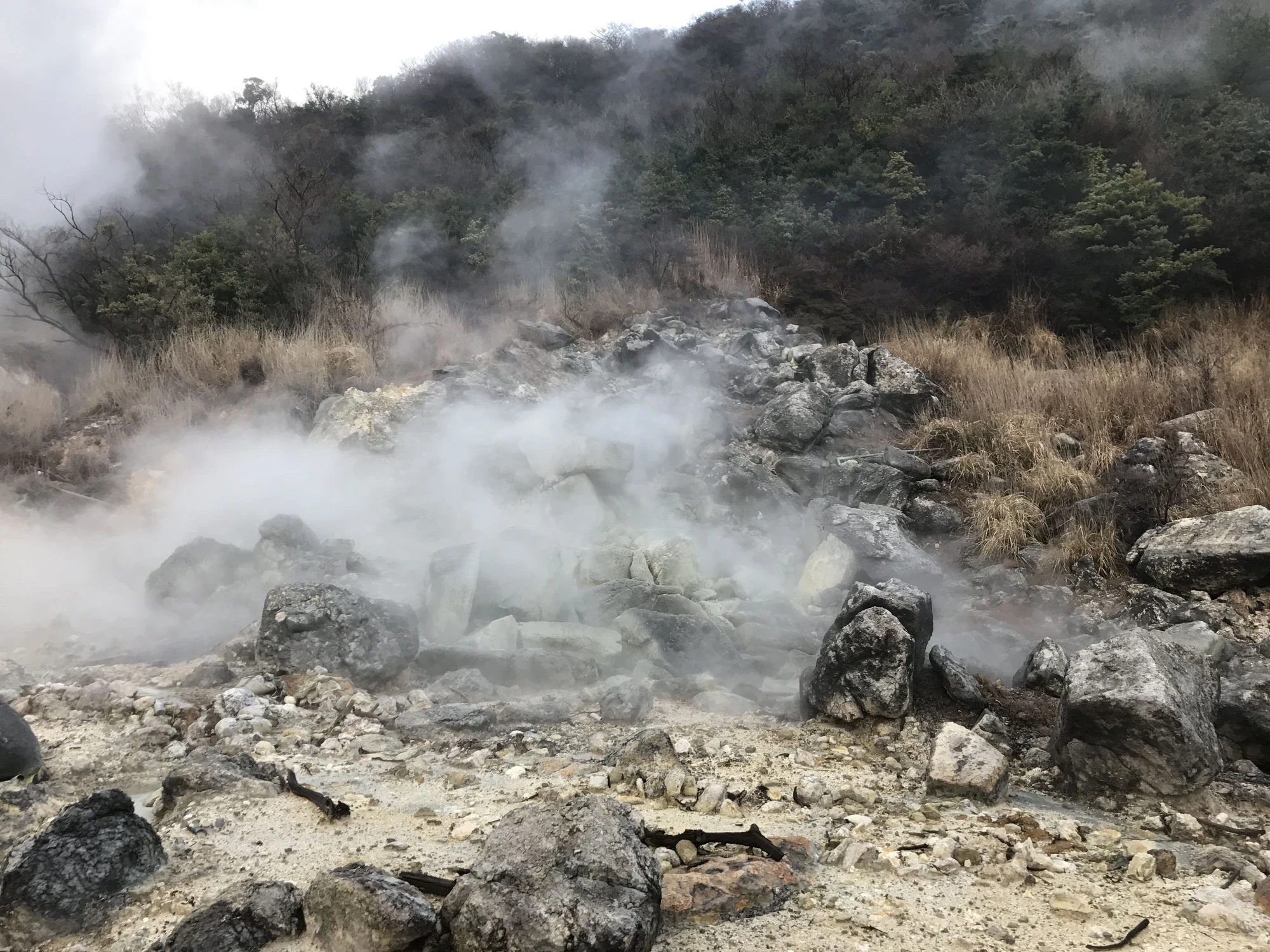
Unzen makes a volcano visit possible without a summit climb. In the hot-spring town, pale ground steams beside the streets, small mud cones change shape, and trees gather around the edges of the geothermal field. Begin at Unzen Visitor Center, locally called Unzen Oyamano Johokan, then spend an unhurried hour or so on the open Jigoku paths. If everyone still wants to walk, the wooded shore of Shirakumo-no-ike offers a gentler change of scene.
This is one corner of a much larger national park. Unzen-Amakusa spans parts of Nagasaki, Kumamoto and Kagoshima, bringing together the volcanic mountains of the Shimabara Peninsula and the islands and coasts of Amakusa. The visitor center and town walk described here are in Nagasaki. Dolphin boats, island viewpoints and marine activities belong to a separate Amakusa outing, with their own travel and weather decisions.
The center helps connect what you see to what lies underground. Use the model of the Shimabara Peninsula to place the mountains and bays, then explore the exhibits on volcanoes and hot springs. Ask staff which paths are open before setting off. The main information building and its historical annex are different places, with different weekly opening arrangements; the annex is useful for old photographs and a quiet break.
Outside, Jigoku means “hell,” a name that fits the hissing vents and clouds of steam. Look for the gray-white clay-like ground, altered by heat and acidic water, and the pale mineral crusts around outlets. At the mud volcano area, escaping gas pushes sticky wet sediment into miniature cones. Daikyokan Jigoku is known for vigorous steam, but a large plume is only one part of the story: a bubbling patch or a newly shaped mud cone can be just as absorbing. View everything from the open paths and platforms.
Notice how quickly the plant cover changes near the hot ground. Grasses and low shrubs occupy places that feel very different from the surrounding woodland; red pines rise farther back. In spring, Miyama Kirishima azaleas add pink to the Unzen landscape. Warm spots around the Jigoku can flower earlier than Ikenohara or Nita Pass, so a single blossom forecast cannot describe the whole mountain. Take a photograph or make a sketch rather than picking a specimen.
For a quieter finish, ask about the walking approach to Shirakumo-no-ike, a small artificial pond surrounded by forest. Pause at the shore and listen before looking for birds. Long-tailed tits can move through the trees in little groups, while a jay may announce itself before it appears. Returning to town for lunch or a bath makes a satisfying half-day. Climbing Kinugasayama above the pond, continuing to the high Fugen trails, and traveling to Amakusa all deserve separate time and preparation. Planning to visit? Download the Snappit app to identify the wildlife you spot in real-time.
Unzen was designated on 16 March 1934 as one of Japan’s first national parks, alongside Setonaikai and Kirishima. The Amakusa area was added in 1956. The town had already developed as a summer retreat for overseas visitors, and the center’s historical displays help explain that resort culture. The Jigoku also holds a much darker history: Christians were persecuted and tortured here in the seventeenth century. The Christian martyrs’ memorial deserves a quiet, respectful stop. More recently, the eruptions that began at Fugen in 1990 reshaped the eastern mountain landscape and formed the Heisei Shinzan lava dome; the town’s geothermal paths and the restricted dome are distinct places.