Snappit logo
Snappit
Get App
Generic illustration, not a photograph of this venueIllustration
ParkCastilla-La Mancha, Spain

Abelardo Sánchez Park

Albacete’s Parque Abelardo Sánchez is an easy place to slow down between city sights.

About

Albacete’s Parque Abelardo Sánchez is an easy place to slow down between city sights. Its roughly 11 hectares bring together mature planting, broad walks, sculpture and places to sit. You can make a worthwhile visit without a car, hiking kit or a full afternoon: choose a shady stretch, notice what is moving in the trees and give yourself permission to linger.

For a first visit, use the main promenade and Fuente Larga as your anchors. The fountain gives children something concrete to look for, while the surrounding planting rewards a slower pace. Add the music pavilion or another sculptural fountain if everyone still feels like walking. There is no need to turn a pleasant park break into a search for every monument.

This is a planted city garden with wildlife living around everyday human activity. Aleppo pines help give it its character, and red squirrels, blackbirds and robins are documented here. A few quiet minutes from a path or bench can be more useful than covering the whole park. Enjoy whatever appears; the animals choose their own timetable.

The Museo de Albacete sits within the park and makes a natural extension for anyone interested in archaeology or art. Its low buildings are part of the setting, but an indoor visit needs its own opening-time check. Decide whether you want a short outdoor pause or a park-and-museum morning before you arrive. Explore the grounds like a pro—download the Snappit app to instantly identify animals and plants.

The council approved the creation of the park in 1910, when this site lay on the southern side of a much smaller Albacete. Its present name honours Abelardo Sánchez, the mayor who promoted the project; an earlier name was Parque de Canalejas. The city grew around the planting, turning an edge-of-town project into a central gathering place. A later change brought the Museo de Albacete to the former swan-pond site. Its present building, designed by Antonio Escario, opened in 1978. The result is a garden whose story includes both urban greenery and the city’s cultural life.

What to do here

Walk the main promenade, pause at Fuente Larga and choose a bench for a little birdwatching. Families can add a play stop; architecture lovers can look for the music pavilion. If the museum is open, finish with its archaeological collections rather than trying to fit every park feature into one circuit.

Seasonal info

Evergreen trees keep the park interesting in winter, when a warm layer makes a bench stop more comfortable. Autumn brings fallen leaves to compare; spring is a good time to listen for birds. Shade helps in summer, but it does not remove the need to avoid intense heat. Wind and storm alerts can close the park.

Accessibility

Plan around the main entrance and broad walks, then check the surface of any side path before continuing. An accessibility visit recorded compacted earth and gravel, with obstacles at some secondary entrances. Ask the tourist office which approach is easiest now, and confirm an accessible toilet separately. The museum has its own assisted access arrangements.

Don't miss

1

A relaxed walk along the main promenade

2

Fuente Larga and the park’s ornamental fountains

3

Tree-watching and quiet pauses for urban wildlife

4

The Museo de Albacete within the gardens

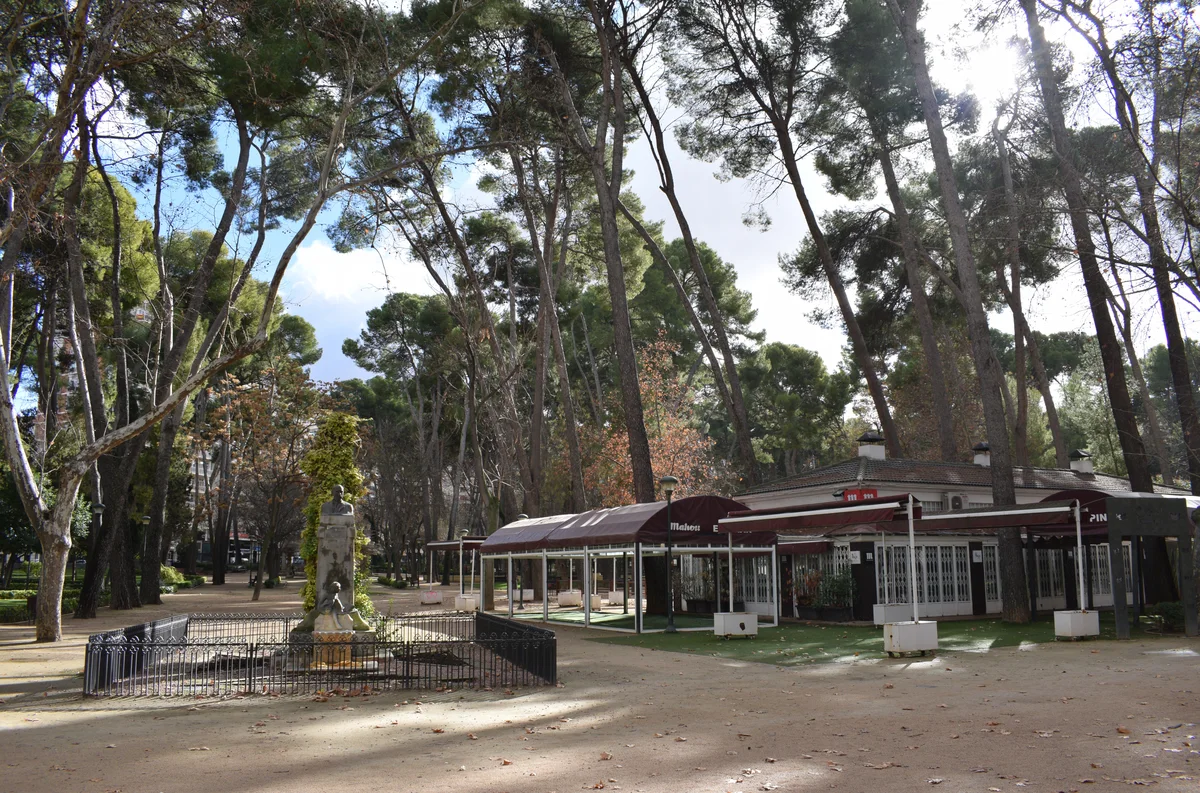
Tall pine trunks and spreading branches above a fenced stone monument and a low café building in Parque Abelardo Sánchez.

Tall trees, a monument and a café building in Albacete’s Parque Abelardo Sánchez, photographed in January 2018.

Albacete. Parque de Abelardo Sánchez 1.jpg — Enrique Íñiguez Rodríguez (Qoan) / Wikimedia Commons / CC BY-SA 4.0 · Creative Commons

Walks and routes

A promenade-and-fountain stroll

Enter through an open park gate and make the main promenade and Fuente Larga your first stops. Give the fountain a few minutes, then choose between another short wander, a play stop or sitting beneath the trees. If you want to extend the outing, look for the music pavilion and the park’s smaller sculptural fountains. Adapt the walk as you go, returning along whichever open paths suit your group.

Use the broad main walks first. Check patches of loose gravel and the approach to play equipment before moving onto side paths. The easiest return may be the way you came; ask locally about a suitable entrance if you need a step-free approach.


If you have half an hour

Choose the most convenient open entrance, take a short walk and stop at a bench or fountain before returning. Keep the plan small: one child-led observation or a quiet rest is enough for this version of the visit.

For a park-and-museum morning

Check the museum’s opening first, then allow roughly 2–3 hours overall. Pair the promenade-and-fountain stroll with an indoor visit, adjusting the order to avoid the museum’s closing time. If children have had enough, trade another gallery for a play stop rather than rushing through both.

Things to try

Try a three-tree comparison

Pick three trees beside the paths and compare leaf shape, bark and canopy outline. Sketch what you see or take a close-up without breaking anything off. Children can give each tree a descriptive nickname before you try to identify it.

Look closely at a fountain

At Fuente Larga, spend a minute looking at the overall shape before noticing the smaller details. Try drawing a reflection or describing how the view changes when you move along the path. Keep the edge clear for others and supervise young children beside water.

Take a five-minute listening break

Choose a bench and sit quietly for five minutes. Count different kinds of sounds rather than trying to name every bird. A short, patient pause is an easy nature activity even when nobody wants a longer walk.

A museum option, if it is open

For ordinary rain, the Museo de Albacete can turn the outing into an archaeology-and-art visit. Confirm the timetable and your entrance first. During a park closure, ask the museum whether it is operating and how visitors should reach it; a building inside the park does not automatically remain accessible.

Wildlife and habitats

Aleppo pine

Pinus halepensis. This planted pine is prominent in the park’s tree inventory. Compare its needle-bearing canopy with the broad-leaved trees around you. Look up from an open path rather than walking into a planting bed.

Mediterranean cypress

Cupressus sempervirens. A historical botanical inventory records this cultivated tree in the park. Its tiny, overlapping, scale-like leaves provide a useful contrast with pine needles. Cypresses can look similar, so check the foliage as well as the tree’s overall shape.

Red squirrel

Sciurus vulgaris. Look quietly around trunks and branches for movement, then let the squirrel carry on with what it was doing. A park-specific naturalist account and the regional visitor guide record red squirrels here. Keep food packed away.

Common blackbird

Turdus merula. The male’s dark plumage and bright bill contrast with the browner female. Watch from the path for the stop-start movement of a bird searching the ground. Blackbirds are documented in this park, including a dated naturalist observation.

European robin

Erithacus rubecula. Look for the orange face and breast on an adult bird around quieter vegetation. A winter observation is documented here, and the official visitor guide also lists robins. Give a calling or feeding bird room rather than moving closer for a photograph.

Stories and discoveries

A school floor found a new home

The music pavilion’s 2026 restoration reused mosaic flooring from the old school on Calle León. The architects’ professional body describes it as a link between two works by Agustín Morcillo. Look at the pavilion from the public paths; going onto the stage depends on how the space is being used.

Getting there and practical advice

Park opening and admission

Ordinary park entry is free. Published hours are 07:00–23:00 from 1 October to 31 May, and 06:00–02:00 from 1 June to 30 September. These are the usual gate hours; weather alerts, maintenance and on-site notices can change access.

Benches, play areas and practical stops

The park’s service inventory lists benches, children’s play areas, drinking fountains, a dog enclosure and public toilets. A café is also listed by regional tourism. Check which facilities are open when you arrive, and bring your own water rather than relying on every tap. Toilet opening and wheelchair suitability need a separate check.

Museo de Albacete: plan separately

From 18 September to 30 June, the published hours are Tuesday–Saturday 10:00–14:00 and 16:30–19:00; Sundays and public holidays 09:30–14:00. From 1 July to 17 September, Tuesday–Saturday opening is 10:00–14:00, with the same Sunday/public-holiday morning hours. It closes on Mondays, 1 January, Maundy Thursday, Good Friday and 25 December. Checked on 17 October 2026, the official page says admission is temporarily free, while retaining its standard €3 tariff and concessions. Confirm the current arrangement before visiting; tickets are offered at the desk or through the official page. Phone +34 967 228 307.

Aula de Naturaleza

For an educational activity, contact the park’s nature classroom on +34 967 236 891 and ask what is available for your group. The regional directory lists weekday morning and afternoon opening, plus Saturday and public-holiday mornings, with specific holiday exceptions. Confirm your date, the activity and any booking requirement before making this the main reason for a visit.

Children’s road-safety area

The Parque Infantil de Tráfico is an educational facility managed by the local police. Do not count on it as freely available play equipment. Ask about organized sessions; the ordinary play areas are the simpler choice for a spontaneous family outing.

Arriving from central Albacete

The park is approached from Avenida de España, Paseo de Pedro Simón Abril and Calle Arcángel San Gabriel. If you are already exploring the centre, continue on foot to a suitable open entrance. For a bus, taxi or step-free arrival, choose your actual gate before planning the journey. The tourist office can advise on +34 967 630 004; check current services and street signs rather than relying on an old route number.

Main walks and essential facilities

A wheelchair-user report from 2018 describes broad, mainly level walks with compacted earth and gravel, but also obstructions at some secondary gates. Use that as a starting point for questions, then confirm today’s entrance, surface and any works. The same older report found no adapted park toilet, so arrange a confirmed suitable toilet stop before visiting if you need one.

Adding the museum

The museum describes its public areas as accessible using lifts, ramps and stair-lifting equipment. Contact it about the easiest entrance and any assistance needed, especially if combining the visit with a park walk. Do not assume the shortest path through the garden is the best museum approach for your wheelchair.

Sources and useful links

Wildlife you might spot

5

Each card links to a full Explore page with photos, traits, and fun facts.

Snap map for this place

Start with the big picture, then zoom in to explore individual wildlife observations around this place.

Loading map…

Good to know before you go

Check park notices after strong wind or storms. Follow closed gates and barriers even if the usual timetable says the park should be open.

Bring water and use the cooler part of a hot day. Treat ornamental fountains as scenery; use only a clearly identified drinking-water point for refills.

Watch squirrels and birds without feeding or pursuing them. Keep a little distance and leave fallen cones, leaves and other natural material in place.

If you use a wheelchair or pushchair, check your entrance and first path before committing to a longer circuit. Confirm toilet access in advance if it is essential.

Plan the museum separately

it closes on Mondays and has a midday break on many days. Check the current admission notice as well as opening times.

Keep children close beside water and through busy path junctions. Pick a suitable play area rather than assuming the road-safety training area is an open playground.

With a dog, follow the park’s signs and keep it close around wildlife and children. Check the rules at the dedicated dog enclosure before letting it off the lead.

Frequently asked questions

The ordinary park visit is free and does not need a ticket. Organized activities and the museum have their own arrangements. Check the gate notices before entering.
Think of it as a flexible city-park outing. A 45–90-minute visit leaves room for stops without needing a measured trail or a full perimeter circuit.
The broad main walks are the best starting point to discuss with the tourist office. Surfaces and secondary entrances vary, so check the approach that suits your equipment and arrange an accessible toilet stop before setting out.
No. The Museo de Albacete follows a separate timetable and closes on Mondays. See the museum planning details, including the temporary admission notice.
Red squirrels are documented in the park, but a sighting depends on timing and luck. Sit quietly, look around the trees and enjoy the birds too. Please do not use food to attract animals.
There are play areas, and a short fountain-and-tree walk works well without booking. The Aula de Naturaleza offers a possible educational addition; ask about its current programme. For the children’s traffic park, check the local police’s activity arrangements.

Recent snaps at this place

Recent snaps will appear here as new observations are added.

View all ›

Take the discovery with you

Exploring Abelardo Sánchez Park?

Identify the wildlife you spot, learn as you go, and keep a collection of the adventure.

  1. 1Spot it
  2. 2Snap it
  3. 3Keep the discovery