
Snappit logo
Snappit
Get App
Generic illustration, not a photograph of this venueIllustration
ParkBR

Anavilhanas National Park

The pleasure of Anavilhanas is in slowing down.

About

The pleasure of Anavilhanas is in slowing down. From a boat, a continuous-looking wall of trees becomes separate islands; a quiet channel opens into a broad reach of river; the guide points out how the same place changes with the water level. This is not a park with one entrance promenade that reveals everything. Choose a manageable excursion, leave room for pauses, and let the conditions shape the day.

The protected area covers about 350,470 hectares in Amazonas and includes more than its famous island landscape. It belongs to the Central Amazon Conservation Complex, a World Heritage property that also includes Jaú, Amanã and Mamirauá. Anavilhanas was protected as an ecological station in 1981, became a national park in 2008 and joined the World Heritage property in the 2003 expansion. These are different milestones, not competing founding dates.

Novo Airão is a practical starting point, with the boat trip treated as a separate part of the journey from Manaus. A stay in town makes it easier to discuss the next day with your operator rather than force a long transfer and several excursions into one day. Ask for an explanation of the planned stops before booking: a town waterfront visit, a channel excursion and a forest walk are different experiences.

There is wildlife worth caring about even when you do not see it. ICMBio lists giant otters, jaguars, Amazonian manatees and pink river dolphins among the animals protected here. Let that knowledge deepen the landscape rather than become a sighting promise. The strongest excursion is one in which the guide interprets habitat and animal signs without chasing, baiting or handling wildlife. Be ready to snap and learn! Get the Snappit app to identify any nature species you find here.

What to do here

Build your visit around one boat excursion through permitted channels, with either flooded-forest exploration or a beach stop if conditions allow. Add a guided land walk only when its access and footing suit your group. Ask your guide to explain igapó, the seasonally flooded forest, and how it differs from higher terra firme forest. A quiet observation pause can be more rewarding than another rushed stop.

Seasonal info

Ask what is navigable now and what has changed recently. The useful question is not simply whether the park is open, but whether your chosen boat can reach the intended channel, landing and return point. A good alternative itinerary matters more than an inflexible list of stops.

Accessibility

Do not assume a boat excursion is step-free. Agree on the exact boarding method, seating, transfers and toilet access before paying. Publicly documented accessibility investment does not establish that your chosen departure point or outing meets your needs today.

Don't miss

1

A boat-level perspective on a large river archipelago.

2

Flooded-forest interpretation when water levels permit.

3

Seasonal beaches and river scenery, without treating every sandbar as a permitted landing.

4

Patient wildlife watching with a guide who prioritizes distance and animal welfare.

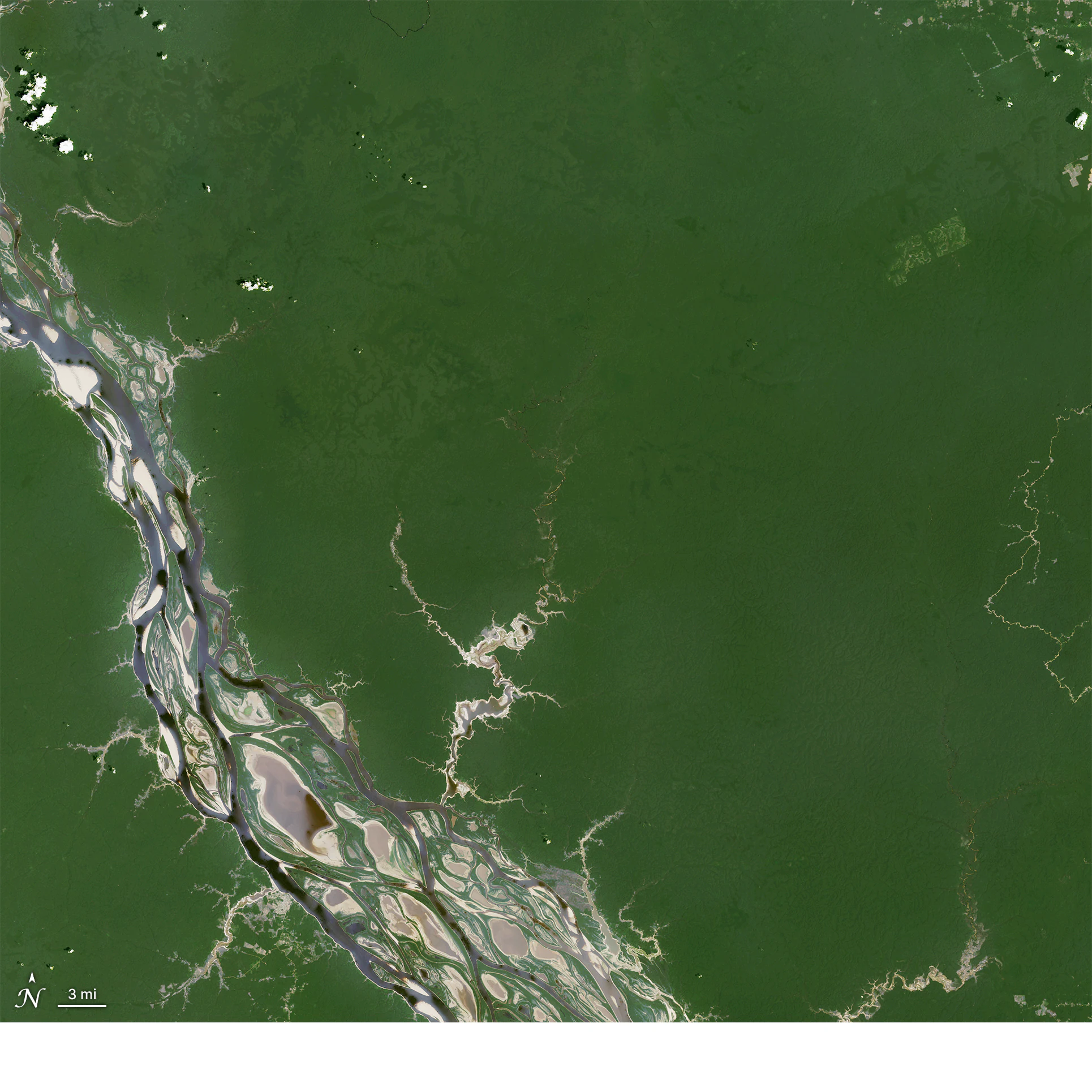
Natural-color satellite image of branching Rio Negro channels and pale sandbars among extensive dark-green forest in the Anavilhanas area. The original north marker, 3 mi scale and white bottom band remain visible.

Natural-color satellite view of the Rio Negro, islands and surrounding forest in the Anavilhanas area, acquired on 29 October 2024. NASA Landsat/Ross Walter. Regional landscape context, not a navigation map or current river-level report. The original 3 mi scale is retained unchanged.

NASA Landsat/Ross Walter · www.nasa.gov

Walks and routes

A first look from the river

Discuss a half-day outing from Novo Airão focused on the island-and-channel landscape, with a few unhurried interpretation stops rather than maximum distance. Ask the operator to name the return point and explain the alternative if the planned passage is unsuitable. Keep a beach or forest stop optional, not the condition for enjoying the trip.

Editorial allowance: half a day, with the actual boat time agreed with the operator.

A higher-water forest outing

When conditions permit, choose a small-group excursion into igapó. Ask for time to look at the tree trunks, reflections and changing canopy, and to listen without competing music. Confirm whether the trip stays in the boat throughout and whether changing boats is involved. This is a suggested focus, not a fixed named circuit or a navigational instruction.

Editorial allowance: one main morning or afternoon excursion; verify all transfers.

Ask about an Apuaú forest walk

The management plan documents the Apuaú land trail. Treat it as an option to discuss with ICMBio or an authorized operator, not a confirmed open route. Ask which section is maintained, how long you will actually walk, how the landing works and whether a shorter return is possible. Do not rely on an old trail length or photograph to judge present difficulty.

No current measured route time is supplied. Agree a suitable walking segment before departure.

Things to try

Make it a family observation trip

Give children a small, non-competitive challenge: notice three kinds of reflection, compare a broad river view with a narrow channel, or sketch an island without collecting anything. Keep the first excursion short enough for everyone to remain comfortable. Confirm properly fitting child lifejackets before departure, not after the boat has left.

Try patient wildlife watching

Bring binoculars if you have them and ask for quiet pauses rather than pursuit. Let the guide decide when a distant animal should be left alone. Avoid turning a possible sighting into pressure to approach a nest, bank or animal. A field notebook can record weather, habitat and sounds as well as identified species.

Choose a seasonal beach pause

ICMBio identifies Orla, Meio and Sarará among the beaches near Novo Airão. Ask which is available and suitable on your date, and whether the outing includes a permitted stop. Treat a beach visit as a chance to rest and look at the river, not an automatic invitation to swim.

Photograph without rushing the boat

Plan for wide landscape views and details you can photograph safely from your seat. Keep straps secure and equipment protected from spray. Ask the operator to stop safely rather than stand or lean out for a better angle. Never request a close approach just to fill the frame.

Stories and discoveries

A protected landscape that changes shape

UNESCO recognizes the importance of the changing relationship between channels, lakes, islands and vegetation. The lesson is easy to miss in a single photograph: conservation here protects ongoing ecological processes, not a permanently fixed postcard view.

Forest is not all the same habitat

Flooded igapó and higher terra firme offer different ways to experience Anavilhanas. A boat passage and a land walk are not interchangeable versions of the same outing. Ask your guide to show the differences in place, without leaving authorized visitor areas.

The view from space is another scale

The NASA image shows the Rio Negro landscape from above, with dark vegetation and pale exposed river features. It is natural-color satellite imagery, not the vegetation-index visualization shown elsewhere on the source page. Its original north marker and 3 mi scale have been retained.

Sources and useful links

Wildlife you might spot

2

Each card links to a full Explore page with photos, traits, and fun facts.

Snap map for this place

Start with the big picture, then zoom in to explore individual wildlife observations around this place.

Loading map…

Good to know before you go

Ask for the departure point, planned return time, passenger capacity, shade and rain protection in writing. Include children’s ages and relevant mobility requirements when checking suitability.

Bring drinking water, sun protection, a light rain layer, a secure bag for electronics and a bag for all rubbish. Take only what you can keep safely stowed while boarding.

Choose an outing whose main experience appeals to you even if wildlife is not visible. Avoid sellers who guarantee rare animals or offer handling, baiting or visitor feeding.

Keep the final day flexible if you have an onward flight. Discuss transport buffers with your provider rather than assuming a short boat ride can never be delayed.

Frequently asked questions

It can be arranged, but check how much of the day is transport and how much is actually in the park. An overnight stay in Novo Airão is the editorial recommendation for a less compressed visit, not an official requirement.
A current park-wide entrance tariff was not verified for this guide. Ask ICMBio and your provider about the arrangements for your date, and request an itemized quote for the boat, guide, meals and any attraction charges. Do not interpret an old free-entry statement as a free excursion.
For a first visit, arrange a reputable local operator and confirm their authorization for the planned activity. The archipelago is not a self-guided walking circuit. This recommendation is not a claim that an identical guide requirement applies to every activity or shoreline.
Visitors must not feed animals. This guide recommends observing dolphins without deliberate contact and does not recommend a swim-with-dolphins experience. If considering an observation facility, verify its current authorization and rules; promotional photographs are not permission.
No. It is a natural-color image acquired on 29 October 2024, useful for landscape context only. It does not mark the legal park boundary, permitted landings, safe channels or today’s river level.

Recent snaps at this place

Recent snaps will appear here as new observations are added.

View all ›

Take the discovery with you

Exploring Anavilhanas National Park?

Identify the wildlife you spot, learn as you go, and keep a collection of the adventure.

  1. 1Spot it
  2. 2Snap it
  3. 3Keep the discovery





