
Snappit logo
Snappit
Get App
Generic illustration, not a photograph of this venueIllustration
ParkBR

Jaú National Park

Jaú National Park lies in the lower Rio Negro region of Amazonas, between Novo Airão and Barcelos.

About

Jaú National Park lies in the lower Rio Negro region of Amazonas, between Novo Airão and Barcelos. Its scale is best understood through the water: the park protects much of the Jaú river basin, with forest, channels and tributaries forming a connected landscape. From a boat, make time for the small things as well as the immense view: a reflection breaking on a wake, different leaf shapes above the bank, or the change in sound when the engine stops.

This is not one unchanging green backdrop. Igapó is forest affected by seasonal flooding; terra firme stays outside the regular river flood. Campinarana and more open campina add further variety. Choosing outings that cross contrasting habitats can be more rewarding than racing between named attractions. A local guide can help explain what the water has covered, exposed or made unreachable that week.

The park also has a human history, visible in archaeological remains and carried by riverine and quilombola communities. Treat a community visit as an invitation, not an exhibit. Arrange it with the hosts, ask before photographing people, and leave time to listen. The landscape is neither empty nor a place where a visitor’s curiosity overrides residents’ privacy.

For a first trip, build around one boat-based outing, one manageable forest walk and time without a checklist. The river level decides which combination works. A July 2025 technical study records that extreme drought prevented river access in 2023 and 2024. That is historical evidence of a real planning constraint, not a claim that the park is closed today. Obtain fresh authorization and navigability advice before committing to dates. Planning to visit? Download the Snappit app to identify the wildlife you spot in real-time.

What to do here

Explore the Jaú or Carabinani waterways with a qualified operator; choose a permitted walk, a quiet birdwatching stop or an arranged community encounter. In suitable conditions, low water reveals rock features and beaches, while high water opens routes among flooded trees.

Seasonal info

The management plan describes usual high-water peaks around June–July and lows around October–November, with substantial variability. Rainfall at your departure point alone does not tell you whether a distant channel is navigable.

Accessibility

Do not assume that a boat-based itinerary is step-free. Assess the actual vessel, boarding points, toilets and transfers with the operator. A shorter outing can still involve difficult landings.

Don't miss

1

Seasonal igapó and quieter channels.

2

Forest walks with contrasting vegetation.

3

Carabinani’s changing river-and-rock scenery.

4

Archaeological traces and living local knowledge.

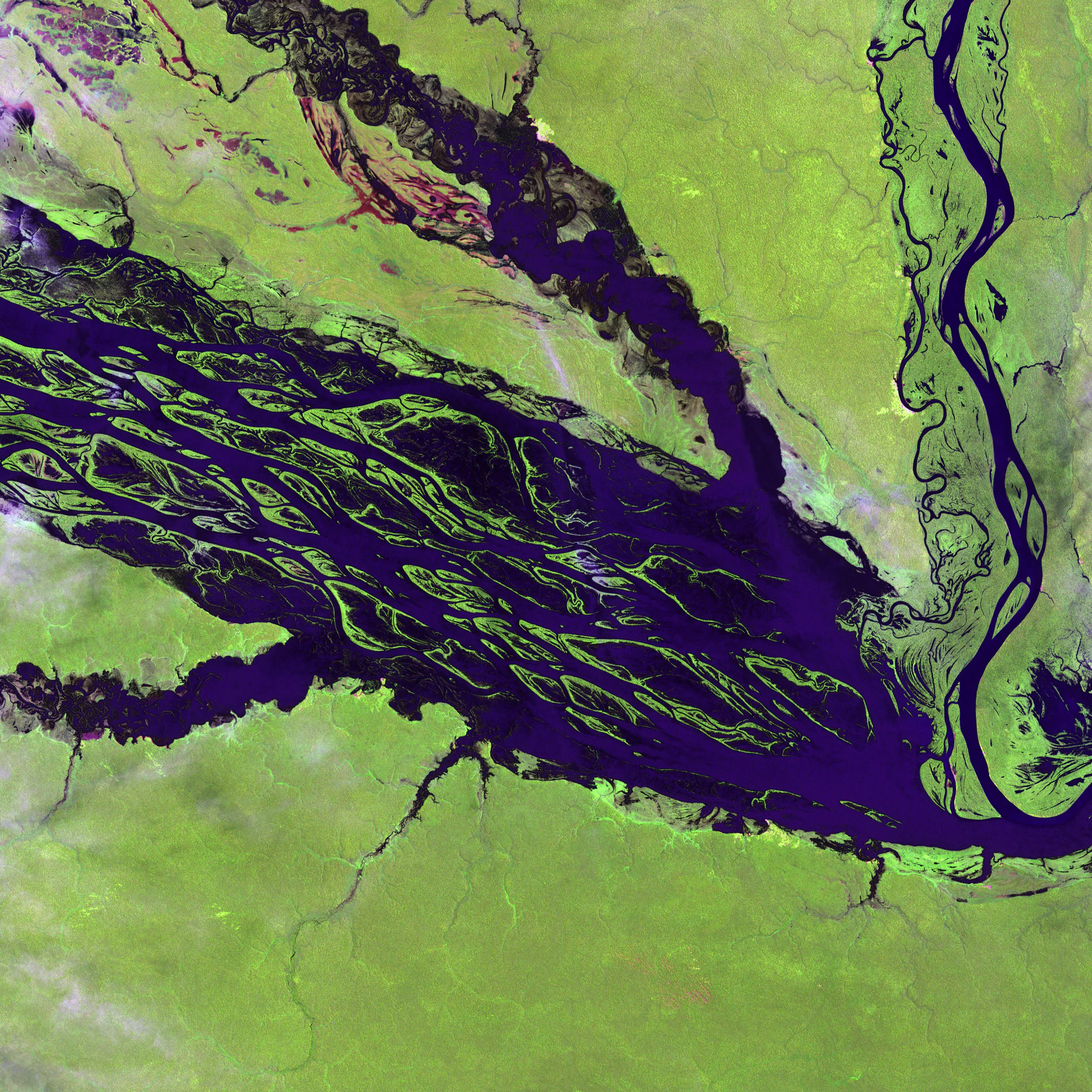
Historical false-color satellite image from 31 August 2000: broad dark-blue and purple river channels and islands amid bright green and pink land. It shows regional context near Jaú’s eastern edge, not a ground photograph or a mapped park boundary.

False-color Landsat 7 view of the Rio Negro and the eastern edge of Jaú National Park, acquired on 31 August 2000. USGS EROS, published by NASA Earth Observatory. Colors are processed, not natural. This historical regional view is not a current-conditions image, park-boundary map or navigation aid.

Image: USGS EROS Data Center Satellite Systems Branch, Landsat Earth as Art; published by NASA Earth Observatory. · www.usgs.gov

Walks and routes

Jaú–Carabinani river outing

Ask for a boat itinerary matched to the water level, with time to stop and look rather than a guaranteed cascade circuit. Carabinani’s rock steps are a low-water feature; high water changes the scene. Keep swimming or paddling conditional on the operator’s safety assessment.

Agree the day’s duration and turnaround with the operator; no fixed route or transfer time is asserted.


Itaubal forest loop

ICMBio lists a 3.5 km circular trail with the Itaubal waterfall as a feature. Consider it for a walking-focused outing once current trail and landing conditions are confirmed. Treat a waterfall stop as time to observe, not an automatic invitation to enter the water.

Editorial allowance: two to three hours for the walk and pauses, excluding boat transfers; adjust with your guide.

Pesquisador habitat walk

The official listing describes 5 km in a linear format, crossing several vegetation types. It is a good candidate for a slow natural-history walk, not a guaranteed bird checklist. Agree the endpoint, return or pickup before setting out; 5 km is not advertised here as a round trip.

Reserve a flexible walking session with the guide; total outing time depends on the return arrangement and transfers.

High-water igapó exploration

Ask about a permitted canoe or small-boat excursion through flooded forest, for example in the Lago Santo Antônio area. This is a seasonal route choice, not a mapped circuit. Look at the relationship between trunks, canopy and water, and resist making every stop depend on finding an animal.

Agree a short or longer session suited to the group and river conditions.

Sumaúma da Enseada tree stop

For a shorter land-based option, ask about the Sumaúma da Enseada trail, listed at approximately 150 m. The source does not specify whether that length includes the return. Plan a quiet look at the giant tree with your guide; a short distance does not guarantee an easy landing or level surface.

Allow a brief stop plus the confirmed approach and return; this is not a measured visit time.

Things to try

A family field notebook

Give each person a small observation challenge: sketch a leaf without picking it, compare two reflections, or record three different sounds. Keep the activity seated while the boat is moving. A short, satisfying session is better than pushing through fatigue.

Slow photography

Try one wide river view and one close detail from a safe, permitted position. Protect equipment from spray and rain. Do not ask a boat driver to crowd wildlife or approach a fragile rock engraving for a better angle.

Listen to local knowledge

When a community visit has been agreed, ask your host how changing water levels affect daily travel and work. Buy services on clearly agreed terms, and ask before entering homes or photographing people.

Stories and discoveries

A park organized around water

Created in 1980, Jaú protects a major river basin rather than a single isolated attraction. Think of a forest walk, a tributary and a seasonally flooded shore as connected parts of the same landscape.

One part of a larger World Heritage property

Jaú entered the World Heritage List in 2000. The property expanded in 2003 and is now called the Central Amazon Conservation Complex. The larger designation is not another name for Jaú alone.

Rock engravings tell a human story

Petroglyphs are among the park’s archaeological features. Some become visible at lower water. Look without touching, tracing or collecting; a boat must not be brought against the carved rock.

Forest is not a single habitat

Igapó, terra firme, campinarana and campina help explain why two nearby outings can feel very different. Ask your guide which transition you are seeing instead of treating all vegetation as interchangeable rainforest.

Getting there and practical advice

Wear an appropriately fitted lifejacket on boat journeys and follow the crew’s instructions. Agree how the group will communicate and obtain help if someone is injured or a boat fails.

The official visitor guidance warns that the park lacks rescue and communication structures. Ask the operator to explain their own working communications, first-aid provision and evacuation plan. Do not rely on ordinary mobile reception.

Water appearance does not establish safe swimming. Check currents, rocks, submerged obstacles and an agreed exit with the guide. Decline an activity that exceeds the group’s abilities.

Keep wildlife wild: do not feed, handle, pursue or surround animals. Return rubbish to the agreed disposal point, avoid disturbing nests, and leave plants and archaeological material where they are.

Sources and useful links

Wildlife you might spot

2

Each card links to a full Explore page with photos, traits, and fun facts.

Snap map for this place

Start with the big picture, then zoom in to explore individual wildlife observations around this place.

Loading map…

Good to know before you go

Ask for a written itinerary showing overnight arrangements, meals, drinking water, fuel, guiding, safety equipment and cancellation terms.

Keep rain protection and a dry bag handy. Bring closed walking shoes, sun protection, insect protection and the personal supplies you cannot easily replace.

Pack binoculars before adding another activity. Looking carefully from one permitted stop often rewards patience more than a rushed extra transfer.

Leave a buffer before an onward flight. Confirm a fallback plan if water levels, weather or a park restriction change the route.

Frequently asked questions

No. The official visitor page requires entry authorization. Ask ICMBio or your operator to confirm the current procedure and ensure permission covers your intended visit before departure.
Do not plan it that way without an operator’s realistic schedule. Long transfers can leave little time ashore. An overnight expedition generally allows more flexibility; the suggested duration here is editorial, not an official requirement.
No. The official webpage currently states that no park entry fee is charged, checked on 22 October 2026. Boats, guiding, food and accommodation are separate arrangements; reconfirm the fee position before booking.
Both are documented for the park, but this is not a sighting promise or a safari timetable. Choose the trip for the habitats and the whole experience, and let any wildlife encounter remain unforced.
Yes, if the itinerary, vessel and overnight setup suit the child. Favor short observation sessions and manageable walks. Confirm correctly sized lifejackets, shade, toilets, supervision and an emergency plan before deciding.
Visitor sport fishing is not permitted, and ordinary pets should stay at home. For a legally recognized assistance animal, discuss the applicable arrangements with ICMBio before booking; the management plan distinguishes this from pet access.

Recent snaps at this place

Recent snaps will appear here as new observations are added.

View all ›

Take the discovery with you

Exploring Jaú National Park?

Identify the wildlife you spot, learn as you go, and keep a collection of the adventure.

  1. 1Spot it
  2. 2Snap it
  3. 3Keep the discovery




