Snappit logo
Snappit
Get App
Generic illustration, not a photograph of this venueIllustration
ParkCastilla y León, Spain

Lake Sanabria and the Segundera and Porto Mountains Natural Park

Start small in Sanabria.

About

Start small in Sanabria. At the Casa del Parque in Rabanillo, find out how moving ice shaped the landscape, then take the short botanical trail outside. Afterwards, make a separate journey to a public lake beach such as El Folgoso. You can spend a satisfying morning looking across the water, noticing the wooded slopes and letting children sketch the shapes they have just learned about.

The lake is the best-known part of a much larger protected landscape. Higher up are glacial basins, rocky slopes, streams and peatlands; lower down, oak woods meet villages and long-used paths. Those changes in height help explain why a lakeside afternoon and a walk towards a mountain lagoon need different clothing, energy and preparation.

Choose your pace before adding stops. A botanical walk and a shore visit make a good first day. A village path, San Martín de Castañeda’s heritage or the upland route to Laguna de las Yeguas can each become another outing. The Tera canyon and Peña Trevinca are substantial mountain objectives, so leave them for a properly planned walking day rather than squeezing them in after the beach. Enhance your adventure: download the Snappit app to identify the local species you encounter.

Sanabria’s landscape records both ice and human use. Glaciers carved the basins and valleys, while communities shaped village paths, grazing land and woodland use. The Romanesque church and surviving monastery buildings at San Martín de Castañeda add a cultural perspective above the lake. The natural park was declared in 1978; a 2017 law enlarged it and gave it the present name, bringing the Segundera and Porto mountains explicitly into its identity.

What to do here

Explore the visitor-centre displays, follow its 650 m botanical trail and choose one public lake-shore stop. Look for the contrast between exposed rock, woodland and open water. If walking is your main interest, ask staff to help you choose a currently usable signed route that matches the least experienced person in your group.

Seasonal info

Spring rain can make paths and stream crossings harder. In summer carry drinking water, sun protection and an extra layer, and check fire restrictions. Autumn offers changing woodland colours but shorter daylight. Winter can bring snow, ice and poor visibility to the mountains and their access roads; stay with a lower-level plan unless you have suitable experience and equipment.

Accessibility

The operator describes the 650 m Casa del Parque botanical trail as adapted for disabled visitors. Make this your first accessibility enquiry: ask about the current surface, slopes, seating, toilets and the route from parking into the building. This adaptation does not extend automatically to lake beaches, village paths or high mountain trails.

Don't miss

1

Understanding the glacier-shaped landscape at the Rabanillo visitor centre

2

A short, plant-focused outing on the 650 m botanical trail

3

The lake and wooded slopes from a public shore stop

4

A separately planned mountain-lagoon walk for suitably prepared visitors

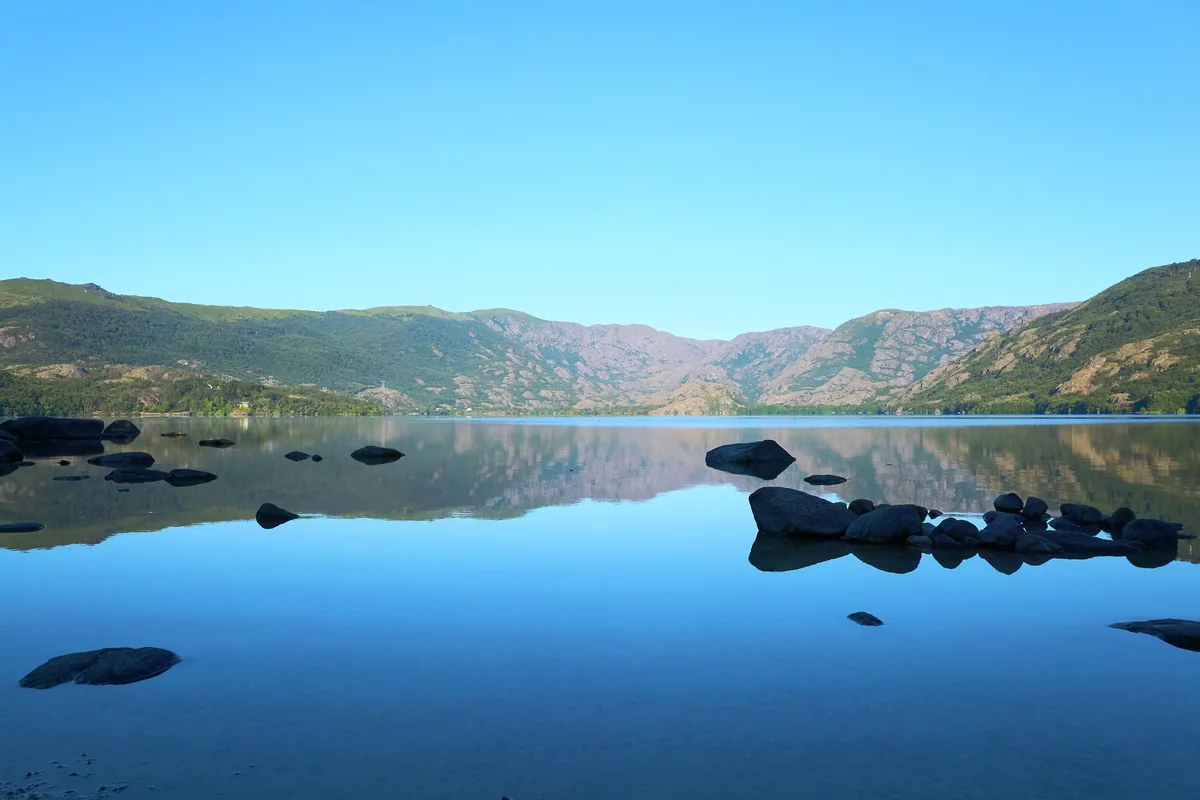
Dark shoreline rocks stand in a calm blue lake, with green and rocky hills reflected beneath a clear sky.

Lake Sanabria from Playa de los Enanos in August 2018, with still water reflecting the surrounding hills.

LagoSanabria.jpg — Francisco Luis Servén Santana / Wikimedia Commons / CC BY-SA 4.0 International · Creative Commons 1 · Creative Commons 2

Walks and routes

Casa del Parque botanical trail

The 650 m interpretive trail beside the Rabanillo visitor centre introduces plants from the park and finishes at a recreated local vegetable garden. Allow around 30–45 minutes if you want to read, look and compare leaves. It is a compact first outing before you decide how much more to do.

Documented as adapted. Ask staff about present surface condition, gradients, seating and the connection from parking; check toilets separately.


Casa del Parque botanical trail

El Folgoso: a short lake-shore stop

Make a separate transfer to the signed public beach access at El Folgoso on the lake’s northeastern side. Stay with the beach and the permitted shore area that suits your group, pause for the view and return to the same access point. Keep this as a flexible shore stop rather than trying to walk around the lake.

Ask about the surface from the public car park to the shore, and any assistance available, before travelling with a wheelchair or pushchair.

El Folgoso: a short lake-shore stop

Rabanillo–Quintana: a village-path alternative

For another outing near the gateway, ask about the official Rabanillo–Quintana route. Get the start, return arrangement and present path condition from the centre, then follow the current signs or official map. Choose it for a slower look at the inhabited landscape, rather than adding it automatically to the lake visit.

Describe your walking or mobility needs to staff before choosing this village path, and ask whether its current surfaces and gradients suit your group.

Rabanillo–Quintana: a village-path alternative

Laguna de los Peces–Laguna de las Yeguas: a separate mountain walk

The operator describes a linear route of about 3 km from Laguna de los Peces to Laguna de las Yeguas through open high-mountain terrain. Returning the same way means about 6 km of walking. This is the option for prepared walkers who want an upland lagoon, with enough daylight for the return and a weather-dependent plan.

Open mountain ground with rocks and uneven footing; it is not the adapted botanical trail. Carry navigation, protective clothing, food and water, and choose it only if everyone can manage the terrain.

Laguna de los Peces–Laguna de las Yeguas: a separate mountain walk

First visit: centre, plants and lake

Allow 2½–4 hours. Begin with the Casa del Parque while it is open, follow the botanical trail at a comfortable pace, then transfer to El Folgoso or another public shore access recommended by staff. Take a snack break and leave time simply to enjoy the view. Shorten the outdoor part if the weather or anyone’s energy changes.

A gentle day with a cultural stop

Keep the short nature plan and, if you want a fuller day, add a separately timed visit to San Martín de Castañeda. Check the monastery exhibition’s opening before travelling there. Have lunch in a local settlement or bring a picnic you can carry away completely.

Another day for the mountains

Make Peces–Yeguas the main outing only after checking the approach, weather and route condition. Carry what you need for the return, keep a comfortable daylight margin and turn back early if conditions worsen. A distant peak or another lagoon is not an automatic extension to the plan.

Things to try

Find the shape left by ice

After the geology displays, look across the lake and sketch a simple outline of water, slopes and skyline. Ask everyone which parts of the view they think moving ice helped shape, then compare their ideas back at the interpretation panels.

Make a leaf-shape notebook

On the botanical trail, choose three labelled plants and draw their leaves without picking them. Compare a broad leaf with a narrow one, and write down the labels you actually find. A few careful observations are more memorable than rushing to complete a species list.

Watch the shore without entering the water

Sit or stand in a safe public spot and notice reflections, small ripples, moving clouds and birds. Take a wide landscape photograph first, then look for one detail from the same place. Keep equipment and children back from slippery edges.

Connect nature and local life

Choose a separate village visit to notice stone buildings, slate roofs and traditional paths. San Martín de Castañeda offers a church and former monastery setting above the lake; confirm its own opening and admission rather than assuming the Rabanillo centre ticket applies.

Let the indoor visit carry the day

If the centre is open, focus on its geology, habitats and local-history displays. Add the botanical trail only if conditions suit your group. Postpone exposed shore stops and mountain routes during lightning, strong wind or heavy rain, and never attempt a flooded crossing.

Wildlife and habitats

Common yew

Yews are part of the park’s woodland story. Learn to recognise one with a reliable field guide or staff help, and observe from existing paths. Look closely without collecting branches or seeds, and ask staff which public woodland paths suit your visit.

European robin

The park’s oak woods support robins. A quiet pause can be more useful than constantly moving: watch the vegetation without pushing into it, and let a bird choose how close it comes.

Eurasian jay

The jay is another documented woodland bird. If you hear movement or a call among the trees, stop and watch from the path. Avoid playback, bait or following a bird into cover.

Brown trout

Brown trout are part of the park’s freshwater fauna. Look into clear water only from a safe, permitted place on the bank; leave fish undisturbed and treat photography and observation separately from regulated fishing.

Golden eagle

Golden eagles belong to the wider park’s birdlife. Use binoculars from a safe stopping place and enjoy distant flight without approaching cliffs or trying to locate nests. A large bird seen briefly may need a closer identification check.

These are wild species documented in the park, rather than a checklist for the short first-visit route. Season, habitat and disturbance affect what you may see. Stay on permitted paths, keep quiet, avoid nests and sensitive banks, and leave plants and animals where they are. The centre’s planted botanical collection is an introduction to local habitats, not evidence that every plant is growing wild beside the lake.

Stories and discoveries

The mountains explain the lake

The lake belongs to a glacial landscape that also includes upland lagoons, valleys and accumulations of material moved by ice. Looking at the surrounding slopes after the centre visit helps connect a flat water surface with the much bigger landform around it.

Wet ground can be important habitat

Peatlands and small headwater wetlands are among the park’s protected features. They may look like an easy shortcut on a mountain walk, but they are places to leave undisturbed. Use the established route rather than stepping around a wet patch into more fragile ground.

A familiar name can mean an older boundary

Older signs and leaflets may say Lago de Sanabria y alrededores. The 2017 enlargement introduced the present name and wider protected area, reflecting the importance of the Segundera and Porto mountains as well as the lake.

When to visit

Spring: fresh growth and changeable paths

The botanical trail and lower-level walks offer plenty to notice as plants grow. Bring waterproofs and ask about recent rain before choosing a route with streams. A waterfall excursion is a different undertaking from the centre trail.

Summer: make time for the shore

Go early if you want a quieter arrival, carry water and sun protection, and check parking and fire notices. If swimming is part of your plan, read the current bathing information and supervise children continuously. Keep a dry layer for afterwards.

Autumn: woodland colours, shorter days

Enjoy the changing woods without filling every hour with travel. Check the centre’s shorter seasonal opening pattern, take footwear that grips wet ground and set a return time that leaves daylight to spare.

Winter: choose a lower-level visit

Confirm that the centre will be open and that your approach roads are suitable. Snow and ice can change the mountains completely, so leave an upland walk for another day if it is beyond your equipment or experience. A short shore view and indoor interpretation can be enough.

Getting there and practical advice

Rabanillo’s Casa del Parque

The main first-visit gateway has interpretation about habitats, glaciation and local memory, plus an audiovisual presentation and a shop. Ask about the next screening and language options when you arrive. The outdoor botanical trail is part of the centre’s visitor offer.

Opening and group reservations

For October 2026 the operator publishes Thursday–Sunday, 10:00–14:00 and 16:00–20:00, with extra opening over 8–12 October and 29 October–2 November. Guided groups can arrange other days in advance. Use the centre’s monthly calendar and +34 980 621 872 for your own date.

Admission and concessions

The retrieved 2026 regional tourism sheet lists €1 general admission and €0.50 for visitors over 65. It lists free entry for under-eights, Amigos de Patrimonio Natural members, teachers and disabled visitors. Ask what proof and booking arrangements apply; activities and combined tickets may have different terms.

Lake-side services vary

The municipality lists parking at El Folgoso and Viquiella, and refreshments or rentals at some beaches. Confirm toilets, refreshments, accessible access and seasonal services rather than relying on them. Carry enough water and food for the outing.

Check before planning a boat trip or campsite stay

Europarques’ booking page, checked on 17 October 2026, says the Sanabria vessel is in dry dock and reservations are unavailable. El Folgoso campsite is separately the subject of a rehabilitation and reopening project announced in January 2026. Confirm actual reopening directly before relying on either service; planned works are not an operating date.

Approach the visitor gateway first

From the Puebla de Sanabria area, follow the ZA-104 towards the lake and the signs for the Casa del Parque at the Rabanillo roundabout, beyond El Puente. The operator gives the address as ZA-104 km 4.5, Rabanillo-Galende. Use the named centre, not a generic pin for the whole natural park.

Treat the lake as a second journey

The centre, the shore access points and the mountain trailheads are separate destinations. At the lake use the signed public car parks and check charges before leaving the vehicle. The July 2025 municipal tariff lists €7.50 for a full day in regulated areas; local notices determine where and when payment applies.

Without a car, arrange the return as well

Before travelling, ask the centre or local tourist office how to reach the exact shore access and return on your chosen day. Do not assume that a service to Puebla de Sanabria also reaches the visitor centre or a beach. A prearranged transfer is more useful than discovering a last-leg gap after arrival.

Ask for the complete chain of access

Use the documented adapted botanical trail as a starting point, then ask about parking, step-free building access, doorways, toilets and any temporary surface damage. Describe the wheelchair, walking aid or pushchair you use and how much distance suits your group.

Keep lake access specific

A car park beside a beach does not establish an accessible connection to the water. Ask about the chosen beach’s surface and seasonal assistance, and be happy to enjoy the view from a suitable stopping place instead. The mountain routes have very different access demands.

Use the indoor visit to reduce the walking

The interpretation centre offers another way to understand landscapes that may be difficult to reach. Ask about seating, audiovisual access and help with the exhibition; arrange a group or supported visit in advance if that would make the day easier.

Sources and useful links

Wildlife you might spot

5

Each card links to a full Explore page with photos, traits, and fun facts.

Snap map for this place

Start with the big picture, then zoom in to explore individual wildlife observations around this place.

Loading map…

Good to know before you go

Use Casa del Parque, Carretera ZA-104 km 4.5, Rabanillo-Galende, as your first destination. It is a separate stop from the lake.

Check the centre’s monthly calendar and book group visits in advance. Call +34 980 621 872 or email [email protected].

Ask which paths and access roads are suitable now, especially in areas affected by the 2025 Porto fire. Respect barriers and restoration work.

Use signed parking areas and read the payment notices. Leave road edges, passing places and access for residents clear.

Bring water, food, footwear with grip, waterproofs and a warm layer. Do not rely on a beach kiosk being open outside the busy season.

Supervise children closely beside water. Swim only where it is permitted and suitable that day, enter gradually and follow current bathing advice.

Keep dogs under control and check the rules for the particular beach before taking one there. Leave plants, rocks and wildlife undisturbed.

Do not light fires or camp outside authorised arrangements. The Sanabria tourist boat was listed as unavailable for maintenance when checked on 17 October 2026; confirm a restart before planning around it.

Frequently asked questions

Start at the Casa del Parque in Rabanillo and use its botanical trail. Then transfer to one public lake beach, such as El Folgoso, for a short shore visit. You do not need to walk around the lake or climb to a mountain lagoon to enjoy Sanabria.
Its October 2026 calendar gives Thursday–Sunday, 10:00–14:00 and 16:00–20:00. It also opens throughout 8–12 October and 29 October–2 November at those times. Group guided visits can be arranged daily with advance booking. Check the current monthly calendar for other dates.
The regional tourism sheet retrieved on 17 October 2026 lists Casa del Parque admission at €1, €0.50 for over-65s, and free entry for children under eight and several eligible groups. Confirm concessions when booking. The municipal parking tariff published in July 2025 lists €7.50 for a full day in regulated areas; check the signs for the current charging period and shorter-stay prices.
The lake has designated bathing areas, but a summer water-quality result is not a year-round safety guarantee. Check the latest health information and local signs, stay within the permitted area and your ability, and watch children continuously. The regional 2026 monitoring season ended on 15 September, so do not treat September results as a fresh October check.
When checked on 17 October 2026, Europarques’ Sanabria booking page said reservations were unavailable because the vessel was in dry dock for maintenance. Check the operator for a restart date before making it part of your day.
No. The documented adapted option is the visitor centre’s botanical trail. Ask staff about the complete visit, including parking, entrances and toilets. Beaches can involve sand or uneven ground, and the mountain routes need their own assessment.
Ask about the particular beach and season before travelling with a dog. Elsewhere keep it closely controlled, use a lead around people, livestock and wildlife, and follow posted restrictions. The park’s general dog guidance is not permission to enter every bathing area.
They are separate destinations in the wider Sanabria area. The wolf centre at Robledo and El Tejedelo woodland in Requejo are outside this park’s protected boundary and need their own travel and visiting arrangements.

Recent snaps at this place

Recent snaps will appear here as new observations are added.

View all ›

Take the discovery with you

Exploring Lake Sanabria and the Segundera and Porto Mountains Natural Park?

Identify the wildlife you spot, learn as you go, and keep a collection of the adventure.

  1. 1Spot it
  2. 2Snap it
  3. 3Keep the discovery