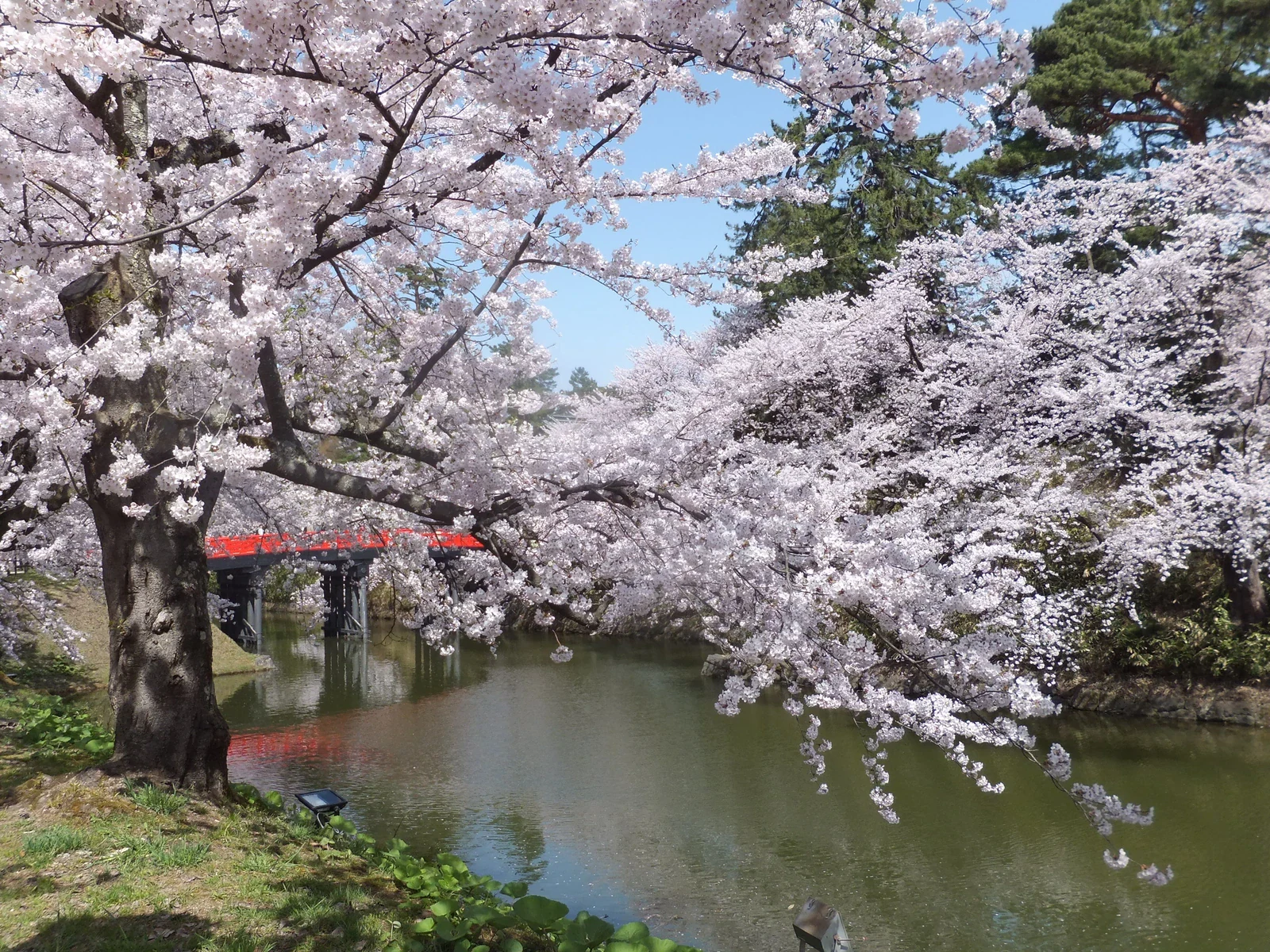
Hirosaki Park is a place to look across water, under branches and through gateways. The old castle grounds still have the shape of a fortified town within the town: moats divide the enclosures, bridges link them, and surviving gates make each change of scene feel deliberate. You can build a satisfying visit around a few of these outdoor spaces without trying to cover every corner.
Cherry blossom is the celebrated season. The tourism bureau describes roughly 2,600 cherry trees of 52 varieties, so a spring walk is more interesting when you compare trees as well as admire the overall colour. At the West Moat, branches arch over the waterside walk. Around the outer moat, fallen petals can gather into the floating pink carpets called hanaikada. Their appearance depends on the bloom, wind and water, so enjoy what the day brings rather than expecting a particular photograph.
Beyond the blossom weeks, give the trees and the botanical garden their turn. Hirosaki Castle Botanical Garden occupies part of the Sannomaru, the third enclosure, and contains a rock garden, wetland planting, a seasonal flower path and Japanese garden areas. Choose a few sections and read the labels slowly; the garden is a good reason to linger after the busiest viewpoints have had their moment. It is inside Hirosaki Park, while nearby Fujita Memorial Garden is a separate attraction.
Restoration changes the castle visit. The keep interior has been closed since 24 November 2025 and is currently planned to remain closed through 31 March 2033. Moving the building back to its original foundation does not reopen its rooms. The park remains visitable, but construction barriers, scaffolding and temporary access arrangements affect the Honmaru, the main enclosure. Start with the current notices, then treat an exterior view as one part of a broader day among the moats, gates and gardens. Don't forget to bring the Snappit nature identification app along to scan local species.
Hirosaki Castle was largely completed in 1611 for the Tsugaru clan. The surviving keep dates from 1810, after the original keep was lost to a lightning fire in 1627. The grounds opened as a public park in 1895. Cherry planting had begun much earlier: the operator records trees brought from Kyoto in 1715 and substantial Somei Yoshino planting in 1882. The botanical garden opened in May 1988, adding a different kind of plant-focused visit within the historic grounds.