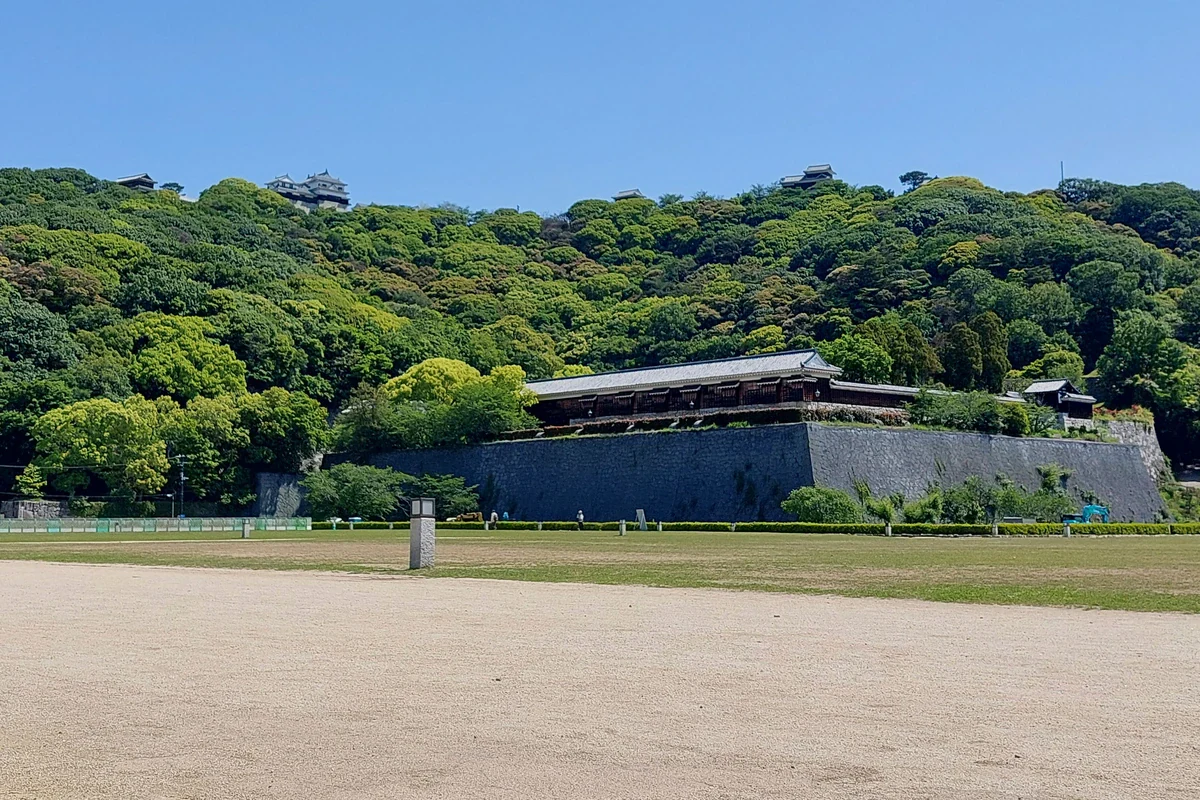
Shiroyama Park gives you a lovely choice before you take a single uphill step. At the foot of Matsuyama Castle, the Horinouchi grounds have room for a slow walk, a picnic and a long look at the wooded skyline. Above them, stone walls and castle roofs appear through the trees. A visit can stay entirely down here, especially with a stroller, small children or someone who would rather save their energy.
Start with Yasuragi Square and let the hill be the view. Walk a little, pause beside the moat, then choose whether to continue. Sakura Square brings cherry blossom into the lower park in spring, while Fureai Square gives families space for gentle games in the permitted area. The simplest outing is a short circuit with plenty of stops, rather than an attempt to cover every corner.
The trees on the hill are part of what makes this place special. Matsuyama Castle Hill Woodland is a prefectural natural monument, with warm-temperate evergreen trees and a leafy understorey. The city's botanical account describes camphor trees, evergreen oaks and tsuburajii, a tree whose pale yellow flowers can brighten the canopy in early May. Look at the layers: rounded crowns high above, shrubs beneath, then ferns close to the ground. You can enjoy the woodland as a landscape from below or meet it more closely on an open ascent path.
For a different kind of plant discovery, add Ninomaru Historic Site Garden. Citrus trees and flowers mark out former palace rooms; elsewhere, water, gravel and grass suggest another part of the old layout. It is an engaging place to ask children where they think a doorway or room once stood. This is a separately ticketed garden on the hillside, so treat it as an optional visit with its own approach and access needs.
The castle summit is another choice again. Walk up the Shinonome approach if everyone enjoys slopes and steps, or take the ropeway to reduce the climb. Either way, there is still uphill walking to reach the main castle area. Honmaru Square gives broad city views without entering the keep; the keep adds a separate ticket and steep indoor stairs. Choose the version that leaves everyone enough energy to enjoy the way back. Be ready to snap and learn! Get the Snappit app to identify any nature species you find here.
Castle construction began in 1602 under Katō Yoshiaki. The hilltop first opened as a public park in 1874, and the hill woodland gained prefectural natural-monument status in 1949. Ninomaru Historic Site Garden opened in 1992. Much of today’s open Horinouchi landscape took shape in the 2010 first-stage park redevelopment, which made the castle setting and buried historic layout easier to appreciate.