Snappit logo
Snappit
Get App
Generic illustration, not a photograph of this venueIllustration
ParkShizuoka, Japan

Rakujuen Park

Step through Rakujuen’s gate and Mishima’s busy station neighbourhood gives way to trees, dark volcanic rock and the quiet outline of a villa above Kohama Pond.

About

Step through Rakujuen’s gate and Mishima’s busy station neighbourhood gives way to trees, dark volcanic rock and the quiet outline of a villa above Kohama Pond. The pleasure here is in the combination: a garden walk can become a short lesson in how Mount Fuji shaped the town, a look at Meiji-period craftsmanship or an easy family afternoon with animals and a miniature train.

The roughly 7.8-hectare municipal park grew around the retreat created for Prince Komatsu Akihito in 1890. Mishima began running it as a public park in 1952. Its historical centre is Rakujukan and the pond landscape, while the western side brings a more playful mood with the animal collection, rides, woodland playground and local museum. You can enjoy both without turning the day into a long-distance expedition.

Come with curiosity about water rather than an expectation of a perfect reflection. Kohama Pond’s spring supply fluctuates, and a low or empty basin is part of the place’s story. When water is present, the villa and trees make a lovely composition; when it falls, the lava becomes much easier to appreciate. The park’s connection with Fuji is underfoot: the mountain itself cannot be seen from inside.

A good first visit balances one quiet stop with one activity. Check the villa-tour times as you enter, choose a few features on the official map and leave time for a seat under the trees. With children, let the animals, play area and a snack set the pace. The useful planning details are the entrance you choose, whether a guided interior visit suits your group, and the season’s current notices. Enhance your adventure: download the Snappit app to identify the local species you encounter.

What to do here

Look at the lava and pond, join a suitable Rakujukan tour, visit the captive animals, explore the local museum or take younger children to the rides.

Seasonal info

Water, foliage and animal activity all change. Check dated notices before making a seasonal display or animal programme the main reason for travelling.

Accessibility

Wheelchairs and strollers are loaned at both entrances, subject to availability. The park has multipurpose toilets, but Rakujukan cannot admit wheelchairs; ask staff about a suitable outdoor route.

Don't miss

1

Kohama Pond and exposed Mishima lava

2

Rakujukan’s architecture and guided interiors

3

Woodland around the former villa

4

Captive animals and children’s rides

Walks and routes

A garden-and-villa visit

Enter through the station-front gate, pick up the map and check the next tour. Spend time in Kohama woodland, then head towards Rakujukan and the pond. Add a rest stop and return through a suitable open path. Allow 90–150 minutes with a tour. This is a flexible sequence, with no measured distance, fixed circuit or verified step-free claim.
A family afternoon

Focus on the western animal and ride areas, then choose the playground or museum according to energy and weather. Add a short pond stop rather than trying to inspect every corner. Allow two to three hours with food and breaks. The woodland athletic equipment is aimed at ages 6–12; ages 3–6 require parental supervision. Check equipment signs and do not assume every activity suits toddlers.

Things to try

Try a quiet observation game

Ask each person to find one interesting root shape, one reflection or rock texture, and one sound. Compare what you noticed at a rest stop. Look without collecting leaves, insects or stones, and keep the path clear for other visitors.

Compare old and new views

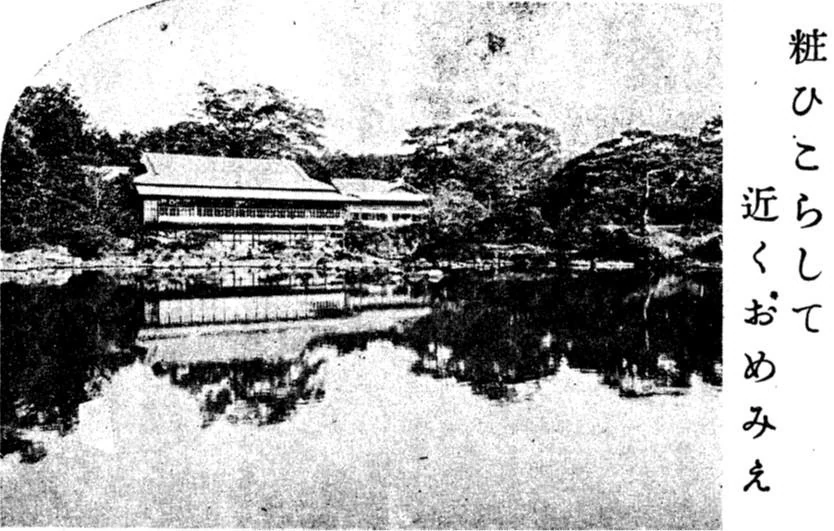
The accompanying 1952 archive photograph shows the villa across water before the municipal park opened. Compare the building’s outline with today’s view, while remembering that both the planting and water level can change. A historical photograph is a conversation starter rather than a promise of current scenery.

Wildlife and habitats

Separate three kinds of looking: free-living birds in the woodland, trees within a long-managed landscape, and animals in enclosures. The named animal examples below are captive residents recorded by the park, with no promise that each will be visible. Chrysanthemums belong to cultivated autumn displays. Older tree surveys are useful for learning what to look for, but they are not a current tree-by-tree census.

Stories and discoveries

Kohama Pond: two kinds of scenery

Stop where the villa, trees and pond can be seen together, then take a closer look from permitted paths at the dark rock. Water arrives through the underground lava landscape and varies over time. A dry visit can reveal shapes hidden beneath reflections on wetter days. Do not step into the basin or onto delicate rock and roots for a better photograph.

Rakujukan’s carefully made interior

The Kyoto-influenced, raised-floor villa was designed to sit comfortably with its garden. Its rooms contain 210 decorative painted panels, including sliding doors, cedar doors and ceilings. Public tours normally start at 9:30, 10:30, 11:30, 13:30, 14:30 and 15:30 and take about 30 minutes; arrive at the entrance five minutes early. Commentary is Japanese. Entry is guided only, with no joining or leaving midway. Preschool-age children and people who have consumed alcohol cannot enter; wheelchairs are also excluded. Interior photography is prohibited. Ask staff if the child-age rule is relevant to your group.

Trees growing with the lava

Kohama and Tokiwa woods make the park especially rewarding for slow looking. Notice roots spreading around rock, the contrast between evergreen and deciduous leaves, and the way shade changes the path. The city’s older woodland survey records Japanese maples, sawtooth oaks and Japanese black pines among many trees. This is a landscape shaped by natural growth, secondary woodland and planting over time, so avoid treating every mature tree as untouched wild forest.

A small animal collection

The park lists red pandas, capybaras, alpacas and other animals in managed enclosures. Watch quietly and give resting animals space. These are captive residents, while birds moving freely through the garden are a different kind of encounter. Do not feed or touch animals outside an explicitly supervised activity. Avoid flash and photographs of back-of-house areas; commercial animal photography needs an advance check with the office.

Rides, mirrors and a real steam locomotive

The carousel and miniature train give younger visitors a cheerful change of pace. Tickets are ¥100 each, required from age two; children through age three need a companion of middle-school age or older. Coin-operated rides are also listed at ¥100. The mirror house adds a playful stop, and the preserved C58 locomotive is distinct from the miniature train. Its cab is advertised as accessible to visitors, subject to the day’s arrangements.

Mishima City Local Museum

The museum is inside the park and introduces local history and culture. It makes a useful quieter stop between outdoor activities, with no separate museum admission charge after entering Rakujuen. Wheelchairs and strollers are welcome inside. Check the museum’s own opening information, especially if an exhibition is your main interest.

A park with Fuji underfoot

The Mishima lava flow forms the foundation of this landscape. The city’s visitor introduction places it around 10,000 years ago; older technical material gives a broader formation range. Look for the consequences in rock shapes, tree roots and the route taken by groundwater.

Protected scenery in the middle of town

The garden’s natural ponds and woodland received national Natural Monument and Place of Scenic Beauty designation in 1954. Their value lies in the relationship between geology, water, vegetation and the villa setting, even when the pond is low.

Grainy black-and-white archival image of a long-roofed villa and surrounding trees reflected in a pond, with vertical Japanese lettering at the right.

Rakujuen before its opening as a municipal park, in an archival image associated with a 1952 Mishima city newsletter. The exact photograph date is uncertain; this is not the present-day water level or garden condition.

Archive image: Mishima City PR office, “公開前の楽寿園”, via Mishima Sepia Cat / OpenPhoto, CC BY 4.0. Published JPEG unchanged. · Creative Commons

When to visit

Spring and summer

Fresh leaves are a lovely reason to wander and compare different shades of green. In summer, plan shorter walks, drinking-water breaks and shade. Do not assume higher seasonal groundwater means the pond will be full on your particular day.

Autumn and winter

Autumn’s chrysanthemum displays are cultivated seasonal exhibits. Leaf colour usually follows in late November to early December. In winter, the park typically offers capybara baths on weekends and holidays from roughly December to March, starting around 11:30 when conditions allow. Rain, temperature or an animal’s choice may change the programme.

Getting there and practical advice

Hours and admission

Regular hours are 9:00–17:00 from April to October, last entry 16:30, and 9:00–16:30 from November to March, last entry 16:00. Mondays are normally closed; when Monday is a holiday, closure moves to the next non-holiday. The New Year closure is 27 December–2 January. Special event notices can override the regular pattern.

What to budget

Standard admission is ¥300 from age 15, with middle-school pupils and younger free. High-school, vocational-college and university students can enter free on presenting their original student ID. Other documented concessions apply; check eligibility with the ticket desk. Admission can be paid by cash or listed cashless methods, while rides and parking require cash. Same-day reentry is possible with your ticket.

A comfortable break

Sakura and Momiji are free rest spaces. Bremen, beside Sakura, lists light meals and snacks with usual hours of 10:00–16:00. Toilets are marked at the gates, ride area, south of Momiji and inside the museum; multipurpose toilets are at the station-front entrance and south of Momiji. Nursing rooms are at Sakura and the ride-area exhibition building. Bring your own nappies.

Luggage and loans

Both entrances have coin lockers; size and availability vary, and they take ¥100 coins. Free wheelchair and stroller loans are offered at each entrance in limited numbers, with no reservations. If a loan is essential, have a backup plan rather than assuming one will be waiting.

The official map marks multipurpose toilets and rest points, but does not establish gradients or a continuous step-free circuit. Lava terrain creates changes in level. Ask entrance staff which paths suit your chair or stroller and whether any work affects them. Rakujukan’s wheelchair restriction does not apply to the local museum, which explicitly welcomes wheelchairs and strollers. Three priority parking spaces are listed at the station-front entrance.

The station-front entrance is about a three-minute walk from JR Mishima Station’s south exit and the Izuhakone Railway’s Mishima Station. The main entrance is on the east side. Drivers should use the visitor car park only for the park visit: ¥200 for up to two hours, then ¥50 per additional 30 minutes, cash only. Gates are locked at closing, so return in good time. Bus parking requires advance reservation and is unavailable on some event dates. The park’s address is 19-3 Ichibancho, Mishima, Shizuoka; telephone 055-975-2570.

Wear shoes with grip for wet leaves and uneven surfaces, stay on permitted paths and supervise children by water and rides. Do not collect plants or insects or feed wild birds. Bicycles, tricycles and ball games are not permitted. Take brought-in food containers and other rubbish home. Keep away from festival construction and follow weather-related instructions. If something happens, seek staff at the station-front office; AEDs are listed there and in the museum.

Visitor information

Checked 20 October 2026: festival preparations

Children’s group outings are not accepted from 29 September to 29 October while chrysanthemum displays are built. The park’s notice explicitly says ordinary opening continues. Expect work areas and follow staff directions; bus parking also has date-specific restrictions.

2026 chrysanthemum festival

The 74th festival is scheduled for 30 October–30 November, with no closing days during that period. Its Kiyomizudera-themed display uses about 8,000 pots; the usual best flower condition is around mid-November. Free evening viewing is announced for 6–8 and 13–15 November, 17:00–21:00, last entry 20:45. Only the flower-display area opens at night, and the park car park does not operate then.

Check animal activities before promising them

The animal page still carries a summer guinea-pig interaction suspension and an anticipated October restart; the inspected notice does not confirm that restart. Ask the park before planning around it. Ordinary exhibition animals and seasonal bathing programmes also depend on welfare and daily conditions.

Sources and useful links

Wildlife you might spot

8

Each card links to a full Explore page with photos, traits, and fun facts.

Snap map for this place

Start with the big picture, then zoom in to explore individual wildlife observations around this place.

Loading map…

Good to know before you go

Arrive early enough for the visit you want; final admission is 30 minutes before the park closes.

Carry coins for rides, lockers and parking, even if you pay for admission by card.

Keep your admission ticket if you plan to return the same day.

Use the official map and local signs; the southern gate is an exit only.

Frequently asked questions

There is no guarantee. Spring flow varies; the city describes water as more usual in summer and dry conditions in winter. Check the park’s water-level link and enjoy the lava landscape if levels are low.
Pets cannot enter, including in carriers. Guide, hearing and assistance dogs are excepted.
The current city FAQ says this aquatic plant cannot be seen in Rakujuen. It directs visitors to Sakuragawa or Mishima Baikamo-no-Sato outside the park.
Yes. The pond, woodland, animal collection, playground and museum offer plenty to choose from. Plan an outdoor-and-museum visit if the guided tour does not suit your group.
The south exit is the convenient way towards Genbe River. That onward walk is outside this park guide; check its own access and water-edge conditions.

Recent snaps at this place

Recent snaps will appear here as new observations are added.

View all ›

Take the discovery with you

Exploring Rakujuen Park?

Identify the wildlife you spot, learn as you go, and keep a collection of the adventure.

  1. 1Spot it
  2. 2Snap it
  3. 3Keep the discovery