




American Flamingo
Phoenicopterus ruber
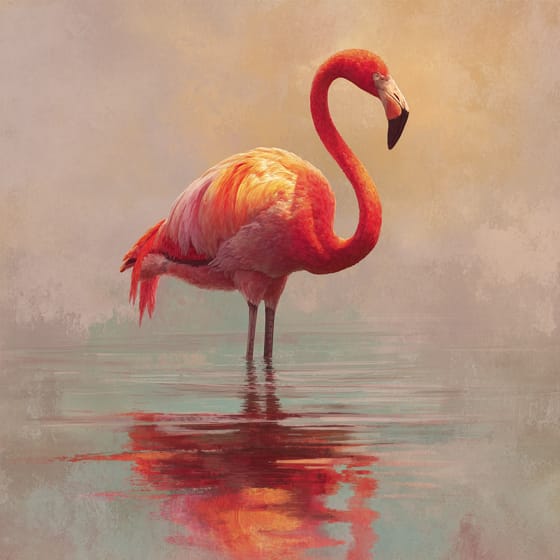
The American Flamingo is known for its bright pink feathers and long legs. They are social birds that like to hang out together.
Habitat: Coastal areas and wetlands
The American Flamingo is a large, vibrant pink or reddish bird with remarkably long legs and an S-shaped neck. It has a distinctive large, downward-curved beak with a black tip, making it easily recognizable from other wading birds.
Category
BirdsRarity
Common
Danger
2/5 · Low
Snaps
Be the first to snap!
A group of flamingos is called a "flamboyance," which describes them perfectly!
Flamingo chicks are born with dull gray feathers and gradually turn pink as they grow up!
They build tall, cone-shaped nests from mud to keep their precious egg safe and dry.
What looks like a flamingo's backward-bending knee is actually its ankle joint!
American Flamingo can filter food with its head completely upside-down, using its specialized beak like a scoop.
American Flamingo has bright pink feathers that come from pigments in its diet, showing how healthy it is.
American Flamingo can stand perfectly still on one leg for hours, helping it conserve energy and body heat.
These filter-feeders use their unique beaks to strain tiny plants and animals from the water.
Age differences: Chicks are fed 'crop milk' by parents, then transition to filter-feeding as they mature.
Artemia salina
A primary food source
Dunaliella salina
Filters this microalga
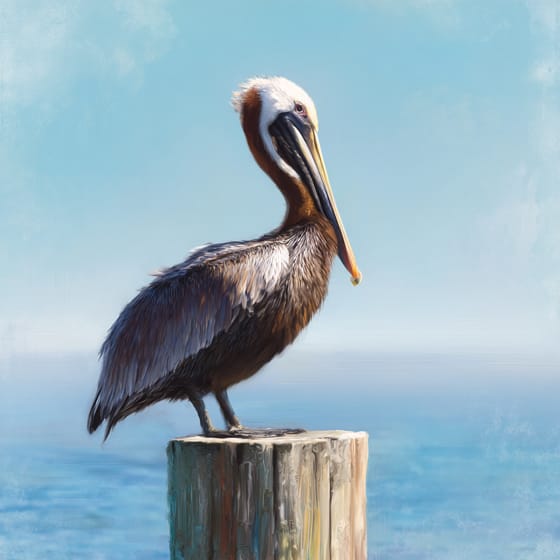
Pelecanus occidentalis
Nests near for protection
Canis familiaris
Can prey on eggs/chicks
Homo sapiens
Habitat relies on conservation
Wildlife encompasses all undomesticated animal and plant life existing in their natural habitats.
Feathered describes animals, primarily birds, possessing a covering of feathers.
Social animals live in organized groups, cooperating for survival benefits such as foraging, defense, and raising offspring.
Aerial creatures spend a significant portion of their lives airborne, utilizing flight for various activities such as hunting, migration, or nesting.

Filter feeders obtain nutrients by straining suspended food particles and small organisms from water.

Coastal habitats are dynamic environments located along the interface between land and sea, influenced by tides, waves, and saltwater.

Migratory animals undertake seasonal movements from one region to another, typically in response to changes in climate or food availability.
Danger
2/5 · Low
Watch quietly from a distance and never try to feed or chase wild animals.
120-145 cm
140-165 cm
2.2-2.8 kg
40-50 years
56 km/h
These filter-feeders use their unique beaks to strain tiny plants and animals from the water.
Coastal areas and wetlands
Filter Feeding
Zoom in to split clusters and explore where this object has been snapped.
Recent snaps will appear here as new observations are added.

Tennessee, US
You might spot Parachromis Managuensis, Giraffes, and Common Ostrich.
View guide →

Maryland, US
You might spot African Lion, Red Fox, and Common Ostrich.
View guide →
Louisiana, US
You might spot African Lion, Giraffes, and Equus Africanus Asinus.
View guide →

Pennsylvania, US
You might spot Snake, Cheetahs, and Crocodilia.
View guide →
California, US
You might spot African Lion, Komodo Dragon, and Cheetahs.
View guide →

Florida, US
You might spot Komodo Dragon, Ocelot, and Cougar.
View guide →