Snappit logo
Snappit
Get App
Generic illustration, not a photograph of this venueIllustration
ParkKansai, Japan

Akashi Kaikyo National Government Park

Start with flowers, finish with a slide.

About

Start with flowers, finish with a slide. On Awaji Island, Akashi Kaikyo National Government Park combines broad seasonal planting beds with water, open lawns and views towards Osaka Bay. At Daichi-no-niji, the colours change with the planting season; at Poplar Hill, flower beds spread below rows of trees. There is room to linger over a single display rather than trying to see every corner.

For a first family visit, choose one flower area and one playground. Arriving by car, Awaji Gate is handy for Yumekko Land and the visitor building. Arriving by bus at Awaji Yumebutai-mae, Higashiura Gate is the more natural start for the flower-and-water gardens. The playgrounds sit far enough apart that promising both can turn a gentle outing into a long march. A picnic and an unhurried return are often the better plan.

The name covers two very different places on opposite sides of the Akashi Strait. This guide's walks, fees, flowers and family facilities refer to Awaji. Kobe's Aina Satoyama Park has farmed fields, ponds, woodland and traditional rural buildings, and deserves a separate trip. Awaji Yumebutai, its Hyakudanen gardens and Awaji Greenhouse, and Hyogo Prefectural Awajishima Park with Nijigen no Mori are also separate destinations; they are not extra sections of this garden walk. Be ready to snap and learn! Get the Snappit app to identify any nature species you find here.

The Awaji landscape was created on land previously used for large-scale earth extraction, including material for Kansai International Airport. Japan Flora 2000 took place here with neighbouring facilities; the national-government park opened its first Awaji sections on 21 March 2002. The Kobe district opened in 2016, with a different emphasis on conserving and sharing satoyama, the landscape shaped by rural life.

What to do here

Wander the seasonal beds at Daichi-no-niji and Poplar Hill, look for the flower-covered phoenix Hanahidori, and leave time for a lawn break. Families can choose Yumekko Land near Awaji Gate or the Children’s Forest playground nearer the central flower gardens. Follow the signs for age and use restrictions on each piece of equipment.

Seasonal info

Summer offers sunflower plantings but also exposed paths, so bring water and sun protection. Winter has shorter opening hours, fewer mass-flower displays and a closed southern entrance. As checked on 16 October 2026, part of the splash pond beside Yumekko Land and the Children’s Forest water-play area were closed for repairs until further notice. Check the current notice before promising water play.

Accessibility

The park says its main paths are generally designed with gradients of up to 6%, with rest spaces on long slopes. Smaller paths can be steeper or include steps. Wheelchairs and strollers are loaned at the gates; use the wheelchair map and ask staff for a route that suits your needs. An accessible main path does not mean every garden viewpoint or playground element is step-free.

Don't miss

1

Seasonal ribbons of colour in the Daichi-no-niji flower beds

2

Poplar Hill’s changing flower displays above Hana-no-nakaumi lake

3

Yumekko Land’s slides, climbing structures and play equipment

4

Hanahidori, a flower-covered phoenix associated with recovery after the earthquake

Walks and routes

A flower-and-water stroll from Higashiura Gate

Start with the octopus-shaped flower display by the entrance, then use the signed garden paths to explore Hana-no-nakaumi and Daichi-no-niji. Add Poplar Hill if the flowers appeal and the slopes suit your group. The Children’s Forest playground makes a convenient optional stop before you return towards Higashiura Gate.

Allow 60–90 minutes for flowers and pauses; longer if you add the playground.
Play first from Awaji Gate

Orient yourself at the visitor building, then make Yumekko Land the main event. Break up the play with the adjacent lawn and, if everyone has energy, the gardens around Utsuroi-no-niwa. Turn back when you need to; the flower gardens at the far end need not be part of this shorter visit.

Allow about 2 hours, including play and a snack stop.

A gentle half-day with children

Start near opening time with the flower area closest to your chosen gate, or let an eager child have the playground first. Spend roughly an hour on each, with a picnic or restaurant break between them. Save a little time for a favourite spot on the way out. For a 3–4-hour outing, resist adding both playgrounds and a neighbouring attraction.

Things to try

Try a colour-and-shape hunt

Choose three colours to find in the beds, then compare a tall flower with a low one. Photograph or sketch your favourites from the path. Leave flowers, seeds and insects where they are.

Find the flower-covered phoenix

Look for Hanahidori beside the flower-and-water gardens. Its bird shape represents a wish for recovery after the Hanshin-Awaji earthquake; the plants that colour it change with the seasons.

Join a flower walk when one is scheduled

The park’s Kaikyō Friends volunteers lead seasonal flower walks. Check the events page for the day, meeting place and any weather cancellation before planning around one.

During a passing shower

Take a break at the visitor building or an open restaurant, then decide whether a short garden walk still appeals. This remains an outdoor day out, so bring waterproofs and avoid slippery play equipment.

If rain is likely to last

Consider the neighbouring Awaji Greenhouse as a separate outing. Check its own opening notice and ticket arrangements before changing plans; the park ticket alone should not be assumed to cover the greenhouse.

Wildlife and habitats

Cosmos: look beyond the flower colour

Look for the finely divided, almost thread-like leaves beneath the open flower heads. Pink and white forms are familiar, but some ordinary cosmos varieties are yellow too. Use the plant labels rather than colour alone to separate them from yellow cosmos.

Yellow cosmos: a separate species

The park’s autumn calendar includes yellow cosmos at Poplar Hill. Compare the labelled planting with ordinary cosmos: they are separate species, even though ordinary cosmos can also have yellow flowers. Enjoy the warm colours without picking a sample.

Mexican bush sage: autumn texture

Look for the purple, velvety-looking flower spikes at Hidamari Hill and along Flower Hill Path when the autumn display is flowering. Comparing their shape with the nearby open cosmos flowers makes a simple observation game for children.

These are garden plants documented by the park. Planting schemes and flowering dates change, so use labels and the latest report to decide what to look for. Look closely from the paths and leave plants and insects undisturbed.

Stories and discoveries

A garden grown on an extraction site

The open flower landscape is a designed recovery of heavily worked land. That history helps explain why this part of the park feels like a carefully composed garden rather than a surviving patch of untouched coastline.

One park, two approaches to nature

Awaji reshapes a former extraction landscape as seaside gardens. Aina preserves a working relationship between fields, woodland and rural culture. The shared name connects these ideas, even though the visitor experiences are separate.

When to visit

Spring: follow the changing beds

Choose a date around your favourite display rather than expecting all spring flowers together. Tulips give way to blue nemophila, with different beds carrying the colour through the season.

Summer: shorter walks, longer breaks

Make an early visit, carry drinking water and take regular breaks. Water-play facilities normally operate from 1 April to 31 October, but the repair notices take precedence; check which areas are actually available.

Autumn: compare the cosmos

Look for the contrast between ordinary cosmos and yellow cosmos, then the purple spikes of Mexican bush sage. In the report dated 15 October 2026, Poplar Hill’s cosmos were at their best while the northern Daichi-no-niji beds were just starting: nearby beds can have different timing.

Winter: keep the outing compact

Plan around the earlier closing time and use Awaji or Higashiura Gate rather than the closed southern entrance. Check the maintenance-closure dates and tram operation before setting out.

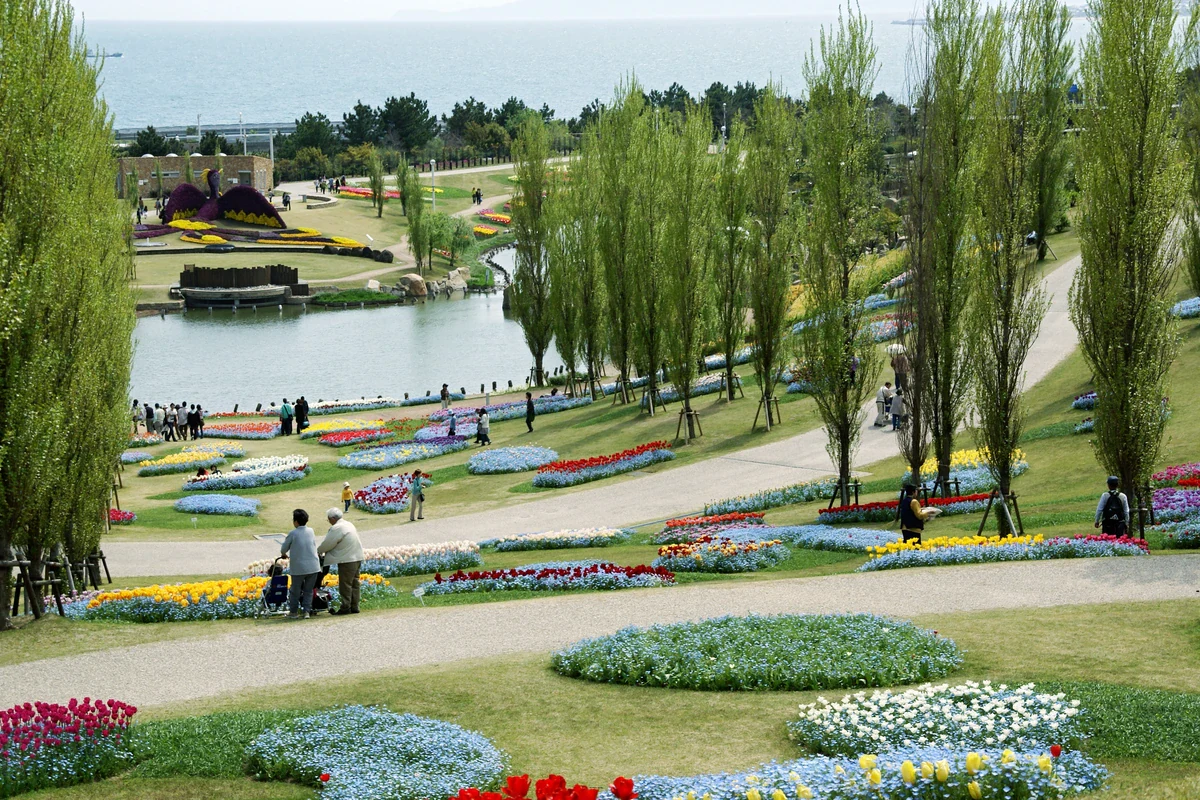
Bands of red, yellow, blue and white flowers beside curving paths, slender trees and a pond, with the sea beyond.

Spring flower beds curve around lawns and water in the Awaji area of Akashi Kaikyo National Government Park, photographed in April 2007.

© 663highland / Wikimedia Commons / CC BY 2.5. AKNGP08s3200.jpg. Source: https://commons.wikimedia.org/wiki/File:AKNGP08s3200.jpg. License: https://creativecommons.org/licenses/by/2.5/. Proportional downsampling to fit 1200 × 1200 pixels without enlargement; WebP quality 92, method 6. No crop, retouch, recoloring or added text. EXIF omitted. Adobe Photoshop CS2 Windows; modification date 2012-06-29. Source processing retained; no specific retouch is declared. · Creative Commons

Getting there and practical advice

Visitor building and baby facilities

Just inside Awaji Gate, the visitor building has a rest area, nursing/baby room, changing equipment and a children’s corner. It is a useful first stop before a playground visit.

Lunch, toilets and a breather

Hanayashiki restaurant and a shop are near Higashiura Gate. The park also marks toilets around the lawn, Children’s Forest and flower-garden areas. Pick up the map at arrival so you know where the next stop is before a child urgently needs it.

The park tram

The tram between Awaji and Higashiura gates takes about 20 minutes. The listed day ticket is ¥300 for adults and children; children aged three and younger ride free. Check operating dates and the departure board, particularly in winter. Pets cannot ride.

By train and highway bus

Use the Ōiso-gō highway bus from Sannomiya or Kōsoku Maiko towards Yumebutai and Higashiura. Awaji Yumebutai-mae is about a 3-minute walk from Higashiura Gate. For Awaji Gate, Seirei Awaji Hospital-mae is about a 5-minute walk, but some services do not stop there. The bus is unreserved and boarding is first come, first served; check the operator’s current timetable in both directions.

By car

From Kobe, cross the Akashi Kaikyo Bridge and leave the expressway at Awaji IC, then follow Route 28 south. Awaji Gate’s car park is the simplest choice for Yumekko Land and costs ¥500 per standard car per day. The southern seaside car park and Seaside Gate close from December through February.

Choose a comfortable path before setting out

Ask the gate staff to mark a manageable out-and-back walk on the wheelchair map. Main paths still include sustained slopes, while some smaller paths have steps or steeper sections. A shorter visit centred on one garden or playground can reduce tiring cross-park travel.

Loans and assistance

Wheelchairs and strollers are available at gates, with availability to be checked on arrival. The park also lists baby and first-aid rooms. If you need a specific wheelchair, transfer assistance or toilet arrangement, contact the management centre before travelling: +81 799-72-2000.

Awaji normally opens at 09:30. Closing is 17:00 in April–June and September–October, 18:00 in July–August, and 16:00 in November–March. For autumn 2026, the 17:00 closing time continues through 15 November. Ticket sales finish one hour before closing.

Closed 31 December–1 January and from the second Monday through Friday of February. Check the annual notice for the exact maintenance dates.

Standard admission is ¥450 for high-school-age visitors and adults, ¥210 for visitors aged 65 and over, and free for junior-high-school children and younger. Bring age identification for the senior rate.

Holders of the disability certificates specified by the park, plus one accompanying person, receive free admission. Ask ahead whether your documentation qualifies.

Sources and useful links

Wildlife you might spot

3

Each card links to a full Explore page with photos, traits, and fun facts.

Snap map for this place

Start with the big picture, then zoom in to explore individual wildlife observations around this place.

Loading map…

Good to know before you go

Pick your entrance around your priority

Awaji Gate for Yumekko Land, Higashiura Gate for the flower gardens and the Yumebutai bus stop.

Check your return bus before starting the walk. Some services skip Seirei Awaji Hospital-mae, the stop used for Awaji Gate.

Arrive well before the ticket-sales cutoff, which is one hour before closing. Keep your ticket for same-day re-entry.

Carry drinks, hats and a light outer layer. The open seaside setting can feel quite different from a sheltered city street.

Leave bicycles, scooters and collecting nets behind. Observe plants and animals without picking or catching them, and check the rules before bringing other play equipment.

For family photographs, keep to paths and leave space for other visitors. Commercial shoots and sessions with professional photographers need advance permission.

Dogs must be on a lead or in a carrier, and owners must clean up. Pets cannot enter indoor facilities or ride the tram or swan boats.

If a particular flower is the reason for your trip, use the weekly bloom report rather than an old photograph: beds are replanted and different varieties peak at different times.

Frequently asked questions

No. They are separate nearby attractions. For the flower gardens in this guide, search for the Awaji district of Akashi Kaikyo National Government Park and choose the appropriate gate.
No. Aina Satoyama is the Kobe district on the mainland, across the strait. Treat it as a separate journey. It normally closes on Wednesdays, or the following day when Wednesday is a public holiday, so the two districts do not share the same closure pattern.
Yes, a packed lunch works well on the lawns or at an appropriate outdoor rest spot. Hanayashiki restaurant is near Higashiura Gate, but check its opening arrangements rather than relying on it for a late lunch.
Check the day’s timetable when you arrive. The paid park tram links Awaji and Higashiura gates, but service changes seasonally and winter operation needs checking. Leave enough time to walk back if necessary.
The displays described here are cultivated garden plantings. Enjoy comparing their shapes and colours, but do not assume that every flower is native to Awaji or that a display will be repeated the following year.

Recent snaps at this place

Recent snaps will appear here as new observations are added.

View all ›

Take the discovery with you

Exploring Akashi Kaikyo National Government Park?

Identify the wildlife you spot, learn as you go, and keep a collection of the adventure.

  1. 1Spot it
  2. 2Snap it
  3. 3Keep the discovery