Snappit logo
Snappit
Get App
Generic illustration, not a photograph of this venueIllustration
ParkCataluña, Spain

Barcelona Botanical Garden

At the Jardí Botànic de Barcelona, a walk across Montjuïc becomes a journey between places that share a familiar problem: getting through a dry summer.

About

At the Jardí Botànic de Barcelona, a walk across Montjuïc becomes a journey between places that share a familiar problem: getting through a dry summer. Plants from Australia, California, central Chile, South Africa and the Mediterranean basin are arranged by geographical origin and the plant communities they form. The pleasure is in the comparisons. A leaf in one collection can suggest a solution you have just noticed in another, even when the plants are unrelated.

This is a planted scientific collection, with labels, designed paths and a close relationship with the Institut Botànic de Barcelona. Its angular layout follows the hillside rather than turning it into a flat ornamental garden. Give yourself room to stop at an unusual trunk or revisit a bed that catches your eye; there is no need to turn the visit into a test of plant names.

For a first visit, use the entrance at Carrer del Doctor Font i Quer, 2, pick up the garden plan and choose either the operator’s 45-minute express itinerary or a slower visit of around two hours. Weekends add the possibility of the bonsai display and Gabinet Salvador, each with its own access times. This is the modern garden opened in 1999. The Jardí Botànic Històric near the MNAC is a separate place, with a different entrance. Explore the grounds like a pro—download the Snappit app to instantly identify animals and plants.

The modern Jardí Botànic opened on 18 April 1999. It followed the earlier Jardí Botànic Històric, whose setting was affected by preparations for the Olympic facilities. The new garden brought a wider Mediterranean-plant conservation project to a different Montjuïc site. Architects Carles Ferrater and Josep Lluís Canosa, landscape architect Bet Figueras, biologist Joan Pedrola and horticulturist Artur Bossy shaped a design that combined plant geography with the terrain. The triangular framework still gives the paths and beds their distinctive rhythm. Today, conservation, botanical learning and research matter as much as the pleasure of the walk.

What to do here

Follow the official express itinerary for an introduction, then spend extra time in whichever collection interests you. Compare the Australian plants with the Mediterranean plantings, look for the small details on a labelled olive or fan palm, and pause over the geometric way the paths fit the hillside. Families can ask for a naturalist backpack at the ticket desk. On a weekend, check whether the bonsai display or Gabinet Salvador fits your plans.

Seasonal info

A dry-looking summer garden tells part of the story: many Mediterranean plants reduce growth or shed some foliage until rain returns. Spring flowering and autumn regrowth depend on the weather, so look for what is happening rather than chasing a fixed bloom calendar. The garden closes at 17:00 in November–January, making a winter afternoon much shorter than a summer one.

Accessibility

The garden is on a slope. The operator describes paths and ramps as practicable for reduced mobility, but specifies a 10% entrance ramp and excludes access to the bonsai collection from that practicable itinerary. Its mobility-scooter loan was listed as unavailable when checked on 17 October 2026. Ask staff to help choose suitable paths before setting off, including which parts of the express walk suit your needs.

Don't miss

1

Compare plants from the world’s five Mediterranean-climate regions in one hillside garden.

2

Use the official 45-minute express itinerary when time or energy is limited.

3

Look closely at the triangular layout and the plant shapes it frames.

4

Add bonsai or the Salvador natural-history cabinet on a weekend, after checking their separate access times.

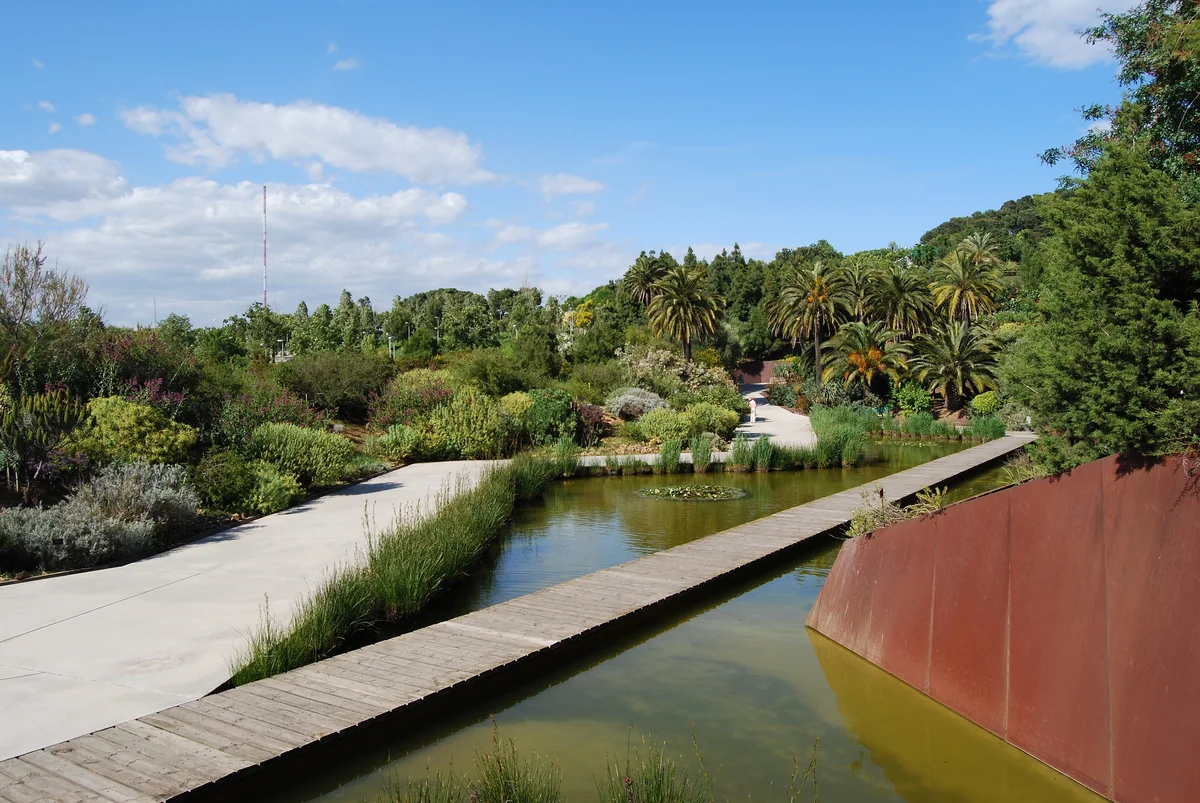
A straight timber walkway crosses a planted pond beside a rust-coloured retaining wall, with pale paths, shrubs and palms beyond.

A planted pond and paths in the modern Jardí Botànic de Barcelona, photographed in May 2013.

Jardí Botànic de Barcelona scene.JPG — Felix König / Wikimedia Commons / CC BY 3.0 · Creative Commons

Walks and routes

Recorregut exprés: the official short visit

The visitor leaflet marks an express itinerary of about 45 minutes for people with limited time. Ask for the current plan at the entrance and follow that marked option, stopping at whatever catches your attention. Keep the plan handy at path junctions and leave the longer detours for another visit if you are short of time.

A shorter itinerary can still involve slopes. Before committing to it, ask the entrance team how its surfaces and gradients fit your wheelchair, walking aid or pushchair. Bear in mind the 10% entrance ramp when planning the help you may need.


Recorregut exprés: the official short visit

About one hour: keep the visit simple

Collect the plan, ask about any path changes and follow the 45-minute express option. Choose just two or three plants to look at properly. Leave some extra time for the entrance and return, rather than arriving only 45 minutes before closing.

About two hours: compare a few collections

Begin with the plan and choose two or three geographical areas that appeal to you. Follow the public paths between them at a comfortable pace, stopping for a leaf comparison, a photograph and a rest. Finish while everyone still has energy for the journey down Montjuïc.

A longer weekend visit

Make the main garden your core outing, then add the bonsai display or Gabinet Salvador if their hours and access suit you. Leave around 2½–3 hours overall if you like to read and linger. Check those additional spaces first so you do not reach them just as they stop admitting visitors.

Things to try

A leaf-shape challenge

Choose two labelled plants from different geographical areas and draw their leaves without picking them. Are they narrow or broad, shiny or hairy, flat or fleshy? For children, finding three different shapes is enough of a challenge; adults can add the scientific names and the plants’ origins.

Borrow a different way of looking

The naturalist backpack is intended for general and family visitors with children from five years old. It offers materials and self-led activities, so you can choose what to try and when to finish. Ask at the ticket desk about availability rather than building the whole visit around a particular kit.

Spot a plant’s water-saving strategy

Look for the fleshy leaves of the Cape aloe highlighted by the garden, then compare them with small, firm leaves elsewhere. The aloe stores water in its leaves; other plants tackle dry conditions differently. Observe without breaking, squeezing or tasting the plants.

Flowers and curious fruiting structures

In the Australian collection, read the Banksia labels and look for dense flower spikes or woody fruiting structures. Their cone-like appearance is a good conversation starter: Banksia are flowering plants, not conifers. What you can see depends on the individual plant and season.

Notice the path design

Take a wider photograph from the path, then a closer one of a leaf or branch. Comparing the angular framework with the organic forms is a simple way to enjoy the garden’s architecture without treating every bed as a collection to tick off. Keep paths clear while stopping.

Find out what is on today

Ask about guided walks and the day’s activity programme. The visitor leaflet describes weekend morning tours led by Friends of the Botanical Garden volunteers, but confirm the date, language, meeting point and booking arrangements before relying on one.

Light rain

If the garden is open and conditions are comfortable, choose a shorter walk and take care on ramps. Keep a phone or paper plan protected from the rain. Ask which paths are suitable rather than pressing on with a route that feels slippery.

Heavy rain, strong wind or storms

Check the operator’s notices and follow staff instructions. Postpone the outdoor walk if necessary. On a weekend, ask whether the Gabinet Salvador or another exhibition is available, but do not treat a building on the map as guaranteed public shelter.

Wildlife and habitats

Eucalyptus

Compare the bark, foliage and overall shapes of labelled eucalypts in the Australian collection. Eucalyptus is a whole genus, so two trees with that first name can look quite different. Read the second name on a label before trying to identify an individual species.

Olive

Look for narrow leaves with pale, silvery undersides and compare the shape of the branches with a nearby tree. You may know olives best as food; here the whole plant is the subject. Leave any fruit in place and use the label to confirm the identification.

Mediterranean fan palm

The fan-shaped leaves make a useful contrast with the olive’s narrow ones. Look at how the leaves are divided and how the plant forms a clump. Observe from the path without reaching among its leaf stalks.

Holm oak

An evergreen oak offers another version of the Mediterranean leaf: look for a dark upper surface and a paler underside. Compare leaf shapes rather than assuming all oak leaves are deeply lobed. Confirm the name on the label before recording it.

Judas tree

Look for broad, heart-shaped leaves when the tree is in leaf. At the right time, pink flowers or flattened pods offer other clues. A simple sketch of one leaf can be a satisfying addition to a family nature notebook.

Pomegranate

Find the label, then look for the narrow leaves, orange-red flowers or rounded fruit according to the season. Seeing the plant before it reaches a fruit bowl can be an enjoyable discovery for children. Observe any fruit without picking it.

The following plants are documented in the garden’s cultivated collections. Displays change, and a label or a staff member is the best guide to the particular plant in front of you. Use these suggestions for noticing shapes and details, not as a promise of flowers or fruit on every visit. Keep to the paths, do not pick or taste anything, and give any insects or other animals space.

Stories and discoveries

Similar climate, different families

Plants from far apart can evolve similar ways to cope with dry summers. The garden’s geographical arrangement lets you compare these solutions without assuming that a similar-looking pair must be closely related.

More than one kind of Mediterranean

The Mediterranean-basin display is subdivided into eastern and western Mediterranean areas, North Africa and the Canary Islands. Look for the island collection on the plan as another way to explore the garden’s geographical variety.

Some trees predate the garden

The operator identifies large stone pines in several parts of the garden as survivors from the vegetation present before its creation. Look at their scale alongside the more deliberately arranged planting beds.

A garden linked to a research institute

The Institut Botànic de Barcelona stands in the upper part of the garden and works with the city and CSIC. The connection helps explain why plant conservation, documentation and scientific collections are central to this visitor landscape. Research rooms are not automatically part of a public garden visit.

When to visit

Spring: a good first introduction

Flowers can make the differences between collections especially clear. Choose a few flowering plants, watch any visiting insects from the path and compare flower shapes. Exact flowering dates vary, so ask what is looking interesting now.

Summer: read the dry landscape

Start early, carry water and keep your visit flexible. Sparse foliage or dry-looking beds can be part of Mediterranean plants’ seasonal strategy. Use the outing to compare water-saving forms, and shorten it if the heat makes the slopes tiring.

Autumn: watch for a response to rain

After rain, new leaves and fresh growth can shift the character of the garden. Repeat a photograph of a plant you saw in summer if you are returning. Wet surfaces and changing weather are good reasons to take more time on slopes.

Winter: allow for an earlier finish

Come earlier in the day and enjoy leaf shapes, bark and the outlines of evergreen and deciduous plants. November–January closing is 17:00, with admission ending at 16:30; the bonsai day is also shorter. Dress for being outdoors rather than assuming the city will feel warm on the hill.

Getting there and practical advice

Main garden: seasonal opening

Regular opening is daily from 10:00. Closing is 17:00 in November–January; 18:00 in February–March; 19:00 in April–May and September–October; and 20:00 in June–August. Last admission is 30 minutes before closing. Annual closing days are 1 January, 1 May, 24 June and 25 December. Check for exceptional closures before travelling.

Tickets and concessions

Standard garden admission is €5 and reduced admission €2.50, according to the operator’s tariff checked on 17 October 2026. Under-16s enter free; bring proof for age-based or other concessions. Sunday free periods are described above. Use the official ticket link for your date and ask about any group arrangements.

Bonsai: a separate timetable

The bonsai display is included in garden admission and regularly opens on weekends and public holidays: 10:30–16:30 in November–January; 10:30–17:30 in February–March; 10:30–18:30 in April–May and September–October; 10:30–19:30 in June–August. The displayed plants rotate with their care needs. Check holiday closures and remember the access limitation.

Gabinet Salvador

This collection of books, natural-history objects and historic cabinets is housed in the Institut Botànic. Visitors look from outside its protective glass. Admission is included in the garden ticket. Regular visits are on Saturdays and Sundays, with access starting 30 minutes after the exhibition opens and ending 30 minutes before it closes: normally 10:30 until half an hour before the relevant seasonal garden closing time. Confirm the arrangement before heading uphill.

Toilets, lockers and small essentials

The operator lists two adapted toilets in the main building, a ticket-desk shop and lockers. The visitor plan marks drinking-water, snack/drink and toilet facilities; ask staff which are available that day. Bring your own water and do not rely on a full meal service.

Parking and bicycle parking

The operator places the nearest car park beside the entrance and lists designated disabled parking spaces. The visitor plan also identifies bicycle parking. Capacity, charges and temporary restrictions need checking; a nearby space is not guaranteed on an event day.

Set the destination precisely

Use Carrer del Doctor Font i Quer, 2, 08038 Barcelona. The garden’s information number is +34 932 564 160. If using a taxi, say Jardí Botànic de Barcelona and give the street, so it is not confused with the historic garden behind the MNAC.

Public transport from the city

The operator suggests metro L1 or L3 to Plaça Espanya, followed by a bus or an uphill walk. It estimates the walk from the square at 2.5 km, about 35 minutes. Bus 150 is listed as an option with a further 5–10-minute walk from the Olympic Stadium area. Check TMB for the current stop and departure details rather than assuming the bus drops you at the gate.

Bus 13: check the direction

AMB’s route table lists Jardí Botànic, stop 002566, towards Parc de Montjuïc. The return direction uses a different stop sequence, so check the route planner for your way back instead of simply waiting at the arrival stop. Check departures before leaving the garden.

Allow for Montjuïc events

Events on Montjuïc can affect your journey. The operator recommends walking or public transport when a football match affects the area. Check current transport notices for your date. If you need a short step-free arrival, discuss drop-off and the entrance ramp with the garden in advance.

Choose paths with the entrance team

The detailed access page gives a 10% gradient for the general entrance ramp. Beyond it, paths and ramps serve the garden, but the hillside still matters for effort, braking and assistance. Ask which sections best suit your needs and how to return without an unexpectedly demanding climb.

Bonsai and mobility equipment

The operator specifically excludes the bonsai approach from its practicable itinerary. Its two mobility scooters are currently marked unavailable on the access page checked on 17 October 2026. Confirm any change directly and bring the support you need; do not plan around borrowing one.

Other accessibility facilities

The main building has two adapted toilets, designated parking is listed, and a tactile model is provided at the garden entrance. Guide and assistance dogs are admitted. Ask about any particular sensory, communication or step-free requirement when planning the visit.

Sources and useful links

Wildlife you might spot

6

Each card links to a full Explore page with photos, traits, and fun facts.

Snap map for this place

Start with the big picture, then zoom in to explore individual wildlife observations around this place.

Loading map…

Good to know before you go

Navigate to Carrer del Doctor Font i Quer, 2. Searching only for “botanical garden” can lead you to the separate Jardí Botànic Històric.

Pick up the current plan and ask which paths or displays are open before choosing your walk.

Bring water, a sunhat and comfortable shoes. Allow extra time and energy for the slopes.

The garden stops admitting visitors 30 minutes before closing. Give yourself enough time to enjoy the walk, especially in winter.

Sunday admission is free from 15

00, and the first Sunday of each month is free all day. Check the calendar for special closures.

Families with children aged five or over can ask whether a naturalist backpack is available; its use is included in admission.

Stay on the paths and leave flowers, seeds, fruit and labels in place. Make sketches or photographs instead of collecting souvenirs.

Plan the journey home before you arrive. The bus 13 stop pattern differs by direction, and events on Montjuïc can affect access.

Frequently asked questions

No. This guide covers the modern Jardí Botànic de Barcelona at Carrer del Doctor Font i Quer, 2. The Jardí Botànic Històric is near the MNAC, at Avinguda dels Muntanyans, with its own entrance and visiting arrangements.
The operator lists €5 standard admission and €2.50 reduced admission. Under-16s enter free, and reduced/free categories require the relevant proof. A qualifying family with at least one under-16 can receive the reduced rate for up to two accompanying adults, including a parent or legal guardian. Check the official tariff for the full conditions.
Every Sunday from 15:00 and throughout the first Sunday of each month, subject to the garden’s opening calendar. Free entry does not extend the closing time or automatically open displays that have a separate schedule.
The operator’s opening-and-prices page links to online ticket sales. Check there for the arrangements on your chosen date. Guided activities and group visits have their own booking conditions, so arrange those separately rather than assuming a garden ticket reserves a place.
The regular bonsai display opens on weekends and public holidays, during a shorter day than the main garden. Its admission is included in the garden ticket. The operator identifies its approach as an exception to the practicable reduced-mobility itinerary.
Do not plan this as an all-weather indoor attraction. The Gabinet Salvador offers a separate weekend viewing opportunity in the Institut Botànic building, but has its own access times. Ask at the desk what indoor spaces or exhibitions are open that day, and shorten the outdoor visit if conditions are unpleasant.
The operator explicitly permits guide and assistance dogs. Contact the garden before bringing another dog and check its entrance signs.
The plant suggestions in this guide refer to the garden’s cultivated collections. Read the labels for their origins: seeing a plant here does not mean it is native to Barcelona or growing wild on Montjuïc.

Recent snaps at this place

Recent snaps will appear here as new observations are added.

View all ›

Take the discovery with you

Exploring Barcelona Botanical Garden?

Identify the wildlife you spot, learn as you go, and keep a collection of the adventure.

  1. 1Spot it
  2. 2Snap it
  3. 3Keep the discovery