Snappit logo
Snappit
Get App
Generic illustration, not a photograph of this venueIllustration
ParkCentre-Val de Loire, FR

Brenne Regional Nature Park

The Brenne’s ponds sit among meadows, heath and woodland in the Indre countryside.

About

The Brenne’s ponds sit among meadows, heath and woodland in the Indre countryside. Their apparently natural shorelines belong to a landscape shaped by fish farming over centuries. Water, vegetation and human work are closely connected here: a pond may be full, drawn down or being managed, and each condition changes what there is to notice.

For a first visit, use two distinct bases. The Maison du Parc at Le Bouchet, in Rosnay, is the general information stop. Farther north, the Maison de la Nature et de la Réserve in Saint-Michel-en-Brenne concentrates on wildlife and the neighbouring Réserve naturelle nationale de Chérine. Ricot gives a reedbed view; Les Essarts looks across more open water. Choose between them according to the light, access conditions and the patience of your companions.

Most Brenne ponds are private. Public roads, signed paths and purpose-built hides give visitors excellent ways to enjoy them, but the park designation does not open every bank or embankment. A good day here is a small number of well-chosen stops, with enough time for the scene to become interesting. Planning to visit? Download the Snappit app to identify the wildlife you spot in real-time.

The park was created in 1989, and the Brenne wetland received Ramsar recognition in 1991. Its ponds have a much longer human history. The park’s historical account describes extensive fishpond construction from the later Middle Ages, using earth dams across shallow valleys. It also challenges the familiar story that early medieval monks drained a vast marsh and immediately created the pond landscape. Today’s mix of conservation, grazing and fish production is the latest chapter in that long relationship with water.

What to do here

Get your bearings at Le Bouchet, then spend an unhurried session at Ricot or Les Essarts. Watch how birds use the open water, reed edge and sheltered corners. If the Maison de la Nature is open, add its nature displays and ask about Cistude access or a guided outing.

Seasonal info

Winter can be excellent for waterbirds, while warmer months offer a chance of pond turtles and summer reedbed birds. Water levels, management work and breeding activity influence the view. Hot weather may alter visitor-centre hours or outdoor access, so check the day’s advice before leaving.

Accessibility

Ricot’s ground floor is specifically described as accessible to visitors with disabilities; its upper floor is a separate proposition. Les Essarts and Cistude also carry mobility-access indications, but these do not provide full surface, gradient or doorway measurements. Check the complete parking-to-viewing route for your needs.

Don't miss

1

Ricot’s elevated view over an old pond and broad reedbed

2

The open-water outlook from Les Essarts

3

Le Bouchet’s restored farm buildings below its château

4

A working pond landscape whose appearance changes with the water

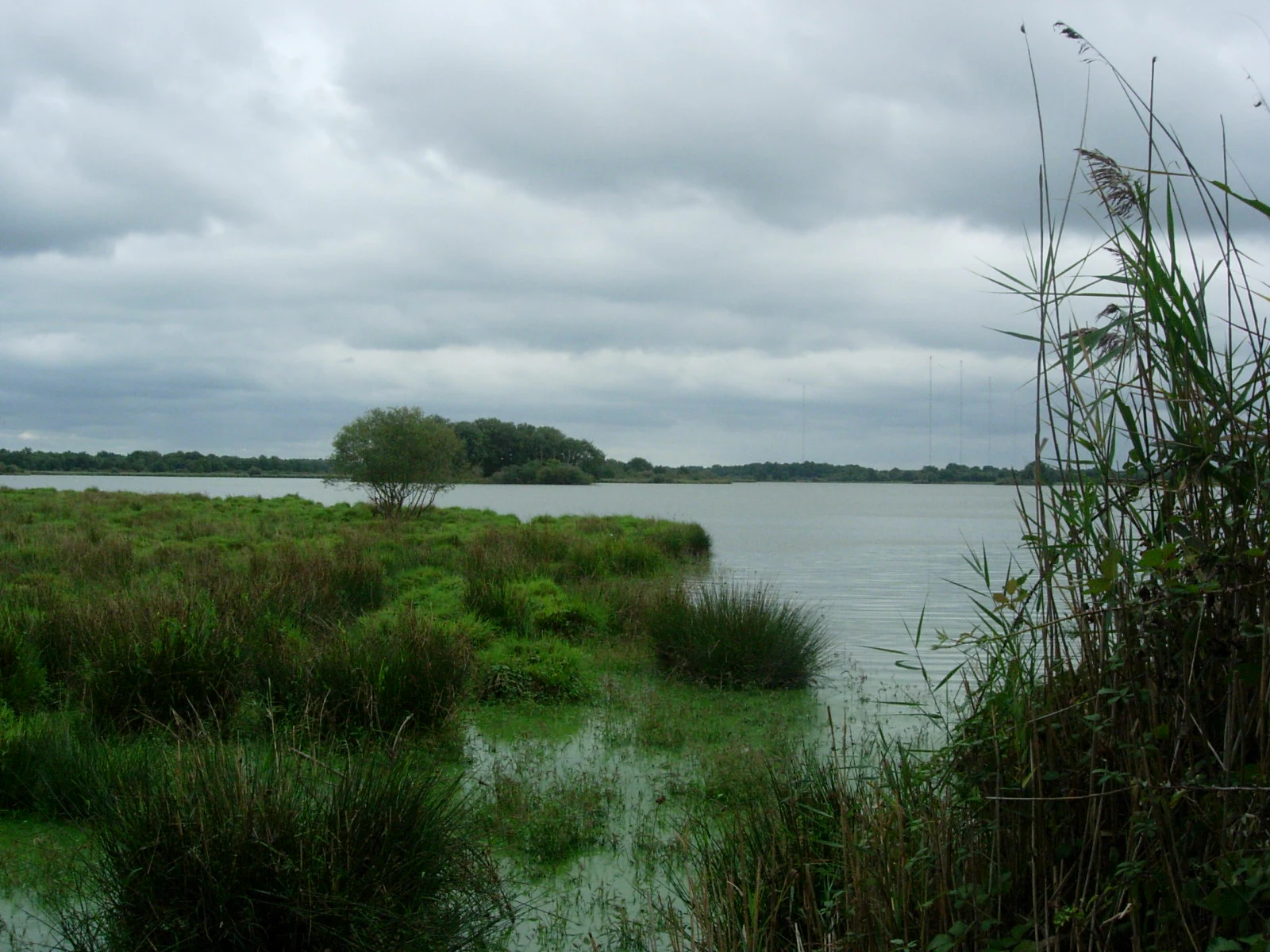
Green wetland vegetation and tall reeds frame a pond beneath grey clouds, with slender transmission masts on the distant horizon.

Étang du Blison in the Brenne, photographed in September 2010; distant transmission masts remain visible. This is a historical landscape view, not a photograph of the Chérine hides.

“Parc naturel régional de la Brenne - Etang du Blison, et pylones du Centre de Transmission de Rosnay (sous-marins de la Marine Nationale, ondes VLF), Brenne, Indre, France” — Jean-David & Anne-Laure, CC BY-SA 2.0. Source: https://www.flickr.com/photos/jedalani/6140769784/. License: https://creativecommons.org/licenses/by-sa/2.0/. Original photograph unchanged. · Creative Commons

Walks and routes

Ricot: a reedbed observation stop

Use the signed access from the D17 between Mézières-en-Brenne and Douadic, near the turning for the Maison de la Nature, and park in the designated area. Follow the visitor approach to the two-storey observatory, then return the same way. Allow 45–75 minutes including time watching. This is a hide visit rather than a circuit of the pond.

The ground floor is described as accessible to people with disabilities. Ask about the approach surface and the viewing openings before relying on wheelchair or pushchair access; the upper storey is not covered by that statement.


Ricot: a reedbed observation stop

Les Essarts: open water in afternoon light

From the D17, take the D44 towards Saint-Michel-en-Brenne and use the signed parking on the right. The rural path through the reserve leads to the hide; the official alternative starts at Picadon parking on the D6a. Choose a single approach and return by it. Allow 60–90 minutes with observation stops, taking time to compare the near margins with the far bank.

The site carries a mobility-access indication. Confirm which parking approach is appropriate, its current surface and any assistance needed; the two approaches should not be assumed equivalent.

Les Essarts: open water in afternoon light

Cistude: add the visitor centre when it is open

At the Maison de la Nature, the small hide is reached from the car park; the large hide uses a pontoon across a small pond. Allow about an hour for a self-directed observation stop when access is permitted. Ask at reception which hide is available. The separate private heron hide is not part of ordinary public access.

The public Cistude listing indicates mobility access. Confirm the usable pontoon, entrances and viewing positions for your party, especially if conditions are wet.

Cistude: add the visitor centre when it is open

An easy first half-day

Start with information and a look around Le Bouchet. Take a break before travelling to one Chérine hide. Choose Ricot for a reedbed-focused session or Les Essarts for its open-water outlook. Finish after that one stop if you are visiting with young children; leave a second hide for another time rather than filling the afternoon with transfers.

A day for keen beginners

Make Ricot your first observation stop, then use the Maison de la Nature if its opening is confirmed. Have a proper lunch break and try Les Essarts in the afternoon. Keep this as several separate visits, with road transfers planned in advance. It is not a signed walking loop linking all the stops.

Things to try

Make a hide visit work for children

Give everyone a task before opening the viewing window: find a bird that dives, one that stays near cover, or two different ways of moving across the water. Take turns with binoculars. If interest fades, leave quietly and have your snack elsewhere rather than trying to make the hide a play space.

Join a short guided session

The Maison de la Nature advertises accompanied Cistude visits of about 45 minutes during its spring-and-summer programme. Booking is required. A guide can help turn distant shapes and sounds into a more satisfying first birdwatching experience; check the current calendar, language and family arrangements before reserving.

Look at the vegetation as well as the birds

From an authorised viewpoint, notice the transition from open water to floating plants, reedbeds and the land beyond. The park’s botanical account describes these successive zones and the importance of changing water levels. You can understand much of the wetland’s structure without identifying every plant or leaving the path.

Use a centre rather than forcing an outdoor circuit

When open, Le Bouchet’s exhibitions and visitor information make a useful shorter visit. Light rain may still allow a hide session if its approach is safe, but a hide is not a reason to continue in a thunderstorm or severe-weather warning. Shorten the day if the path is waterlogged or conditions deteriorate.

Wildlife and habitats

European pond turtle

Ricot is a documented place to try for the Brenne’s emblematic freshwater turtle. In warm weather, scan quietly from the hide before moving on. A distant resting shape can take time to resolve, and cooler conditions may bring no visible turtles at all.

Common reed warbler

A small brown bird that often stays hidden in reeds, the common reed warbler is a summer inhabitant of Ricot. Its rhythmic, repeated phrases can reveal it before you get a view. Listening is part of the pleasure here: give the reed edge as much attention as the open water.

Black-necked grebe

Cistude’s warm-season birdlife includes this small grebe. In breeding plumage, a red eye and golden feather tufts behind it give a surprisingly vivid face to a distant dark shape. Bring binoculars and let the birds approach in their own time; a close view is a bonus.

Black-headed gull

Look for this gull among Cistude’s warm-season birds. The breeding adult’s hood is chocolate brown; outside that plumage the head becomes pale with a dark ear spot. Comparing several birds is a good way to notice how age and season change appearances, without needing every bird to look like a field-guide illustration.

Stories and discoveries

A pond can be part of a chain

Traditional fish harvesting involves lowering water levels and working through connected ponds. The park describes the sequence beginning downstream so water released from the next pond can refill the one below. A partly empty pond may therefore be part of an active management cycle, not an abandoned attraction.

Conservation involves active work

At Chérine, extensive grazing and selective fish management help maintain a range of habitats, including reedbeds, meadows and heath. The landscape you observe is cared for through practical decisions about water and vegetation, as well as through limits on visitor disturbance.

When to visit

Spring and early summer

The Maison de la Nature highlights April and May for migration diversity. Summer reedbed birds and the possibility of turtles add different interests. Plan a modest route that leaves time to watch, and check whether the large Cistude hide requires a particular visiting period or a booked guided session.

Late summer and autumn

September is another migration period highlighted by the operator. Later in the year, pond fishing and changing water levels can concentrate birds in different places. Ask for current public-viewpoint advice instead of chasing a particular pond from an old photograph. In warm spells, take heat and fire notices seriously.

Winter

The broader park supports wintering ducks and other waterbirds; the visitor centre’s seasonal guidance singles out February and March for large duck numbers. Short daylight and cold hides favour a compact outing. Carry an extra layer and a warm drink, and check opening if your plan includes an indoor stop.

Getting there and practical advice

Le Bouchet: information and a meal break

The Maison du Parc occupies restored farm buildings below the château. It provides visitor information, temporary exhibitions, a shop and a tasting/food area, with a covered outdoor picnic space. Food service has its own hours. Check those separately if lunch is an important part of your day.

Maison de la Nature: equipment and local advice

This is the more specialised stop for asking what to look for at nearby public sites. Binocular hire is advertised, which can be useful before buying your own pair. Availability depends on opening and stock; call ahead if hire is essential. Check toilet access with the centres rather than assuming each hide has facilities.

Getting between the two areas

Set your first destination to Maison du Parc, Le Bouchet, Rosnay, and your wildlife stop to its specific named hide. The Maison de la Nature is a different destination in Saint-Michel-en-Brenne. Arrange transport between these areas before setting out; the two centres are separate stops on a wider visit.

Arriving without a car

Châteauroux and Argenton-sur-Creuse are useful rail gateways. The park identifies Rémi line Q for Mézières-en-Brenne and line 433 for Le Blanc, alongside demand-responsive transport. Check where these wider-area services stop and how you will reach your chosen hide from there. Arrange the final leg and return with your accommodation or the operator before booking your train. For cycling, choose an official itinerary suited to your road confidence.

Check the whole journey to the viewing window

When contacting the reserve on 02 54 28 11 02, specify the hide, whether you use a wheelchair or pushchair, and the distance you can manage. Ask about the parking surface, path, thresholds, turning space and seated sightline. A mobility icon is helpful, but it does not answer all of those questions or establish current conditions after rain.

Sources and useful links

Wildlife you might spot

4

Each card links to a full Explore page with photos, traits, and fun facts.

Snap map for this place

Start with the big picture, then zoom in to explore individual wildlife observations around this place.

Loading map…

Good to know before you go

Bring binoculars if you have them; distant shapes are much easier to enjoy with magnification.

Choose one hide first. A settled half-hour often works better for children than repeated short car stops.

Keep conversation low and avoid bird-call playback, flash or movements that disturb wildlife.

Pack water, a snack and a windproof layer; sitting still can feel colder than walking.

Use designated parking and leave farm access and narrow roads clear.

Keep children beside you on pontoons, around steps and near open water.

Take muddy footwear and wet surfaces into account, even when planning only a short visit.

Check opening arrangements before relying on a visitor centre for your break or equipment hire.

Frequently asked questions

Only where a specific public route permits it. A visible bank or track is not permission to enter. In particular, do not improvise a circuit of the privately owned Étang de la Mer Rouge: the 2026 visitor guide also flags its usual short bankside access as temporarily closed.
There is no single attraction ticket for this dispersed landscape. The Maison du Parc and the public observation sites described here are listed as free. Guided activities and equipment hire have separate charges and arrangements.
Pet dogs are not admitted to these hide visits. The reserve regulations contain specific exceptions, including guide dogs and dogs on a lead on the named Picadon–Moulin du Bois communal path. Those exceptions do not make the observation sites generally dog-friendly; ask the reserve if they apply to your visit.
No. Its name is no guarantee of what you will see. Ricot is also a documented pond-turtle observation site. Ask staff which public viewpoint suits the current conditions, and enjoy whatever is active without approaching or handling animals.

Recent snaps at this place

Recent snaps will appear here as new observations are added.

View all ›

Take the discovery with you

Exploring Brenne Regional Nature Park?

Identify the wildlife you spot, learn as you go, and keep a collection of the adventure.

  1. 1Spot it
  2. 2Snap it
  3. 3Keep the discovery