
Snappit logo
Snappit
Get App
Generic illustration, not a photograph of this venueIllustration
ParkBretagne, FR

Brest National Botanical Conservatory Garden

Bamboo, eucalyptus and palms give the Stang-Alar valley an unexpectedly far-travelled character.

About

Bamboo, eucalyptus and palms give the Stang-Alar valley an unexpectedly far-travelled character. The outdoor collections bring plants from different geographical regions together beside a stream and ponds, beneath the old quarry faces. A plant label can take you from Brittany to an oceanic island in a few steps.

The garden combines threatened wild species grown in cultivation with plants chosen for their ornamental qualities. That distinction makes it rewarding to read the labels: a magnificent tree and a rather modest shrub may have very different conservation stories. The scientific work also extends beyond the beds you see, through seed storage and propagation.

Make the outdoor garden your main visit. Its plant itinerary and audio guide give a walk a clear focus without requiring you to cover every corner. The tropical greenhouses offer a more concentrated encounter with conservation collections, but have their own opening calendar, tickets and entrance arrangements. They are an optional second part of the same destination. Unlock an interactive field guide for this spot: get the Snappit app to identify nature on the go.

Jean-Yves Lesouëf developed the idea of a garden devoted to threatened plants during the 1970s, after seeing species at risk during his travels. The setting was itself a recovery project: a former quarry was rehabilitated in a sheltered valley. Its rock faces remain part of the garden’s character. This is a useful way to read the place today: a restored landscape supporting plants whose future may depend on sustained human care.

What to do here

Choose a few named trees from the official garden leaflet, listen to their stories, and compare them with the smaller plants along the way. If the greenhouses are open, use their contrasting climates to explore why a plant that flourishes in one place may struggle in another.

Seasonal info

The outdoor collections change with the seasons, while the greenhouses recreate tropical conditions. A flower mentioned in a collection description is a reason to look closely, not a promise that it will be flowering on your visit.

Accessibility

The operator describes the garden, tropical greenhouses and reception pavilion as accessible to people with reduced mobility. The outdoor garden has a tarmacked main avenue. Plan around that avenue first; this statement does not establish the suitability of every smaller path.

Don't miss

1

Geographical plant collections framed by the Stang-Alar valley’s quarry landscape

2

The outdoor garden’s giant sequoias and dawn redwood

3

Four contrasting tropical environments in the seasonal greenhouses

4

Conservation stories linking Brest with threatened plants around the world

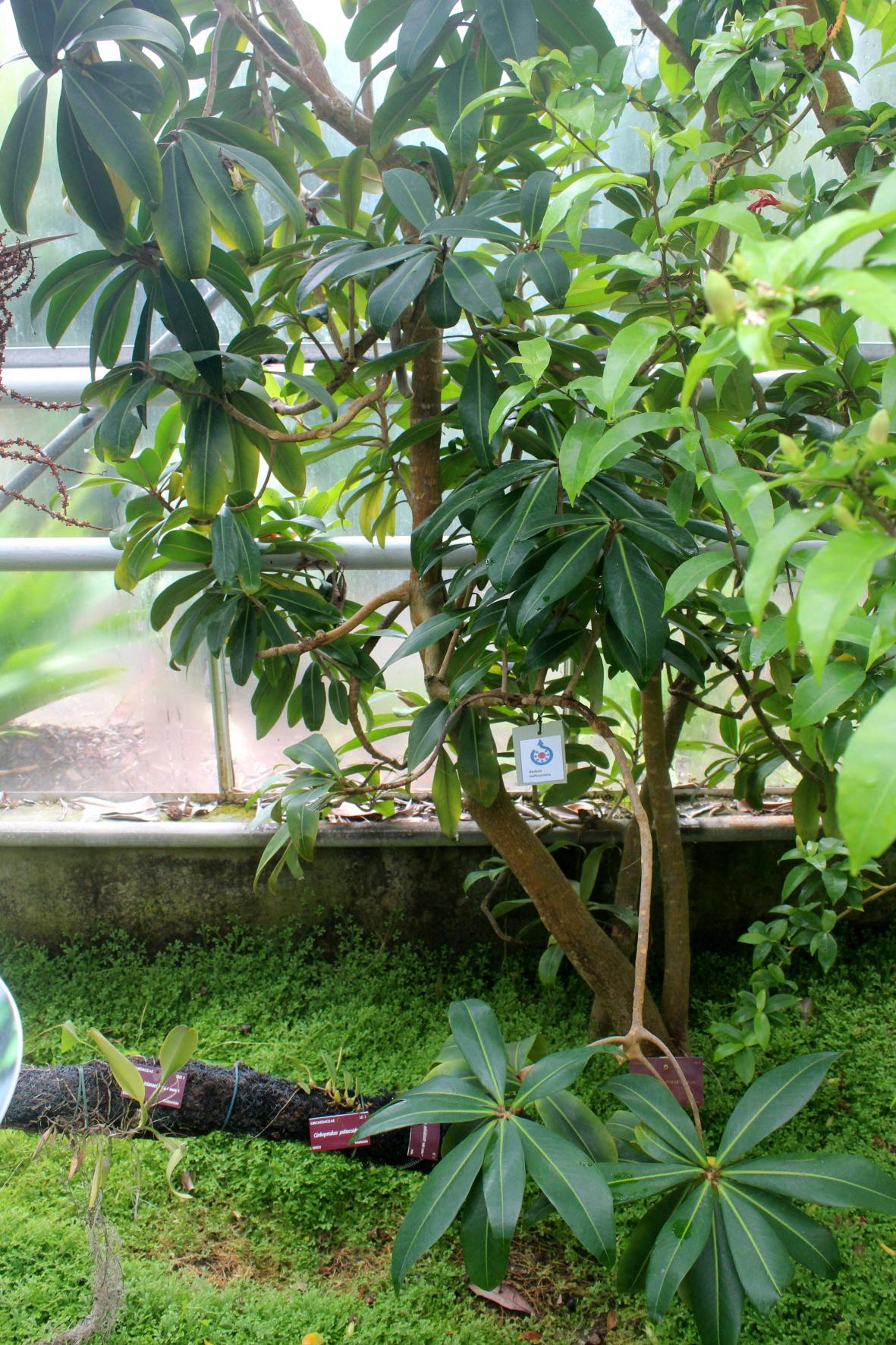
A woody shrub with long dark-green leaves grows inside a greenhouse among smaller plants; a hanging label identifies it as Badula balfouriana.

Badula balfouriana in the conservatory’s greenhouse collection, photographed by Claude Péron on 1 July 2015. This historical plant portrait illustrates a cultivated collection; it does not show today’s display.

“Conservatoire botanique national de Brest-Badula balfouriana-15 07 01-ClaudePERON” — Claude Péron / Conservatoire botanique national de Brest, CC BY-SA 2.0. Source: https://www.flickr.com/photos/133577373@N08/19599877193/. License: https://creativecommons.org/licenses/by-sa/2.0/. Original photograph unchanged. · Creative Commons

Walks and routes

A garden walk built around plant stops

Allow 1–2 hours including stops. Start with the operator’s leaflet, which introduces ten plants or plant groups, and choose a manageable selection. A tall conifer, the bamboo collection and a pond-side stop make a varied first visit. Use the leaflet for orientation and current signs for paths; there is no need to complete every numbered stop. The garden’s published 1.5 km length describes the site, not the distance of this suggested outing.

For a mobility-focused visit, start with the tarmacked main avenue and ask which interpretation stops are reachable from it. The complete leaflet itinerary has not been established as an accessible circuit.


A garden walk built around plant stops

Four climates in the tropical greenhouses

Allow about 45 minutes. The visitor spaces represent humid tropical mountains, subtropical oceanic islands, dry tropical regions and humid tropical forests. Compare how plants use leaves, stems and branching in these different conditions. The display includes rare hibiscus, carnivorous plants and interpretation of the titan arum’s life cycle. Take time to compare the broad leaves of humid environments with the forms represented in the dry-region display.

The operator includes the tropical greenhouses in its reduced-mobility access statement and identifies two dedicated parking places. Contact staff to arrange the most suitable approach for your needs.

Four climates in the tropical greenhouses

A relaxed first visit

Begin with your downloaded plant leaflet and pick three or four stops. Leave time for a pond-side pause and one audio story rather than trying to collect every name. If you have greenhouse tickets, keep that session as the fixed point of the day and fit your outdoor walk around it. Before leaving, choose one plant whose story you want to read about again.

Things to try

Listen to the plants’ stories

The free izi.TRAVEL audio guide focuses on roughly fifteen threatened plants and includes text, illustrations and quizzes. The operator links English and French versions. Choose two or three stories for a short outing, or allow its suggested 1½ hours for all stations. Download ahead of time so that setting up the phone does not take over the walk.

Give children a botanical mission

For ages 7–12, the outdoor Grimoire des plantes follows Ruizia the elf through puzzles about eight plants. Print it beforehand and bring a pencil. The greenhouse game is a separate hunt for five plants leading to a treasure tree, with English, French and Breton versions linked by the conservatory. With younger children, simplify the challenge: choose one memorable leaf shape to draw, then find its label together.

Make a small plant portrait collection

Try three paired photographs: a whole plant and its label, a leaf and its attachment to the stem, a tree’s outline and its bark. These details make a better memory than a list of names. Work from the public path and leave leaves, seeds and flowers on the plants.

If the weather turns wet

A light-shower visit can still work with suitable clothing and a shorter garden plan. The greenhouses make a useful indoor addition only when their public session is operating. If strong winds or flooding lead to closure, postpone the garden rather than treating the glasshouses as an automatic fallback.

Wildlife and habitats

Giant sequoia — Sequoiadendron giganteum

Use the leaflet’s first tree stop to meet this cultivated Californian conifer. Its evergreen crown, reddish-brown bark and short, pointed leaves make a good contrast with the dawn redwood. Look at the outline from farther back, then study any foliage visible from the path. Giant sequoia and coast redwood are different species, so the scientific name on the label is useful even for such a conspicuous tree.

Dawn redwood — Metasequoia glyptostroboides

Look among the Asian plants for this deciduous conifer. Its soft foliage sits in opposite rows, giving the shoots a feathery appearance; it turns tawny before falling in autumn. That seasonal change makes it a particularly good tree to revisit. Its story also links living botany with fossils: the tree was known from fossil material before living examples were recognised in China.

Stories and discoveries

Why a cultivated plant can matter

Ex situ conservation means safeguarding plants outside their natural habitat. At Brest, living collections and stored seeds can support research, propagation and, where conditions allow, a return to restored habitat. A healthy specimen in a garden does not mean its wild population is secure. That is why the quieter-looking plants deserve attention alongside the showy ones.

A rescue that took decades

Cylindrocline lorencei, a shrub from Mauritius, disappeared from the wild and then from cultivation. Brest still held seeds, but ordinary sowing failed. In 1993, living embryos were rescued through laboratory culture with the INRA team at Ploudaniel. Later work with Vegenov made larger-scale propagation possible. The conservatory’s October 2024 account describes plants being returned to managed sites in Mauritius that year. Earlier losses and the need to control invasive species show why raising a plant is only one stage of restoring it.

When to visit

What to look for through the year

In spring, give flowers time as well as trees. In summer, compare foliage and the different textures of the planted areas. Autumn is a good moment to return to a familiar tree and notice what has changed. In winter, a shorter visit can concentrate on trunks, branching and evergreen foliage; choose a calm day and check the closing time.

Getting there and practical advice

Opening times and tickets

The outdoor garden is free and opens year-round from 09:00, with seasonal closing times. Official pages give differing closing summaries, so check the current calendar before a late visit. As checked on 18 October 2026, the homepage announces greenhouse visits through 1 November: self-guided 14:00–17:30, tickets before 17:00; guided visits Wednesday and Thursday at 11:00, with tickets collected 10:30–11:00 and a 25-person limit. Standard prices are €6 self-guided or €8 guided; reduced prices are €4 or €5, and under-eights are free. Confirm eligibility for older children because official pages differ on the age limit. Later dates need their own programme check.

Reception and practical breaks

The reception pavilion is the ticket collection point during public greenhouse opening. The garden leaflet also marks toilets there, but does not establish year-round toilet availability. If access to a toilet is essential, ask before setting out. Bring drinking water, and plan any meal separately from the time you want to spend looking at plants.

Getting to the visitor entrance

Use Rampe du Stang-Alar, 29200 Brest. For public transport, plan to the Jardin botanique stop using Bibus and include the onward walk to the garden in your itinerary. Check the return journey as well as the outward trip, especially on Sundays or during school holidays. The headquarters at 52 allée du Bot is a different address.

Match the visit to your mobility needs

Call 02 98 02 46 00 for advice about gradients, the approach from parking and the stops you hope to see. Ask specifically about any wheelchair, mobility scooter or pushchair you use. The published main-avenue and greenhouse information is useful, but does not supply measurements for every slope, threshold or turning space. A shorter route with selected plant stops can be more satisfying than committing to the whole garden.

Sources and useful links

Wildlife you might spot

2

Each card links to a full Explore page with photos, traits, and fun facts.

Snap map for this place

Start with the big picture, then zoom in to explore individual wildlife observations around this place.

Loading map…

Good to know before you go

Download the garden leaflet and audio guide before arriving, then choose the stops that interest your group most.

Bring a pencil if you want to use the family plant games.

Photograph the label as well as the plant; it makes later identification much more reliable.

Keep children beside you around the ponds and leave planted beds undisturbed.

For a shorter outing, turn back along your chosen public path before anyone becomes tired.

Use the Rampe du Stang-Alar visitor address when planning your arrival.

Frequently asked questions

Self-guided access to the outdoor garden is free. Tropical-greenhouse visits and guided activities are separate; check the current programme before building your day around them.
No. The conservatory also maintains a seed bank and propagation facilities. The public garden and visitor greenhouses reveal part of a much larger conservation effort; technical spaces and the headquarters are not ordinary visitor stops.
Pets are allowed in the outdoor garden on a short lead. They are not allowed in the tropical greenhouses. If you need an assistance-dog arrangement, contact the conservatory before visiting.
Yes. The outdoor plant collections, tree itinerary and audio stories can fill a satisfying visit on their own. Choose that plan if your dates fall outside the greenhouse programme.

Recent snaps at this place

Recent snaps will appear here as new observations are added.

View all ›

Take the discovery with you

Exploring Brest National Botanical Conservatory Garden?

Identify the wildlife you spot, learn as you go, and keep a collection of the adventure.

  1. 1Spot it
  2. 2Snap it
  3. 3Keep the discovery




