Snappit logo
Snappit
Get App
Generic illustration, not a photograph of this venueIllustration
ParkProvence-Alpes-Côte d’Azur, FR

Camargue Regional Nature Park

The Camargue’s wide horizons can hide just how complicated the landscape is.

About

The Camargue’s wide horizons can hide just how complicated the landscape is. A canal, a raised bank or a change in vegetation may mark a different water regime. Rice growing, livestock, reed cutting and salt production belong to the story alongside migrating birds and protected wetlands. The regional nature park is a lived-in territory, with working land and individually managed reserves.

The museum makes those connections visible before you head out. Its permanent exhibition, Le fil de l’eau, le fil du temps, uses objects, photographs, voices and films to explore how people have adapted to the delta. Give the historical images a little time: they help explain why a seemingly timeless panorama keeps changing. Outside, the mix of cultivated fields, marsh and salt-tolerant vegetation makes more sense once you have followed the water indoors.

For a first visit, concentrate on this one site. It is a satisfying half-day without a long drive between viewpoints. Save the coast, larger lagoons or another reserve for a separate outing with its own access information. Take the ultimate field guide with you: use the Snappit app to identify birds, plants, and animals on your trip.

The park was established on 25 September 1970, and its headquarters moved to Mas du Pont de Rousty in 1975. The museum opened in 1978 in the former sheepfold. The Rhône floods of 1993 and 1994 forced it to close for ten months, a reminder that water here is more than a theme for an exhibition. The museum was renovated in 2013 and gained a new extension in 2019.

What to do here

Start with the museum, then walk the marked Pont de Rousty circuit if conditions are comfortable. The sequence can be reversed on a hot day: enjoy the outdoor section early and visit the exhibition afterwards. Bring binoculars if you have them, but leave time for the buildings and water-management features as well as birds.

Seasonal info

Water levels, reed growth and agricultural work change the view through the year. An open stretch of water in one season may look very different on your next visit. The landscape is part of the attraction even when birds stay distant.

Accessibility

The museum is the stronger option for visitors needing step-free facilities. The operator describes pushchair access on the trail only as far as the cabane; that does not establish wheelchair access around the full circuit or into every lookout.

Don't miss

1

The museum’s account of life with fresh water and salt

2

A marked walk connecting cultivated land and wetland habitats

3

The cabane and the local tradition of reed construction

4

Watching the marsh from designated viewpoints without approaching wildlife

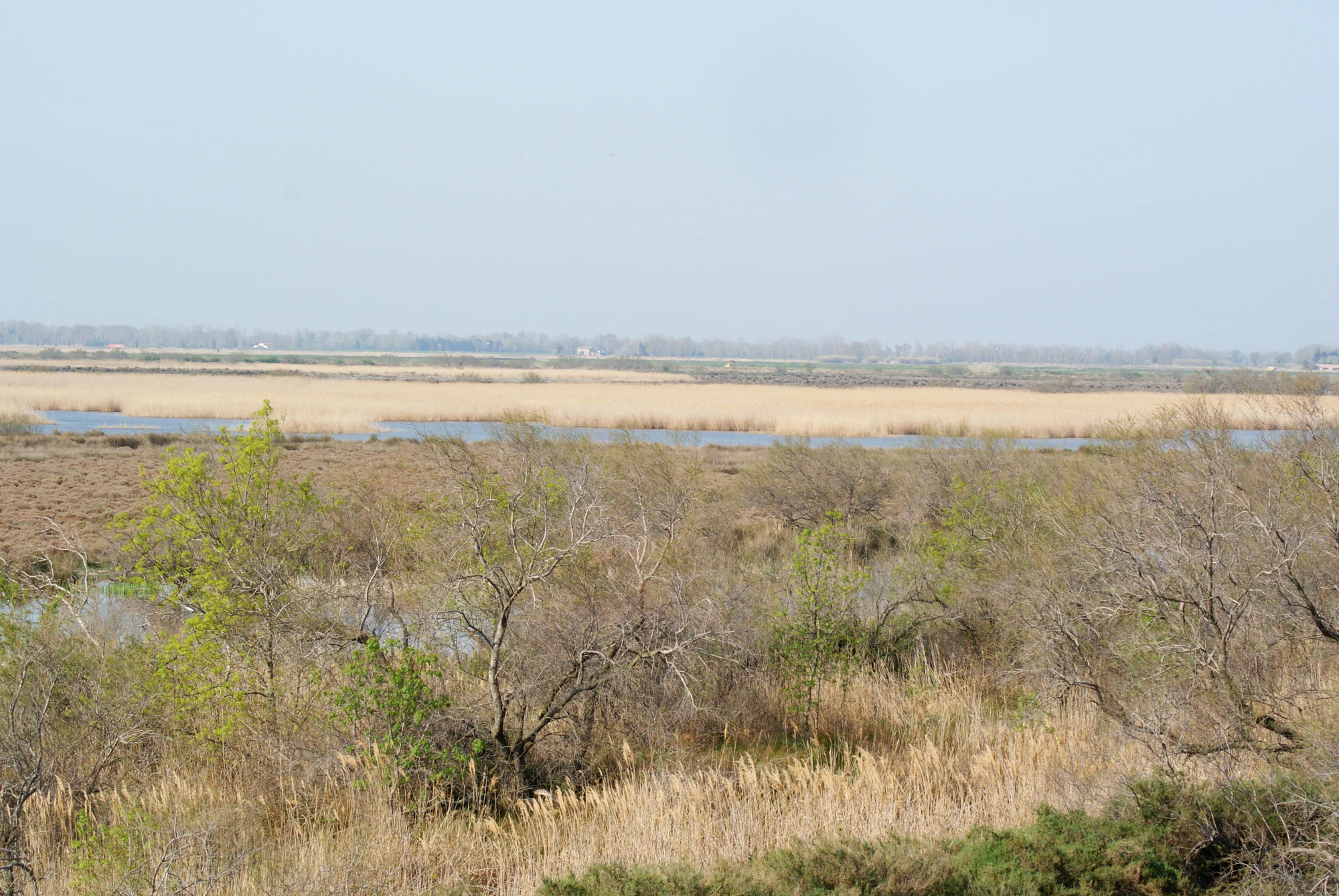
Pale reedbeds, low shrubs and narrow blue strips of water cross a flat landscape beneath a hazy sky.

Wetland landscape at the Marais du Vigueirat, photographed on 10 April 2010. This is elsewhere within today’s regional park, not the Pont de Rousty walk or the Vaccarès reserve.

“Paysage de camargue” — Deuns, CC BY-SA 3.0. https://www.lestaxinomes.org/media1889. https://creativecommons.org/licenses/by-sa/3.0/. Original unchanged. · Creative Commons

Walks and routes

Pont de Rousty: the mapped circuit

Chemins des Parcs publishes this easy loop from the museum as 5.3 km, with 5 m of ascent and a 2-hour walking time. Follow the canal, then the signed circuit towards the reedbed footbridge and marsh observatory; both viewpoints involve retracing a section before completing the return. Use the linked official directions at junctions. The museum describes its discovery trail as 4.8 km and 1h30, so plan with the longer mapped itinerary and leave room for stops.

The museum allows for a pushchair outing as far as the cabane. For a shorter visit, return along the same permitted approach rather than committing to the whole circuit. Check the surface after rain. For wheelchair use, ask reception about the precise section and structures you want to reach.


Pont de Rousty: the mapped circuit

A balanced half-day

Allow 3–4 hours. Begin with roughly an hour in the museum, adjusting to your interests, then take the mapped circuit with time at the viewpoints. Bring a picnic if you want a longer pause. On a hot day, reverse the sequence and keep the afternoon for the exhibition.

A shorter, flexible visit

Make the museum the main event and add only as much outdoor walking as everyone comfortably wants. The approach towards the cabane offers a turn-back option; confirm conditions with reception rather than treating the full route as essential. This works better for mixed-energy groups than splitting up around the marsh.

Things to try

Trace the water

After the exhibition, pick out a canal, cultivated plot and marsh as you walk. Ask what each needs: water arriving, water leaving, or salt kept out. You do not need to identify every plant to see why neighbouring patches can look so different. Do not touch sluices or other working equipment.

Make the museum a family investigation

Ask at reception about the museum’s discovery games. Outside, the trail also has a family puzzle with eight small challenges near interpretation panels. Choose a few things to notice together rather than turning the walk into a race to finish; the panels give you natural places to pause.

Photograph the layers of a wetland

Try a wide view with vegetation in the foreground, a waterline farther back and the horizon beyond. It can tell more about this place than a heavily cropped distant bird. Keep the camera on the public route and avoid blocking a viewpoint while others are observing.

When the outdoor plan needs to change

Strong mistral, thunderstorms, heavy rain or flood warnings are good reasons to postpone the walk. Check Météo-France and local instructions; never drive or walk through floodwater. The museum is a useful alternative only when open and safely reachable. Temporary hunting or wildlife-management notices also take priority: past park reports record wild-boar control at Rousty, so ask about current operations rather than assuming the estate is hunting-free.

Wildlife and habitats

The pale-pink body, long neck and legs make a flamingo unmistakable at a good viewing distance. It is recorded at the Marais du Vigueirat within the park. Look through binoculars from a permitted viewpoint; this wider-park record is not a promise for the museum trail.

A small white heron can be worth a second look. In good views, the little egret has a slender dark bill and dark legs with yellow feet. It is recorded at Vigueirat. Let a feeding bird work its way across your view instead of moving closer.

This black-and-white wader carries its body on remarkably long pink legs. Vigueirat’s species list records it within the park. Keep a generous distance from any agitated bird: alarm calls and repeated flights are a reason to move away, not a cue to search for a nest.

Rousty’s reedbeds have supported bird-ringing research in stands of common reed. Look at the height and density of the stems from the path, then compare the living plants with the reed material used in local buildings. The habitat matters even when its birds remain hidden.

Stories and discoveries

A roof grown in a marsh

The park identifies common reed as a traditional building material for sheepfolds and cabanes. The connection joins habitat, work and architecture: a reedbed is also a source of local craft knowledge. Admire the construction without pulling at the thatch or taking a stem as a souvenir.

Water management reshapes the view

The sea dyke dates from 1859. Across the delta, gates, drainage and irrigation connect choices about salinity with agriculture and nature conservation. A low bank or narrow channel may therefore explain the landscape more clearly than a distant landmark.

An artwork that asks you to look again

Horizons, by Tadashi Kawamata, stands at the start of the museum trail. Its raised wooden form is part of the cultural interpretation of water and landscape. Enjoy the structure from the ground if climbing is unsuitable, or if conditions or signs prevent access.

When to visit

Spring

Make room for looking and listening without approaching the reedbed edge. Keep to the path during the breeding season and avoid lingering where birds show alarm. A quiet observation stop is often more useful than covering extra ground.

Summer

Walk early, carry water and use the museum as an indoor part of the day. Mosquito protection helps, but heat and exposure should determine the length of your outing. Shade along part of the approach does not make the whole circuit a shaded walk.

Autumn and winter

Bring binoculars and a windproof layer, and keep the return comfortably within daylight. Research at Rousty has highlighted the reedbed’s importance to migrating and wintering birds. There is plenty to learn from a quieter landscape, even without a close sighting.

Getting there and practical advice

Admission and opening

Museum admission is currently €7.50 full price and €5 reduced; under-6s and disabled visitors with accompanying people qualify for free entry. Family passes are available. October 2026 is listed daily, 10:00–17:00; November is weekdays plus 1 and 11 November; December is weekdays plus holiday weekends, closed 25 December. The published April–September 2027 schedule is daily 09:00–18:00 except 1 May. Check the dated operator page for your visit, especially winter holidays. Arrive at least an hour before closing.

At the museum

The site lists free parking for cars, coaches and campervans, a picnic area and dry toilets; overnight stays in the parking area are not allowed. The museum also has a book and gift shop. Bring the food and drinking water you need for the walk rather than relying on refreshments along the route.

Groups and guided activities

Groups of ten or more must book in advance; the operator asks for at least two months. For guided visits and special activities, check the museum programme and contact reception on 04 90 97 10 82. An ordinary walk does not include access to research operations or bird handling.

Arriving at Pont de Rousty

The museum is on the RD 570, about 10 km from Arles and 27 km from Saintes-Maries-de-la-Mer. Navigate to Musée de la Camargue, Mas du Pont de Rousty. Its published coordinates are 43.6238067, 4.5287493; they locate this visitor base within the much larger park.

Bus and cycling choices

The museum identifies Envia A50 between Arles and Saintes-Maries-de-la-Mer, stopping at Pont de Rousty. Use its access page for current seasonal timetables, and verify the date, return departure and access from the stop. For cycling, choose a published park itinerary suited to your experience; do not assume the RD 570 approach is a protected family cycleway.

Separate indoor and outdoor access

The destination’s accessibility listing describes a ground-level museum, reserved parking, an accessible toilet with right-side transfer, tactile models and hearing support for sound installations. Ask about the specific equipment you need before travelling. Outside, pushchair suitability to the cabane is the operator’s stated limit; it does not certify the footbridge, observatory or full loop for wheelchairs.

Sources and useful links

Wildlife you might spot

4

Each card links to a full Explore page with photos, traits, and fun facts.

Snap map for this place

Start with the big picture, then zoom in to explore individual wildlife observations around this place.

Loading map…

Good to know before you go

Carry your own drinking water, a sunhat and mosquito protection; pack a windproof layer even when the forecast looks bright.

Use the official route page alongside signs on the ground. Leave time for the return rather than adding an unplanned detour.

Keep children close beside canals, bridges and open water, and use the picnic area for a relaxed break.

Look at cattle from the public path. Do not cross fences, feed animals or try to draw them towards you.

Keep dogs on a lead on the trail; pets are not admitted inside the museum. Check arrangements for an assistance dog directly.

Stay on marked paths, leave plants where they grow and take rubbish home. Never light a fire or barbecue.

If you arrive by bus, check both journeys first and keep a margin for reaching the return stop.

Frequently asked questions

No. The park contains towns, working land and separately managed visitor sites. At Pont de Rousty, the landscape trail is free and independent of museum admission. Other reserves and attractions have their own tickets, booking arrangements and restrictions.
Do not make a flamingo sighting the condition of a successful visit. They occur in the wider park, but a Rousty walk offers a changing mix of habitats and birds. Ask locally about suitable observation sites if flamingos are your main interest.
The Camargue’s familiar grazing herds belong to managed livestock traditions. At Rousty the museum describes a bull herd present from May to October, spread across a large area. Seeing animals close to the path is not guaranteed.
The operator lists independent trail access 24 hours a day, seven days a week. For this visit, choose daylight and obey any temporary closures or management instructions. Museum toilets, advice and services should not be assumed available outside opening hours.

Recent snaps at this place

Recent snaps will appear here as new observations are added.

View all ›

Take the discovery with you

Exploring Camargue Regional Nature Park?

Identify the wildlife you spot, learn as you go, and keep a collection of the adventure.

  1. 1Spot it
  2. 2Snap it
  3. 3Keep the discovery