Snappit logo
Snappit
Get App
Generic illustration, not a photograph of this venueIllustration
ParkKanto / Chubu, Japan

Chichibu-Tama-Kai National Park

You can start exploring this mountain national park without starting up a mountain.

About

You can start exploring this mountain national park without starting up a mountain. At Okutama Station, head first to the nearby visitor center, then make the short Hikawa Gorge circuit your main outing. Two rivers meet below the town, suspension bridges carry you across the gorge, and woodland gives you plenty to examine at walking pace. It is a satisfying introduction for a family that would rather notice a bird or an unfamiliar flower than tick off a summit.

The scale changes dramatically once you look beyond that little circuit. Chichibu-Tama-Kai stretches across Tokyo, Saitama, Yamanashi and Nagano, protecting mountain country and the headwaters of several major rivers. Its mountains are not volcanic: erosion, varied rock and forest are the central story here. The Okutama visit in this guide occupies one small eastern corner. Mount Kumotori, distant gorges and the park's western granite peaks belong to other, separately planned days.

Okutama Visitor Center is in the town, about two minutes on foot from the station. Use the displays to get your bearings, then ask a staff member what is worth looking for and whether the gorge path is suitable today. Natural-history exhibits, photographs and local terrain interpretation help you make sense of the green landscape outside. Give children one question to take outside: Which plants keep their leaves? What can you hear above the river? Where might a small bird find shelter?

Hikawa Gorge is part of the national park itself, in a designated special zone. Here the Nippara River meets the Tama River among wooded slopes. Evergreen oaks grow alongside deciduous trees such as Japanese zelkova and Japanese horse chestnut, so the gorge has texture even outside the autumn-color season. The operator describes a circuit of roughly 40 minutes with two suspension bridges. Leave yourself longer to stop; steps, exposed roots and uneven ground make this a short nature walk rather than a pushchair stroll.

The small things are worth your attention. A grey wagtail's yellow underside can be easier to pick out than its name suggests. In autumn, the fine red flower spikes of mizuhiki reward a closer look from the path. The visitor center's surveys also record mammals such as sika deer, Japanese macaques and Japanese squirrels in Hikawa Gorge, but an ordinary daytime walk is better planned around plants, birds and signs of animal life than around a hoped-for large-animal encounter.

Keep the river as the setting for your visit, viewed from the path and bridges. Swimming is prohibited in Hikawa Gorge, and the entrances can close after rain or during dam releases. If the route is closed, spend your time with the center's exhibits and change the outdoor plan with staff advice. The pleasure of this visit is how much fits close to the station; there is no need to salvage the day by turning a short outing into an unplanned mountain hike. Eager to name that creature? Identify any animal you find during your visit using the Snappit app.

The national park was designated on 10 July 1950. Its identity is tied to the wooded mountain ranges and river headwaters shared by four prefectures. Hikawa’s long-running nature surveys add a smaller, local history: repeated attention to the same gorge reveals animals and plants that a passing visitor could easily miss. The station-side visitor center continues that work by turning field knowledge into exhibits, maps and guided interpretation.


What to do here

Begin with the natural-history displays and current trail advice at Okutama Visitor Center. With an up-to-date map, walk the Hikawa Gorge circuit, pause on the approaches to its suspension bridges, and compare riverside plants with the trees above you. Try a short bird-listening stop away from other walkers. Finish back in town; keep Mount Atago, the O-tama Walking Trail and journeys to Lake Okutama for separately planned extensions.

Seasonal info

Spring brings fresh leaves and an active soundscape. Summer shade is welcome, but heat, thunderstorms and high river levels can change the plan quickly. September–November has a sequence of small flowers; their timing varies and does not match a single foliage peak. Winter exposes more of the branch structure, with shorter daylight and potentially slippery or icy shaded ground. Ask about the day’s footing rather than assuming a low-elevation walk is always easy.

Accessibility

The visitor center has a wheelchair ramp, an adapted toilet with ostomate facilities and a baby-changing provision. Its second-floor exhibits can be reached by wheelchair only via a substantial detour, so ask staff about the route and any construction effects before visiting. The Hikawa circuit includes steps, roots and suspension bridges and is not a verified wheelchair or pushchair route. For a lower-effort visit, concentrate on the center and ask staff for an individually suitable outdoor option.

Don't miss

1

A compact gorge walk at the meeting of the Tama and Nippara rivers

2

Two suspension bridges and a mix of evergreen and deciduous woodland

3

Visitor-center interpretation that gives the landscape a story

4

Birdsong, small autumn flowers and a slower way to explore Tokyo’s mountains

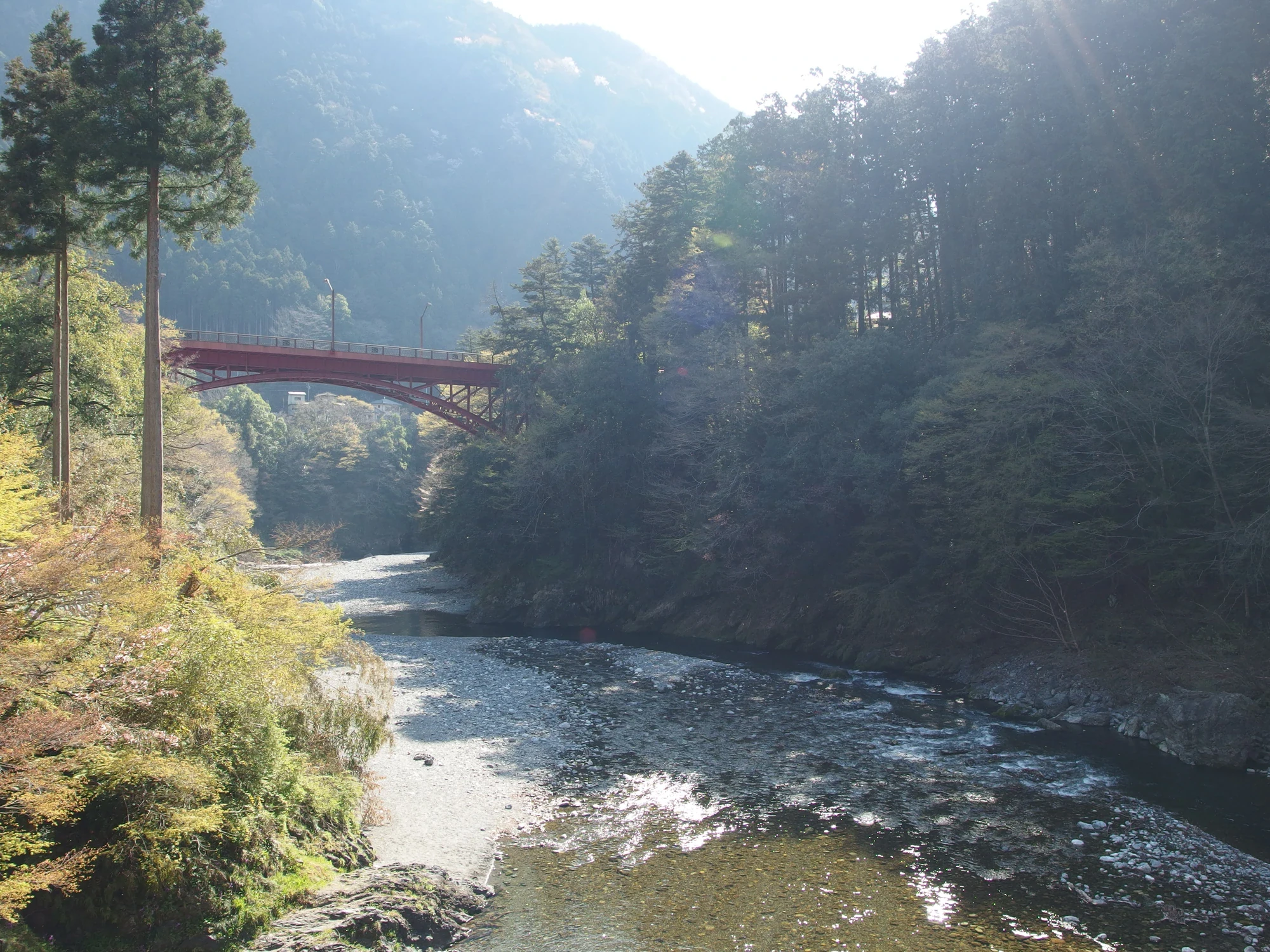
Sunlight falls across a river and pale gravel bank in a wooded gorge, with a red bridge crossing between the trees and hazy forested hills behind.

Hikawa Gorge in Okutama, photographed on 15 April 2014. Wooded banks and a red bridge frame the river in this historical view.

Hikawa gorge @ Trail from Okutama to Mount Mitake (13893429405).jpg — Guilhem Vellut, CC BY 2.0 (https://creativecommons.org/licenses/by/2.0/). Source: https://commons.wikimedia.org/wiki/File:Hikawa_gorge_@_Trail_from_Okutama_to_Mount_Mitake_(13893429405).jpg. Resized and recompressed as WebP; no crop or retouching. · Creative Commons

Walks and routes

Hikawa Gorge: a short circuit with time to look

Pick up or download the current Hikawa Valley map and ask staff to point out the gorge circuit. Follow the marked riverside paths and suspension-bridge connections, allowing time for the confluence and woodland. Keep the mountain branches toward Mount Atago and beyond out of this short plan. The circuit brings you back toward the station area without needing an onward bus; follow the current signs rather than using this description as turn-by-turn navigation.

Stepped and uneven, with exposed roots and suspension bridges. The return from river level involves climbing back up. Not a verified step-free route; carry only what your group can manage comfortably.

Hikawa Gorge: a short circuit with time to look

Arrive in the station area and start at the visitor center after opening. Check the route, bear information and weather; explore the exhibits and choose one nature question.

Walk the Hikawa Gorge circuit if conditions suit your group. Spend the extra time on plants, river views and short listening stops rather than extending toward a summit.

Return to town, compare your photographs with the center’s identification material if it is still open, and make the train you checked earlier. Leave extra room for slow walking and toilet stops.

Things to try

Give the landscape three layers

From a safe place on the path, compare the river, the shrubs beside you and the higher canopy. Ask everyone to choose one sound or shape from each layer. There is no need to identify everything: a careful sketch can be more useful than a hurried list.

Try a bird-listening pause

Stop where your group is not blocking the path and listen before raising binoculars. Is a call coming from the canopy, the town side or near the water? Note its rhythm and describe it to staff later. Keep all sound playback off; do not leave the route to search for a singer.

Make a tiny-flower photo set

In autumn, choose three flowers you can photograph from the path: perhaps a red thread-like spike, a pale cluster and a purple flower. Photograph the whole plant as well as the bloom, without picking it. The center’s seasonal field guide gives you a useful comparison sheet afterward.

Let an interpreter lead

If you would enjoy help noticing the less obvious wildlife, ask about the center’s guided walks. It also runs some specialized family programs, including aquatic-life learning. Those are scheduled activities with their own supervision and conditions, rather than a reason to enter the river independently.

Make the visitor center the main visit

Use the exhibits, seasonal photographs and local natural-history information while the center is open. Ask staff to help identify a plant or explain how the valley formed. If conditions are severe, postpone the outing rather than treating any woodland trail as a rain-safe substitute.

Wildlife and habitats

Grey wagtail

Look for yellow beneath a grey-backed bird, then listen for a clear, sharp call above the water. The name describes only part of its color. Use binoculars from the walking route rather than edging down onto rocks.

Asian jumpseed (mizuhiki)

Its slender spikes carry very small flowers, an easy detail to overlook if you only look upward at the trees. The local guide records flowering mainly in September–October. Photograph it in place and compare the image with the center’s guide.

Japanese knotweed (itadori)

Look for sturdy, jointed stems and clusters of small pale flowers in their season. The plant occurs naturally in Japan and can grow strongly along open edges. Here the useful activity is observation; leave stems and roots undisturbed.

Sika deer

Deer feature in the local survey, but use that fact to ask about the forest rather than to hunt for an encounter. Have staff help interpret any signs you photograph. Keep your distance from wildlife and avoid handling droppings or remains.

Japanese macaque

The gorge survey records wild macaques. If you happen to see one, keep food out of view and give it room; never feed it or follow it for a photograph. No stop on this outing depends on finding monkeys.

Japanese squirrel

The local survey emphasizes that this animal was often confirmed through signs rather than direct sightings. That is a useful lesson for children: evidence of wildlife can be interesting even when the animal stays hidden. Ask the center to help with identification.

Blue-and-white flycatcher

The center highlights this bird among Hikawa Gorge’s singers. Make the soundscape part of a spring visit, but leave a bird concealed if it wants to stay that way. Hearing a bird without seeing it still counts as a worthwhile moment.

Stories and discoveries

Mountains without volcanoes

Despite its high mountain landscape, this national park contains no volcanic mountains. River erosion and contrasting rock types help explain why its valleys look so different from one sector to another.

A meeting of rivers beside the station

The Nippara and Tama meet in Hikawa Gorge. Looking at their confluence is a compact way to begin thinking about the much larger headwater landscape upstream.

A small gorge with a long species list

The visitor center’s fiscal 2020–2023 survey recorded 722 taxa in Hikawa Gorge, including 73 birds. Those figures describe a multi-year survey, not what you will see in one visit; changes in survey coverage also mean they are not a simple measure of increase or decline.

Flowers as fine as a thread

Mizuhiki takes its Japanese name from the red-and-white decorative cords used on gifts. Its tiny flowers invite you to slow down and look closely, even when the trees have yet to put on their autumn display.

When to visit

spring

Use April–May as a starting window for birdsong. Listen without imitating calls; keep the main outing in daylight and check local bear advice first.

summer

Choose the day for its weather as much as its greenery. Check heat and rain forecasts, carry water and use the center if storms or river conditions rule out the gorge.

autumn

Small flowers give September–November a story beyond leaf color. The center’s historical observations place mizuhiki mainly in September–October and Japanese knotweed flowers in September; current blooms vary.

winter

Keep the visit compact, allow for cold and early darkness, and ask whether shaded paths or bridge approaches are icy. Check the center’s holiday closure before traveling.

Getting there and practical advice

Okutama Visitor Center

Free natural-history and local-information center at 171-1 Hikawa, Okutama, Tokyo. Normal hours are 09:00–16:30. Mondays are normally closed, with opening on a Monday that is a public holiday or Tokyo Citizens’ Day and closure the following day; year-end closure is 29 December–3 January. Check special schedules. Telephone: +81 428 83 2037.

Toilets and accessible interpretation

The center provides a wheelchair-accessible/ostomate toilet and baby-changing facilities, plus pointing-board and written communication. Its entrance has a ramp. Ask for the practical route to upper-floor exhibits rather than expecting a lift.

Use JR East’s Ome Line to Okutama Station, then walk about two minutes to the center. A bus is unnecessary for this local plan. Check an actual journey planner for connections and the station’s weekday or holiday timetable for the return; do not assume a direct train throughout.

During the scheduled 1 September 2026–26 February 2027 visitor-center car-park closure, use an appropriate station-area car park. The operator names the town office Times lot and municipal Hikawa car park as alternatives. Check their current charges and availability rather than counting on the center’s usual five spaces.

Ramp access and an adapted toilet are documented. Wheelchair access to the second floor involves a long detour; contact the center about your requirements and the effect of ongoing roof works.

Steps and roots are specifically documented by the operator. Ask the center about the exact approach and assistance your group needs. A short distance should not be confused with easy access.

Sources and useful links

Wildlife you might spot

5

Each card links to a full Explore page with photos, traits, and fun facts.

Snap map for this place

Start with the big picture, then zoom in to explore individual wildlife observations around this place.

Loading map…

Good to know before you go

Check the visitor center’s trail table and Okutama Town’s river-closure notice before leaving, then respect barriers on arrival. A listed reopening does not guarantee conditions will stay unchanged.

Wear shoes with grip and keep children close on steps and bridges. Leave the stroller out of the gorge circuit; do not treat the larger Mt. Atago map as one easy loop.

Swimming is prohibited. Stay out of the river and keep to the walking route, especially after rain or when water is high or cloudy.

Ask about recent bear activity. Local guidance advises avoiding solo walks and carrying a bear bell or other means of announcing your presence, particularly near noisy water and blind bends.

Bring drinking water, a layer, rain protection and a bag for all your rubbish. Keep food packed away around wildlife; leave plants, seeds and animal remains where you find them.

The center normally opens 09

00–16:30 and is free. It closes on Mondays, with holiday/Tokyo Citizens’ Day exceptions, and 29 December–3 January; check the date-specific calendar.

The visitor-center car park is scheduled to remain closed until 26 February 2027 for roof work. The center stays open; using the train avoids relying on those spaces.

Check your return train before starting the walk. For birds, use binoculars and patient watching; avoid playback or imitated calls, and photograph flowers without stepping off the path.

Frequently asked questions

It introduces the wider park, but the practical plan is Okutama Visitor Center and Hikawa Gorge in Tokyo. The park also extends into Saitama, Yamanashi and Nagano; its major summits and distant valleys require separate travel and hiking plans.
Yes. The visitor center’s Hikawa field guide identifies the gorge as part of a national-park special zone. The center is a town-based starting point, so you do not need to reach a remote trailhead to begin learning about the park.
It can suit children who can manage steps and rough ground with close adult supervision. The short published walking time does not make it step-free. The operator’s family walk guidance notes steps and exposed roots and excludes pushchairs.
Do not plan a swim: swimming in Hikawa Gorge is prohibited. This guide is a dry-land walk. High water and dam releases can make the river dangerous and can lead to the entrances being closed.
Neither is needed for the center-and-gorge plan. Take the JR Ome Line to Okutama Station; the visitor center is about two minutes away on foot. Check JR East for your journey and return service.
Ordinary admission is free. Guided walks and special nature activities have their own dates, age limits and booking arrangements. Ask the center about the current program rather than assuming a published past event is running again.
Use the center while it is open and ask staff whether any suitable outdoor option remains. Do not bypass a locked entrance or switch to a longer mountain route simply because it appears on the map.
Do not approach it or try for a closer photograph. Stay calm, keep the bear in view and slowly back away; do not run or turn your back. Give it space and report the encounter to the visitor center once you are safe. Read the Ministry of the Environment’s guidance before walking.

Recent snaps at this place

Recent snaps will appear here as new observations are added.

View all ›

Take the discovery with you

Exploring Chichibu-Tama-Kai National Park?

Identify the wildlife you spot, learn as you go, and keep a collection of the adventure.

  1. 1Spot it
  2. 2Snap it
  3. 3Keep the discovery