Snappit logo
Snappit
Get App
Generic illustration, not a photograph of this venueIllustration
ParkChubu, Japan

Echigo Hillside National Government Park

Echigo Hillside is a park where different kinds of day out fit together comfortably.

About

Echigo Hillside is a park where different kinds of day out fit together comfortably. One person can linger over the flowers while another looks forward to the playground, and there is no need to turn a first visit into a long hike. The most useful starting point is the Welcome Gate and the garden-and-recreation area called the Health Zone on the park map.

Flower Hill supplies a changing splash of colour: tulips in spring, sunflowers in summer and cosmos in autumn. The beds are planted displays, so their layout and timing change. Come for the flowers that are doing well on your actual visiting day, rather than trying to recreate a photograph from another season.

The Nagaoka Fragrant Rose Garden rewards a slower pace. Its themed sections invite you to compare roses by scent as well as appearance. Try choosing a favourite before reading the label, then see whether your companions agree. The garden began with roses donated from a much-loved local collection, which gives this carefully tended place a distinctly personal story.

Beyond the flowers, Koshinoike is a series of ornamental pools and gentle falls inspired by terraced rice fields. The broad Midori no Senjōjiki lawn is a good place to ease the pace, and the play area gives children another reason to stay. There is indoor play at KIDS Station for a wet-weather change of plan. Some equipment has restrictions, so choose from what is open when you arrive.

The park also includes the Satoyama Field Museum, a larger landscape of woodland and waterside areas. Give that its own time and check access before extending your outing: it is not a shortcut between the gardens. Winter changes the visit again, with snow activities when conditions allow and substantial areas closed. The garden visit described here works best in the April–November green season. Don't forget to bring the Snappit nature identification app along to scan local species.

The park first opened in part on July 30, 1998, following construction that began in 1989. The rose garden has its own later story: after a privately maintained local garden closed in 2001, around 900 roses were donated to the park with help from Nagaoka City. The new garden opened in spring 2003 and took the name Nagaoka Fragrant Rose Garden in 2023.

What to do here

Start with Flower Hill and the rose garden, pause beside the ornamental pools, then choose a lawn picnic or an open play area. Keep the outing flexible: a favourite flower bed and an unhurried lunch can be enough for a good visit.

Seasonal info

Summer calls for shade breaks, water and a shorter walk in the heat. Water play has its own summer opening dates. December–March is a different visit: the Satoyama Field Museum and parts of the Health Zone close, while snow activities depend on sufficient snow and the day’s operating notice.

Accessibility

Begin at the Welcome Gate and ask staff to suggest a garden outing suited to your wheelchair, walking aid or stroller. Free equipment loans and accessible toilets are listed, but hills, garden approaches and seasonal conditions still matter. Accessible toilets do not have adult changing beds or benches.

Don't miss

1

Flower Hill’s spring tulips and autumn cosmos

2

Comparing scents in the Nagaoka Fragrant Rose Garden

3

The terraced-pool design and fountains at Koshinoike

4

A flexible family day with lawns, outdoor play and KIDS Station

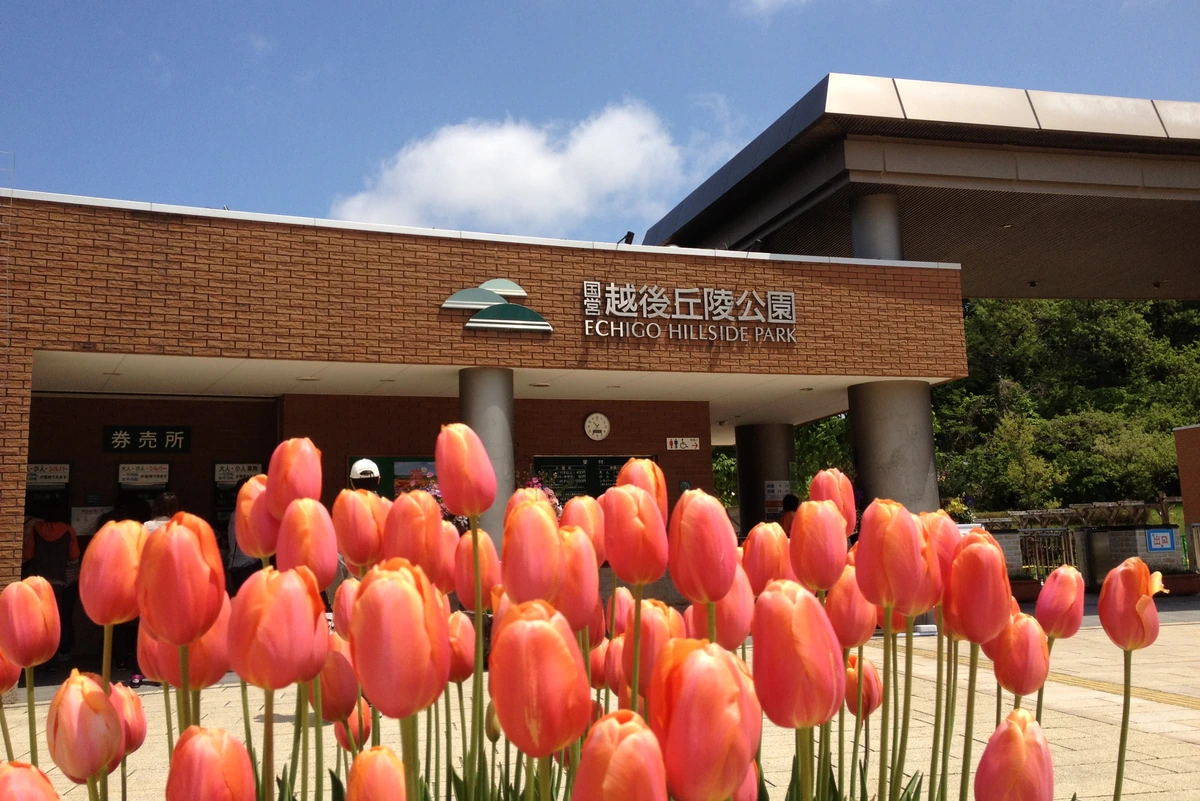
Pink-orange tulips fill the foreground beneath the brick entrance building and its Japanese and English park sign.

Tulips outside the entrance to Echigo Hillside National Government Park, photographed in May 2012. Planting changes from year to year.

Echigo Hillside Park 02.jpg — uka0310, CC BY 2.0 (https://creativecommons.org/licenses/by/2.0/). Source: https://commons.wikimedia.org/wiki/File:Echigo_Hillside_Park_02.jpg. Proportional reduction to at most 1200 pixels wide without upscaling; encoded as WebP quality 92, method 6. No crop, retouching, added text or colour correction. EXIF omitted. · Creative Commons

Walks and routes

A first visit through the gardens

Begin at the Welcome Gate and pick up the day’s map. Choose Flower Hill or the rose garden first according to the flowering report. Use the signed garden paths to visit the other, then pause by Koshinoike before returning to the gate. Skip a stop if your group would rather stay longer in one place.

Keep the route short by selecting one garden and returning the same way. Ask staff which paths best suit your mobility needs; do not use a woodland trail as a substitute for a closed garden path.


A first visit through the gardens

An optional lap of Midori no Senjōjiki

If everyone wants more movement, follow the open perimeter of the broad lawn. The park describes its outer circuit as about 1 km; allow 20–30 minutes at an easy pace, plus the walk to and from it. The large keyaki tree makes a memorable visual landmark.

Check the usable surface and access with staff, especially after rain or snow. You can enjoy the lawn edge without completing a lap.

An optional lap of Midori no Senjōjiki

A relaxed half-day

Arrive around opening, spend the morning with the best seasonal flowers and leave time for a drink or picnic. Add one final stop by the pools or play area, then return to the Welcome Gate well before your bus. Budget about 3–4 hours inside the park.

When you want to explore Satoyama

Make the Satoyama Field Museum the focus of another visit, or add it only after checking its open paths and return transport. The free park bus normally runs on weekends and holidays in April–November; weekdays have no regular service. Avoid relying on a woodland walk to connect the two entrances.

Things to try

Make a scent comparison

Choose two labelled roses and describe each scent in your own words before reading the garden’s classification. Fruity, tea-like and spicy are useful starting points. Enjoy flowers from the path, without pulling stems towards you.

Watch the water change

Pause beside Koshinoike and look for the way one level of water leads into the next. If the musical fountain is operating, wait for a display. These ornamental pools are separate from the designated summer water-play space.

Let the children choose the last stop

After the flowers, offer a choice between an open outdoor play area and a lawn break. The white bouncing dome is one of the park’s familiar features, but use only equipment currently open and suitable for the child’s age.

KIDS Station

Head to the second floor of Dan no Yakata for indoor play when it is open. MoiMoi is listed for ages 3–8, the infant space for ages 0–3, and the bouldering wall for elementary-school children with indoor shoes. Ask staff about the right area for your child; Cyber Hall is listed as suspended.

Wildlife and habitats

Garden roses

These are cultivated roses, with many different varieties. Use the labels to compare flower shape and scent; a rose that looks similar to its neighbour may smell quite different. Look at the variety names on the labels as well as the flowers themselves.

Cosmos

In autumn, look at the red, white and pink cosmos on Flower Hill. Compare their finely divided leaves with the broad outline of the flower heads. The beds are planted and flowering depends on the season; later cultivars can extend the show.

Sunflower

Sunflowers are a summer planting on Flower Hill. Notice the contrast between the yellow outer rays and the central disc, and check the current flower report before making them the reason for your trip. Do not pick the flowers or seeds.

Stories and discoveries

A rose garden with a rescue story

The original donation kept a local enthusiast’s roses in public view after the old garden closed. Today the park arranges its rose collection into eight themed areas, so the story continues through both preservation and new planting.

A landscape borrowed from rice fields

Koshinoike’s stepped pools were designed with terraced rice fields in mind. Looking across the different water levels is a small way to connect this landscaped park with the wider countryside.

When to visit

Spring: follow the tulips

Late April to early May is a useful starting window for Flower Hill. Early and late varieties are mixed, and the cultivar displays give you a reason to look closely at petal shapes as well as the overall colour. Follow the current flowering report for timing.

Early summer: linger with roses

The main spring rose period usually runs from late May to late June. Give the garden time for scent comparisons, rather than treating it as a quick photo stop.

Summer and autumn: choose the day’s display

Sunflowers are normally listed for mid-July to mid-August. Cosmos takes over in autumn, with varieties flowering at different times through September and October. October also brings autumn roses. Heat, rain and the progress of the planting should shape how long you stay outside.

Winter: make a snow-day plan

Snow play, sledding and other winter activities open only when snow and operations allow. The 2026 snow slopes closed on March 8; check the next season’s announcement before booking a trip around them. The Satoyama Field Museum and some garden, pool and play areas close during December–March.

Getting there and practical advice

Food and picnic breaks

Koshinoike Rest House lists light meals, snacks and a deck overlooking the water. Check its opening that day, and bring water and a backup snack if you are planning a long stay. Use open lawn areas for a picnic and leave the flower beds undisturbed.

Help with babies and small children

Nursing rooms are listed in Hana to Midori no Yakata and KIDS Station. Ask at Hana to Midori no Yakata information if you need hot water for formula. Free stroller loans are available at the Welcome Gate, subject to availability.

From Nagaoka Station by bus

For the Welcome Gate, the park directs visitors to stand 6 at Nagaoka Station’s Ōteguchi exit. The journey to the Echigo Kyūryō Kōen stop takes about 40 minutes. From December through March, that service ends at Yōkōdai 4-chōme, about a 10-minute walk from the Welcome Gate; allow extra time in snow. Check the linked operator timetable for both directions.

From Nagaoka Station by bus

By car

The Welcome Gate is about 10 minutes from Nagaoka Interchange in normal traffic. Confirm that navigation is taking you to this northern gate for the gardens, rather than the southern Satoyama gate. Allow more time on flower-festival and event days.

By car

Arrange the practical details first

Wheelchairs, walking aids and strollers are loaned free at the Welcome Gate. Accessible and ostomate toilets are listed at the gate and rose garden, among other locations. If you hope to use the park bus, ask about the wheelchair-capable vehicle and capacity before depending on it; this is a seasonal, limited service.

Sources and useful links

Wildlife you might spot

3

Each card links to a full Explore page with photos, traits, and fun facts.

Snap map for this place

Start with the big picture, then zoom in to explore individual wildlife observations around this place.

Loading map…

Good to know before you go

Check the current closure notices before leaving home, then follow barriers and staff advice. Wasps, bear reports and equipment maintenance can change which areas are available.

Choose the Welcome Gate for this garden visit. A search for the park name alone can send a car navigation system to the separate Satoyama entrance.

If travelling by bus, choose your return service before going into the park. The winter service stops short of the Welcome Gate.

Use the latest flowering report to pick your main stop. A festival date or an old photograph does not promise flowers at their best.

Bring water, comfortable shoes and sun protection. Pack a spare set of clothes if summer water play is part of the plan.

Check the posted age and operating rules before using play equipment. For the indoor bouldering wall, bring indoor shoes; it is for elementary-school children.

Leave plants and animals where they are, stay out of the beds and keep paths clear for other visitors. Drones are prohibited.

Check event-day hours as well as the ordinary calendar. Some evening events require everyone to leave after the daytime visit and return with a separate ticket.

Frequently asked questions

Use the Welcome Gate for the rose garden, Flower Hill and the main family facilities. The Satoyama entrance serves another part of the same park. It is closed from December through March.
As checked on October 16, 2026, general admission is ¥450 for adults, ¥210 for people aged 65 and over, and free for junior-high-school children and younger. Standard-car parking is ¥320. Admission is free in December–March, but winter parking is free only on weekdays; weekends and holidays remain charged. Special events can have separate tickets.
Standard hours are 9:30–17:00 from April through October and 9:30–16:30 from November through March. Closures are irregular in April–December; the park closes December 28–January 1 and on Mondays in January–March, or the following day if Monday is a holiday. Check the calendar and event notices for your date.
KIDS Station in Dan no Yakata offers indoor play, including a space for ages 0–3. Other equipment has its own age limits. A wet day is better suited to a short garden visit and an indoor break than a long woodland outing.
Dogs must stay on a short lead or in a carrier. They cannot enter buildings or certain play, water-play and lawn areas, apart from assistance-dog exceptions. Satoyama has additional carrier rules and some designated exceptions: check the current pet map before heading there.
Call the Echigo Park Management Center on 0258-47-8001. Ask about your visiting date, preferred entrance, equipment loans and the paths or facilities you hope to use.

Recent snaps at this place

Recent snaps will appear here as new observations are added.

View all ›

Take the discovery with you

Exploring Echigo Hillside National Government Park?

Identify the wildlife you spot, learn as you go, and keep a collection of the adventure.

  1. 1Spot it
  2. 2Snap it
  3. 3Keep the discovery