
Snappit logo
Snappit
Get App
Generic illustration, not a photograph of this venueIllustration
ParkNiigata, Japan

Fukushimagata Waterside Park

Start with the view, then look closer.

About

Start with the view, then look closer. From the visitor centre, water, reedbeds and fields spread towards the mountains; outside, a small movement on a pond can hold your attention just as easily. Fukushimagata Waterside Park makes a good introduction to this landscape because observation places, exhibitions and a thatched rest house sit close enough together for an unhurried outing.

The destination here is 水の公園福島潟, Niigata City’s municipal waterside park. Its facilities and planted or managed grounds occupy several parcels beside the much larger Fukushimagata lagoon. The visitor centre, View Fukushimagata, is part of the park, rather than a separate park to tick off. The surrounding wetland supplies the expansive scenery and much of the wildlife story, but it is not all unrestricted parkland.

There is no need to be an expert birder. Watch how birds move, listen before lifting binoculars, and let children choose one small thing to follow. A duck feeding, a patterned leaf or the texture of a reed roof can start a conversation about why people and wildlife have lived together here for so long. Return in another season and the same view may feel entirely different. Be ready to snap and learn! Get the Snappit app to identify any nature species you find here.

What to do here

Combine View’s exhibitions and lookout with the natural learning garden, a rest at Kataraitei and time watching the water. Add the nearby Ganbaresha bird-observation building if conditions and energy allow.

Seasonal info

Bird numbers, flowers and water levels change. A dated wildlife bulletin helps set expectations, but cannot promise what you will see when you arrive.

Accessibility

Begin by asking View staff about a suitable route. Designated parking and an accessible toilet are documented, but a continuous step-free route through every building, rooftop and wetland path has not been verified.

Don't miss

1

View Fukushimagata’s panorama and lagoon interpretation

2

Small-scale nature watching in the learning garden

3

Kataraitei’s reed-thatch roof and waterside history

4

Seasonal waterbirds across the neighboring lagoon

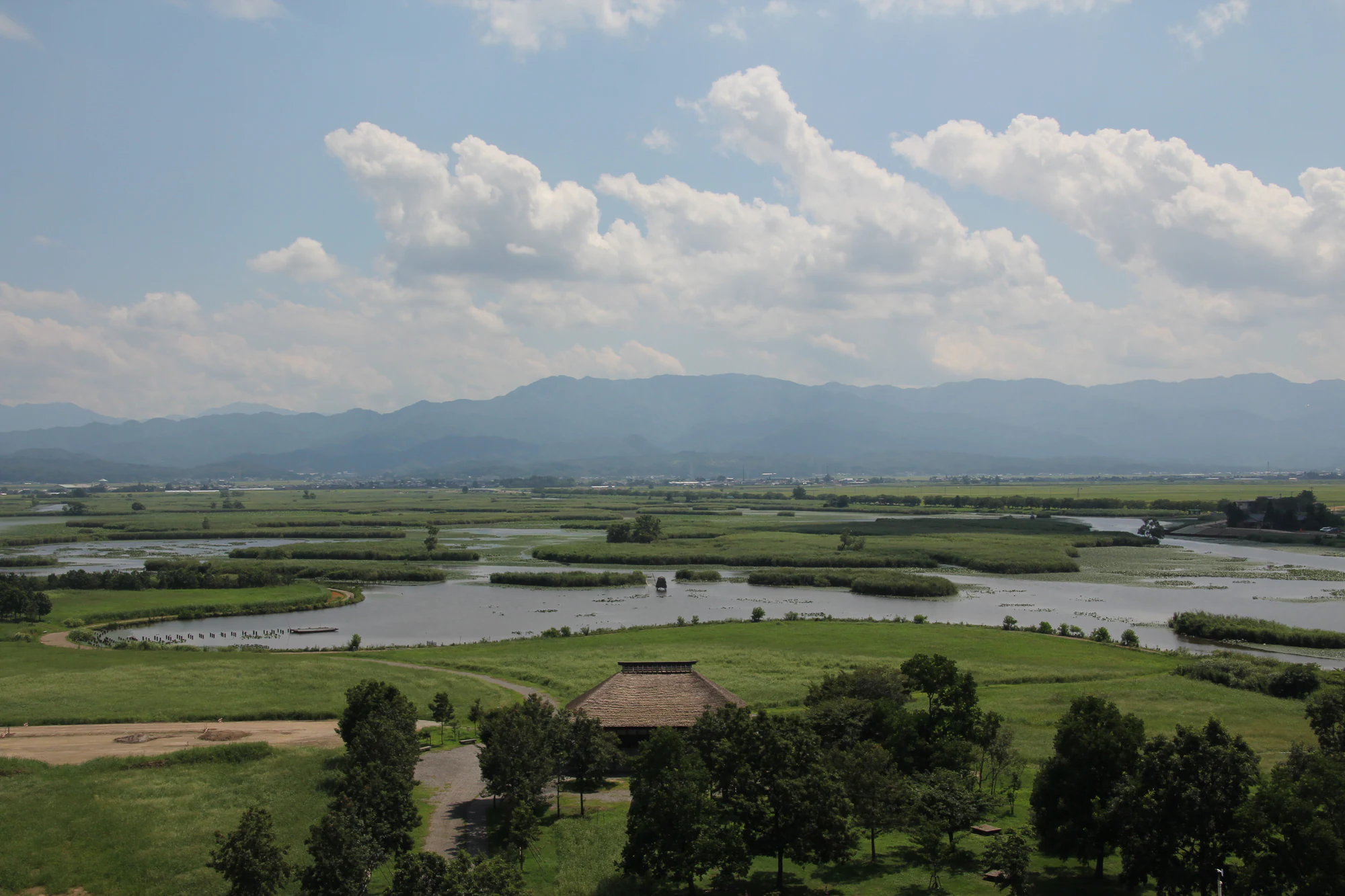
A reed-thatched roof and green trees stand in front of open water, patches of reeds and distant mountains beneath summer clouds.

A summer view over the park’s waterside grounds and thatched rest house towards the wider Fukushimagata wetland, photographed on August 22, 2014. The landscape beyond the visitor grounds is not all municipal parkland.

「夏の福島潟」、新潟市、クリエイティブ・コモンズ・ライセンス 表示 2.1 日本 (https://creativecommons.org/licenses/by/2.1/jp/). No changes. Source: https://www.city.niigata.lg.jp/shisei/seisaku/it/open-data/opendata-gazou/od-fukei/od-kata/od-fukushimagata/od-fukushimagata003.html · Creative Commons 1 · Creative Commons 2

Walks and routes

First visit: view, reeds and a rest

Begin at View and ask about the day’s path conditions. Spend time with the panorama and interpretation, then use the signed crossing into the natural learning garden. Make Kataraitei your rest stop and choose a short pond-side return to View. The official map supports these connected destinations, but this is an editorial sequence, not a surveyed route or a promise that every path is open.

About 2–3 hours, including observation stops
Small discoveries with children

Choose one accessible-to-your-group pond-side section after checking with staff, then return by the same familiar way. Look for three kinds of movement: something swimming, something flying and something moving in the wind. A snack and a sketch can be a better finish than trying to cover every area. Keep young children within reach beside water.

About 60–90 minutes outdoors, adjusted for weather

Things to try

For a deeper visit, arrange a ranger in advance: the published group options are 60 minutes for ¥6,000 or 90 minutes for ¥9,000, with one ranger for up to 20 people; building admission is extra when required. Ask about language, age suitability and availability. Independently, try a sound map: sit quietly, sketch where each call or rustle comes from, then compare notes. Photograph from paths without approaching nests, playing bird calls or feeding wildlife.

Wildlife and habitats

The October 10–16, 2026 bulletin specifically reports increasing male mallards in the park. Watch from a comfortable distance and compare feeding or resting behaviour. Seasonal plumage, light and distance can make identification harder than a field-guide picture suggests.

The same park report names increasing male wigeon. Try comparing a few birds patiently rather than identifying an entire mixed flock at once. A ranger or the live-camera display can help when birds are distant.

These winter visitors are central to the wider lagoon’s appeal. Their movements cross water, farmland and the park’s field of view. Use the latest observations to decide where to watch; an earlier count is not proof of a bird in a particular park pond.

Look for its broad leaves and small flowers in season, while respecting barriers around protected plants. Different ponds may be managed differently. Enjoy the conservation planting without touching the spines or treating it as proof that every specimen arose naturally.

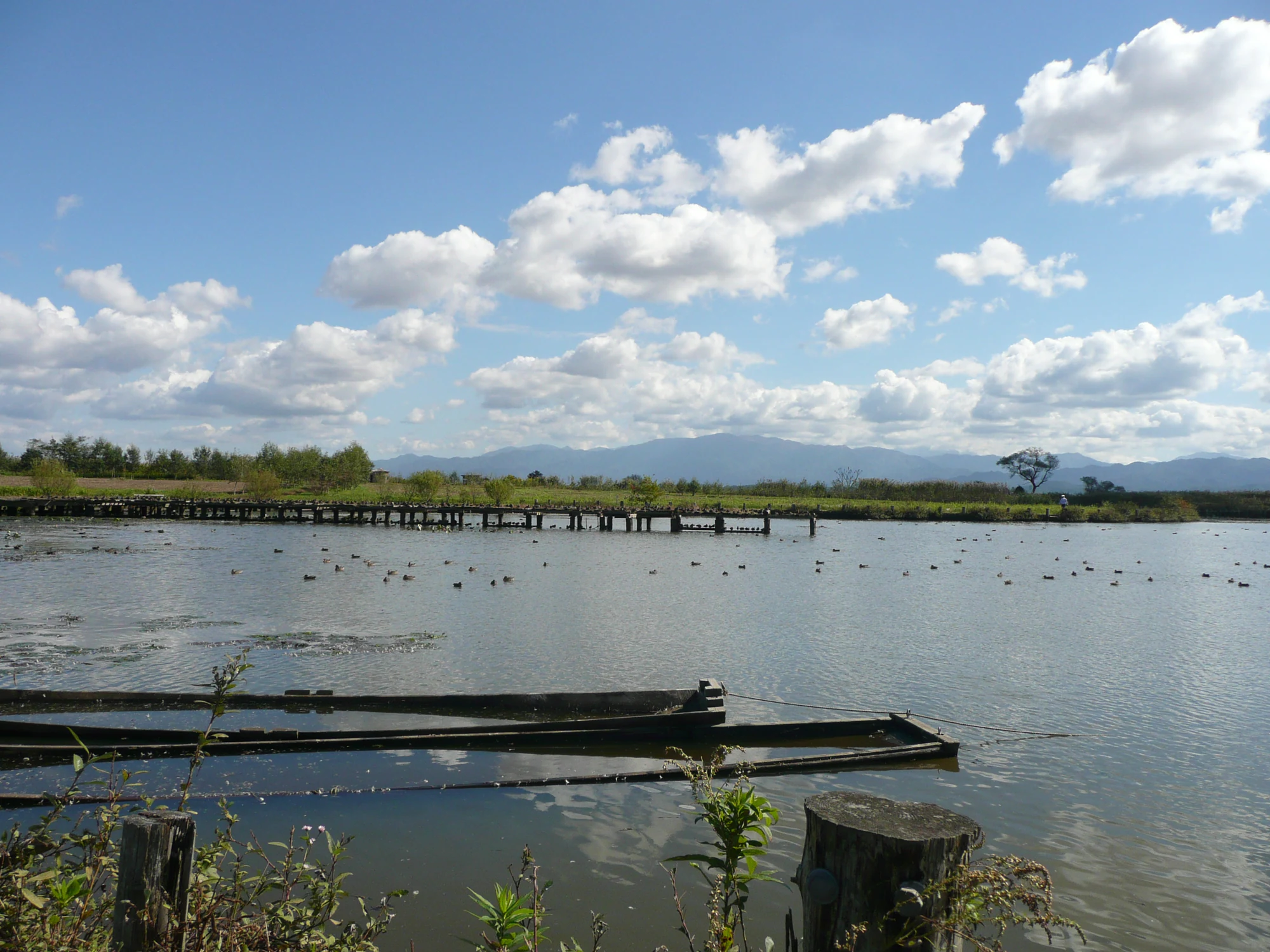
Long low boats are moored in the foreground of a pond with scattered birds, a wooden crossing, grassy banks and distant mountains under a blue sky.

Boats, waterbirds and a low wooden crossing at Fukushimagata, photographed on October 15, 2009. This historical scene does not establish current boat access, path condition or bird sightings.

「秋の福島潟」、新潟市、クリエイティブ・コモンズ・ライセンス 表示 2.1 日本 (https://creativecommons.org/licenses/by/2.1/jp/). No changes. Source: https://www.city.niigata.lg.jp/shisei/seisaku/it/open-data/opendata-gazou/od-fukei/od-kata/od-fukushimagata/od-fukushimagata004.html · Creative Commons 1 · Creative Commons 2

Stories and discoveries

Use the building to understand what you will see outside. The fourth floor combines films with a live camera looking into the lagoon; the fifth hosts changing exhibitions. The sixth-floor outlook and roof reveal the broader landscape. The building reaches 29 metres, a height figure rather than a walk’s ascent. The free third-floor lobby and terrace offer a shorter introduction.

Follow the public paths around ponds and open ground, pausing where you can watch without blocking the way. This is a place to notice differences between water, reeds and land. At the learning pond, aquatic plants are actively cared for; conservation work is part of the landscape rather than evidence that every plant is untouched wild growth.

The reed-thatched building recreates an old home beside the lagoon. Its hearth and roof materials bring the human story into focus after a walk among the reeds. It is a shared daytime resting place, normally open 09:00–17:00 with the same regular closure pattern as View; do not mistake it for an all-hours indoor shelter.

This national wildlife-protection-area building has telescopes for looking across the lagoon. Its indoor area is normally free, 09:00–17:00, with Monday/holiday and year-end closures. The operator describes the roof as available outside those hours, but that does not guarantee safe weather, step-free access or open approaches on your visit. Leave time to observe rather than simply rushing to a second lookout.

The park opened in October 1997 in what was then Toyosaka City, which became part of Niigata City in 2005. Its design brings nature learning and local culture together.

Fukushimagata’s waterscape has changed through reclamation and river works. Some reclaimed land later returned to water. The lagoon’s commonly quoted 262 hectares describes the larger waterbody, not the size of this municipal park.

The winter visitor called oohishikui links this wetland with Kamchatka. Historical tracking work identified its breeding area in 1999, and its calls were selected for Japan’s soundscape list in 1996. Listening is part of the experience.

The striking onibasu plant has huge, prickly leaves and comparatively small flowers. Local people also call it donbasu. Its recovery involves protection and propagation, so the visitor ponds tell a conservation story as well as a botanical one.

When to visit

Rapeseed flowers and cherry blossom make a bright contrast with water and distant hills. The 2026 spring traffic controls ended on May 6; do not assume that an old spring promotion or road arrangement applies now. Flower timing changes each year.

Give the aquatic plants time. Onibasu is a summer highlight, and the learning garden’s plants receive protection from grazing crayfish. The city guide describes flowering into September, rather than promising an October display. Avoid the hottest part of the day and carry water.

Migrating geese, swans and ducks shift attention back towards open water. The October 16, 2026 lagoon count recorded 180 oohishikui, 210 greater white-fronted geese and 2,200 Bewick’s swans. These are a dated wider-wetland snapshot, not numbers promised inside the park or on a later visit.

Watch the relationship between roosting waterbirds and the surrounding feeding landscape. Wind can make a stationary observation feel much colder than a walk. Dress warmly, check ice and snow, and plan around indoor closure days. Do not enter fields to follow flocks.

Getting there and practical advice

View’s normal hours are 09:00–17:00, last admission 16:30. It closes Mondays, or the following day when Monday is a holiday, and December 28–January 4; special openings can differ. Floors 1–3 are free. Upper-floor and roof admission is ¥520 for adults, ¥260 for elementary through high-school students and free for preschool children. The shop is on the first floor and a rest lobby on the third. Bring a dependable snack or lunch rather than relying on unverified café hours. The mapped toilets include View and Kataraitei; the operator lists Kataraitei’s toilets as usable 24 hours, including an accessible toilet. Swimming at Yusuikan and accommodation at Ryofuso require separate planning and payment.

View’s car park includes two designated accessible spaces. An accessible toilet is documented at Kataraitei, but the route between parking, toilet and desired viewpoint still needs checking for your needs. The official maps are visitor schematics, with no verified gradients, widths or complete step-free itinerary. Call 025-387-1491 to ask about the entrance, lift or ramp arrangements, rooftop access and current outdoor surfaces before making an access-dependent trip. Eligible disability-certificate holders and one accompanying carer receive free View admission under the operator’s stated rules; ask what proof is accepted.

Aim for View Fukushimagata, Maeshinden Otsu 493, Kita Ward, Niigata City, 950-3328. Take the JR Hakushin Line to Toyosaka Station, then arrange a taxi or walk. The city estimates about 30 minutes on foot and the operator about 40; allow 30–40 minutes plus stops, and consider weather and your group’s mobility. A taxi is listed at about five minutes, subject to availability and traffic. By car, the operator gives about five minutes from Toyosaka-Niigata-Higashiko Interchange. View has free parking listed for 120 cars, five large vehicles and two designated accessible spaces. No current everyday direct bus or shuttle timetable is verified here; festival shuttles should not be treated as regular transport.

Stay on signed visitor routes and outside closed banks, works areas and wildlife-management ground. The published illustrated map is dated March 2023: its water-gate construction label neither confirms a current closure nor proves completion. Ask locally. Water margins can be slippery, and open ground offers little shelter from wind or summer heat. Wear suitable shoes, long clothing and a hat; add warm layers in colder weather. Do not fish, bring pets or ride bicycles in the natural learning garden. Avoid disturbing wildlife, never feed birds, and take rubbish away.

Visitor information

Checked October 20, 2026: the latest wildlife bulletin covers October 10–16 and reports more male wigeon and mallards in the park. The “Mukaeru Kata” art exhibition runs through October 24, excluding closed days. A beginner birdwatching session is advertised for October 25, 10:00–11:30, with telephone booking for ten people, binocular loans and rain cancellation; availability is unconfirmed. November 3 brings a 10:00–15:00 market and free View admission, while the campsite is explicitly closed that day. Recheck notices before travelling; this is not an all-paths-open confirmation.

Sources and useful links

Wildlife you might spot

2

Each card links to a full Explore page with photos, traits, and fun facts.

Snap map for this place

Start with the big picture, then zoom in to explore individual wildlife observations around this place.

Loading map…

Good to know before you go

Save the Japanese destination name and arrange the return to Toyosaka Station before heading out.

Binoculars make distant birds much easier to enjoy; keep voices low and let wildlife come and go.

Bring drinking water, weather protection and a bag for your rubbish. There are no park litter bins.

Treat boardwalks, pond margins and winter ice with care. Follow the day’s barriers rather than an old photograph.

Frequently asked questions

No. It is in Kita Ward, Niigata City. Use the address Maeshinden Otsu 493 and the name ビュー福島潟 when planning your arrival.
View’s first three floors are free; its upper exhibitions and lookout are paid. Kataraitei’s shared daytime rest space is free. Camping, swimming, lodging and booked activities have their own arrangements.
This guide does not propose a lagoon circuit. Choose the signed visitor paths in the municipal park and check any extension with staff. The lagoon, river works, farmland and wildlife-protection areas extend beyond the park.
Pets and bicycles are not permitted in the natural learning garden; the campsite also excludes them. Use the bicycle parking by View rather than riding through observation areas.
The operator’s guided wooden-boat programme is listed for March–September and requires advance booking. It is not an October walk-up rental service. Future-season operation must be confirmed separately.
On an open day, focus on View’s films, live lagoon camera, exhibition and sheltered outlook. Do not assume rooftop access is suitable in strong winds. Kataraitei offers a shared rest space during its own opening hours.

Recent snaps at this place

Recent snaps will appear here as new observations are added.

View all ›

Take the discovery with you

Exploring Fukushimagata Waterside Park?

Identify the wildlife you spot, learn as you go, and keep a collection of the adventure.

  1. 1Spot it
  2. 2Snap it
  3. 3Keep the discovery





