Snappit logo
Snappit
Get App
Generic illustration, not a photograph of this venueIllustration
ParkFR

Haut-Jura Regional Nature Park

The Haut-Jura spreads across Doubs, Jura and Ain, in Bourgogne-Franche-Comté and Auvergne-Rhône-Alpes.

About

The Haut-Jura spreads across Doubs, Jura and Ain, in Bourgogne-Franche-Comté and Auvergne-Rhône-Alpes. Its character comes from contrasts: folded limestone and waterlogged hollows, conifer forest and open pasture, quiet peatlands and settlements shaped by craft and industry. This is an inhabited mountain landscape with many separate gateways, rather than a park you enter through one main gate.

Peatlands are a particularly good starting point because they make the mountain’s history visible at a small scale. The Lac des Rousses interpretation walk explores the relationship between a glacial lake, wet ground and the water people use today. You can learn a great deal without climbing a summit or leaving the constructed path. The lake is part of the local drinking-water supply, which gives its protection an everyday importance as well as a wildlife value.

Leave enough time to look between the interpretation stops. Compare the low, open vegetation beside the boardwalk with the wooded slopes beyond it, and the dark water with the changing colour of the land. With children, one good question is more useful than a long species checklist: why does a mountain made largely of limestone also contain such wet places? The path and its displays give you a way into the answer. Turn your visit into a safari! Use the Snappit app to scan and log wildlife sightings here.

The Haut-Jura’s open and wooded areas tell a human story as well as a natural one. Farming, grazing and forestry have shaped the landscape, while water power helped establish workshops and factories in its valleys. Peatlands also carry a history of drainage and peat extraction. Restoration now aims to retain water and restore their functioning; a damp-looking hollow may be the result of active conservation, not neglected land.

What to do here

Choose the Sentier de la tourbière du lac des Rousses, starting at the lake car park. Walk towards the beach and the boardwalk beyond the nautical base. For a simple family visit, return along the same permitted path when you have had enough; there is no need to complete the road-return option or circle the whole lake.

Seasonal info

This short walk is a fair-weather, snow-free introduction. Snow, ice, flooded sections or a barrier can change what is possible. In winter, choose a currently authorised winter outing with local advice instead of treating the summer boardwalk as a snowshoe route.

Accessibility

The park lists the Lac des Rousses route for pushchairs and Joëlette all-terrain chairs. That does not establish independent wheelchair access: the approach descends, surfaces vary, and the road-return option deserves separate consideration. Ask about current conditions and choose your turning point before committing to the full circuit.

Don't miss

1

A short peatland boardwalk beside Lac des Rousses

2

Interpretation connecting glacial landscapes, peat and drinking water

3

The Maison du Parc’s interactive exhibition and forest sound experience

4

A wider landscape of forest, pasture, limestone valleys and working villages

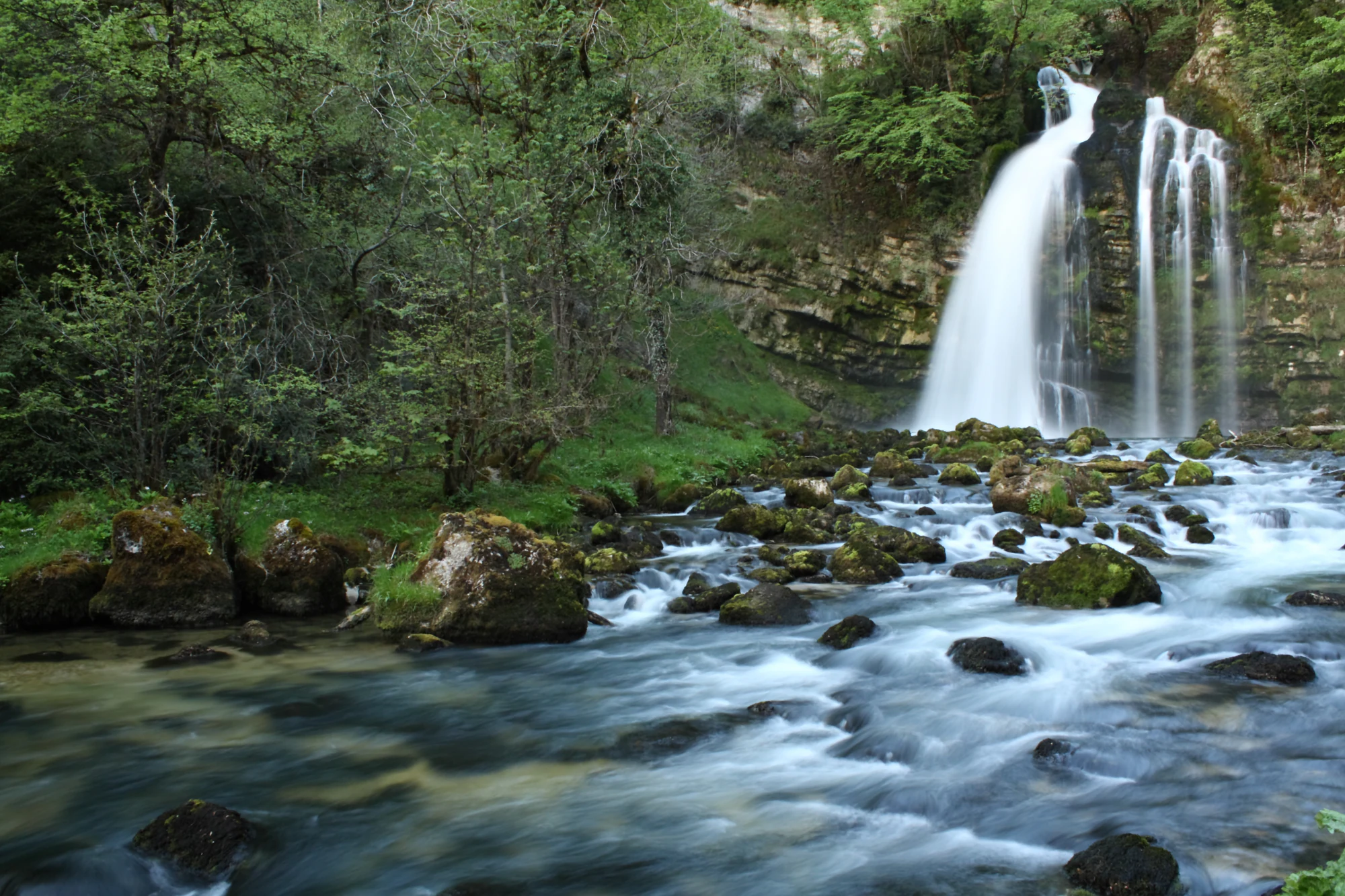
White water falls over layered rock beside green woodland and runs between moss-covered boulders.

A waterfall in the Flumen gorges, photographed in May 2009. This is a different part of the Haut-Jura from the Lac des Rousses walk; the image does not show current flow or access conditions.

“Les gorges du Flumen dans le Parc Naturel du Haut-Jura, en mai” — Ghost-in-the-Shell, CC BY2.0. https://www.flickr.com/photos/ghost-in-the-shell/3527114682/. Original unchanged. · Creative Commons

Walks and routes

Sentier de la tourbière du lac des Rousses

The official easy circuit starts at the Lac des Rousses car park, passes the beach and continues on wooden decking beyond the nautical base towards the Rocher du Lac. Its five interpretation stops explain the lake, peatland and their history. The published return can use the road via Côte de Lavenna, or retrace the outward path. For younger children, retracing your steps makes a simpler choice. Keep the outing to the marked lakeside sector.

There is a descent from the main car park, followed by mixed surfaces and boardwalk. The published pushchair and Joëlette indications are useful starting points, but check board condition, gradients and passing space for your equipment. Returning the same way avoids choosing the road section.


Sentier de la tourbière du lac des Rousses

An easy half-day with a change of scene

Begin with the Lac des Rousses path while everyone is fresh. Take time at a few displays, return along the permitted route and have a snack at a designated picnic area. If you still have energy, transfer separately to Lajoux for the Maison du Parc. Check its opening day first: an autumn weekend walk does not automatically combine with an open exhibition. Allow roughly half a day overall, adjusting for your journey and breaks.

Things to try

Read a landscape from the boardwalk

At an interpretation stop, look for the boundary between open water, wetland vegetation and trees. Ask everyone to describe one difference before reading the display. Sketching those bands makes a useful souvenir and works even when no animal appears. Keep the drawing session on a suitable stopping space so other walkers can pass.

Listen to the forest indoors

The Maison du Parc’s sound experience, Le chant de la forêt du Risoux, offers a different way into the landscape. Pair it with the interactive Haut-Jura, Terre Vivante ! exhibition, especially if a child is more interested in sound and hands-on displays than in a long walk. Visitor booklets are available for ages 6–14.

Photograph the small-scale landscape

The boardwalk gives you a fixed viewpoint over a delicate habitat. Try including the line of the walkway, a patch of vegetation and the distant slopes in one frame. A phone camera is enough; moving off the decking for a lower angle is unnecessary. Put the camera away occasionally so the outing stays a shared experience.

Make Lajoux the main visit

On a wet or icy day, the Maison du Parc can carry the outing on its own when open. Allow the published 1½ hours for the exhibition, sound experience and heritage visit, and bring a question from the landscape you passed on the way. If the forecast includes strong wind or a weather warning, avoid adding a woodland detour simply to fill the day.

Wildlife and habitats

Round-leaved sundew

The park records this small carnivorous plant in its wetland habitats. Its round leaves carry sticky hairs that trap tiny prey, an adaptation to nutrient-poor ground. Treat it as something to learn about rather than a target to search for off-path. A view from an authorised walkway, when available, is enough; never press into moss or move vegetation for a photograph.

Common frog

The park’s atlas and habitat information record the common frog. It offers a connection between water and the surrounding land, but this guide does not promise it at any particular point on the boardwalk. If a frog crosses an open path, give it room to move and watch without handling it. Do not collect spawn or turn the lake margin into a pond-dipping exercise.

Western capercaillie

This forest bird helps explain why quiet-zone rules matter. The park’s atlas records it, and local conservation guidance stresses its sensitivity through winter and the breeding season. Appreciate its place in the landscape without seeking display grounds, following tracks into closed forest or playing recordings. A visit that leaves the bird undisturbed is a successful one.

Eurasian lynx

The lynx belongs to the wider Haut-Jura’s wild fauna. Its tufted ears, spotted coat and short tail are useful features to recognise in the exhibition or a field guide. Seeing one on a short family walk would be an exceptional encounter, not an expected part of the day. Keep your outing on public paths and enjoy the knowledge that the surrounding forest supports this elusive animal.

Stories and discoveries

A wetland can keep a long memory

Peat accumulates where plant material decomposes slowly in waterlogged conditions. Draining the ground changes that system and can release stored carbon. The Jura’s restoration programmes work on water levels and damaged flows as well as on visible vegetation. Protecting a bog means keeping its water processes working, not simply preserving a pretty patch of plants.

The secure little building beside the farm

The Maison du Parc also presents a grenier-fort, a small building traditionally separated from the main farm to protect a family’s valuables. It is a useful reminder that the park’s heritage includes the practical ingenuity of mountain households alongside its lakes and forests.

When to visit

Late spring and summer

Pick a clear day once the path is free of snow and ice. There is more time for unhurried outdoor stops, but also more people using the lakeside. Keep the picnic separate from the peatland walk, and make space for others on the decking. The seasonal dog restriction applies from 15 May to 15 September.

Autumn and winter

Autumn colours can make a short outing especially satisfying, provided the boards are not slippery. Start with enough daylight for the return. In winter, never step onto the frozen Lac des Rousses: the municipality explicitly prohibits access. Use local winter-route information for any snow outing and do not make a shortcut through the bog or forest.

Quiet forest zones

In the five protected forest zones of the Massacre, Bois de Ban-Arobiers, Risoux, Haute-Joux and Combe Noire, entry from 15 December to 30 June is restricted to authorised routes. The rule concerns mapped zones, not a blanket closure of the whole park. Before adding a forest walk, consult the map for your date and activity; a visible track is not necessarily authorised.

Getting there and practical advice

Parking, picnic stops and the exhibition

The tourist office lists two free parking areas at Lac des Rousses, picnic space and public toilets; check seasonal toilet availability rather than relying on an open restaurant. Bring your own water. At the Maison du Parc, the published individual admission is €5 for adults, €3 for children aged 6 and over, and free for under-6s. In autumn 2026 it opens Tuesday–Friday, 14:00–18:00, excluding public holidays. Consult the dated calendar for other seasons and reserve any activity that requires registration.

Choose a gateway before booking the journey

For the walk, navigate to the Lac des Rousses car park rather than to the park headquarters in Lajoux. The tourist office identifies Morez/Hauts-de-Bienne and La Cure as rail gateways for the Les Rousses area. Arrange the final connection and return before travelling; a railway station nearby does not mean a frequent bus to the trail. Skibus links are winter services, with seasonal timetables, and should not be assumed to operate for a summer peatland visit.

Ask about the whole journey

For a wheelchair visit, ask the tourist office which car park gives the most suitable approach, whether there are thresholds or damaged boards, and whether an accessible toilet is open. The separate gentle-walk listing explicitly says its routes are not formally approved for wheelchair accessibility. A short distance and low overall ascent do not describe every ramp, cross-slope or surface. The Maison du Parc is a separate venue whose access requirements should also be checked directly.

Sources and useful links

Wildlife you might spot

4

Each card links to a full Explore page with photos, traits, and fun facts.

Snap map for this place

Start with the big picture, then zoom in to explore individual wildlife observations around this place.

Loading map…

Good to know before you go

Save the official route sheet before leaving your accommodation.

Bring shoes with grip, a waterproof layer, drinking water and a snack.

Keep children close beside open water and on the boardwalk.

Leave peat, mosses, flowers and fallen wood where they are.

Use the designated picnic areas rather than spreading out in wetland vegetation.

Keep a clear passage when stopping to read or take photographs.

Frequently asked questions

No. It explores a limited lakeside and peatland sector. Follow the named interpretation route and its return options; do not extend it into an improvised shoreline circuit.
From 15 May to 15 September, the tourist office says animals, even on a lead, are prohibited on the beaches, lawns and lakeside pedestrian path. Outside that period, check the signs and keep a dog on a lead where permitted. The route page’s general lead instruction does not override the seasonal restriction.
No. The park’s route instructions prohibit cycling on this trail. Arrive by bicycle if your journey allows, then use the designated parking and explore on foot.
Do not plan around it. Both belong to the wider park’s wildlife, and the short peatland trail is not a viewing site for them. Learn about them through interpretation and leave their quiet habitats undisturbed.
No. The photograph shows the Flumen gorges elsewhere in the park. It illustrates a different landscape and was taken in May 2009; it is not a stop on the Lac des Rousses route.

Recent snaps at this place

Recent snaps will appear here as new observations are added.

View all ›

Take the discovery with you

Exploring Haut-Jura Regional Nature Park?

Identify the wildlife you spot, learn as you go, and keep a collection of the adventure.

  1. 1Spot it
  2. 2Snap it
  3. 3Keep the discovery