
Snappit logo
Snappit
Get App
Generic illustration, not a photograph of this venueIllustration
ParkTohoku, Japan

Kitakami Tenshochi Park

Tenshochi makes a simple walk feel like an occasion.

About

Tenshochi makes a simple walk feel like an occasion. In spring, the cherry trees pull your attention overhead; in summer, their leaves give the avenue a completely different mood. The broad Kitakami River is the constant beside it all. You can walk the whole avenue, but you do not need to reach the far end to enjoy the place.

The familiar riverside stretch runs for about two kilometres from Sango Bridge towards Tenshochi Rest House. It is one part of a larger municipal park, with planted flowers and the low hill of Jingaoka beyond. For a first visit, make the avenue your main outing and decide later whether everyone wants more. A short out-and-back is an especially good choice with young children or limited walking energy.

Cherry season is usually centred on mid- to late April, with different trees continuing into early May. The main flowering period changes each year, and a festival date is not a blossom forecast. After the petals fall, azaleas, leafy trees and summer flower beds bring other things to notice; autumn returns colour to the cherry leaves, while winter brings the possibility of swans on the river.

There is a satisfying cultural extension nearby at Michinoku Folklore Village, where relocated traditional houses show another side of the region. Treat it as a separate visit with its own opening days and hillside paths. If the river walk has already filled the day, a pause for something to eat at the Rest House is a perfectly good finish. Planning to visit? Download the Snappit app to identify the wildlife you spot in real-time.

The park grew from a local civic effort. Waga Tenshōkai was established in 1920 at the initiative of Kōji Sawafuji, who later became mayor of Kurosawajiri. Cherry trees and azaleas were planted, and Waga Tenshochi opened on May 21, 1921. The name evokes a place with an outstanding outlook, associated with the view from Jingaoka. Tenshochi was selected among Japan’s 100 famous cherry-blossom places in 1990.

What to do here

Walk beneath the cherry trees, pause where the river is visible from the public path, and compare the planted flowers along the way. Choose either a short return walk or the full avenue. Add Jingaoka for a change of viewpoint, or Michinoku Folklore Village for old houses, only if time and conditions suit.

Seasonal info

Flowers follow the weather. Azaleas normally follow the cherries; summer planting changes from year to year. Autumn colours can make a rewarding visit without blossom crowds. In winter, snow, ice and shorter days call for a brief outing and a check on available toilets and refreshments.

Accessibility

Multipurpose toilets are listed at the Rest House, the Sawayaka toilet by the children’s park and the South Sawayaka toilet. That does not make every path or hill approach suitable for every wheelchair. Ask which entrance and short riverside section suit your needs, especially after rain or snow; Jingaoka and the folklore village add slopes.

Don't miss

1

The long cherry avenue beside the Kitakami River

2

Azaleas and changing flower beds after cherry season

3

A higher view from Jingaoka when the approach suits your group

4

An optional visit to the traditional houses of Michinoku Folklore Village

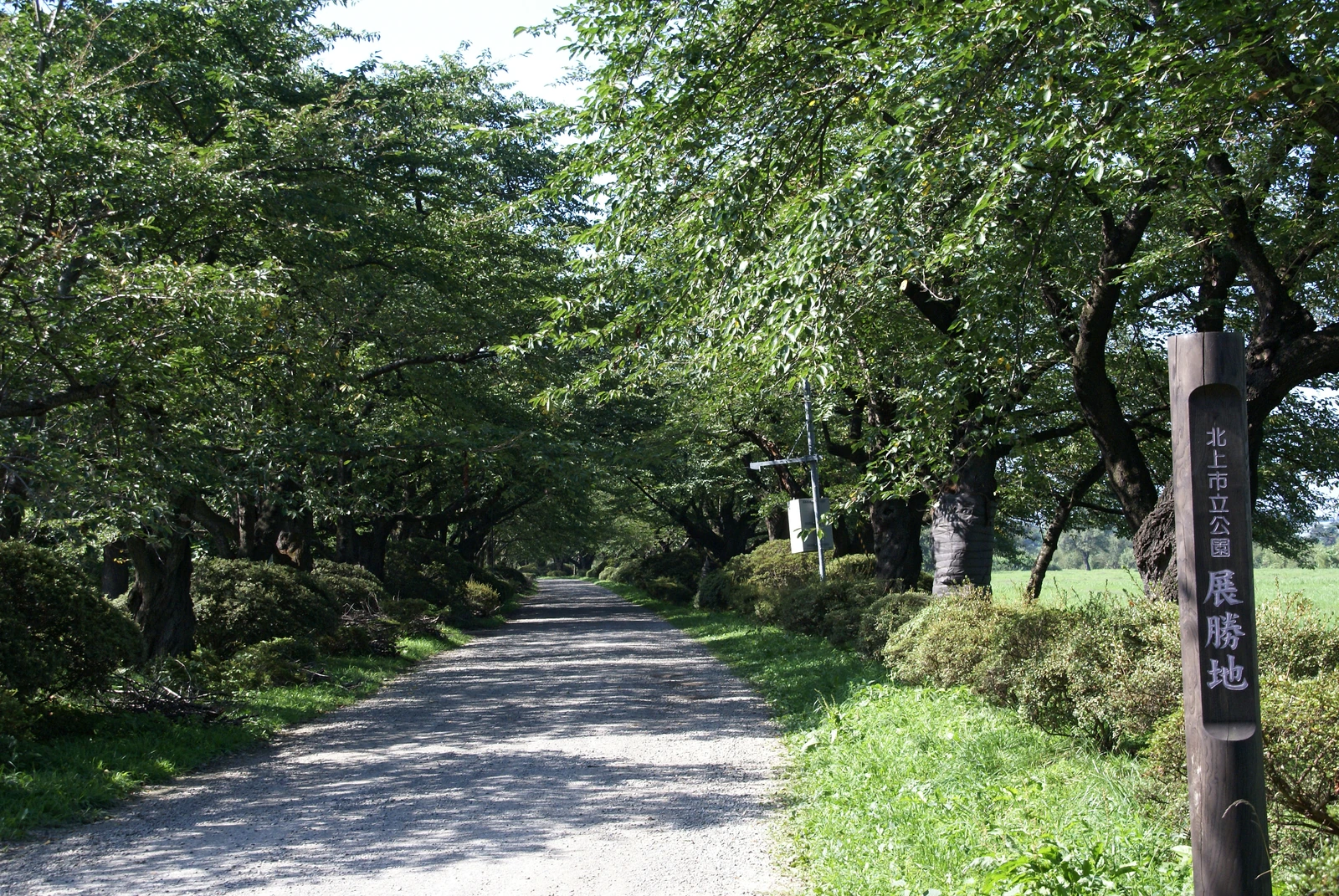
A gravel avenue runs beneath leafy trees beside a wooden sign bearing the Japanese name of Tenshochi Park.

Summer foliage shades a park avenue at Kitakami Tenshochi, photographed in August 2007.

Tenshochi01s3872.jpg — 663highland, CC BY 2.5 (https://creativecommons.org/licenses/by/2.5/). Source: https://commons.wikimedia.org/wiki/File:Tenshochi01s3872.jpg. Proportionally reduced to a 1600-pixel long edge without upscaling; recompressed as WebP quality 92, method 6. No crop, retouching, added text or colour changes. EXIF omitted. · Creative Commons

Walks and routes

The cherry avenue, at your own pace

Begin by Sango Bridge if arriving on foot from the station, or at the Rest House end if arriving by taxi or car. Follow the signed cherry avenue towards the other end, then return the way you came. About 2 km each way makes a 4 km return; allow 2–3 hours with stops. For a shorter outing, choose a turning point before everyone is tired rather than committing to the full length.

For wheelchairs or strollers, ask about the most suitable approach and today’s path surface before choosing a distance. A short visit close to an open toilet may work better than trying to complete the avenue.


The cherry avenue, at your own pace

A gentle 90-minute visit

Start beside an open facility, spend about half an hour walking a short section of the avenue, then turn back with time for photographs and a rest. Let the distance follow the slowest walker. If arriving from the station, add the approach and return separately.

Half a day with the folklore village

Give the river and trees 1–2 hours, then decide whether to add 1–2 hours among the village’s old houses. You can combine a short avenue walk with the village rather than doing the full 4 km return first. Check the village calendar and your return transport before starting.

Things to try

Compare two flowering trees

If the cherries are flowering, look at two nearby trees rather than trying to name them all. Are the blossoms single or many-petalled? Have the leaves opened at the same time? The local festival leaflet introduces several kinds of cherry, so a label or a photograph can help you continue the comparison later.

Jingaoka, if you want a different view

The low hill associated with Tenshochi’s name adds an outlook over the river landscape. Ask about the open approach and current bear notices before leaving the riverside outing; leave this extra out if slopes or the day’s conditions do not suit your group.

Give children a play break

The children’s park near Sango Bridge can break up the walk. The tourism association also lists the separate Ishitsubute Park in Kitakami, opened in April 2025. Check the local map and current opening notices rather than assuming either playground lies directly on your chosen stretch.

A small outing, or a different day

A shower may leave room for a short visit followed by food at the Rest House if it is open. The folklore village is an open-air museum, so it still involves outdoor walking between buildings. In heavy rain, strong wind or unsafe river conditions, postpone the park rather than sheltering beneath trees or approaching the water.

Wildlife and habitats

Planted cherries: follow the labels

Somei-yoshino is part of the local display, with other cherries extending the season. Compare the timing of leaves and flowers, and the number of petals, from the path. A tree labelled with a cultivar name gives a more useful identification than calling every blossom “sakura”.

Azaleas: colour closer to the ground

The city records red, pink and white azaleas around the avenue and Jingaoka, generally from early May into early June. Look for how the shrubs change the view beneath the trees. The plantings include azaleas as a group; colour alone does not identify a species.

Sunflowers: one head, many small flowers

Sunflowers have been planted beside the avenue, including a display reported in August 2025. If they are planted on your visit, look closely at the disc of tiny flowers in the centre, surrounded by petal-like ray flowers. Leave the heads and seeds for the planting to complete its season.

Notice what is here today

Use the flowers and winter birds as prompts for looking, rather than a checklist to finish. Planting plans change and wild birds move around. Photograph plants from the path, keep a comfortable distance from birds, and leave every flower, seed head and branch in place.

Stories and discoveries

A name rooted in the view

Tenshochi’s name is linked to the outlook from Jingaoka. Remembering that helps you see the park as a river landscape with hills and changing seasons, as well as a cherry avenue.

A park shaped by local effort

The 1921 planting of cherries and azaleas followed the creation of a local civic association the previous year. The present-day flower displays continue that sense of a landscape cared for by people.

When to visit

Spring: choose by the flowers

The main cherry display is usually in mid- to late April; later-flowering trees can extend interest into early May. Check the current blossom report before a long journey. Festival activity depends on the year, and the April 10–29, 2026 event is already over.

Late spring and summer: look below the canopy

Azaleas follow the cherries, and the city’s flower calendar also describes early-summer hydrangeas and summer bedding. Let the current display decide your stops. In hot weather, shorten the walk and take water rather than counting on a shop being open.

Autumn and winter: river views and shorter walks

Autumn gives the cherry avenue another change of colour. In winter, look for swans from a safe open path, with binoculars if you have them. Wear warm layers and grippy footwear, and confirm toilets and indoor opening before you leave.

Getting there and practical advice

Rest House: a useful pause, if open

The Rest House offers food, local souvenirs and Tenshochi mochi. Its published hours are 10:00–17:00, with food orders 11:00–14:30 and café orders 11:00–16:30. Call 0197-64-2110 before planning a Monday visit, as the published closure details differ. Holiday arrangements may move the closure to Tuesday.

Toilets along the outing

Official visitor information lists multipurpose toilets at the Rest House, Sawayaka toilet by the children’s park and South Sawayaka toilet. Ask which is open and easiest to reach from your arrival point. For a winter visit, confirm which toilets are operating and plan a stop before a long walk.

Michinoku Folklore Village is a separate visit

The nearby open-air museum has relocated traditional houses and displays about local life. Entry is listed as free and the opening period as 09:00–17:00. The operator says it is open daily from April through November 2026. From December 2026 through March 2027, Monday and post-holiday closures apply, with holiday adjustments; it is also closed December 28, 2026–January 5, 2027. Check the exact date before going. Pets are not admitted, except assistance dogs.

Winter sports-facility closure

The city states that outdoor sports facilities cannot be used from November through March. This is a facility closure, not a reason to assume the entire park is closed or that every other service is open.

Train and a walk over Sango Bridge

Use JR Kitakami Station’s east exit for the walking approach. Official guidance allows about 20 minutes to the avenue entrance near Sango Bridge; the Rest House is farther along the approximately 2 km avenue. Allow extra time for children, mobility needs, photographs and festival crowds.

Taxi or car to the Rest House end

A taxi can reduce the approach walking; tell the driver whether you want Sango Bridge or Tenshochi Rest House. The Rest House website gives about 10 minutes by car from the station’s west exit in ordinary conditions. Ask for a current fare and pickup plan. Festival traffic can make road travel much slower.

Festival transport needs that year’s plan

Festival parking charges, traffic restrictions and shuttles are seasonal arrangements. The completed 2026 programme is useful background, but use the organizer’s new notice for your travel year. Do not substitute an old ferry listing for a confirmed way across the river.

Choose an arrival point before choosing a distance

Describe your wheelchair, stroller or walking needs to the tourism association or Rest House and ask about surfaces, gradients, drop-off arrangements and the nearest open multipurpose toilet. The named toilets are helpful facilities; they do not establish a continuous step-free route between every attraction.

Keep hills optional

Jingaoka and the folklore village’s hillside setting change the demands of the visit. If slopes are difficult, ask for a suitable short riverside section and make that the whole outing. Snow and rain can change what is manageable, even on a familiar path.

Check bear information before exploring

Kitakami City advises checking current reports before entering wooded areas, going with others, avoiding dawn and dusk, and making your presence known with conversation or a bell. Take all food and rubbish away, and turn back if you find tracks or droppings. If you see a bear, do not approach or run; keep it in sight and retreat slowly. Never approach a cub. Follow any closure or staff instruction.

Give winter birds space

Watch swans without feeding them, even if an older travel page suggests otherwise. Iwate’s current guidance asks people to avoid feeding wildlife and leaving food behind. Stay back from the birds and do not handle sick or dead wildlife; tell local staff if you find an animal in distress.

Sources and useful links

Wildlife you might spot

3

Each card links to a full Explore page with photos, traits, and fun facts.

Snap map for this place

Start with the big picture, then zoom in to explore individual wildlife observations around this place.

Loading map…

Good to know before you go

The station’s roughly 20-minute walk reaches the avenue entrance near Sango Bridge, not the Rest House at its far end. Leave time and energy for the return.

Check current bear reports and park notices before setting out, particularly before a hillside extension. Avoid closed areas and choose a daylight visit.

For spring travel, check that year’s festival transport and parking arrangements. The 2026 festival has ended, and its ferry and sightseeing boats did not operate.

Bring water, a layer against the river breeze and shoes with grip. Keep children back from the water and stay on open paths after heavy rain.

Use an open toilet before starting the longer walk. Confirm winter facilities rather than assuming every toilet or shop is available.

Keep flowers, branches and tree roots undisturbed, and take food scraps and rubbish away. Watch winter swans from a distance without feeding them.

If you are relying on the Rest House for lunch, check opening first. Its website lists 10:00–17:00 hours and food orders until 14:30, but its Monday closure information is inconsistent.

A professional photo shoot needs advance permission; Tenshochi applications go through the Rest House. Leave paths clear when taking ordinary visitor photographs.

Frequently asked questions

The official tourism guidance gives about 20 minutes on foot from the east exit to the cherry-avenue entrance near Sango Bridge. The avenue then continues roughly 2 km towards the Rest House. For a slower group, allow 40–60 minutes for that avenue section with short stops.
No. Start at whichever end best suits your transport and walk as far as feels comfortable before returning. Walking the whole avenue out and back is about 4 km, excluding the station approach and any side visits.
Yes. The prefectural tourism listing describes the park as open throughout the day. The Rest House, museums, village and sports facilities have their own schedules; daylight is the better choice for this walk.
Do not make a boat your essential crossing. The organizer cancelled both the ferry and sightseeing boats for the April 10–29, 2026 festival while safety measures were reviewed. Check a new season’s announcement before relying on any boat service.
Swans are a documented winter feature of the Kitakami River here, but they move around. Bring binoculars, stay on a safe open path and watch quietly. Iwate Prefecture asks visitors not to feed wild birds.
For general visitor information, contact the Kitakami Tourism and Convention Association on 0197-65-0300. The Rest House is on 0197-64-2110; the folklore village is on 0197-72-5067. Ask about your actual visiting date, especially on Mondays and in winter.

Recent snaps at this place

Recent snaps will appear here as new observations are added.

View all ›

Take the discovery with you

Exploring Kitakami Tenshochi Park?

Identify the wildlife you spot, learn as you go, and keep a collection of the adventure.

  1. 1Spot it
  2. 2Snap it
  3. 3Keep the discovery




