Snappit logo
Snappit
Get App
Generic illustration, not a photograph of this venueIllustration
ParkKanto, Japan

Sankeien Garden

Sankeien is a garden to enjoy at two different scales.

About

Sankeien is a garden to enjoy at two different scales. First take in the broad pond, the wooded slopes and the roofs appearing between the trees. Then slow down for a branch in flower, a reflection or the way a small building sits beside a stream. The pleasure is in moving between those views, rather than ticking off every building on the map.

The garden occupies about 17.5 hectares of rolling ground in Honmoku, away from Yokohama’s central waterfront. Businessman and art patron Hara Sankei brought historic buildings here from places including Kyoto and Kamakura and arranged them within the landscape. The result feels connected, even though the structures have travelled from very different settings. The former Tōmyōji Temple pagoda, built in 1457 and moved here in 1914, became an important focus for the garden’s views.

For a first outing, start at the Main Gate and spend time beside the large pond in the Outer Garden. Continue to the Inner Garden, where Rinshunkaku’s connected buildings face a more enclosed scene of water and planting. The Sankei Memorial Hall adds paintings, objects and the founder’s story. You can then decide whether to continue towards Chōshūkaku and the bamboo around Rengein, or turn back for a comfortable tea break. Both gardens belong to the same visit; the Inner Garden is not a separate attraction requiring a second ordinary garden ticket.

Treat the historic buildings mainly as things to appreciate from outside. Most interiors open only for special occasions. The former Yanohara House is closed for restoration until the planned end of March 2027, and from April 2027 the pagoda is scheduled to be enclosed for major repairs and hidden from view. Check the latest notices before making either building the reason for your trip. There is still plenty to enjoy in the planting, ponds and changing spaces, even when a particular building is unavailable. Be ready to snap and learn! Get the Snappit app to identify any nature species you find here.

Hara Sankei opened what is now the Outer Garden to the public free of charge on May 1, 1906. His garden also became a place where artists worked and encountered older art. After wartime damage, the Sankeien Hoshōkai foundation took responsibility for restoration in 1953. The Inner Garden first opened to the public in 1958, and the whole garden was designated a national Place of Scenic Beauty in 2007. The contrast between the two areas reflects that history, rather than two unrelated gardens.

What to do here

Combine a pond-side stroll with the Inner Garden and Sankei Memorial Hall. Look at how roofs, trees and water frame one another, then choose a seasonal plant to examine closely from the path. Keep the hill climb optional, and leave room for a tea-shop stop rather than rushing through the whole garden.

Seasonal info

Each season changes the balance between flowers, foliage and architecture. Hydrangeas and irises add interest around the rainy season; lotus rewards a morning visit in summer. Early openings, evening illuminations and extra paths operate only on announced dates, not throughout an entire season.

Accessibility

The operator offers a lower-step, 90–120-minute wheelchair course, but warns that its unpaved gravel is difficult without assistance. It includes the Main Gate, Inner Garden and Memorial Hall area. Ask staff to adapt it around current works; the hill route is a different outing. Loan wheelchairs are limited and cannot be reserved.

Don't miss

1

The Outer Garden’s broad pond and changing seasonal planting

2

Rinshunkaku and the quieter spaces of the Inner Garden

3

Art and the founder’s story in Sankei Memorial Hall

4

Summer lotus and the bamboo setting around Rengein

Walks and routes

A gentle first circuit

From the Main Gate, begin with the large pond, then follow the signed route into the Inner Garden for Rinshunkaku and Sankei Memorial Hall. Return to the Outer Garden for a pause near the central square. Add Chōshūkaku and Rengein only if your group feels like more walking. Choose your way with the official map and staff advice, rather than trying to join every path.
The optional hill section

The operator’s fuller course continues beyond Rengein towards the former Shōfūkaku site and the pagoda, using rising ground. Make this an optional extension for visitors comfortable with slopes and steps. Follow posted diversions during conservation works and omit the section if conditions or your energy make it less appealing. The pagoda’s enclosure from April 2027 will change the view.

A comfortable half day from Yokohama

Travel out in the morning, spend roughly two hours between the pond, Inner Garden and Memorial Hall, then choose a tea-shop break or a little more walking. Leave enough time for the bus back. If blossom crowds, heat or rain slow things down, drop the hill section before shortening the pauses that make the visit enjoyable.

Things to try

Find three different frames

Choose a roof, a flowering branch and a patch of water. Move a little along the public path and notice what appears or disappears around each one. Children can choose a favourite view and sketch it without needing to identify every building.

Make the Memorial Hall part of the walk

The displays introduce Hara Sankei and the art connected with him, including paintings and decorative works. A short visit gives the garden more context; the lobby also offers seats and an outlook over water. Exhibits change, so do not build the day around one specific painting.

Add a seasonal opening only when it fits

The path behind Chōshūkaku opens for limited fresh-greenery and autumn-colour periods. Interior visits to other historic buildings are also occasional. Check the event listing for the exact area, times, price and reservation rules, and keep a garden-only version of the day in mind.

Choose the museum and a shorter walk

In light rain, combine a short pond-side route with the Memorial Hall when it is open. Most historic buildings are not walk-in shelters, so do not rely on their interiors. Wet gravel, steps and slopes can be awkward; if heavy rain or strong wind affects the grounds, follow the operator’s notice and postpone the outdoor visit.

Wildlife and habitats

Lotus: look for the stages

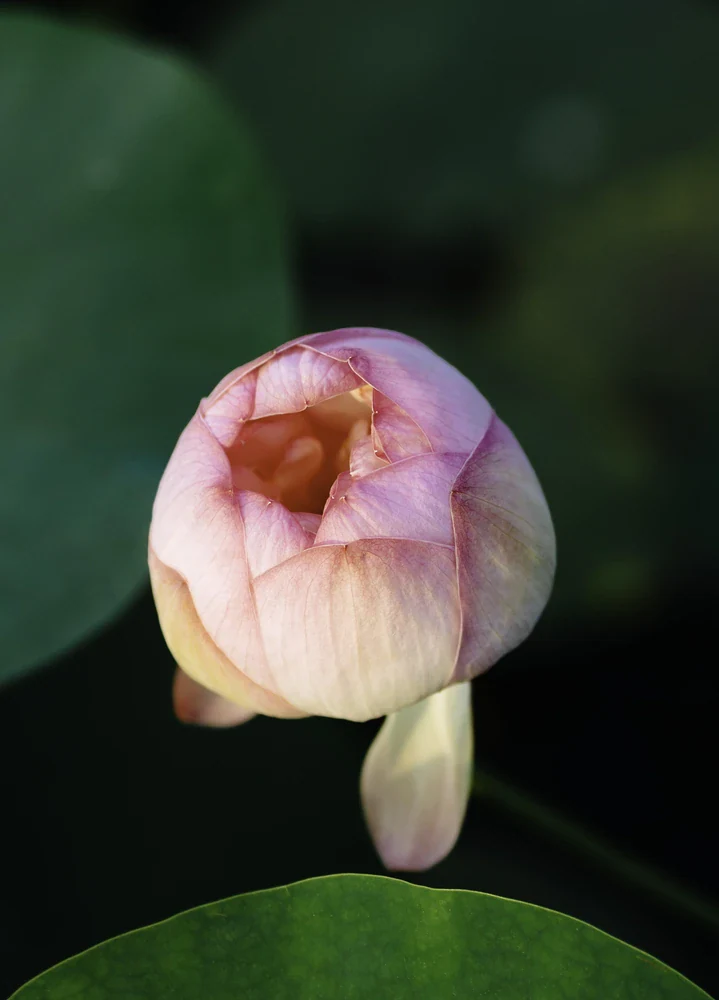
In summer, compare a tightly closed bud with an open flower or a seed head if they are visible. The garden grows mainly a tall lotus variety called genshibasu (原始蓮). Morning is the most useful time to look for flowers opening. The accompanying photograph is an example from India, not a Sankeien plant or proof of the same variety.

Bamboo: notice the setting

Around Rengein, look from the path at repeated upright stems and the change from open garden to a more enclosed green setting. You do not need to put a species name to the bamboo to appreciate how it frames the tea house.

Maples: follow the leaves

Look at the outline of a maple leaf, then compare how the same branching shape reads in fresh greenery and autumn colour. The garden calendar places the main colour season in November–December; use the current report to judge the day you actually visit.

A close look at garden plants

These are plants in a managed garden. Use labels and the current flowering report to guide your attention, and leave stems, leaves and flowers undisturbed. A visit outside peak bloom can still reveal buds, seed heads, bark and changing leaf shapes.

A rounded pink lotus bud above a green leaf against a dark, blurred background; photographed in India.

A lotus bud (Nelumbo nucifera), photographed in West Bengal, India, in April 2017. This example illustrates the plant cultivated at Sankeien; it is not a photograph of the garden or its exact lotus cultivar.

A budding lotus flower.jpg — Subhrajyoti07, CC BY-SA 4.0 (https://creativecommons.org/licenses/by-sa/4.0/). Source: https://commons.wikimedia.org/wiki/File:A_budding_lotus_flower.jpg. Proportionally reduced to a 1000-pixel long edge without upscaling; recompressed to WebP quality 92, method 6. No crop, retouching, added text or colour correction. EXIF omitted. Source creator’s prior edits retained: desaturation, changed colour profile and added grain (Commons history, 1 December 2018). · Creative Commons

Stories and discoveries

Buildings composed into a landscape

The pagoda was not simply put on a hill as an isolated exhibit. Other buildings and garden views were arranged to make use of it. Look for the relationship between built forms and the surrounding trees, while remembering that the restoration enclosure will interrupt that familiar composition.

An older public garden and a later opening

The Outer Garden opened in 1906; the Inner Garden did not admit the general public until 1958 after restoration. Walking between their different spaces is also a small journey through the garden’s public history.

When to visit

Late winter through spring

Plums generally flower in February–March, followed by several kinds of cherry in March–April. Wisteria and fresh leaves add reasons to return later in spring. Pick one seasonal priority and check the flowering report shortly before travelling.

Rainy season and summer

Look for irises around May–June and hydrangeas in June. Lotus is the main July–August attraction. Flowers start opening early, so a morning visit is worthwhile; the 2026 early-morning event has ended, and its 7:00 opening should not be assumed for another date or year. In heat, shorten the walk and cool down indoors.

Autumn into winter

Maples and ginkgo usually colour in November–December. Winter makes rooflines and tree shapes easier to study, with wintersweet and early plums offering smaller-scale interest. Check daylight, weather and the December 26–31 closure before setting out.

Getting there and practical advice

Hours and admission

Checked October 16, 2026: normal hours are 9:00–17:00, with last entry at 16:30. The annual closure is December 26–31. Admission is ¥900 for high-school age and above and ¥200 for elementary- and junior-high-school pupils. Yokohama residents aged 65 or over pay ¥700 with proof of address and age. Special events may change hours or add charges.

Wheelchairs, toilets and family needs

Free wheelchairs are available at the Main and South gates, one per group, without reservations. The operator lists spacious wheelchair toilets at the Main Gate car park, South Gate, central square and Memorial Hall. Baby-changing facilities are provided at these toilet locations, but there is no nursing room or pushchair hire. Ask in advance if a particular facility is essential.

Food, lockers and short rests

Tea shops provide places to pause, but their opening days and hours vary. Check the current temporary-closure notice before relying on a particular shop. The Main Gate has coin lockers requiring a refundable ¥100 coin; travel light because locker sizes and numbers are limited.

From Yokohama or Sakuragichō

From Yokohama Station’s east-side bus terminal, stop 2, city bus 8 runs via Sakuragichō Station to Sankeien-iriguchi. The garden’s diagram allows about 40 minutes from Yokohama, or 30 minutes from Sakuragichō, followed by a five-minute walk. Route 168 is another option from Yokohama; check the municipal planner for your date and direction. Road traffic can lengthen the journey.

From Negishi Station

JR Negishi is the nearest station. The garden directs visitors to buses 58 or 101 from stop 1 towards Honmoku, about ten minutes on the bus, then about ten minutes on foot from the Honmoku stop. A taxi is another option. Check the current service rather than assuming the garden is right outside the station.

Driving and the South Gate

The Main Gate car park is shared by cars and buses and can fill up. The published car rate is ¥1,000 for the first two hours, then ¥200 per 30 minutes, with no daily cap; payment is cash. Neighbouring Honmoku Shimin Park has a separate car park near the South Gate. Compare access and current charges before choosing it, and do not confuse its parking ticket with garden admission.

Use the published lower-step course

The garden’s wheelchair course favours areas with fewer level changes, but the operator explicitly warns that gravel can be hard to manage without a companion. Its route includes the Inner Garden and Memorial Hall, so a meaningful visit does not require climbing to the pagoda. Discuss any current barriers and construction diversions at the entrance.

Admission concessions

Visitors presenting a disability certificate and up to one accompanying person are admitted free. Show the certificate at entry; the operator does not apply this concession retrospectively after the visit, and parking is not discounted. Confirm which documentation is accepted if yours was issued outside Japan.

Visitor information

Restoration changes in 2026–2027

The former Yanohara House is closed from January 21, 2026, through a planned end-March 2027 repair period. From April 2027, the former Tōmyōji pagoda will be covered by a protective enclosure and cannot be seen. Older walking-course descriptions still describe the farmhouse as normally open, so use the dated restoration notices when planning.

A busy autumn weekend

The operator expects heavy garden and parking demand on October 31 and November 1, 2026, during the Sankeien Grand Tea Gathering. The tea gathering is sold out and does not accept walk-up participation. Choose another day if you want a more unhurried ordinary visit.

Sources and useful links

Wildlife you might spot

3

Each card links to a full Explore page with photos, traits, and fun facts.

Snap map for this place

Start with the big picture, then zoom in to explore individual wildlife observations around this place.

Loading map…

Good to know before you go

Check the construction notices before travelling, especially if you want to see the former Yanohara House or the pagoda.

Wear comfortable shoes with grip. The paths are gravel, and hill sections add slopes and steps; wet surfaces need more care.

Come in the morning for lotus. A 7

00 opening happens only on designated early-morning event days; normal opening is 9:00.

Bring water and take shade or indoor breaks in hot weather. The Memorial Hall is air-conditioned; ask staff for help if you feel unwell.

Keep food and drink to permitted Outer Garden areas. Eating and drinking are prohibited in the Inner Garden; picnic sheets, tents, tables and chairs cannot be brought in.

Take casual photos without blocking narrow paths. Tripods, monopods and selfie sticks are prohibited in the Inner Garden. Commercial photography and commercial reuse need prior arrangements with the garden.

Leave pets at home. Recognized guide, assistance and hearing dogs are allowed.

Enjoy plants from the paths and keep children close beside water. Do not feed wildlife or cats; koi may receive only the fish food sold by the garden’s tea shops.

Frequently asked questions

Ordinary admission covers the garden’s Outer and Inner Garden areas. Access to a historic building’s interior is a separate question: most are normally closed, and special openings or events can have their own dates, booking requirements and charges.
Not during the current restoration closure. The former Yanohara House has been closed since January 21, 2026, with work planned through the end of March 2027. Wait for an official reopening announcement before planning an interior visit.
From April 2027 it is scheduled to be enclosed in a protective structure for major repair, so the familiar pagoda view will be unavailable. No reopening date is promised here; check the preservation notice for updates.
No reservation is required for ordinary garden admission. A special tea gathering, workshop or building opening may work differently, so read the individual event page before buying tickets or travelling.
A quiet food break in the permitted Outer Garden is possible, but this is a heritage garden with restrictions on picnic equipment. For running games or a longer park outing, consider neighbouring Honmoku Shimin Park separately and check its own rules.

Recent snaps at this place

Recent snaps will appear here as new observations are added.

View all ›

Take the discovery with you

Exploring Sankeien Garden?

Identify the wildlife you spot, learn as you go, and keep a collection of the adventure.

  1. 1Spot it
  2. 2Snap it
  3. 3Keep the discovery