Snappit logo
Snappit
Get App
Generic illustration, not a photograph of this venueIllustration
ParkIT

Torbiere del Sebino Nature Reserve

The reserve covers about 360 hectares between Iseo, Provaglio d’Iseo and Corte Franca.

About

The reserve covers about 360 hectares between Iseo, Provaglio d’Iseo and Corte Franca. The inland pools, known as the Lame, receive spring, stream and rainwater; the Lamette connect directly with Lake Iseo. This distinction matters: the visitable paths show you only part of a wetland whose quieter, protected areas give wildlife room to feed and breed. [Meet the reserve](https://torbieresebino.it/riserva-naturale/). Explore the grounds like a pro—download the Snappit app to instantly identify animals and plants.

The pools look settled into the landscape, but much of what you see was shaped by work. After the glacier retreated, falling water levels separated the inland basin from Lake Iseo. Waterlogged plant remains accumulated as peat. Intensive extraction began in the second half of the nineteenth century: workers cut out blocks, dried them and supplied fuel for factories, kilns and the local railway. By the time use ended around the 1950s, former grassy ground had become flooded excavations. Later clay extraction added another set of basins. The reserve was formally established in 1984. That history makes the surviving strips of land especially interesting: they connect a working past with today’s habitat mosaic. [Read the reserve’s history](https://torbieresebino.it/storia/).

What to do here

Choose one clear aim: the short walk from Iseo to the birdwatching tower, a southern waterside outing from San Pietro in Lamosa, or the longer outer circuit. Bring binoculars if you have them and leave time to pause.

Seasonal info

Central-route access needs special attention. In the latest notice checked on 19 October 2026, only part of the crossing has reopened after the breeding-season closure. Plan your visit without relying on a complete central loop. [Read the partial-reopening notice](https://torbieresebino.it/percorso-centrale-3/).

Accessibility

The northern Percorso per tutti is the lower-effort choice, but it is not uniformly step-free or level. The tower itself has stairs; a separate viewing platform has ramp access. Check the detailed surface and width information below before choosing it.

Don't miss

1

Open water framed by reedbeds and the surrounding hills

2

The short northern tower walk and its interpretation stops

3

Peat-cutting history written into the shape of the pools

4

Wet woodland, meadow edges and former clay pits on the outer paths

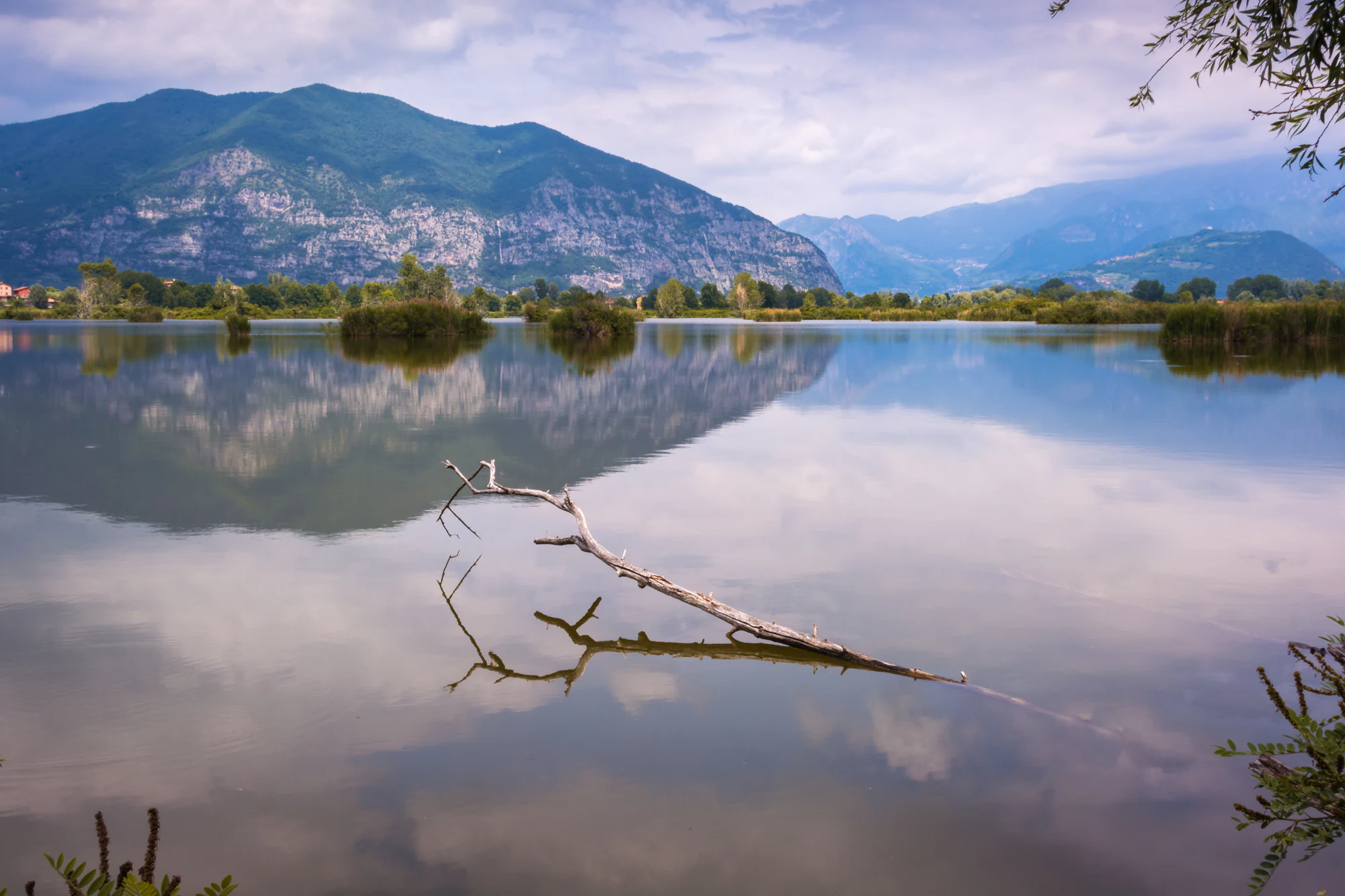
Calm water reflects wooded hills and a cloudy sky, with low vegetated islands and a fallen branch in the foreground.

Open water, reed margins and wooded hills at Torbiere del Sebino, photographed on 31 May 2020. This historical view illustrates the wetland setting, not current access conditions.

“Torbiere di Sebino.jpg” by Hadz68, via Wikimedia Commons, CC BY-SA 4.0. Unmodified original. · Creative Commons

Walks and routes

Iseo to the tower: the short northern visit

Start at the Centro Accoglienza Visitatori by the Iseo entrance and follow the northern path towards the Torretta. The operator lists this as 1 km each way, or 2 km out and back, with about an hour of walking and visiting. Interpretation stops make it a good first choice with children; you can turn around earlier without committing to a circuit. The final spur follows a surviving peat-working bank and ends at the viewing area, so retrace your route rather than looking for a through-path. See the official short-route details.

Choose this instead of the full wetland circuit if you need a shorter outing; read the measurements in the accessibility section before assuming it suits your wheelchair or pushchair.


Iseo to the tower: the short northern visit

San Pietro in Lamosa: the southern landscapes

Begin beside the monastery in Provaglio d’Iseo and follow signs for Percorso Sud around the southern side, towards the former clay-extraction pools. Here the interest is the change of habitat: open basins, meadow and woodland rather than one continuous boardwalk. Make this a flexible out-and-back, allowing 1½–2½ hours including stops as a suggested visit. Return on the same signed path, leaving time for the monastery’s setting above the wetland. See the reserve’s alternative walks.

Wooden sections, uneven ground and the railway crossing make this a more demanding choice than the short northern option; use only the designated crossing and obey its signals.

San Pietro in Lamosa: the southern landscapes

Percorso Nord-Sud: the longer outer circuit

This signed perimeter walk can start at any of the three official entrances. It links the northern pools and wet woodland with meadows, the former clay pits and the monastery side, so choose it when you want to understand the wetland as a whole. It also passes roads and cultivated edges: expect a reserve embedded in a lived-in landscape. The main route page gives 8 km and the alternative-walk page about 8.5 km; use 8–8.5 km for planning, with the tower spur an optional extra. The operator suggests about three hours; add time for wildlife stops. Follow the official outer-route description.

This is not the accessible short route. Steps near the Funtanì spring, varied surfaces and the length matter more than the generally low-lying setting.

Percorso Nord-Sud: the longer outer circuit

An easy first visit

Choose Iseo, sort out your ticket, and begin with the tower out-and-back. Let the weather and your interest decide how long to stop, rather than trying to add every path. Return with daylight to spare, then have a meal or continue into Iseo outside the reserve. Leave the longer circuit for another day if you prefer to linger.

Things to try

Birdwatching without disturbing the reedbeds

Use the existing viewing points and keep your voice low. A quiet pause usually gives you a better chance to notice movement than continuous walking. Avoid calling birds closer, using playback or feeding them; give other visitors space at narrow viewpoints. Include the plants and insects in your visit too.

Add the monastery, if you have time

San Pietro in Lamosa stands on a rise beside the reserve and gives the southern entrance a very different feel from Iseo. Its Cluniac history and frescoed spaces make a natural companion to the wetland walk. Treat an interior visit as a separate stop and confirm opening arrangements; the reserve ticket does not establish access to the monastery. Explore nearby places.

When the weather does not suit the paths

After rain, shorten the walk rather than pushing on through waterlogged ground. The reserve recommends boots in wet conditions. In strong wind or thunderstorms, postpone exposed waterside walking and follow local restrictions. The visitor centre, if open, or a separately checked monastery visit can be a better use of the time. Consult ARPA Lombardia’s forecast and regional weather alerts before leaving.

Wildlife and habitats

Great crested grebe

Look over open water for a long-necked diving bird. Breeding plumage brings striking head plumes, while winter birds look plainer. The reserve records breeding birds and winter visitors, and March can bring courtship displays. Watch from an existing viewpoint without approaching a nesting bird. Reserve species account.

Common kingfisher

A low turquoise flash may be your only glimpse. The reserve records resident, breeding kingfishers and highlights late summer and autumn, when young birds add to the population. Pause where an open view already exists; do not search banks or tree roots for nests. Reserve species account.

Western marsh harrier

Lift your gaze above the reeds as well as across the water. This raptor hunts over reedbeds, and the reserve records it throughout the year, with spring and autumn particularly interesting. Seeing one depends on its movements and the conditions, not on reaching a particular hide. Reserve species account.

Red-crested pochard

The male’s rounded orange head and red bill make this duck a satisfying identification. Females are much browner. The reserve records the species in its pools and notes winter gatherings in the Lamette, which remain closed to entry. Use distant views rather than treating that record as a destination. Reserve species account.

Black alder

The wet woodland is worth your attention too. Black alder grows in the reserve’s swampy groves; rounded leaves and small woody cone-like fruits are useful clues. Its roots can live in wet ground, helping explain why these patches look different from woodland on the surrounding hills. Reserve species account.

Purple loosestrife

In July and August, look for upright pink-purple flower spikes beside damp margins and channels. The reserve describes this plant as common along its paths. It is an easy reason to slow down in summer, even when birds stay screened by reeds. Leave the flowers where they grow. Reserve species account.

Stories and discoveries

A landscape made by water and work

Water depth and the amount of moisture in the ground help determine which plants grow where. Peat digging disrupted the earlier vegetation, but its pools and banks also created a patchwork of different habitats. That is why a short walk can move between reeds, open water, meadow and wet woodland. Some valuable plants have declined, and maintaining this variety needs continuing care.

Why a small wetland matters

Roads, buildings and cultivated land surround the reserve. Its shelter and food therefore matter well beyond its size, especially for birds moving between distant breeding and wintering grounds. Wetlands also retain water and support natural water purification. Protection here includes Ramsar recognition and the European Natura 2000 network; the restrictions on access help those functions continue. Read about conservation.

When to visit

Spring and summer

Spring migration runs broadly from February to May, followed by nesting activity. Some birds start breeding early, so the central closure protects more than a brief peak in spring. In summer, choose a shorter walk if the heat makes open sections tiring; carry water and a hat. Flowering wetland plants can be as rewarding as the birds.

Autumn and winter

Autumn passage extends roughly from August to November, while December and January bring wintering waterbirds. Shorter days make an early start useful for the longer circuit. Warm layers and patience suit a winter visit; seasonal bird records describe possibilities, not a promise of particular species on a particular day.

Getting there and practical advice

Tickets and opening hours

Published entry hours are dawn to sunset, every day including holidays. The ordinary contribution is €3 per person. Children up to age 12 inclusive, people with disabilities, and residents of Iseo, Provaglio d’Iseo and Corte Franca are exempt; residents should be able to show proof if asked. Machines at Iseo and Corte Franca take electronic payments only. All entrance machines support contactless payment; do not rely on getting change where coins are accepted. Check current prices and exemptions.

Visitor centre, toilets and food

At Iseo, the visitor centre offers information and free binocular loans when it is open. Toilets, including an adapted toilet, are inside the centre and depend on its opening hours; do not treat them as an all-day trail facility. Bring drinking water and plan food outside the protected area. Centre hours vary, so confirm them with the reserve on +39 030 9823141 if your visit depends on toilets, assistance or equipment.

Arriving by train

From Brescia, use the Brescia–Iseo–Edolo line towards Provaglio–Timoline for the monastery entrance, or Iseo for the northern entrance. The reserve estimates about ten minutes on foot from either station to the relevant gateway. At Iseo, head towards Stadio dell’Orsa and cross the provincial road carefully. Check the exact train’s stops, return options and any replacement service in Trenord’s current timetable; the timetable includes both stations, but services and works can change.

Arriving by car

For the northern walk, use the sports-ground parking opposite the Iseo entrance on Via Tangenziale Sud. For the southern side, aim for the parking by San Pietro in Lamosa in Provaglio d’Iseo. Corte Franca’s entrance is reached on foot along Via Segaboli from the Le Torbiere shopping-centre side. Choose the entrance for your intended walk before setting off, and follow current parking signs. Official directions.

What “Percorso per tutti” means on the ground

The regional accessibility survey describes compacted fine gravel, sections narrowing to about 85 cm, unprotected edges and four metal ramps with gradients of 4–9%. The tower has 15 steps; the separate adjacent platform has an approximately 8% ramp. These details make individual needs important even on the easier northern route. The Iseo visitor centre approach also includes a ramp and a small entrance step. Ask the reserve about current surfaces, ramp condition and toilet availability before travelling, especially after rain. Read the measured accessibility description.

Sources and useful links

Wildlife you might spot

6

Each card links to a full Explore page with photos, traits, and fun facts.

Snap map for this place

Start with the big picture, then zoom in to explore individual wildlife observations around this place.

Loading map…

Good to know before you go

Keep to signed paths and turn back at barriers, even when an older map shows a connection.

Bring a contactless card for entry and water for the walk.

Wear shoes with grip; recent rain can leave wet or muddy sections.

Leave enough daylight for the return

access is from dawn to sunset.

Leave pets, bicycles and drones outside the reserve; bicycles cannot be wheeled through either.

Frequently asked questions

Do not assume so. The normal central crossing is interrupted by structural closures, in addition to seasonal protection for nesting birds. Use the current notice and entrance signs, rather than following an old circular route. The northern tower walk avoids the central crossing.
Ordinary entry uses a ticket machine at an official entrance. Organised groups of more than eight people must be accompanied by a guide authorised by the reserve; arrange that before travelling. [Check entry arrangements](https://torbieresebino.it/orari-e-costi/).
The published rule excludes dogs and other pets, including animals on leads or in carriers. If you travel with an assistance animal, ask the reserve about the applicable access arrangements before setting out; the general visitor page does not resolve that situation.
Plan it as a walking and wildlife visit. Picnics are prohibited and there are no picnic areas; camping and bivouacking are also excluded. Keep out of the pools and off the banks beyond the marked paths. Have your meal before or after the reserve visit.
No wildlife encounter is guaranteed. Binoculars make distant birds rewarding without approaching them. Reedbed species can remain hidden even when they are nearby, and staying quietly on the path is more useful than trying to get closer.

Recent snaps at this place

Recent snaps will appear here as new observations are added.

View all ›

Take the discovery with you

Exploring Torbiere del Sebino Nature Reserve?

Identify the wildlife you spot, learn as you go, and keep a collection of the adventure.

  1. 1Spot it
  2. 2Snap it
  3. 3Keep the discovery