Snappit logo
Snappit
Get App
Generic illustration, not a photograph of this venueIllustration
ParkFR

Écrins National Park

The Écrins rise to 4,102 metres at the Barre des Écrins, but a rewarding first visit need not climb towards the glaciers.

About

The Écrins rise to 4,102 metres at the Barre des Écrins, but a rewarding first visit need not climb towards the glaciers. In the southern part of the massif, Réallon brings the mountain story close to a lived-in hamlet. Meadows and larches frame Les Gourniers; water cuts through its rock; paths continue towards summer grazing grounds. On this visit, let the discovery circuit set the scale of the day.

The whole national park spans Isère and Hautes-Alpes, across Auvergne-Rhône-Alpes and Provence-Alpes-Côte d’Azur. It contains a specially regulated protected core and an adhesion area where participating communes work with the park through its charter. Les Gourniers is a gateway in that surrounding inhabited landscape. The short circuit presented here stays around the hamlet; longer routes up the valley enter the core. A park information point and a national-park trail page do not by themselves mean you are already inside the core.

Water, plants and buildings make a good trio of subjects for children. Which parts of the rock look rounded? How do meadow plants differ from those beside the path? What do the houses suggest about living through a mountain winter? You can enjoy those questions without turning a modest walk into a summit challenge. Be ready to snap and learn! Get the Snappit app to identify any nature species you find here.

The national park was established in 1973, following an earlier, short-lived protected-area initiative at La Bérarde in 1913. Its work brings together nature conservation, scientific study and public understanding with the lives of the surrounding valleys. Around Les Gourniers, that connection remains visible in the hamlet and the grazed landscape above it. The village is part of the visit, not a backdrop to hurry past on the way to higher ground.

What to do here

Follow the Sentier de découverte des Gourniers, using its interpretation panels and botanical labels. Make the giant’s-kettle lookout the main geology stop, then finish through the hamlet. In July and August, add the park’s seasonal welcome point at Base Nature de l’Iscle if it is open. Leave the higher valley routes for another, separately planned day.

Seasonal info

This is a valley outing at around 1,500 m, so winter conditions still matter. Snow, ice or a damaged crossing can make a short circuit unsuitable. The park’s general walking season runs roughly from mid-June to late September, but that is not a route-opening calendar. In spring and autumn, ask specifically about this loop before setting off.

Accessibility

The loop begins with stone steps and includes a climb, a torrent bridge and a lookout above the rock hollow. Its short length does not make it a step-free route. Families should be comfortable with uneven walking surfaces. For wheelchair access, consider the separately located Maison du Parc de l’Embrunais and ask about the facilities you need.

Don't miss

1

A compact discovery circuit around a real mountain hamlet

2

The marmite de géant, carved and polished by moving water and stones

3

Botanical labels that connect the flowers to their surroundings

4

A summer park welcome point and a separate year-round visitor centre

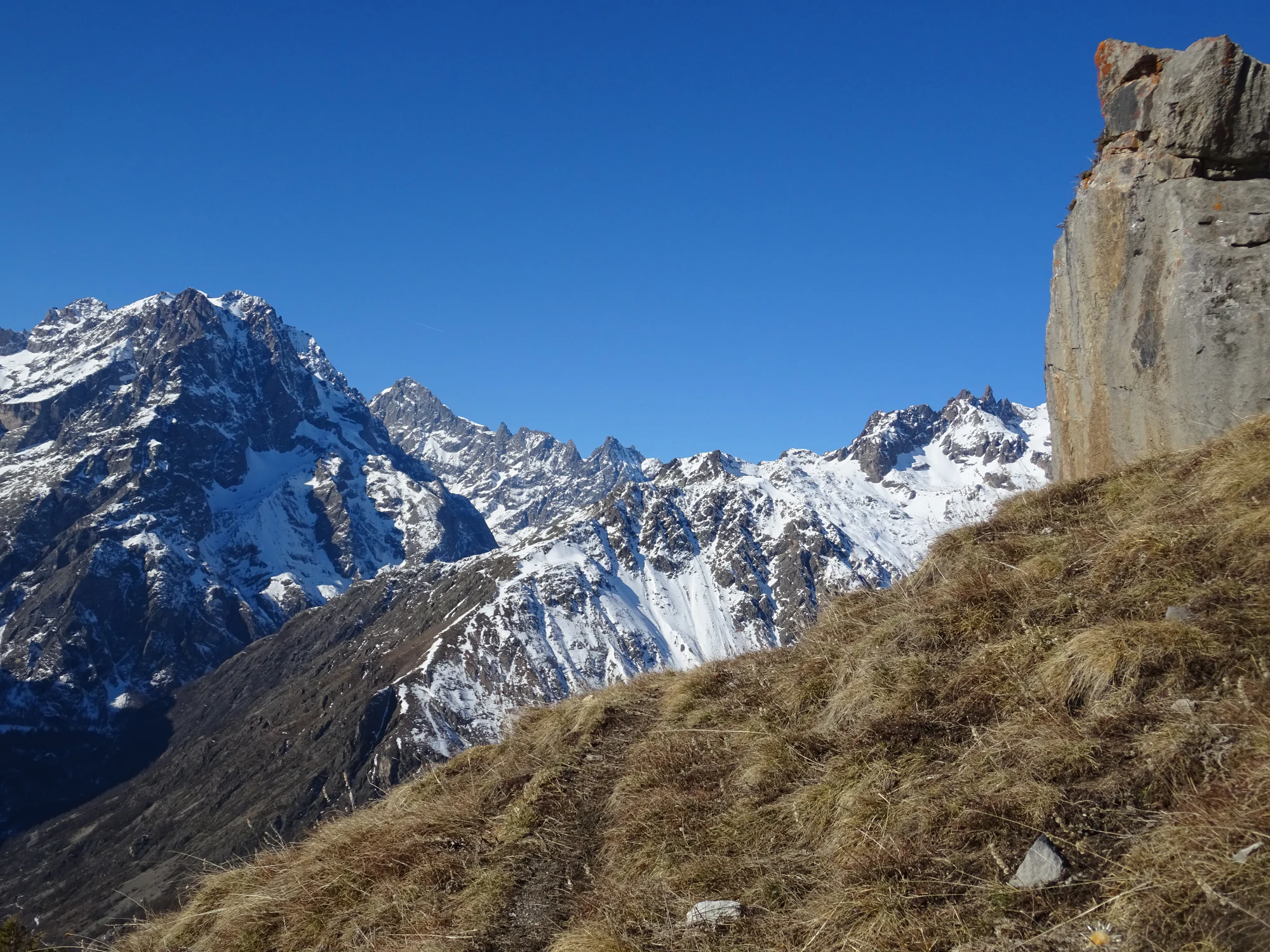
Snow-streaked jagged mountains behind a dry grassy slope, with a large weathered concrete structure at the far right edge.

A winter view toward Écrins peaks, photographed on 31 December 2024. The exact viewpoint is unverified; this is not a photograph of the Gourniers discovery loop or a report of current snow.

Photograph: Olive Titus, “Pic Sans Nom, Mont Pelvoux, Barre des Ecrins”, CC BY 2.0. Original photograph, unchanged. · Creative Commons

Walks and routes

Sentier de découverte des Gourniers

Start at the sign beside the parking area before the bridge. Stone steps lead onto the signed circuit; it rises, crosses the torrent, passes the giant’s-kettle lookout and returns through the hamlet. The park grades it very easy. Use the official route page for the full directions and keep to this loop rather than continuing towards Chargès.

Steps and uneven sections make this a walking route, not a verified wheelchair or pushchair circuit. The lookout is a supervised stop for children, with no descent to the torrent included.


Sentier de découverte des Gourniers

A relaxed first visit

Plan the day around the discovery loop rather than a list of distant sights. Start by checking the route notice, then give the panels and lookout enough time to be interesting. Finish the circuit before deciding whether anyone wants more walking. In summer, the park welcome point can add context; a picnic can make the small outing feel complete. Allow roughly 2–3 hours for this unhurried combination when the local reception is open, excluding travel. The Maison du Parc de l’Embrunais is a separate stop on another part of your journey, not an extension of the walking loop.

Things to try

Read the work of the torrent

At the lookout, look for the difference between angular rock and the smoother hollow. Water carrying stones can grind and polish a cavity over time. Ask children to describe the shape before explaining the name. This is a good place for a sketch or a photograph taken from the established viewing area, with everyone staying on the path.

Make one botanical stop count

Choose a single plant beside a label and compare the leaf shape, stem and flower with the description. It is more satisfying than trying to name every flower. Take a wider photograph showing its surroundings as well as a close view, so you can remember the habitat. Leave the plant intact and avoid stepping off the path to reach a better specimen.

Finish with the hamlet

The return through Les Gourniers gives the outing a different rhythm. Pause to notice how the houses fit the slope and how roof materials vary. The park’s heritage notes describe earlier local slate roofing and a communal bread oven beneath the former school. These are useful details to discuss from public space; an attractive doorway or building is not an invitation to enter.

An indoor mountain-nature visit

If the outdoor route is wet, icy or affected by a closure, use the Maison du Parc de l’Embrunais on a confirmed opening day. Its exhibitions and screenings let you explore the park without committing to slippery steps. Check the road journey too, and choose the day’s programme rather than counting on a particular temporary exhibition remaining in place.

Wildlife and habitats

Martagon lily

The discovery trail includes the martagon lily among its botanical points of interest. Look for pink, spotted flowers with strongly recurved segments when it is in bloom. The leaves can be just as useful to notice outside flowering time. Admire it from the path and leave bulbs, stems and flowers untouched.

Brown trout

Brown trout belongs to the cold, oxygen-rich water story here. The park’s trail interpretation identifies it, and the local atlas records the species in Réallon. Spotting a fish through broken water is a bonus, not a reason to climb down the bank. Watch only from a secure part of the public route.

European larch

Larch is part of the landscape around the Réallon hamlets and is recorded in the park’s atlas for the commune. Its fine needles let light through the canopy; in autumn they become yellow-orange before falling. Look at the whole wooded slope as well as any tree visible beside the route. Individual trees may have a history of human management.

Chamois

The park documents chamois on the slopes above Les Gourniers. Their short, hooked horns are a useful distinction if binocular views are good. Scan from the path without approaching or calling. In winter especially, disturbance spends energy the animals need to conserve; their presence never justifies leaving the planned route.

Stories and discoveries

A southern approach to the Écrins

Réallon is the park’s southernmost valley. Its connection towards Serre-Ponçon makes it a different introduction from the famous glacier approaches: the inhabited valley, meadows and larch woods come first. Looking uphill from this gateway helps put the park’s range of environments into perspective, even when the day’s walk is deliberately short.

A conifer that changes with the season

European larch sheds its needles. That makes the wooded slopes especially readable across the year: fresh growth, a light summer canopy, then yellow-orange autumn colour and bare branches. A winter photograph and a summer walk can therefore show very different versions of the same broader mountain landscape.

When to visit

Late spring and early summer

Let the actual snow and surface conditions decide when to begin. Flowering follows altitude and the season’s weather, so a calendar date cannot promise martagon lilies. On a suitable day, the botanical labels make the walk rewarding even if the most conspicuous flowers have not opened.

Midsummer

This is the easiest period for combining the walk with the local seasonal welcome point. Keep a flexible schedule around any forecast storm: the bridge and torrent viewpoint are reasons to choose a settled spell, not places to wait for weather to improve.

Autumn into winter

Larch colour is a reason to look at the wooded slopes, but do not trade good footing for a photograph. If snow or ice has arrived, treat a winter outing as a different plan. The summer circuit’s time and grade do not describe a snow-covered route; ask about currently managed winter options instead.

Check the valley you will actually use

The park’s September 2026 bulletin described extensive flood damage after the late-August storms, including upper Vallouise and Vénéon access. An announcement of repair work is not a reopening notice. Check the specific road and route for your visit; do not substitute a closed high-valley approach for this short Réallon outing.

Getting there and practical advice

Summer welcome at Les Gourniers

Serre-Ponçon tourism places the July–August park welcome point at Base Nature de l’Iscle, beside the leisure area. Use it for local explanations and up-to-date route advice. Confirm the exact reception location and hours before travelling: some older descriptions still refer to the former village school. Outside summer, do not depend on a staffed desk at Les Gourniers.

Maison du Parc de l’Embrunais

At 102 rue Saint-Irénée in Châteauroux-les-Alpes, the park centre offers information, exhibitions and screenings. The current published year-round hours are Tuesday, Thursday and Friday, 10:00–12:00 and 14:00–17:00, excluding public holidays. For July and August, the current programme gives daily opening, 09:00–12:30 and 14:30–18:00. Entry is free; check dated activities separately. Contact 04 92 43 23 31 or [email protected] before making a special journey.

Bring the basics

Carry water and food rather than relying on seasonal refreshments. The leisure area advertises picnic facilities, but availability of toilets, drinking-water points and adapted facilities at the walking start needs checking locally. Keep the parking and village entrances clear for residents and working vehicles.

Road approach

The official walking sheet approaches Les Gourniers from Savines-le-Lac via the D41 towards Réallon, then the D241 up the valley. Use the named Gourniers parking, not the ski-station car park. Check Info Route 05 for road restrictions before leaving; an open main road does not establish that the last valley section is usable.

Arriving without a car

Chorges and Embrun are the rail gateways cited by the tourism office. Arrange and verify the onward journey to Les Gourniers, including the return, before relying on rail alone. Winter shuttles to Réallon’s ski station do not establish a service to this hamlet or a summer walking connection. Ask the tourism office about the service available on your actual date.

Choose the experience that fits

The park’s accessibility guide describes the Embrunais centre with an access ramp, guidance strip and hearing loop. Ask whether those facilities are operating and whether staff support is available. That indoor option can suit a visitor who would not enjoy the discovery loop’s steps. No uninterrupted step-free route around the giant’s kettle is established here.

Sources and useful links

Wildlife you might spot

4

Each card links to a full Explore page with photos, traits, and fun facts.

Snap map for this place

Start with the big picture, then zoom in to explore individual wildlife observations around this place.

Loading map…

Good to know before you go

Read the starting panel before walking; use the named discovery circuit rather than following a higher-valley sign by mistake.

Keep children beside you at the lookout and torrent crossing. Enjoy the rock hollow from the path, without descending towards the water.

Wear shoes with grip for the stone steps. After rain or frost, be prepared to shorten or cancel the walk.

Bring drinking water, a snack and an extra layer; choose a picnic spot away from the torrent edge.

Photograph flowers where they grow. A closer picture is not worth trampling the vegetation around them.

Download the official route before leaving. If the marked crossing is missing or closed, return the way you came.

Frequently asked questions

The discovery loop stays around Les Gourniers, at the park’s gateway. Higher routes up the valley reach the core, where specific rules apply. Look for the boundary signs and do not assume every route leaving the same parking area has the same conditions.
Treat it as a geological feature to view from the lookout. This itinerary does not include entering the torrent or scrambling down to the hollow. The park discourages swimming in mountain torrents because of their hazards and sensitivity.
Serre-Ponçon tourism lists this discovery loop among the Réallon walks unaffected by its summer alpine-pasture dog restrictions. Keep your dog under close control and follow current signs. In the national park’s core, pet dogs are prohibited even on a lead; working-dog exceptions are specific.
You can follow the signed circuit independently. If you choose a guided outing, workshop or group visit, check its booking conditions separately. Visitor-centre exhibitions and talks have their own dates and opening arrangements.
Do not build the outing around that expectation. Chamois are documented above Les Gourniers and in the wider Réallon valley, but a short visit around the hamlet cannot guarantee one. Binoculars are useful if an animal is visible from the public path; do not follow it uphill.

Recent snaps at this place

Recent snaps will appear here as new observations are added.

View all ›

Take the discovery with you

Exploring Écrins National Park?

Identify the wildlife you spot, learn as you go, and keep a collection of the adventure.

  1. 1Spot it
  2. 2Snap it
  3. 3Keep the discovery