Snappit logo
Snappit
Get App
Generic illustration, not a photograph of this venueIllustration
ParkProvence-Alpes-Côte d’Azur, FR

Luberon Regional Nature Park

The Luberon is a lived-in landscape across Vaucluse and Alpes-de-Haute-Provence, within Provence-Alpes-Côte d’Azur.

About

The Luberon is a lived-in landscape across Vaucluse and Alpes-de-Haute-Provence, within Provence-Alpes-Côte d’Azur. Its regional nature park was first classified in 1977; the 2026–2041 charter now covers 77 classified communes. Roussillon and Apt are two useful starting points, rather than the boundaries of the park.

The ochres make a vivid introduction. Around 110 million years ago, sand accumulated in a shallow sea. Once exposed on land, it weathered in a hot, wet climate: changes in its minerals produced the yellow and red colours. Quarrying and later erosion helped create the sculpted landscape you see today. Look at the cliffs as a record of several processes, rather than a single event.

Elsewhere, the park shifts between limestone slopes, woodland, dry grassland and small agricultural plots. Grazing has helped keep some grasslands open, while vines, orchards, hedges and stone buildings give the countryside its close-grained pattern. This is part of the nature experience too. A day here works best with one main outing and time to notice the landscape between stops. Planning to visit? Download the Snappit app to identify the wildlife you spot in real-time.

Ochre has a long history as a pigment, but the landscape at Roussillon also reflects an industrial story. Extraction expanded strongly in the late nineteenth century, leaving open quarries that erosion continued to reshape. The park’s UNESCO Global Geopark recognition, established under that programme in 2015, connects such places with geological research, conservation and education across the territory.

What to do here

Choose the yellow short loop of the Sentier des Ocres in Roussillon. It gives children a definite route and a satisfying sequence of changing colours, trees and viewpoints. Read a few interpretation panels together rather than trying to absorb every one. On an opening weekday, the Maison du Parc in Apt adds an indoor introduction to the wider territory, with a geology museum and an interactive discovery table.

Seasonal info

Opening hours shorten in late autumn, and there is a winter maintenance break. Fire restrictions, heavy rain or thunderstorms can close the trail regardless of its normal calendar. Check the municipality’s live notice before leaving.

Accessibility

The full ochre walk includes sandy ground and stairs and is unsuitable for wheelchairs or pushchairs. An adapted initial section runs about 50 metres to a panoramic view. Treat that as a separate short visit and discuss the approach with staff.

Don't miss

1

A marked, compact ochre walk starting beside the village of Roussillon.

2

Geology, former quarry workings and woodland in the same small landscape.

3

A park spanning two departments, with inhabited countryside as well as protected habitats.

4

Optional fossil displays and family interpretation at the Maison du Parc in Apt.

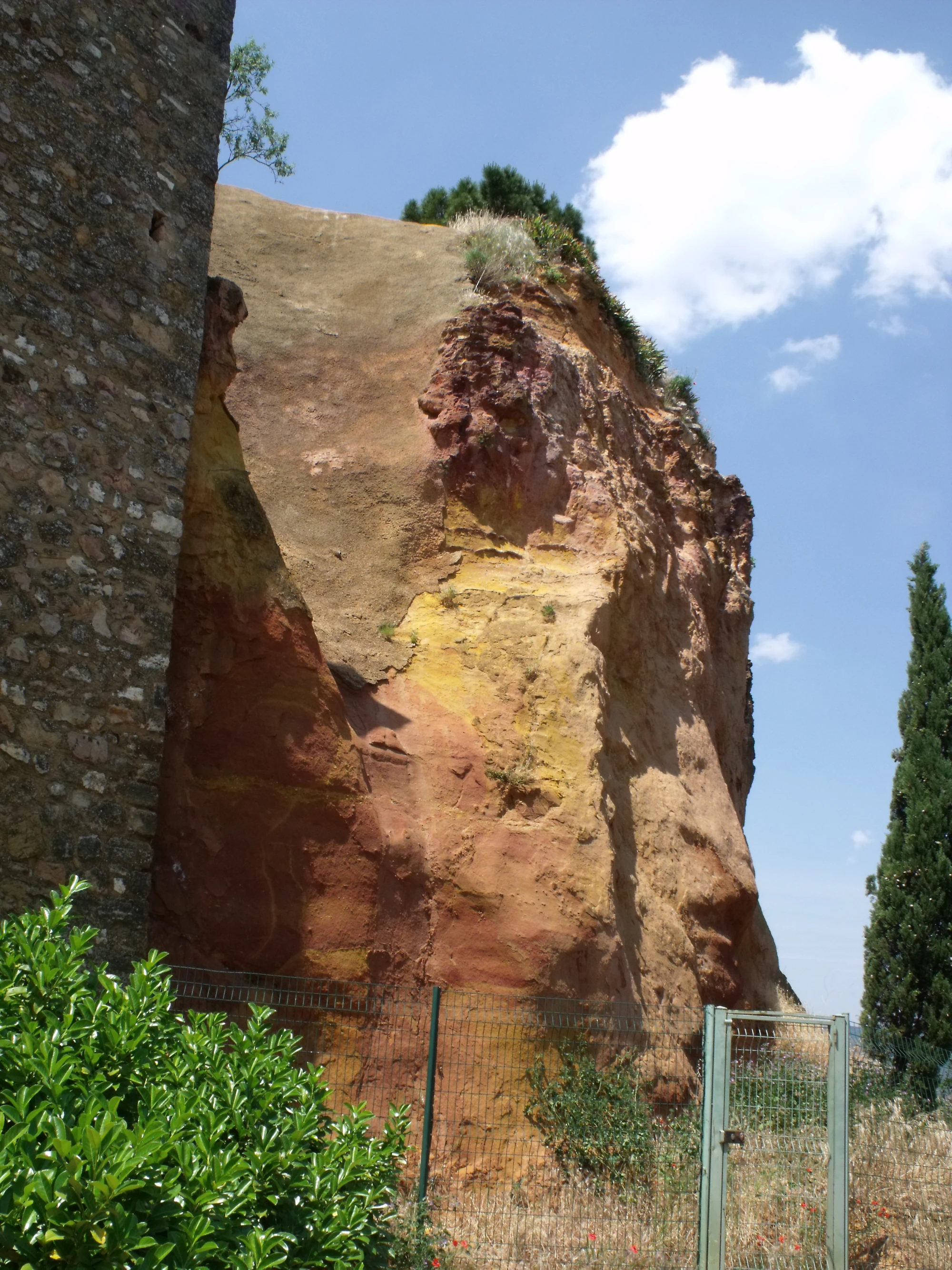
A tall yellow, orange and red ochre face rises beside a stone building, with a wire fence, gate and shrubs below and blue sky above.

An ochre cliff beside Place Camille Mathieu in Roussillon, photographed on 26 May 2011.

“Roussillon - Place Camille Mathieu - ochre cliff” by Elliott Brown, CC BY 2.0. Original photograph, unchanged. · Creative Commons

Walks and routes

Sentier des Ocres: the yellow short loop

Start at the managed entrance in Roussillon and follow the yellow arrows for the boucle courte. The municipal map gives 35 minutes and marks a belvédère along the shared part of the circuit. Use the site’s current plan at the entrance: this is a signposted visitor walk, so there is no need to improvise a path across the coloured slopes. The short loop is the sensible first choice if you want room for questions, photographs and a village stop afterwards.

Sandy surfaces and stair sections make the loop a walking route rather than a wheelchair or pushchair circuit. Being short does not make it level. For young children, use a suitable carrier only if the adult is comfortable carrying them on steps.


Sentier des Ocres: the yellow short loop

The red long loop: an alternative

The red circuit is the alternative longer loop, shown as 50 minutes in total on the municipal plan. It adds the cirque des aiguilles and the vallon des chênes verts before rejoining the return. Choose it for the extra shapes and woodland contrast, not to tick off more distance. Ask at the entrance which circuit is available that day, and allow more time than the map estimate if children want to stop.

The same sand-and-stairs limitations apply. This is not the adapted panoramic access, and it should not be presented as an accessible detour.

The red long loop: an alternative

A compact family visit

Use the toilet and sort out water before entering. Walk the yellow loop, with one colour-notebook stop and a few panels chosen by the children. Finish outside the trail with food and a little village time. Allow roughly 1–2 hours overall, plus any longer walk from your parking place. Keep the red loop as an alternative, rather than something you must squeeze in.

A weekday with a wider view

Make Roussillon your outdoor focus, then add Apt only if the Maison du Parc’s opening hours fit. Leave transfer time and lunch space between the two. A museum visit of around 45–60 minutes is a suggested allowance; it can be shorter or longer depending on the displays that catch your attention. This is two separate stops, not a continuous walking route.

Things to try

Make a colour notebook

Bring a small notebook and coloured pencils. At a safe stopping place, choose three patches of cliff and try to match their colours without touching the rock. Compare the same patch in direct light and in shade. Children can give the shades their own names, then use an interpretation panel to connect the colour experiment with the geology. Leave room for other visitors to pass.

Read the woodland as well as the cliff

Give the trees a turn. From the marked path, compare the outline of a broad-leaved tree with a conifer and notice how the shade changes the view of the ochre. The point is to link the wooded setting with the exposed quarry faces. You don’t need to identify every plant, and a phone photograph can wait until you are standing somewhere stable.

Keep the fossils for an indoor discovery

At the Maison du Parc, let each person choose one fossil or display that changes how they imagine the Luberon. Ask what sort of environment the evidence suggests, then compare that ancient picture with the countryside outside. This works particularly well after the ochre walk: the museum widens the story beyond the single place you have just explored.

When the outdoor plan falls through

Heavy rain and thunderstorms are reasons to postpone the ochre trail. On an opening weekday, the Maison du Parc gives the day a different focus. On Friday, at the weekend or on a public holiday, it is not a dependable fallback; choose another confirmed indoor attraction or save the geological outing for better conditions.

Wildlife and habitats

Holm oak

The municipal plan names a holm-oak valley on the long circuit, giving the woodland a clear place in the visit. Think of it as a contrast with the exposed ochre faces. You can appreciate the change in tree cover from the marked route without taking leaves or stepping into the undergrowth.

Scots pine

Scots pine is documented in the ochre woodland of La Bruyère at Villars, elsewhere in the park. It is a useful reminder that the ochre landscape includes living woodland as well as bare coloured ground. This is wider-park context, not a promise of identifying the species on the short Roussillon loop.

Egyptian vulture

This rare vulture belongs to the wider Luberon conservation story. The park and its partners monitor breeding birds and protect them from disturbance. Enjoy any distant bird encounter without pursuing it; do not seek nest locations, feeding stations or close photographs. The ochre walk is not presented as a vulture-watching site.

Stories and discoveries

The colour began with a different-coloured sand

The sediments that became the ochres once contained glauconite, a green mineral. Weathering later created new minerals, including iron compounds responsible for the changing yellow-to-red palette. A bright cliff is therefore evidence of chemistry as well as a striking sight. The park’s geological interpretation helps connect those small mineral changes with the larger landscape.

A rare bird links nature to working countryside

The Egyptian vulture’s story in the Luberon involves cliffs, feeding areas and grazing land. Conservation work has included reducing disturbance and maintaining feeding stations, alongside support for pastoral landscapes. The connection is worth remembering when you pass open country: protecting a bird can depend on what happens well beyond its nest. Feeding stations are conservation infrastructure, not places for visitors to approach.

When to visit

Autumn and winter opening

For October 2026, the municipality lists opening at 10:00, last entry at 17:30 and closure at 18:00. From 1–15 November, last entry moves to 16:30; from 16 November–31 December, opening is 11:00 with last entry at 15:30. The site closes on 25 December and 1 January, with an additional winter maintenance period. Recheck the calendar for later dates.

Summer: read the site status and the fire map

In Vaucluse, the usual regulated forest-access period is 15 June–15 September. The Sentier des Ocres appears on the 2026 list of sites with an exemption at the Rouge risk level, but Rouge E prohibits access. This distinction does not guarantee that the operator will open. Check the prefecture’s next-day map after its evening publication and the trail’s own notice; choose another activity if either requires closure. For outings in Alpes-de-Haute-Provence, use that department’s separate guidance.

Getting there and practical advice

Admission and the village around it

The trail has a staffed admission point, and public toilets and parking are listed for the site. Plan your food break outside the entrance. Check toilet opening and the nearest suitable facilities before starting, particularly if anyone needs an accessible toilet; the listing does not establish that every facility is step-free.

Maison du Parc: useful, but weekday-only

Find the Maison du Parc at 60 place Jean-Jaurès, Apt. Entry is free. Published public hours are Monday, Tuesday and Thursday 14:00–17:30, and Wednesday 09:00–12:30 and 14:00–17:30, excluding public holidays. It is closed to the public Friday to Sunday. The discovery table includes games and a geological puzzle for children. Check before making a special journey: +33 4 90 04 42 00.

Equipment worth bringing

A small day bag with water, sun protection, a layer and any essentials for your children is more useful than a heavy hiking kit for this outing. Put the notebook or camera somewhere easy to reach without juggling it on the stairs. Keep hands free for balance and supervision. The attraction here is close observation, so binoculars are optional.

Arriving by car

Follow the village’s signed visitor parking arrangements and read the charge at your chosen car park. The municipality lists paid parking at Les Ocres, Saint-Michel and Saint-Joseph, among other locations. Don’t use the 45-minute blue-zone spaces for a leisurely trail visit. Two designated disabled spaces are listed on the approach to the Sentier des Ocres; their availability is not guaranteed.

Arriving by bus

ZOU! line 917 serves Roussillon on the Apt–Gordes–Maubec network. The timetable valid from 1 September 2026 runs Monday to Saturday, excluding public holidays, and different journeys serve different stops. Through-services from Apt are limited, so check both directions before committing to a visit. Use the current ZOU! timetable to choose your stop and allow for the walk to the entrance. Download the current timetable rather than assuming there is a frequent shuttle.

A panoramic visit without the full circuit

The first approximately 50 metres provide the adapted panoramic access. Tourism information describes free access for disabled visitors and an accompanying person. Confirm the approach, surface condition and closest drop-off with the site for your needs. Beyond this opening section, stairs and sand change the character of the visit completely.

Check the museum separately

The geology museum is housed in vaulted cellars, with toilets and parking nearby. Call the Maison du Parc to discuss the route to the displays before travelling if you need step-free access. Ask about stairs, turning space and the toilet facilities so you can decide whether this stop will work for you.

Visitor information

A separate woodland option to leave for another visit

An access-roadworks closure affects the Forêt des Cèdres, a separate woodland outing in the wider park. Confirm that it has reopened before planning a visit there. Even after reopening, it will need its own route choice and fire-access check.

Sources and useful links

Wildlife you might spot

3

Each card links to a full Explore page with photos, traits, and fun facts.

Snap map for this place

Start with the big picture, then zoom in to explore individual wildlife observations around this place.

Loading map…

Good to know before you go

Wear closed shoes with grip and clothes you don’t mind marking with ochre dust.

Choose the short loop before setting off; save the longer circuit for a comfortable, unhurried day.

Eat before entering or after leaving

food and picnics are prohibited on the trail.

Keep children beside you on stairs and behind barriers; never climb the ochre formations.

Carry drinking water from the village rather than relying on a refill along the walk.

Leave rocks, sand, fossils and plants where they are. A photograph is the better souvenir.

Frequently asked questions

No. It is one managed visitor site within a much larger regional nature park. This guide uses Roussillon for a manageable first walk and Apt for optional orientation; other parts of the park need their own route and access planning.
No advance reservation is required. Buy admission at the entrance. The municipality currently lists an individual ticket at €3.50; check the current price and any concessions before visiting. Village parking is a separate expense.
Dogs are allowed on the Sentier des Ocres if kept on a lead throughout. Pick up after them, and consider whether sandy steps, heat and other visitors will make the outing comfortable for your dog.
Make this a looking-and-learning trip, without collecting. The national geological reserve’s designated sites prohibit removing fossils and minerals. For close-up fossil study, use the museum displays rather than digging or lifting material outdoors.

Recent snaps at this place

Recent snaps will appear here as new observations are added.

View all ›

Take the discovery with you

Exploring Luberon Regional Nature Park?

Identify the wildlife you spot, learn as you go, and keep a collection of the adventure.

  1. 1Spot it
  2. 2Snap it
  3. 3Keep the discovery