
Snappit logo
Snappit
Get App
Generic illustration, not a photograph of this venueIllustration
ParkBourgogne-Franche-Comté / Grand Est, FR

Forêts National Park

The Source de l’Aube is an inviting place to begin: a small river, an interpretation trail and the remains of an ironmaking landscape, all within one modest forest outing.

About

The Source de l’Aube is an inviting place to begin: a small river, an interpretation trail and the remains of an ironmaking landscape, all within one modest forest outing. The wider Parc national de forêts stretches across Côte-d’Or and Haute-Marne, in Bourgogne-Franche-Comté and Grand Est. Base a first visit around Auberive and give this one corner time to unfold; the other forest areas can wait for a longer stay.

Created in 2019 to protect lowland deciduous forests, the park brings a different perspective from France’s mountain national parks. Its limestone plateaux are cut by valleys and combes, and woodland is interwoven with villages, farmland, springs and wet ground. The long continuity of forest cover is important: an ancient forest means land that has remained wooded, not that every tree is ancient or that people have never worked there.

Give the familiar-looking trees as much attention as the rarer wildlife. A standing trunk, a hollow or a decaying branch can be habitat in its own right. In the park’s state forests within the core, retained habitat trees help make room for life that depends on older wood. Elsewhere, tufa-forming springs show a very different partnership between water, limestone and living mosses. These small features make a satisfying visit even when large animals stay out of sight. Unlock an interactive field guide for this spot: get the Snappit app to identify nature on the go.

At La Thuilière, the walk meets a woodland economy that long preceded national-park status. The ironworks belonged to Auberive Abbey before the French Revolution and closed in the middle of the nineteenth century. The remaining buildings help connect the small river with a much bigger story: local water, wood and iron ore supported metalworking in the upper Aube valley. The forest has preserved traces of work as well as wildlife, making this a good place to read nature and human history together.

What to do here

Choose the Source de l’Aube interpretation loop for a first visit. Follow the river-side story towards La Thuilière, then return through the woods. Read a few panels carefully instead of rushing to finish them all, and leave time to compare the stream edge with the drier forest. A longer stay can add a booked nature outing or a separate cultural visit in Auberive.

Seasonal info

Spring is a sensitive breeding season, so quiet observation matters. Summer woodland can offer shade, but carry drinking water and check fire or weather restrictions. Autumn brings shorter days as well as hunting activity. In winter, bare branches reveal tree shapes, while wet ground, frost and forestry work can change the feasibility of a short route.

Accessibility

The Source de l’Aube route is rated easy by the park, but that is a walking difficulty rating. It is not confirmation of a step-free or wheelchair-suitable circuit. Published information does not establish continuous firm surfaces, gradients, barriers or accessible toilets. Ask about the precise route and current ground conditions before bringing a wheelchair, mobility scooter or pushchair.

Don't miss

1

A 4 km interpretation loop around the first waters of the Aube

2

La Thuilière and the connection between woodland, water and ironmaking

3

Beech woodland, habitat trees and the smaller details of forest life

4

Tufa wetlands that reveal the limestone landscape’s water chemistry

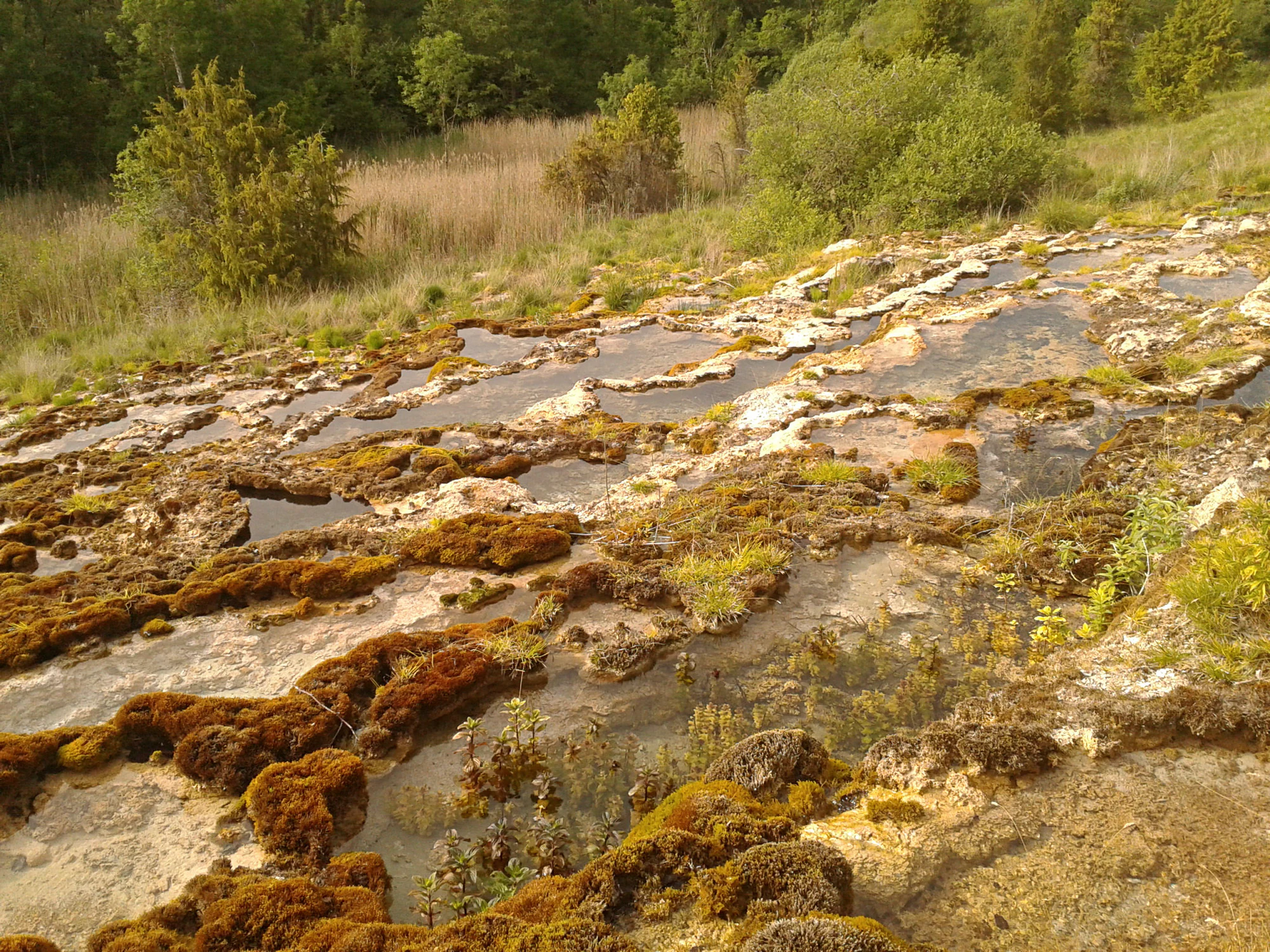
Shallow water fills irregular pale limestone basins, edged by brown-green moss, with reeds and trees behind.

Tufa pools at Saint-Germain-le-Rocheux, photographed by Mélissa and published on 13 February 2016. The capture date is unknown. This historical image illustrates the wider landscape’s wetland ecology; it does not show the Source de l’Aube walk or establish access to the pools.

“Marais tufeux” — Mélissa, CC BY-SA 3.0. Source: https://www.geodiversite.net/media1564. License: https://creativecommons.org/licenses/by-sa/3.0/. Original unchanged. · Creative Commons

Walks and routes

Sentier de découverte de la Source de l’Aube

The official route is an easy 4 km loop with 52 m of ascent and 53 m of descent, starting and finishing at the Parking des sources de l’Aube in Auberive commune. From the village, follow the road signs for Sources de l’Aube, then the route towards the ferme de la Salle to the parking. Use the linked route map for the walking line; forest junctions are not a place to rely on an improvised shortcut.

The trail connects the sources and riverbanks with La Thuilière, before a more wooded return. Eight interpretation panels give the walk a clear theme. At the beginning, notice how modest the river is; later, ask how water could have helped a working settlement. In the woods, let the change in shade and ground vegetation become part of the story. The official description mentions dragonflies and mayflies, but their visibility depends on season and weather.

Plan this as a woodland walk on natural ground. The route’s small total ascent does not establish the steepness of individual sections or the condition of the surface. Keep the group together at wet edges. If you need to turn back, retrace the same open path rather than assuming a shortcut completes the loop.


Sentier de découverte de la Source de l’Aube

A half-day from Auberive

Start with the day’s access and weather check, then travel to the signed source parking. Give the loop most of your available time, with a longer pause at whichever interpretation stop interests your group. Finish with a snack brought from the village and a look back at what changed between water’s edge and woodland. If the walk takes longer than expected, let it be the whole outing rather than adding a rushed second destination.

Things to try

Make a woodland portrait

Choose a short stretch of the open path and make three photographs: the canopy, a trunk and the forest floor. Compare the amount of light in each. Keep the camera at your own eye level or use zoom for details; moving logs or stripping bark would change the very habitat you came to examine.

Give children a water-and-work challenge

At the interpretation panels, ask each child to find one clue about water, one about wood and one about past work. Bring the answers together at the end: which resources would an ironworks have needed, and which are still visible in the landscape? It gives the industrial remains a purpose beyond being an old building beside a walk.

Auberive Abbey, when its doors are open

The abbey offers a separate cultural visit that connects well with the ironworks story. Check its own opening calendar and admission conditions first: winter historical visits are by appointment, and the contemporary-art programme is seasonal. Do not assume that rain means you can simply arrive and go indoors. If no suitable visit is open, save the forest for a better day.

Wildlife and habitats

European beech · Fagus sylvatica

Beech is the park’s predominant tree and a rewarding starting point for identification. Look for a relatively smooth, silvery-grey trunk and oval leaves; young leaf edges carry fine hairs. Compare several features with the park’s tree guide rather than trusting bark alone. You can make a useful identification from the path without removing a leaf or opening a seed case.

Black stork · Ciconia nigra

This shy breeding bird links forest and water: woodland provides nesting habitat, while streams and valleys provide feeding habitat. Its presence is one reason to value the whole landscape, not just the trees. A distant encounter would be a bonus. Keep it distant, avoid following its flight towards trees, and never search for or share a nest location.

European wildcat · Felis silvestris

The park supports a wild population of this discreet cat. It is a reason to protect quiet forest landscapes rather than a realistic target for a short family walk. A briefly seen striped cat is not enough for a confident identification. Photograph only from where you already stand, if possible, and leave the animal an undisturbed escape route.

Red deer · Cervus elaphus

Red deer are part of the park’s large-mammal community, although an individual walk may reveal none. Look across an already open view without leaving the trail or pushing into cover. If you want to learn about deer behaviour, choose a locally organised outing whose leader can explain the season and the access arrangements.

Stories and discoveries

Stone forming around living moss

Tufa wetlands occur where mineral-rich spring water deposits calcium carbonate around mosses and other surfaces. The resulting light rock can build irregular rims and shallow basins. These systems depend on their water supply: drainage or excessive capture of springs can damage them. Their fascination lies in a process still shaping the ground, not in an invitation to walk across the formations.

Three levels of protection to understand

The national park includes a specially regulated core and an adhesion area formed by communes taking part in its charter. Being in an adhesion commune does not mean that every field, road or wood is in the core. Within the core, the Arc-Châteauvillain integral forest reserve has a further purpose: studying a forest allowed to develop with greatly reduced human intervention. Check the relevant map and rules for the place you actually intend to visit.

Visiting the integral reserve

Public walking is confined to the marked routes designated as open, with dogs on leads. Off-path entry, bicycles and scooters are prohibited; collecting, fires and camping are also prohibited. This is a separate visit requiring the current access plan, not a forest extension to improvise after the Aube loop. Reserve signs and any additional time restrictions take precedence.

When to visit

Hunting and working forests

National-park status does not mean that hunting or forestry has ceased. The ONF’s hunting-calendar service covers the 2026–2027 season, and the park publishes its own hunting guidance. Consult the appropriate forest calendar shortly before your visit and read the notices on arrival; a blank or incomplete online result is not evidence of a hunt-free day. Forestry barriers are equally decisive, even when machinery seems silent.

Choose conditions that suit your group

After heavy rain, a short forest route may feel considerably harder. In strong wind or a thunderstorm forecast, postpone time beneath trees rather than depending on their shelter. In cold weather, allow for slippery surfaces and an earlier finish. Keep one simple alternative in mind so turning back feels like a sensible decision, not a failed visit.

Getting there and practical advice

Bring the basics with you

Parking is listed for the Source de l’Aube. Toilets, drinking-water taps, refreshments and accessible facilities are not confirmed at the trailhead, so organise those needs in advance. Keep the access clear for other users and emergency or forestry vehicles. The source’s clear appearance should never be used as proof that its water is safe to drink.

Getting to the right forest entrance

Auberive is the gateway for this outing, with the sources outside the village. The park itself identifies a vehicle as the simplest way to move around its dispersed territory. Langres and Chaumont are rail gateways to the wider park, but arrival by train still needs a planned last leg. No direct station-to-source bus is confirmed here: arrange transport in both directions before booking a rail-based day trip.

Decide by the route, not the park label

For someone who needs level, predictable ground, request information on the entire loop: usable width, slopes, roots or steps, the current firmness of wet sections and places to rest. A car park alone does not establish accessible access to the spring. For a mixed-ability group, agree a turnaround point in advance and avoid splitting the party into the forest.

Sources and useful links

Wildlife you might spot

4

Each card links to a full Explore page with photos, traits, and fun facts.

Snap map for this place

Start with the big picture, then zoom in to explore individual wildlife observations around this place.

Loading map…

Good to know before you go

Save the official route page and its map before leaving your accommodation.

Carry water and a snack; a natural spring is not a verified drinking-water supply.

Wear shoes with grip and keep children beside you near the water.

Check hunting dates and on-site signs before entering the forest.

Turn back at forestry barriers rather than improvising a route through the trees.

Leave moss, dead wood, fungi and flowers where they are.

Use binoculars or a camera zoom; never follow an animal into cover.

Keep a dog close and preferably on a lead throughout this outing.

Frequently asked questions

No. It is a large inhabited landscape with several forest areas and villages. For this visit, use the Parking des sources de l’Aube named on the official route card, rather than navigating to the park’s administrative office.
The official site listing describes free access, year-round outside hunting activity. That is not a guarantee that the trail is available every day: local closures, work and weather can override normal access.
Both belong to the park’s wildlife, but neither is a dependable sighting on this loop. Enjoy whatever appears from the path. Do not look for nests, use calls or bait, or publish precise locations of sensitive wildlife.
No. The Réserve intégrale forestière d’Arc-Châteauvillain is a particular part of the protected core with stricter access rules. The Source de l’Aube outing is a separate visitor focus; reserve restrictions must be checked independently if you plan to go there.

Recent snaps at this place

Recent snaps will appear here as new observations are added.

View all ›

Take the discovery with you

Exploring Forêts National Park?

Identify the wildlife you spot, learn as you go, and keep a collection of the adventure.

  1. 1Spot it
  2. 2Snap it
  3. 3Keep the discovery











