
Snappit logo
Snappit
Get App
Generic illustration, not a photograph of this venueIllustration
ParkKanto, Japan

Yoyogi Park

Yoyogi Park is an easy place to give a busy Tokyo day some breathing room.

About

Yoyogi Park is an easy place to give a busy Tokyo day some breathing room. You can arrive with a picnic and no ambitious plan, then alternate between open grass and the shade of the trees. A good first visit needs only one part of the park: a walk from Harajuku Gate into the wooded A district, a pause by the Central Plaza and time to look closely at the trees.

The park has different moods. The A district is the leafy heart of this guide; across the road, the B district contains sports and event spaces. The Jinnan 1-chome district has its own operator and urban-sports facilities. They belong to the same metropolitan park, while neighboring Meiji Jingu and its forest are a separate destination. Choose the part that suits your day instead of trying to cover everything.

The bird sanctuary is a place for birds to be left in peace. Its fruiting trees are enclosed by protective fencing, and visitors cannot enter. Bring binoculars and watch from permitted park paths instead. A quiet pause can be more rewarding than a long checklist: listen, notice movement in the canopy, and let birds keep their distance.

Trees give the walk interest beyond cherry-blossom season. Compare the small, deeply divided leaves of Japanese maple with the broader shapes around you, then look up at the spreading zelkova branches. A modest survivor of the Olympic village adds a different kind of discovery near the Harajuku side. Because major works and event preparations are changing some paths in autumn 2026, keep the route flexible and check the current notices before setting out. Explore the grounds like a pro—download the Snappit app to instantly identify animals and plants.

The site has had several lives: an army parade ground, the postwar US military housing area known as Washington Heights, and the athletes’ village for the 1964 Tokyo Olympics. Yoyogi Park opened on October 20, 1967. The remaining Olympic accommodation building was used by Dutch athletes; the operator says it reopened as a café on April 9, 2026, with its exterior design retained. Across the road, Oda Field also carries a sporting legacy: it hosted the opening ceremony and competitions of the 1964 Tokyo Paralympics.

What to do here

Explore the open A-district paths, settle on an available lawn for a picnic, and spend a few quiet minutes watching birds outside the sanctuary fence. Look for contrasting tree shapes rather than racing between attractions. If the cycling course is open, bicycle hire gives older children and adults a different way to enjoy the greenery.

Seasonal info

Spring brings cherries and later flowering trees; summer is a time for shade and frequent water breaks. Autumn offers changing leaves, fruit and acorns to observe without collecting. In winter, bare branches make tree shapes easier to study. Flowers, foliage and access vary with weather and maintenance.

Accessibility

The park publishes a barrier-free map, and Tokyo’s accessibility directory lists wheelchair-accessible and ostomate toilets, wheelchair loans and baby-care facilities. Construction can change the usable route. Contact the service center on 03-3469-6081 to choose an entrance, open toilet and suitable path for your wheelchair or stroller; do not assume a lawn or wooded shortcut is as easy as the main path.

Don't miss

1

The contrast between the Central Plaza’s open lawn and the wooded A district

2

Birdwatching from public paths outside the fenced sanctuary

3

Seasonal leaves, flowers and fruit on a varied collection of park trees

4

A surviving 1964 Olympic accommodation building near Harajuku Gate

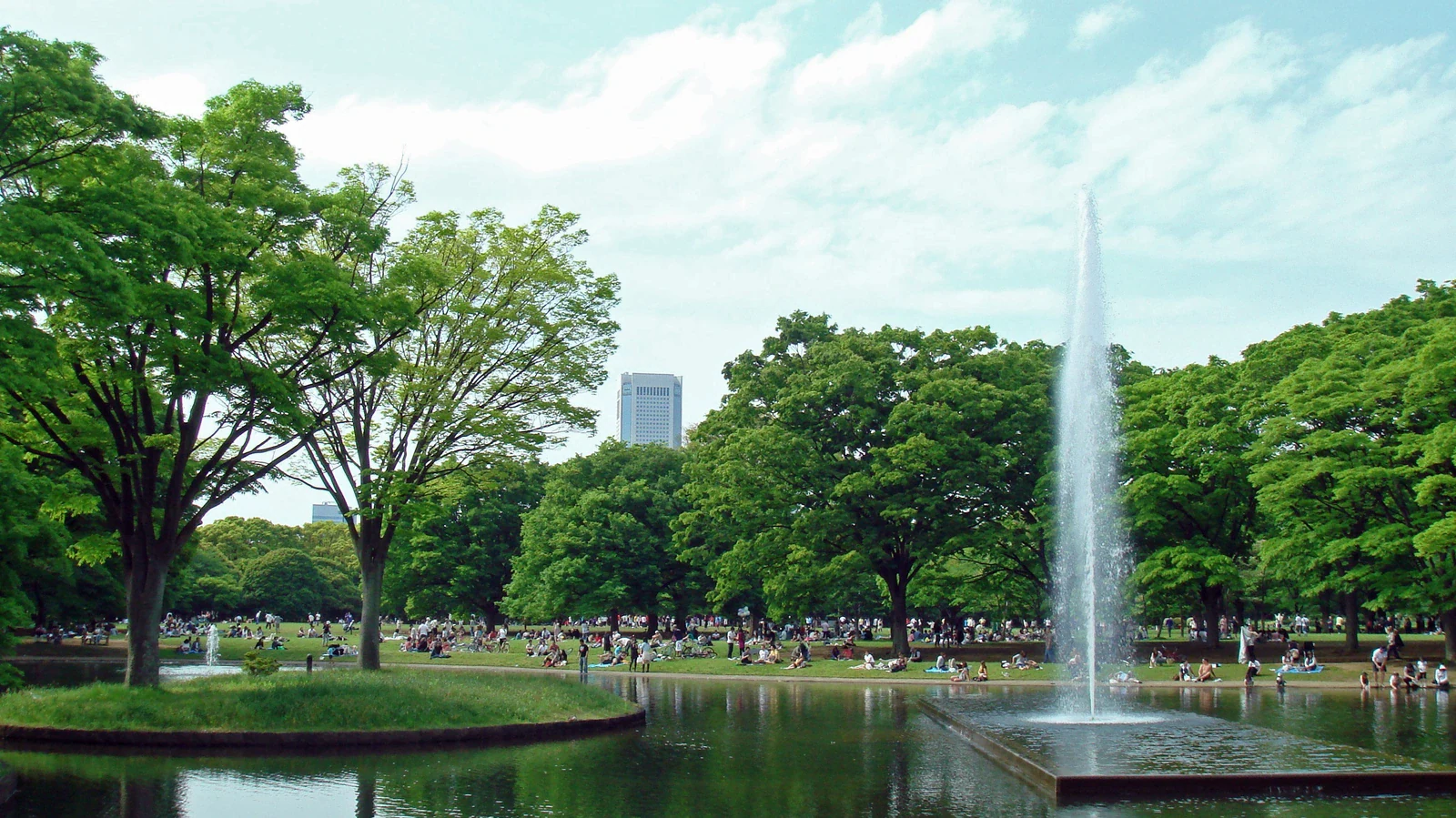
A tall fountain rises from a pond beside leafy trees and lawns where visitors are relaxing.

Yoyogi Park’s fountain pond and lawns in May 2010. This is a historical scene; check the current works notice before planning a fountain stop.

Fountain Yoyogipark.JPG — Shinjiro, CC BY 3.0 (https://creativecommons.org/licenses/by/3.0/). Source: https://commons.wikimedia.org/wiki/File:Fountain_Yoyogipark.JPG. Proportionally reduced to a 1600-pixel long edge without upscaling; recompressed as WebP quality 92, method 6. No crop, retouching, added text or colour changes. EXIF omitted. · Creative Commons

Walks and routes

Harajuku-side woodland and lawn wander

Enter through Harajuku Gate and use the open pedestrian paths towards the Central Plaza. Make the lawn your pause rather than a compulsory circuit. If the signed paths allow, add a quiet look from outside the sanctuary fence and the Olympic accommodation building before returning towards your chosen exit. Skip any stop that would require a closed or awkward detour.

Use the barrier-free map to discuss a short route with the service center. Construction diversions may be narrower than the usual paths; a return by the same suitable path can be the easiest choice.


Harajuku-side woodland and lawn wander

An optional turn on the cycling course

Start at the Pedalico cycling center, choose suitable equipment with staff and use the designated course. The main course is approximately 2 km; a separate practice course is approximately 160 m, and the young children’s course is for bicycles with training wheels. Choose one activity that suits the group rather than treating all the courses as interchangeable.

Ask staff about bicycle size, support needs and the equipment currently available. Check whether a bicycle suits your balance and mobility needs before planning the outing around a ride.

An optional turn on the cycling course

A gentle 90-minute visit

Start on the Harajuku side, spend around half an hour following open wooded paths, and pause near the lawn. Use the remaining time for tree-watching, a short sanctuary-edge stop if the approach is open, and an unhurried return. Drop the last stop if anyone is tired.

A two-to-three-hour family outing

Begin with a short nature walk, make a picnic the middle of the day, then choose either bicycle hire or more time on an open lawn. Check the cycling desk before promising a ride. There is no need to add the sports districts or the neighboring shrine to make this a complete outing.

Things to try

Give the picnic time of its own

Find an open patch of lawn, spread a simple sheet and leave enough room for people passing. Bring food ready to eat: cooking equipment, tents and sunshades are not part of this picnic plan. Take leftovers and rubbish away, and keep food away from wildlife.

A three-shape tree game

Ask children to find a leaf with deep finger-like divisions, one with a fan shape and one with a gently toothed edge. Compare what you can see on the tree or photograph on the ground, then use a name label to check your guess. Leave leaves, fruit and acorns where they are.

Listen before looking

Choose a permitted path beside trees, step clear of moving visitors and stay still for a few minutes. Use binoculars when movement catches your eye. Keep the sanctuary undisturbed and let a bird leave if it chooses; this is a pause for observation, not a hunt for a particular photograph.

When rain changes the plan

Keep to a short open-path walk and skip bicycle hire, which stops in rain or poor course conditions. A café break can be a pleasant finish if the outlet is open; the park is primarily an outdoor visit, so save the longer nature outing for another day if the weather turns rough.

After heavy rain

Leave soft lawns and signed restoration areas alone, especially the Jinnan district’s Nigiwai lawn. Stay on open paths and shorten the outing if puddles or narrowed detours make progress awkward.

Wildlife and habitats

Japanese maple

Look for small leaves divided into deep lobes, with toothed edges. Compare the shape while leaves are green as well as when autumn colour develops.

Japanese zelkova

Look up at the branching outline, then study a narrow oval leaf with a pointed tip and toothed edge. A name label is useful when several broad-leaved trees stand together.

Ginkgo

Look for the distinctive fan-shaped leaves. In autumn, compare fallen leaves where they lie; leave the seeds and other plant material undisturbed.

Flowering dogwood

Autumn brings another way to notice a tree often associated with spring: look for red fruit and changing leaves from the path. The park’s October 2026 report describes this seasonal change; leave all fruit on the tree.

Common kingfisher

Kingfishers have been recorded in the park. If one appears, look for blue-green upperparts and an orange underside, or listen for a sharp high call. Enjoy the encounter from an open public path; do not enter the sanctuary or a closed water-feature area to search.

The park’s trees include cultivated plantings; its birds are wild and sightings depend on the day. Keep to permitted paths, stay outside the sanctuary fence and leave plants, seeds and wildlife untouched.

Stories and discoveries

A small Olympic survivor

The remaining athletes’ accommodation building was used by the Dutch team in 1964. Its new café use began on April 9, 2026, according to the park operator, retaining the exterior design. Look at it as part of the park’s changing history; check café opening before relying on it for a stop.

A refuge with a boundary

The sanctuary’s fruiting trees and protective fencing make the boundary part of its purpose. You can enjoy the wider park’s birds without needing to enter every patch of habitat.

When to visit

Spring: flowers and company

Follow current blossom reports for cherries and later flowering trees. A weekday morning is a practical choice if your group prefers fewer competing activities. Keep the outing flexible when the popular lawns and approaches are busy.

Summer: a shorter shaded visit

Choose shade, carry water and rest often. In strong heat, a brief tree walk and a drink may be plenty; postpone vigorous cycling when conditions feel uncomfortable.

Autumn: leaves, fruit and buds

Look for different stages on neighboring trees rather than expecting everything to change at once. The park’s October 2026 report highlights dogwood fruit and early leaf colour, maples, zelkovas and acorn-bearing trees. Observe without picking, and check the works notice before aiming for a particular area.

Winter: branches and quieter pauses

Use the open paths for a short daylight outing and study the shapes that leaves usually hide. Bring a warm layer, check café availability and remember that bicycle hire closes from December 29 to January 3. The announced winter light event also changes evening cycling-course access.

Getting there and practical advice

Entry and assistance

General entry is free and the grounds are normally open continuously. Facility hours differ, and year-end closures apply to the service center and individual facilities. Main-park questions go to 03-3469-6081.

Pedalico bicycle hire

Listed hours are 09:00–16:30, with reception ending at 16:00. Closed Mondays, or the following day when Monday is a holiday, and December 29–January 3. Standard bicycles cost ¥300 per hour; training-wheel bicycles ¥100 per hour; tandems ¥500 per circuit, approximately 15 minutes. Helmet hire is ¥100 per hour. Check prices, equipment and course access before visiting.

Refreshments

The park lists kiosks at Harajuku Gate, Yoyogi-no-Oka and the outdoor-stage area, plus DOUTOR Park Café YOYOGI. Opening hours vary by outlet and season. Carry water and a small snack if a particular café is not essential to your visit.

Toilets and baby care

Use the barrier-free map to locate an appropriate toilet before setting off. Tokyo’s directory lists wheelchair-accessible and ostomate facilities, baby-changing provision, a nursing room and wheelchair loans. Ask staff about availability and the nearest open facility during works.

The Jinnan 1-chome district

This district has its own park office, lawn, terrace and designated Urban Sports Park. The sports facility normally opens 10:00–19:00, with use ending at 18:55; weather, maintenance and event closures can override this. Ask at its office about the nursing room during 08:30–17:30. There is no car park within this district.

Arrive from Harajuku

The park operator gives approximately three minutes on foot from JR Harajuku Station or Tokyo Metro Meiji-jingumae (Harajuku) Station. These are park-approach times, not the time to every lawn or facility. Choose the Harajuku side for the suggested woodland visit.

Arrive from Yoyogi-kōen or Yoyogi-hachiman

The operator lists approximately three minutes from Tokyo Metro Yoyogi-kōen Station and six minutes from Odakyu Yoyogi-hachiman Station. These approaches may suit the service-center side better than retracing a Harajuku arrival. Check your station’s current lift route if step-free access matters.

If you drive

The main park lists a paid 24-hour car park with 65 spaces, including four designated accessible spaces. Busy weekends can bring entry controls, and waiting on the public road is not allowed. This car park is separate from the Jinnan 1-chome district, which has no on-site car park.

Plan a short route around open facilities

Start with the park’s February 2026 barrier-free map, then ask about changes caused by construction. Agree on the entrance, toilet and return route before committing to a long walk. The map’s accessible facilities do not mean that all wooded paths, lawns or temporary detours will suit every chair.

Ask ahead about support

Tokyo’s accessibility directory, surveyed November 13, 2025, records wheelchair loans and staff support through written communication. Contact the service center to confirm what is available for your date. Leave extra time if a comfortable route is longer than the most direct one.

Visitor information

Works affecting the main park

Checked October 16, 2026: fountain, water-corridor, plaza-path and rose-area works remain listed with planned completion around autumn 2026. Some paths are closed or narrowed. Follow the signed detour and do not run along the narrow fountain-works bypass. Oda Field is closed through November 30, 2026 as planned; general use is expected to resume in December, with additional inspection closures still to be announced.

Cycling-course event restrictions

Construction around the cycling course runs October 5–November 12, 2026, with some sections unavailable by day or night. From November 13, 2026 to January 11, 2027, the course is unavailable from 17:00 to 22:00 during the Forest of Lights event. These temporary restrictions override the usual evening shared-use arrangement.

Jinnan 1-chome: check the lawn and sports notices

The Nigiwai lawn is resting on weekdays without scheduled events, and can close on any day during rain, on soft ground or when the grass is worn. Upcoming October 2026 closures announced for the Urban Sports Park are October 20, 24 and 25. Check this district’s website separately before adding it to the day.

Sources and useful links

Wildlife you might spot

5

Each card links to a full Explore page with photos, traits, and fun facts.

Snap map for this place

Start with the big picture, then zoom in to explore individual wildlife observations around this place.

Loading map…

Good to know before you go

Check the dated works and cycling notices below before coming. Follow the barriers on the day, and walk rather than run on the narrow fountain-works detour.

Bring a picnic sheet, water and a bag for your rubbish. Tents, tarps, sunshades, barbecues and other open flames are prohibited in the main park.

Keep out of the bird sanctuary and other closed areas. Do not feed, catch or harm wildlife, or pick plants and fruit; binoculars and photographs are better souvenirs.

During normal operation, the main cycling course is bicycle-only from 09:00 to 17:00. From 17:00 to 09:00 it is shared, with pedestrians first and runners next in priority. Temporary event closures override these hours; use walking paths for a daytime stroll.

Use public transport on busy weekends and holidays. The park asks drivers not to queue for its car park on the public road.

Keep dogs on a lead outside the designated dog run and take their waste away. The dog run requires current registration; a visitor’s vaccination certificate alone does not establish eligibility.

For organized or commercial photography, contact the relevant district operator in advance. When taking ordinary visitor photographs, keep paths clear and respect the people around you.

Skateboarding and sports practice are restricted in the main park. Use the appropriate designated facility and its rules; the Jinnan 1-chome skate facility has its own hours and closure notices.

Frequently asked questions

General park entry is free and the grounds are normally open continuously. Paid facilities, cafés, the service center and event areas have separate schedules. Temporary works can close individual areas, so an open park does not mean every facility or path is available.
No. The shrine and its forest are neighboring but separate. If you want to visit both, allow additional time and check the shrine’s own access and visiting rules.
No. The fenced sanctuary interior is closed to visitors. Observe from permitted park areas outside it, leave birds undisturbed and keep paths clear for other people.
The Pedalico cycling center lists children’s and adult bicycles, tandems, a practice course and a course for bicycles with training wheels. Ask staff which equipment and area suit your child. Hire stops in rain or poor course conditions, and the current construction and event restrictions also matter.
The notices checked on October 16, 2026 still list fountain, water-corridor, plaza-path and rose-area works with planned completion around autumn 2026. Do not rely on an operating fountain or full access to the rose area until the park confirms reopening.
For the main park, call Yoyogi Park Service Center on 03-3469-6081; for bicycle hire, call 03-3465-6855. The separately managed Jinnan 1-chome district is on 03-3460-5700.

Recent snaps at this place

Recent snaps will appear here as new observations are added.

View all ›

Take the discovery with you

Exploring Yoyogi Park?

Identify the wildlife you spot, learn as you go, and keep a collection of the adventure.

  1. 1Spot it
  2. 2Snap it
  3. 3Keep the discovery












