

ʻAweoweo
chenopodium oahuense
ʻAweoweo (Chenopodium oahuense) is a highly resilient, endemic Hawaiian shrub or small tree that plays an essential role in Hawaii's dryland and coastal ecosystems. Belonging to the goosefoot family, Amaranthaceae, this plant is remarkably adapted to survive in harsh, arid climates, ranging from sun-baked coastal lava fields to high-elevation subalpine shrublands. It varies beautifully in form, growing as a low, sprawling groundcover in wind-swept environments or as an upright woody shrub reaching up to five meters tall in sheltered inland forests. Historically, ʻaweoweo was valued by Native Hawaiians for its edible leaves—which were cooked like spinach—and its sturdy wood, used for crafting tools. Today, it remains an ecological anchor, providing critical food and nesting material for endemic Hawaiian birds and insects, and is increasingly appreciated in xeriscaping for its extreme drought tolerance.
Habitat: Found in coastal shrublands, dry forests, and subalpine slopes across the Hawaiian Islands, often growing directly on dry lava flows or sandy soil.
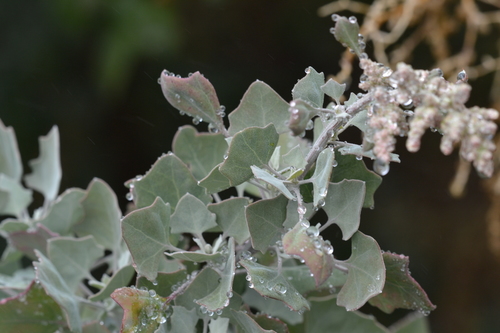
This evergreen woody plant is easily recognized by its dusty, pale green to bluish-gray foliage. The thick, fleshy leaves are shaped like a goose's foot (triangular to three-lobed) and measure about 1 to 5 centimeters in length. New growth often exhibits a powdery or mealy texture due to tiny salt-excreting glands on the leaf surface. ʻAweoweo produces clusters of very small, dense, inconspicuous flowers at the ends of its branches; these flowers lack petals and turn from a pale green to a dry, brownish seed-head when mature.
Category
PlantsRarity
Common
Danger
1/5 · Very low
Snaps
Be the first to snap!
The Hawaiian name 'ʻAweoweo' translates to 'reddish' or 'glowing,' which is also the name of the red Hawaiian bigeye fish, likely connecting the fishy smell of the crushed leaves to the marine animal.
The hard, dense wood of mature, upright ʻaweoweo shrubs was traditionally crafted into durable shark hooks and shallow bowls by Native Hawaiians.
The young leaves and shoots are edible and were historically cooked as a green vegetable, serving as a vital food source during times of drought and crop failure.
The plant features specialized glandular hairs on its leaves that store and excrete salt, allowing it to survive in highly saline and arid coastal environments.
When crushed, the leaves release a strong, fishy odor caused by trimethylamine, which acts as a natural deterrent against browsing animals.
Depending on environmental wind and soil conditions, it can adapt its growth habit from a low-lying, wind-resistant ground mat to a robust, upright woody shrub.
As a photoautotrophic plant, ʻaweoweo produces its own sugars and energy using sunlight, carbon dioxide, and water through photosynthesis, supplemented by soil minerals.
Telespiza cantans
The seeds, buds, and leaves of this plant are a critical food resource for this endangered endemic finch.
Hylaeus anthracinus
This native bee visits the flowers for nectar and pollen, acting as an important pollinator in dry coastal habitats.
No trait badges are assigned for this object yet.
No aliases listed yet.
Collections for this object will appear here as more themes are added.
Danger
1/5 · Very low
No special safety notes yet.
Start with the whole plant, then compare leaf arrangement, leaf edges, stems and any flowers or fruit. Opposite leaves grow in pairs; alternate leaves come one at a time along the stem. These details tell you far more together than a single green leaf does. Plant Identifier: upload a photo and compare the visible details.
50-500 cm
5-30 years
As a photoautotrophic plant, ʻaweoweo produces its own sugars and energy using sunlight, carbon dioxide, and water through photosynthesis, supplemented by soil minerals.
Found in coastal shrublands, dry forests, and subalpine slopes across the Hawaiian Islands, often growing directly on dry lava flows or sandy soil.
Zoom in to split clusters and explore where this object has been snapped.
Recent snaps will appear here as new observations are added.
Take the discovery with you
Snap it with Snappit to identify it, learn what makes it special, and add the discovery to your collection.