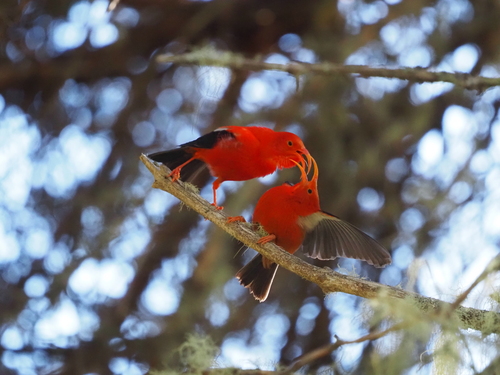


ʻIʻIwi
drepanis coccinea
The 'I'iwi is one of the most iconic and visually striking birds of the Hawaiian Islands. Belonging to the Hawaiian honeycreeper subfamily, this vibrant bird is celebrated for its brilliant scarlet plumage, contrasting black wings, and an extraordinarily long, downward-curved bill. Historically, the 'I'iwi played an important role in Hawaiian culture, as its bright red feathers were gathered by royal birdcatchers to fashion spectacular capes, cloaks, and helmets for high-ranking chiefs (ali'i). Today, it stands as a celebrated symbol of Hawaii's unique and fragile forest ecosystems. Fascinatingly, the 'I'iwi's evolution is deeply intertwined with native Hawaiian flora. Its specialized bill is perfectly adapted for sipping nectar from tubular blossoms, making it a critical pollinator for high-canopy trees. However, due to its extreme susceptibility to introduced avian malaria, the 'I'iwi is now mostly restricted to cool, high-elevation montane forests where disease-carrying mosquitoes cannot survive.
Habitat: Found in high-elevation wet and mesic montane forests of Hawaii, primarily associated with canopy-dominant 'Ohi'a lehua trees.
Adult 'I'iwi are instantly recognizable by their intensely bright scarlet-red bodies, which contrast sharply with their jet-black wings and tail. They possess a large, decurved pinkish-orange or salmon-colored bill, which matches the curve of native flowers. The inner wing feathers feature a small, distinctive white patch visible when perched or in flight. Immature birds look quite different, displaying a mottled greenish-yellow plumage with black spots, helping them stay camouflaged before they molt into their brilliant adult coloration.
Category
BirdsRarity
Common
Danger
1/5 · Very low
Snaps
Be the first to snap!
Because their bills are so curved, they cannot easily feed from modern flat-faced introduced flowers, making them entirely dependent on native tubular flora.
The 'I'iwi's striking red feathers were once used to construct the prized, royal feather capes ('ahu'ula) of Hawaiian kings.
Their song includes a bizarre assortment of whistles, gurgles, and a characteristic sound that closely mimics a squeaky, rusty door hinge.
The long, sickle-shaped bill is evolutionary tailored to extract nectar from deep, tubular native Hawaiian flowers like lobeliads and Ohi'a blossoms.
They can fly long distances up and down mountain slopes to track the seasonal blooming patterns of their favorite nectar plants.
They are capable of hovering briefly in front of flowers to feed on nectar, a dynamic physical feat similar to hummingbirds.
Feeds primarily on nectar from native Hawaiian flowers, supplementing its diet with small insects and spiders for essential protein.
Age differences: Chicks are fed regurgitated insects by their parents to provide high protein for development, shifting to nectar as they mature.
Metrosideros polymorpha
Feeds heavily on the nectar of this dominant forest tree, serving as one of its primary pollinators.
Culex quinquefasciatus
Acts as a vector for avian malaria (Plasmodium relictum), a disease that is highly lethal to the 'I'iwi and has pushed populations to high altitudes.
Himatione sanguinea
Competes directly with the 'I'iwi for nectar resources in the high forest canopy.
No trait badges are assigned for this object yet.
No aliases listed yet.
Collections for this object will appear here as more themes are added.
Danger
1/5 · Very low
No special safety notes yet.
Compare the silhouette, bill shape, tail length, wing bars and markings around the eyes. The same small brown bird at your feeder can look quite different in breeding plumage, winter plumage or its first year. Bird Identifier: upload a photo and compare the visible details.
15 cm
20-22 cm
0.016-0.02 kg
5-15 years
Feeds primarily on nectar from native Hawaiian flowers, supplementing its diet with small insects and spiders for essential protein.
Found in high-elevation wet and mesic montane forests of Hawaii, primarily associated with canopy-dominant 'Ohi'a lehua trees.
Foraging
Zoom in to split clusters and explore where this object has been snapped.
Recent snaps will appear here as new observations are added.
Take the discovery with you
Snap it with Snappit to identify it, learn what makes it special, and add the discovery to your collection.