

Akeake
dodonaea viscosa
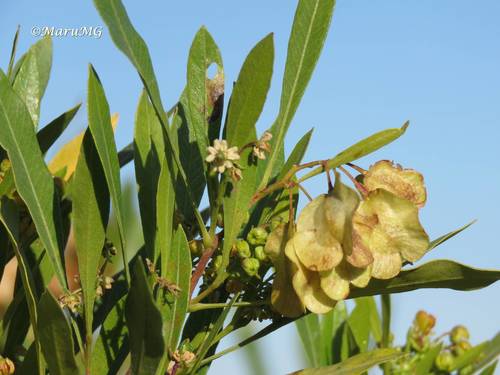
Akeake (Dodonaea viscosa), also known as the hop bush, is a hardy and versatile evergreen shrub or small tree native to New Zealand, Australia, and other tropical and subtropical regions. Renowned for its extreme resilience, its Maori name 'Akeake' translates to 'forever and ever,' hinting at its tough nature and ability to survive in harsh coastal environments, dry soils, and strong winds. It plays an important role in ecological restoration, quickly colonizing disturbed ground and providing shelter for other native plants to establish. In traditional Maori culture, its incredibly dense, heavy wood was prized for crafting durable weapons, digging sticks, and walking canes.
Habitat: Typically found in coastal dunes, lowland forests, open scrublands, and rocky cliffsides where it tolerates salty winds and poor soils.
Akeake typically grows as a multi-branched shrub or small tree reaching heights of 2 to 9 meters. It features simple, light green to bronze-green, narrow leaves that are alternate and secrete a sticky, resinous substance, giving them a slightly shiny appearance. In spring and summer, it produces small, inconspicuous greenish-yellow flowers that lack petals, which develop into highly distinctive, papery, two-to-four-winged seed capsules. These seed pods mature from a pale green or creamy yellow to a dry light brown, resembling hops, and are easily dispersed by the wind.
Category
PlantsRarity
Common
Danger
1/5 · Very low
Snaps
1
Akeake wood is one of the densest and heaviest of any New Zealand native tree, so heavy that it sinks in water when green.
Early European settlers in Australia and New Zealand used the winged seed pods of this plant as a substitute for hops in beer brewing, giving it the common name 'hop bush'.
The Maori name 'Akeake' means 'forever and ever,' referencing the incredible strength and durability of the wood.
Secretes a sticky, resinous film over its leaves that minimizes water loss and protects the plant from salt spray and intense UV radiation.
Produces light, papery, winged seed capsules that act as sails, allowing the wind to transport seeds over long distances to colonize new areas.
Possesses flexible branches and tough, leather-like foliage that withstand strong gales and highly saline coastal environments where other trees fail.
As a photosynthetic plant, Akeake generates its own organic nutrients from sunlight, carbon dioxide, and water while absorbing essential minerals through its root system.
Aenetus virescens
The caterpillars of this moth feed on the wood of the Akeake, boring tunnels into the stems.
Anthornis melanura
Feeds on the nectar of Akeake flowers and helps in pollination.
Vitex lucens
Akeake provides shelter and canopy cover, aiding the germination and growth of slower-growing canopy trees like the Puriri.
No trait badges are assigned for this object yet.
No aliases listed yet.
Collections for this object will appear here as more themes are added.
Danger
1/5 · Very low
No special safety notes yet.
The easiest way to identify Akeake is to use the Snappit nature identifier app.
200-900 cm
15-60 years
As a photosynthetic plant, Akeake generates its own organic nutrients from sunlight, carbon dioxide, and water while absorbing essential minerals through its root system.
Typically found in coastal dunes, lowland forests, open scrublands, and rocky cliffsides where it tolerates salty winds and poor soils.
Zoom in to split clusters and explore where this object has been snapped.
Take the discovery with you
Snap it with Snappit to identify it, learn what makes it special, and add the discovery to your collection.












.jpg&width=800)



_001.jpg&width=800)




