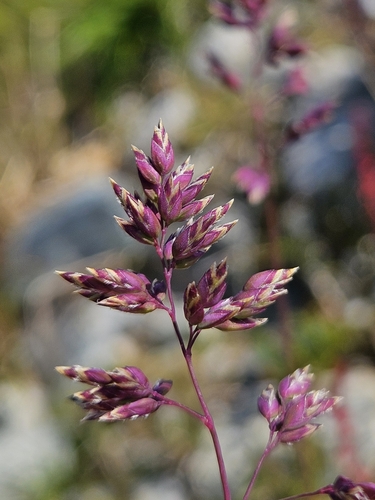


Alpine Bluegrass
poa alpina
Alpine Bluegrass (Poa alpina) is a resilient, perennial bunchgrass that acts as a quiet champion of the world's highest and coldest environments. Thriving in alpine meadows, rocky tundras, and mountain crevices, this remarkable plant has adapted beautifully to survive where few other plants can. Its ability to withstand freezing temperatures, heavy snowpack, and poor soils makes it an essential anchor for high-altitude ecosystems, helping to prevent soil erosion and providing forage for mountain wildlife. What truly sets Alpine Bluegrass apart is its fascinating reproductive strategy. In the harshest mountain habitats, where the growing season is too short for seeds to reliably germinate, this grass often bypasses seed production entirely. Instead, it undergoes a process called pseudovivipary, where miniature, fully formed plantlets sprout directly from its flower heads. When these plantlets become heavy enough, they drop to the ground and immediately take root, ensuring the next generation can rapidly establish itself during the brief alpine summer.
Habitat: Typically found in high-altitude environments such as alpine meadows, rocky scree slopes, tundra, and gravelly riverbanks across the Northern Hemisphere.
This small, tufted perennial grass typically grows between 10 to 40 cm in height, forming dense, compact cushions. Its leaves are distinctive—short, flat, and remarkably broad at the base, tapering to a boat-shaped or hooded tip, with a bluish-green to grayish-green hue. During the flowering season from mid to late summer, it produces dense, contracted egg-shaped panicles that are often tinged with striking shades of purple, green, and gold. In viviparous forms, these flower heads are easily identified by the presence of miniature leafy plantlets growing directly out of the spikelets instead of typical grains, giving the grass a bushy, feathered appearance.
Category
PlantsRarity
Common
Danger
1/5 · Very low
Snaps
Be the first to snap!
Alpine Bluegrass can conduct photosynthesis at temperatures near freezing, maximizing energy production during brief, cold mountain summers.
It is highly valued for ecological restoration and erosion control on high-altitude ski slopes due to its tough, soil-binding roots.
Rather than dispersing seeds, the viviparous variety of Alpine Bluegrass drops fully formed clones of itself that can immediately take root in the soil.
Bypasses seed production by sprouting fully formed plantlets directly on the flower heads, allowing for rapid colonization in short growing seasons.
Possesses specialized cellular proteins that prevent damage from sub-zero temperatures, allowing survival during sudden summer freezes.
Grows in dense, low-to-the-ground cushions that trap warmth and resist the drying effects of harsh alpine winds.
As an autotrophic plant, Alpine Bluegrass produces its own food through photosynthesis, utilizing sunlight, carbon dioxide, and water while drawing essential minerals from alpine soils.

Rupicapra rupicapra
Provides critical high-altitude summer forage for wild mountain herbivores.

Lepus timidus
Foraged upon by tundra-dwelling mammals searching for nutrient-rich greenery.
Festuca rubra
Competes for moisture, space, and scarce soil nutrients in alpine meadow communities.
No trait badges are assigned for this object yet.
No aliases listed yet.
Collections for this object will appear here as more themes are added.
Danger
1/5 · Very low
No special safety notes yet.
The easiest way to identify Alpine Bluegrass is to use the Snappit nature identifier app.
10-40 cm
0.01-0.05 kg
5-20 years
As an autotrophic plant, Alpine Bluegrass produces its own food through photosynthesis, utilizing sunlight, carbon dioxide, and water while drawing essential minerals from alpine soils.
Typically found in high-altitude environments such as alpine meadows, rocky scree slopes, tundra, and gravelly riverbanks across the Northern Hemisphere.
Zoom in to split clusters and explore where this object has been snapped.
Recent snaps will appear here as new observations are added.
Take the discovery with you
Snap it with Snappit to identify it, learn what makes it special, and add the discovery to your collection.









.jpg&width=800)



_001.jpg&width=800)




