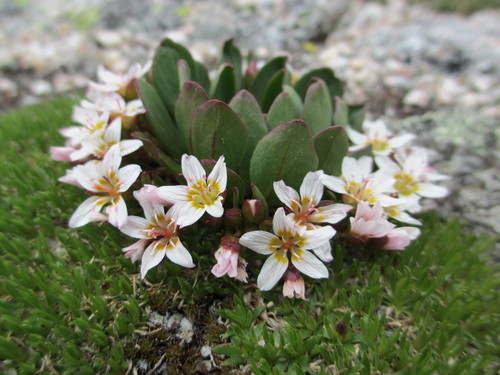


Alpine Springbeauty
claytonia megarhiza
The Alpine Springbeauty (Claytonia megarhiza) is a charming and resilient perennial herb that thrives in the harsh, high-altitude environments of western North America. This small but distinctive plant is a true survivor, epitomizing the tenacity of life in alpine zones. Its delicate appearance belies its robust adaptations to cold temperatures, intense UV radiation, and short growing seasons. It's an important component of alpine ecosystems, providing early season food and nectar for pollinators and small herbivores. Its presence signals a thriving, undisturbed mountain habitat, making it a beloved sight for hikers and naturalists who venture above the tree line. The plant's ability to complete its life cycle rapidly during the brief alpine summer is a fascinating example of evolutionary specialization.
Habitat: Found in alpine meadows, rocky slopes, scree fields, and moist crevices above the tree line in mountainous regions.
Alpine Springbeauty typically grows low to the ground, reaching heights of only 5-15 cm. It features a basal rosette of fleshy, succulent, spoon-shaped leaves that are usually green to reddish-green, aiding in water retention and cold tolerance. From this rosette emerge slender stems, each bearing a loose cluster of small, cup-shaped flowers. The flowers are typically white or pale pink, often adorned with delicate darker pink or purplish veins. Each flower has five petals and prominent yellow anthers, creating a striking contrast. Its robust, often enlarged, tuberous taproot is a key subterranean feature, allowing it to store nutrients and survive harsh winters.
Category
PlantsRarity
Common
Danger
1/5 · Very low
Snaps
Be the first to snap!
It's one of the earliest plants to flower after snowmelt in many alpine areas, providing crucial early-season nectar.
Its succulent leaves help it conserve water in dry, windy alpine conditions.
The genus name 'Claytonia' honors John Clayton, an early American botanist.
The large, starchy taproot was historically consumed by indigenous peoples as a survival food.
Possesses physiological adaptations, such as a low growth habit and succulent leaves, to withstand freezing temperatures and strong winds characteristic of alpine environments.
Optimizes the brief alpine summer by growing, flowering, and setting seed quickly before the onset of autumn frosts and snow.
Develops a deep, often tuberous taproot that stores energy and nutrients, enabling it to survive harsh winters and regenerate rapidly each spring.
As a plant, Alpine Springbeauty produces its own food through photosynthesis, converting sunlight, carbon dioxide, and water into sugars. It absorbs essential minerals and water from the soil.
Bombus alpinus
Pollinator, aids in reproduction by transferring pollen between flowers.
Ochotona princeps
Herbivore, feeds on the plant's leaves and flowers.
.jpg&width=800)
Marmota caligata
Herbivore, grazes on the plant, especially during early summer.
_and_beneficial_bacteria_on_plant_performance_and_soil_fertility.webp&width=800)
Fungi
Forms a symbiotic relationship with the plant's roots, aiding in nutrient and water absorption.
No trait badges are assigned for this object yet.
No aliases listed yet.
Collections for this object will appear here as more themes are added.
Danger
1/5 · Very low
No special safety notes yet.
The easiest way to identify Alpine Springbeauty is to use the Snappit nature identifier app.
5-15 cm
0.01-0.05 kg
3-10 years
As a plant, Alpine Springbeauty produces its own food through photosynthesis, converting sunlight, carbon dioxide, and water into sugars. It absorbs essential minerals and water from the soil.
Found in alpine meadows, rocky slopes, scree fields, and moist crevices above the tree line in mountainous regions.
Photosynthesis And Nutrient Absorption
50-200
Zoom in to split clusters and explore where this object has been snapped.
Recent snaps will appear here as new observations are added.
Take the discovery with you
Snap it with Snappit to identify it, learn what makes it special, and add the discovery to your collection.









.jpg&width=800)



_001.jpg&width=800)




